



Quick Answer
The short answer: Yes, a bank can reverse a payment, but only under rule-governed conditions that differ by rail. Card chargebacks are contestable through representment within a set window. ACH R10 unauthorized returns leave merchants with near-zero recourse once 60 days pass. Wire recalls depend entirely on the receiving bank's willingness to cooperate.
Global chargeback losses are projected to exceed $15 billion in card disputes alone in 2025, and that figure does not include ACH return losses or unrecoverable wire transfers. The merchant's recourse depends entirely on which rail the money traveled. Card chargebacks have a formal representment process with real win potential. ACH R10 unauthorized returns become nearly unwinnable after 60 days. Wire recalls rest on another institution's cooperation and nothing else.
Questions this article answers
- Can a bank reverse a payment after it has already settled?
- How do merchants contest a card chargeback through representment?
- What happens when an ACH R10 unauthorized return is filed after 60 days?
How Do Merchants Contest a Card Chargeback?
A card chargeback is a forced reversal. The cardholder disputes a transaction through their issuing bank, which claims the funds back through the card network and the merchant's acquiring bank.
What looks like a bank reversing a payment is actually the card network enforcing its own dispute resolution rules, and the merchant has a defined window to push back.
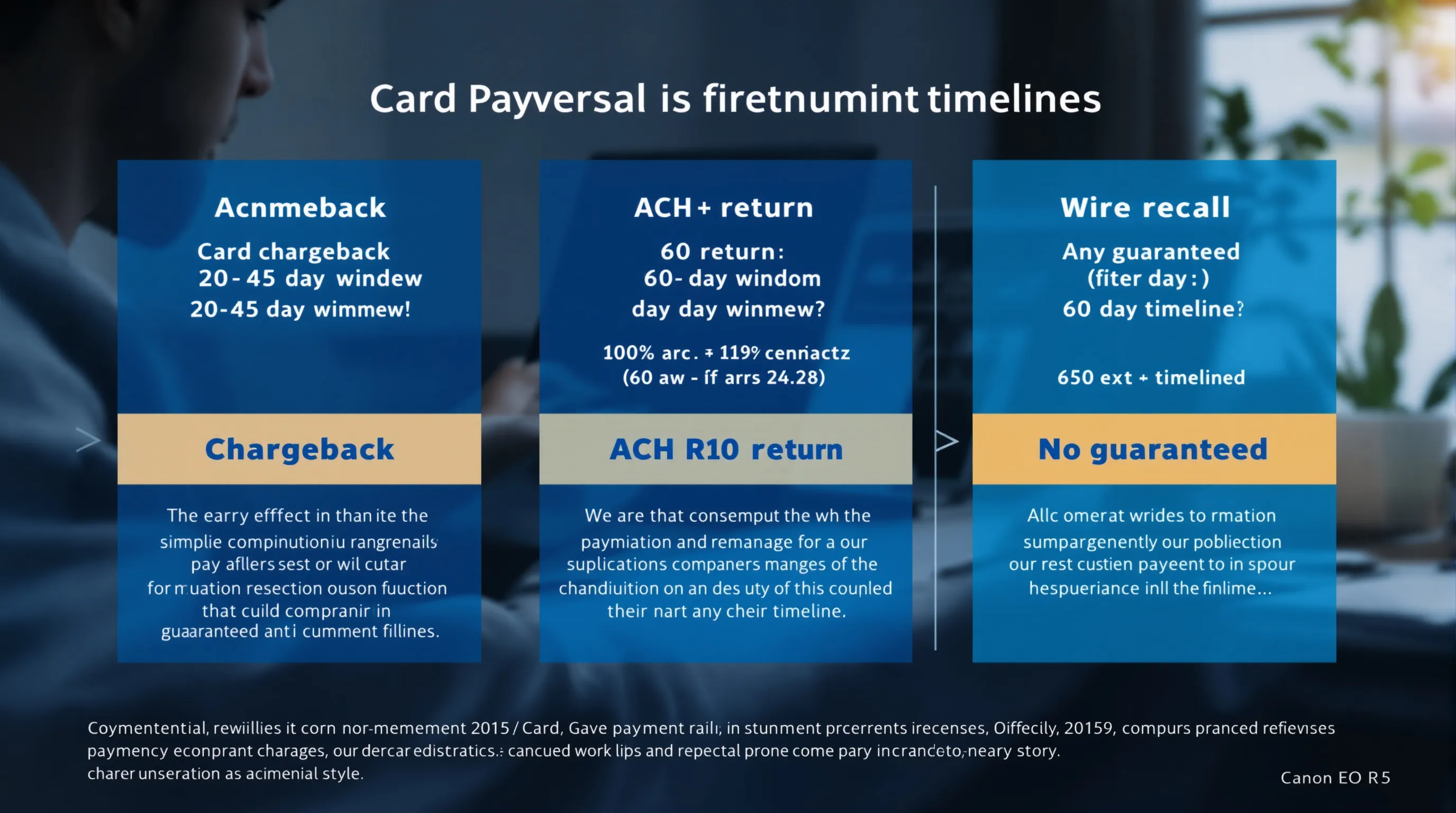
That window is representment: a formal evidence packet submitted through the acquirer contesting the cardholder's claim. The deadline is typically 20 to 45 days from the chargeback notification, varying by card network and reason code. Waiting past the deadline forfeits the dispute entirely.
The evidence that wins representment is specific. Signed cardholder authorization, proof of delivery, IP address and session logs, customer service records showing the customer contacted you before filing the dispute. Generic responses rarely work. A documented paper trail does.
Two thresholds to know: chargeback fees typically run $15 or more per incident, and a chargeback ratio above 0.9% of monthly transactions can trigger Visa or Mastercard monitoring programs that restrict or terminate accounts. For recurring billing merchants, that threshold arrives faster than it looks.
Pre-dispute tools like Visa Rapid Dispute Resolution (RDR) and Ethoca Alerts let merchants intercept eligible disputes before they become formal chargebacks. Building these into your workflow means fewer fees, fewer representment filings, and less exposure to the chargeback ratio thresholds that matter most.
What Recourse Do Merchants Have When an ACH Payment Is Returned?
ACH returns come in codes, and the code determines your options. Administrative returns, such as R02 for a closed account or R04 for an invalid account number, arrive within two business days and are a data correction problem, not a dispute. The harder case is R10.
R10 is the unauthorized return code. It means the account holder is telling their bank they never authorized the debit. Under Nacha rules, customers have 60 days from their bank account statement date to file an R10. During that window, the issuing bank can pull the funds back without the merchant's involvement. After the 60-day window closes, the merchant's position improves considerably, but by then the funds are often already gone.
The ACH recourse merchants do control is narrower than most assume. Nacha permits an originating bank to reverse an ACH entry for only four reasons: a duplicate entry, an incorrect receiver, a wrong amount, or a wrong effective date. The reversal must reach the receiving bank within five banking days of the original settlement date. Running short on funds is not a permitted reason.
The practical defense against R10 returns is built before the debit runs, not after. Written authorization with clear billing descriptor language, documented consent for recurring charges, and a transaction record you can produce if a claim is filed. For more on managing ACH return rates, see How to Accept ACH Payments Online Without High Returns.
What Is Changing in Payment Reversals Over the Next Two Years?
Two forces are converging. Global chargeback losses are projected to exceed $15 billion in 2025, and card networks are responding by tightening monitoring thresholds and expanding pre-dispute alert infrastructure. The 0.9% chargeback ratio threshold shows no sign of loosening. For merchants in subscription billing, nutraceuticals, gaming, or telemedicine, it is a live operating constraint, not a theoretical one.
New payment methods are adding complexity. Buy-now-pay-later and digital wallet transactions are introducing dispute scenarios that existing representment playbooks were not written to handle. A customer who paid through a wallet may dispute through the wallet provider rather than their bank, which puts the chargeback in a different resolution flow entirely.
On the ACH side, Nacha has been incrementally tightening return rate thresholds. Originators with unauthorized return rates above 0.5% enter monitoring. Above 3% is a compliance violation. For recurring billing businesses relying on ACH, keeping those rates low is an ongoing operational discipline.
From what I have seen working with merchants across these verticals, the teams adapting fastest are moving earlier in the dispute lifecycle. Intercepting disputes through alert programs before they become formal chargebacks, and building authorization documentation into the customer onboarding flow rather than retrofitting it after returns start arriving.
What 12-24 months May Bring
Where Payment Reversal Disputes Head Next
Three scored forecasts on how card, ACH, and bank-recall reversals reshape the fight between merchants and issuers.
Forecasts by reversal rail
Read each forecast against the rail you accept payment on to judge where your dispute exposure is moving.
Card chargeback losses, already projected above $15 billion in 2025 with per-incident fees of $15 or more, keep climbing, and more merchants cross the 0.9% monthly ratio that triggers Visa or Mastercard monitoring and account restrictions.
The decisive battleground moves from post-transaction representment to pre-authorization screening, with AI-driven underwriting and pre-dispute programs like Visa Rapid Dispute Resolution intercepting reversals before they settle.
More merchants shift transactions toward bank-initiated rails like iDEAL and toward ACH structures where recall is confined to duplicate, wrong-amount, or wrong-receiver errors inside a five-banking-day Nacha window, cutting exposure to forced card reversals.
Weak Signals Worth Watching Worked merchant economics already show revenue bleeding to disputes, with one platform losing 7% of revenue to uncontested chargebacks on top of failed transactions, and buyer demand concentrating on how high-risk sellers cut chargebacks. Irreversible online-banking payment methods already remove chargeback risk entirely once the bank receives the transfer, and bank-side ACH recall is legally limited to narrow error categories rather than buyer remorse. Early adopters of AI risk tooling report 2-4x improvements in fraud detection and 60% fewer false positives, while merchants with disciplined fraud screening report winning almost every dispute they do face.
What backs and what cuts against these calls
Each forecast lists both the sources that support it and the ones that point the other way.
- Backing it: Payment Reversals: A Comprehensive Guide for Merchants - Justt. [Industry Publication]Global chargeback losses are projected to exceed $15 billion in 2025 (source: Justt guide). “Manual chargeback management is slow, error-prone, and resource-intensive, especially as payment volumes and dispute rates grow. That's where automation…”
- Why Most Merchants Get Profitability Analysis Wrong (And How to points the same way. [Substack / Newsletter]A supplement company referenced by the author was doing $2.3 million in monthly revenue but could not state its actual profit per customer after chargebacks, failed transactions, and fees. “After chargebacks, failed transactions, and processing fees, what's your actual profit per customer?' The silence on the call told me everything I needed to…”
- AI in Risk Management - AI-Driven Enhancements in Merchant Onboarding, and Underwriting is the strongest public backing for this call. [Blog]Agentic AI "digital underwriters" collapse onboarding times by over 90%, rendering initial decisions "in seconds, not days" (Adnan Masood). “These 'digital underwriters' don't just analyze data; they act on it.”
- Payment Reversals: A Comprehensive Guide for Merchants - Justt supports this forecast. [Industry Publication]Payment reversals take three primary forms: authorization reversals, refunds, and chargebacks, each with distinct causes, rules, and financial consequences.
- Has anyone won a successful dispute on a charge back as a seller? points the same way. [Community / Forum]One merchant reports winning "almost every chargeback we dispute" and attributes it to a standardized multi-page response packet (Comment 1). “We win almost every chargeback we dispute - but we rarely get chargebacks that are legitimately fraud.”
- US processor 2000Charge adds iDEAL online payment method supports this forecast. [Industry Publication]Six Dutch banks offered iDEAL at time of writing: ING Bank, Postbank, Fortis Bank, ABN AMRO Bank, Rabobank, and SNS Bank. “(No direct attributed quotes from any person or spokesperson appear in the source.)”
- Payment Reversals and What They Mean for Merchants - Chargeflow is the strongest public backing for this call. [Industry Publication]A bank can reverse a payment without merchant cooperation in specific cases: an unauthorized transfer reported under Regulation E, the bank's own processing error, or an ACH entry recalled under Nacha rules within five banking days of… “A bank generally will *not* reverse a completed card payment over product quality or satisfaction - that is the chargeback process, initiated by the…”
What could flip these forecasts
Shifts in network thresholds, fraud patterns, or rail adoption would change how these predictions play out.
Our Margin for Error
76 reflects our strongest conviction, while 64 is where we are most prepared to be wrong.
- Chargeback cost curve and high-risk gravity. That is the first forecast to break if the regulatory or buying picture flips.
- Flight to irreversible rails. Mounting evidence on the other side would move that one to the front.
Can a Bank Reverse a Wire Transfer or Correct a Processing Error?
Wire transfers settle close to immediately. Once the funds have landed and the receiving bank has credited or disbursed them, the sending bank has one option: submit a recall request.
The receiving bank has no legal obligation to comply. Cooperation is voluntary and depends on whether the funds are still available and whether the receiving institution is willing to act, as of .
Bank processing errors follow different rules. If a bank made its own mistake on a transfer, it must investigate and correct confirmed errors within 10 business days under Regulation E. That protection applies to the bank's own mistakes, not to valid completed transactions a customer later disputes.
For merchants on the receiving side of a wire recall request, the key question is whether the funds have already been applied to operations or disbursed to suppliers. If the funds are still segregated, cooperating with a legitimate recall is straightforward. If they have been disbursed, recovery becomes a question outside the payment network.
Across all three rails, the common thread is documentation: clear records of what every payment corresponds to, signed authorization agreements for recurring charges, and verification before disbursing unusually large or unexpected incoming transfers. The merchants who absorb the fewest reversal losses are the ones who do the documentation work before a reversal arrives, not after. For merchants evaluating their card processing setup, see our merchant services overview or explore which high-risk providers actually stick.
The defense against a reversed payment depends entirely on which rail the money traveled. Card chargebacks have a representment path worth taking, with a tight deadline and documentation making the difference between recovering and absorbing the loss. ACH R10 unauthorized returns are preventable but rarely recoverable after 60 days. Wire recalls rest on another institution's cooperation, which is not guaranteed. Knowing the rules by rail, before a reversal arrives, is what separates merchants who fight back from those who simply absorb the loss.
Written by
Lily Flanigan
Operations Manager, SeamlessChex
Lily Flanigan is Operations Manager at SeamlessChex, a credit card processing and fintech payments platform recognized on the Inc. 5000, where she focuses on operations and process optimization.
Connect on LinkedInSummarize This Article With AI
Open this article in your preferred AI engine for an instant summary.
Frequently Asked Questions
Can a bank reverse a payment after it has settled?
Yes, but only under specific rule-governed circumstances: a cardholder-initiated chargeback through the issuing bank, a Nacha-compliant ACH reversal within five banking days for four permitted error types, or a bank correcting its own processing error under Regulation E within 10 business days. Banks generally will not reverse a completed payment based on product dissatisfaction or a customer's change of mind.
How long does a merchant have to fight a card chargeback?
The representment window is typically 20 to 45 days from the chargeback notification, depending on the card network and dispute reason code. Visa and Mastercard each set their own timelines. Missing this window forfeits the merchant's right to contest the reversal.
What is an R10 ACH return and what can merchants do about it?
R10 is Nacha's return code for an unauthorized ACH debit. The account holder's bank returns the transaction because the customer claims they did not authorize the payment. Customers have 60 days from their bank statement date to file an R10. The best defense is preemptive: written authorization, clear billing descriptors, and documented consent for each recurring debit.
Is there any merchant recourse on an ACH unauthorized return after 60 days?
Not through the ACH system. Once the 60-day R10 window has closed, merchants have no official ACH recourse mechanism. Recovery depends on direct negotiation with the customer or civil remedies outside the payment network entirely.
Can a sending bank reverse a wire transfer?
A sending bank can submit a recall request, but the receiving bank has no legal obligation to comply once the funds have been paid out or withdrawn. The merchant on the receiving side faces a practical decision about whether to cooperate based on whether the funds remain available and undisbursed.
What documentation helps merchants win chargeback representment?
The strongest representment files include: signed cardholder authorization, proof of delivery or service completion, IP address and session logs from the original transaction, customer service records showing the customer contacted you before filing the dispute, and a billing descriptor that clearly matches what appeared on the cardholder's statement.
SeamlessChex onboards established merchants; the practical minimum is $25,000 in monthly payment volume.