



What this guide covers
- Why your license class affects which acquirers will approve your merchant account
- Which licensing jurisdictions open the most payment options (and which narrow them)
- How to match a payment partner to your license class before comparing rates
Quick Answer
Your gambling license is not just a regulatory requirement. It is the single biggest variable acquirers use to decide whether to approve your merchant account, which card brands they will process for you, and how large a rolling reserve they will hold. In our experience working with online gaming operators across multiple jurisdictions, license class drives more payment decisions than country, chargeback history, or monthly volume combined. Operators who understand this pick their payment partners more efficiently, negotiate from a stronger position, and avoid the months-long application cycle that comes from applying to the wrong processors for their license class.
Why acquirers underwrite by license class
When a merchant bank reviews a gambling application, the first question is not "where is this operator located?" It is "what license does this operator hold?" License class tells the acquirer three things at once: how rigorous the AML and KYC requirements are in that jurisdiction, what the operator's dispute resolution framework looks like, and how predictable the regulatory environment is.
This is not abstract. UK Gambling Commission-licensed operators, for example, must follow compliance rules tied to POCA (the Proceeds of Crime Act), with identity verification required when a customer approaches a deposit, spend, or win of £2,000. That kind of embedded, regulator-enforced compliance framework is exactly what acquirers want to see. It tells them that the operator is subject to oversight that reduces fraud and chargeback risk, which is the underwriting risk they are pricing, as of .
Tier-1 licenses carry robust compliance frameworks that acquirers have already vetted internally. That prior vetting is why these licenses unlock more banking relationships, lower reserve requirements, and better card brand acceptance than any other credential a gambling operator can present.
Tier-1 licenses: the broadest payment access
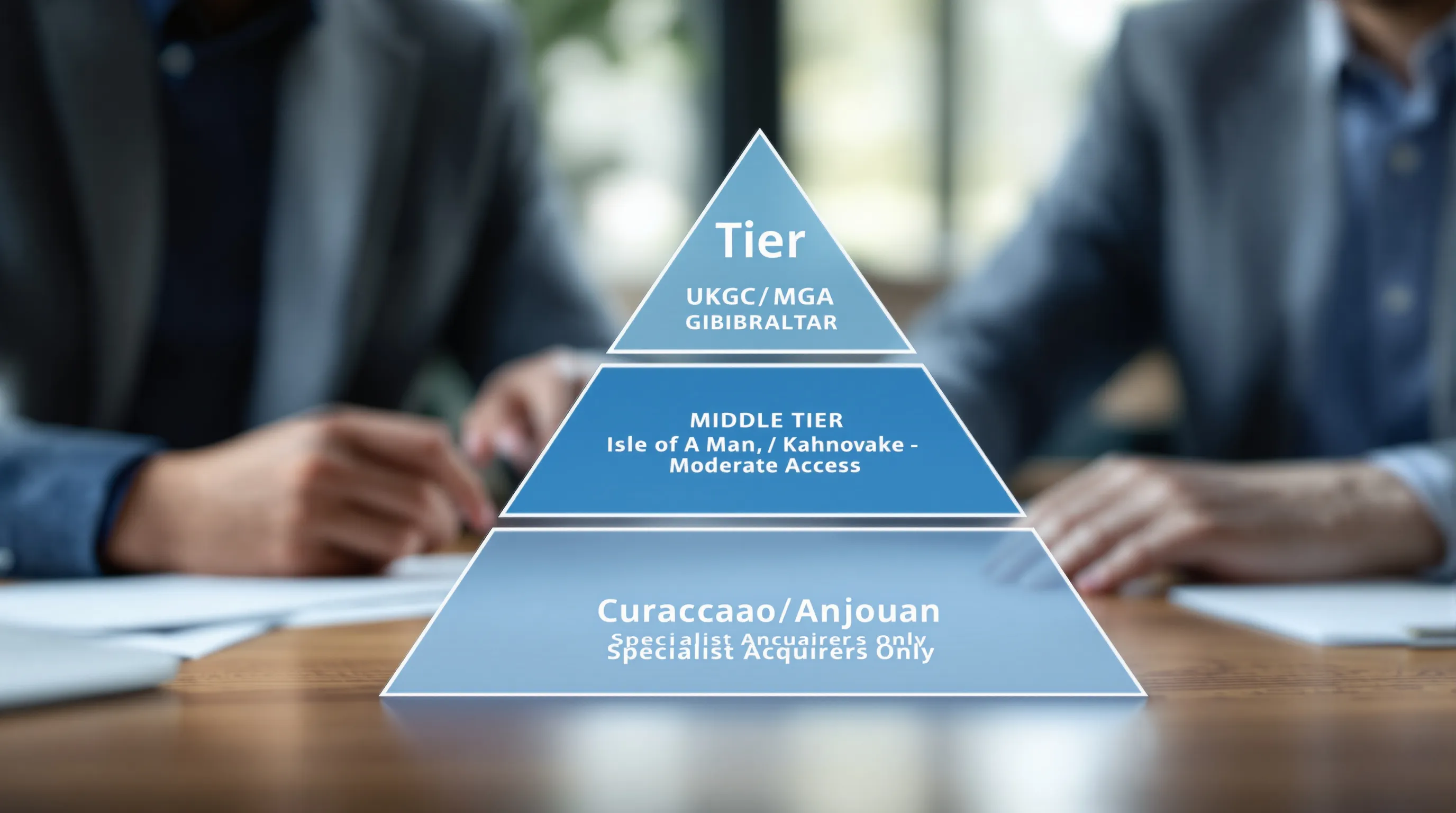
Three licenses sit at the top of the acquirer confidence hierarchy: the UK Gambling Commission (UKGC), the Malta Gaming Authority (MGA), and the Gibraltar Regulatory Authority.
These are the licenses that open the most acquiring relationships, support the widest card brand acceptance, and typically carry the lowest rolling reserve requirements in the gambling category.
- UKGC: The strictest AML and player protection requirements of any major gambling jurisdiction. Acquirers view UKGC-licensed operators as the lowest-risk category in online gaming. Rolling reserves typically land in the 5 to 10% range. Visa and Mastercard acceptance is standard, with Amex available through select acquirers.
- MGA: EU-anchored compliance framework with strong dispute resolution standards. Widely accepted by European and US-linked acquirers. Reserve requirements are comparable to UKGC. MGA is often the practical first choice for operators who want European licensing without UK regulatory complexity.
- Gibraltar: Recognized by most major card brands. Strong player protection rules and a transparent regulatory structure. Reserve requirements tend to run slightly higher than UKGC or MGA, typically 7 to 12%, but Visa and Mastercard acceptance is broadly available.
If your operation holds any of these three licenses, your payment options are as wide as the gambling industry allows. The conversation with acquirers becomes one about rates and terms, not eligibility.
Mid-tier licenses: workable, but with trade-offs
Isle of Man and Kahnawake are two of the most established mid-tier licenses, and they sit in a workable but constrained middle band.
Acquirers recognize them, but they do not carry the same automatic approval weight as tier-1 licenses. Processing relationships tend to require more documentation, higher initial reserves in the 10 to 20% range, and in some cases a secondary review of the operator's player base geography.
Kahnawake is particularly complex because it licenses operators that accept US players, a segment many card networks restrict by policy. Operators holding Kahnawake licenses need to be precise about their player geography before applying for a merchant account. Acquirers will ask, and a vague answer extends the underwriting timeline significantly.
The practical implication for mid-tier license holders: work with a payment partner that already has established relationships with acquirers familiar with your specific license. Cold applications to general high-risk processors burn time that a targeted introduction from a specialized partner can save.
Lower-tier licenses and the acquirer access challenge
Curaçao is the most common gambling license globally, largely because it is the most affordable and fastest to obtain.
That accessibility comes with a payment access trade-off. Operators on Curaçao licenses have historically faced the narrowest acquiring options, in part because the jurisdiction's oversight framework has been less standardized than tier-1 counterparts. Players and payment partners have both noticed, with documented cases of Curaçao-licensed casinos imposing withdrawal limits as tight as $500 every 10 days on large wins, a pattern that flows from constrained banking relationships rather than operator bad faith.
The reformed Curaçao Gaming Authority (CGA) framework launched in 2023 has started to shift this. The new framework brings closer alignment with tier-1 compliance standards. Acquirer recognition is improving, but the update takes time to register across the acquiring market.
Anjouan, Mwali, and similar newer jurisdictions face an even steeper path. Most acquirers are still in an evaluation period for these licenses, which means the approved-acquirer pool is thin and reserve requirements are high, typically 20 to 35%. Processing is possible on these licenses, but only through specialist payment partners who already have those acquirer relationships in place.
Match your payment partner to your license before comparing rates
The most common mistake I see from gaming operators is starting the payment processor search at the rate sheet.
Rates only matter if you qualify. The smarter sequence is to filter by license class first, then by the card brands and payment methods you need, then by rate.
Practically, this means asking processors a specific question before submitting an application: "What licenses do your current acquirers already have approved relationships with?" An honest answer reveals whether their approval rate for your license class is high or whether you would be a novel case requiring extra underwriting time.
- Ask for examples of approved operators holding your license class
- Confirm which card brands the acquirer supports for your jurisdiction
- Ask whether rolling reserves are license-dependent or volume-dependent
- Clarify the expected timeline: tier-1 approvals typically run 2 to 4 weeks; lower-tier licenses with specialist acquirers run 6 to 12 weeks
SeamlessChex works with online gaming operators to match them with acquirers that already have established relationships for their specific license class, rather than submitting cold applications across a broad pool of processors. For operators processing at least $25,000 per month, we can identify the right payment partner before an application is submitted.
License class to payment access: quick reference
| License | Acquirer Access | Typical Rolling Reserve | Visa / Mastercard | Approval Timeline |
|---|---|---|---|---|
| UKGC | Broad | 5 to 10% | Standard | 2 to 4 weeks |
| MGA | Broad | 5 to 10% | Standard | 2 to 4 weeks |
| Gibraltar | Broad | 7 to 12% | Standard | 2 to 5 weeks |
| Isle of Man | Moderate | 10 to 15% | Available | 4 to 8 weeks |
| Kahnawake | Moderate (US player complexity) | 10 to 20% | Processor-dependent | 4 to 8 weeks |
| Curaçao (CGA) | Narrow to moderate | 15 to 25% | Specialist acquirers | 6 to 12 weeks |
| Anjouan / Mwali | Narrow | 20 to 35% | Limited | 8 to 12+ weeks |
Ranges reflect typical underwriting outcomes across multiple acquirers. Individual outcomes depend on volume, chargeback history, and player geography.
The difference license-aware payment strategy makes
Before: A Curaçao-licensed operator applies to six processors in sequence. Three decline on license class alone. Two request documentation the operator was not prepared to provide. One approves after 11 weeks with a 30% rolling reserve and restrictive withdrawal terms.
After: The same operator, working with a payment partner that filters by license class first, submits to two targeted acquirers already familiar with the CGA framework. One approves in five weeks with a 22% reserve and a documented reduction path at six months.
Key Takeaways
Key takeaways
- Acquirers underwrite gambling merchants against license class, not geography. The same country can yield very different payment access depending on which license the operator holds.
- Tier-1 licenses (UKGC, MGA, Gibraltar) open the broadest acquiring options, lowest rolling reserves (5 to 12%), and widest card brand availability.
- Mid-tier licenses (Isle of Man, Kahnawake) require more documentation but workable acquiring relationships exist, with reserves typically in the 10 to 20% range.
- Lower-tier licenses (Curaçao, Anjouan) narrow the acquirer pool significantly. Specialist payment partners are essential, and the CGA reform is gradually improving Curaçao's standing.
- Filter payment partners by license compatibility before comparing rates. Rates only matter if you qualify, and the wrong processor will cost you months of application time.
- Approval timelines range from 2 to 4 weeks for tier-1 licenses to 8 to 12+ weeks for lower-tier licenses with specialist acquirers.
Your license class is a payment credential as much as it is a regulatory one. Operators who treat it that way, filtering acquirer options by license compatibility before comparing rates, spend less time on failed applications and more time processing revenue. If you are evaluating payment partners for a gaming operation and want to start with the right acquirer pool for your license class, SeamlessChex can help you narrow the field before you submit a single application. We work with established gaming businesses processing at least $25,000 per month and take a partner approach from the first conversation.
Written by
Lily Flanigan
Operations Manager, SeamlessChex
Lily Flanigan is Operations Manager at SeamlessChex, a credit card processing and fintech payments platform recognized on the Inc. 5000, where she focuses on operations and process optimization.
Connect on LinkedInFrequently asked questions
Does my gambling license affect which payment processors will approve me?
Yes, directly. Acquirers use your license class as a primary underwriting variable. A UKGC or MGA license signals a high regulatory standard and opens broader payment options. A Curaçao or Anjouan license narrows the approved acquirer pool and typically results in higher rolling reserve requirements.
Can I get Visa and Mastercard processing with a Curaçao license?
Yes, but through a smaller set of specialist acquirers. Card acceptance for Curaçao-licensed operators is not universal across the acquiring market. The reformed CGA framework is improving this, but the change takes time to register. You need a payment partner that can route applications to acquirers already familiar with that license class.
Which gambling license gives the best payment processing access?
UKGC and MGA licenses consistently yield the broadest acquirer access, lowest rolling reserves (typically 5 to 10%), and widest card brand availability. If payment access is a primary consideration, these licenses offer the most flexibility. Gibraltar is a close third, with slightly higher reserves but comparable card acceptance.
How long does merchant account approval take for gaming operators?
It depends heavily on license class. Tier-1 licensed operators (UKGC, MGA, Gibraltar) typically see approvals in 2 to 5 weeks. Mid-tier licenses often take 4 to 8 weeks. Lower-tier licenses (Curaçao, Anjouan) can require 6 to 12 weeks or longer with a processor unfamiliar with those licenses.
Will the Curaçao gaming reform improve payment access?
Over time, yes. The CGA framework introduced in 2023 brings Curaçao licensing closer to tier-1 compliance standards. Acquirers update their underwriting policies gradually, so operators licensed under the new CGA framework should see improving payment access through 2026 and into 2027 as more acquirers formally recognize the reformed structure.
What questions should I ask a payment processor before applying?
Ask specifically: what gambling licenses do your current acquirers already have approved relationships with? Ask for examples of approved operators on your license class, confirm which card brands are supported for your jurisdiction, and clarify whether rolling reserves are license-dependent or volume-dependent. These answers reveal whether you are a known quantity or a novel case for their underwriting team.
Does SeamlessChex work with all gambling license classes?
SeamlessChex works with gaming operators across multiple license classes, matching each to acquirers that already have established relationships for that specific license. We are straightforward about what is realistic for each license class and focus on identifying the right acquirer before an application is submitted. SeamlessChex works with established gaming businesses processing at least $25,000 per month.
Sources & Further Reading
Further reading
- UK Gambling Commission - Regulatory framework and AML compliance requirements for UKGC-licensed operators
- Malta Gaming Authority (MGA) - Official licensing standards and compliance framework for MGA licenses
- Gibraltar Regulatory Authority - Gibraltar gaming licensing information and player protection standards
- Curaçao Gaming Authority (CGA) - Reformed Curaçao regulatory framework introduced in 2023
- iGaming News: Licensing and Compliance Trends - Industry perspective on emerging jurisdictions and AML requirements
SeamlessChex onboards established merchants; the practical minimum is $25,000 in monthly payment volume.