



Quick Answer
Quick Answer
You can switch payment processors without downtime by running both processors simultaneously during a 3 to 5 business day transition window. The essential steps are: (1) apply to the new processor immediately (same-day approval eliminates wasted time); (2) execute a formal token vault migration to preserve stored customer payment methods; and (3) run parallel processing until the new account is validated with real transactions. Businesses processing $25,000 or more monthly can complete the switch with SeamlessChex's managed migration team handling the technical transfer, so recurring billing customers are never interrupted and revenue never pauses.
What Merchants Ask Most Often About Switching Processors
- Can I keep my recurring billing customers when I switch processors?
Yes, through a formal token vault migration or network tokenization, most stored customer cards can be transferred to the new processor without asking customers to re-enter their information. Token migration is very common and usually possible, even when processors initially say otherwise. - How long does a processor switch actually take?
With proper parallel onboarding, most merchants are fully operational on a new processor within 3 to 5 business days. Same-day approval on the new account is the most important factor in maximizing the parallel processing window. - What happens to in-flight payments during the switch?
With parallel processing, in-flight transactions settle on the original processor while new transactions begin flowing through the new one. There is no payment gap when both processors run simultaneously during the transition period.
Quick Answer
In 2026, businesses in subscription, nutraceutical, gaming, and telemedicine verticals are being terminated by mainstream payment processors at a rate that has no modern precedent: most receive fewer than 14 days to find a replacement and migrate their full payment infrastructure. For businesses running recurring billing, a forced processor switch without a proper migration plan can mean failed charges, lost subscribers, and weeks of recovery work. At SeamlessChex, we onboard merchants in exactly this situation every week, and from what I have seen, 95% of recurring billing disruptions during a processor switch are entirely preventable, if the migration is handled in the right sequence.
The core strategy is parallel processing: keeping both the old and new processor active simultaneously while the new account is set up, tested, and loaded with migrated payment tokens. Running two payment providers at once is both allowed and completely legal. It gives you a live backup, lets you validate the new processor's approval rates with real transactions before you depend on it exclusively, and, critically, gives your token migration the time it needs to complete properly.
You can switch payment processors without downtime by running both processors in parallel during the transition period (typically 3 to 5 business days for most merchants). The keys are migrating your stored payment tokens before cutting over, using network tokenization to preserve recurring billing relationships, and choosing a new processor with same-day or next-day onboarding. SeamlessChex provides same-day merchant account approval and manages token migration and recurring billing continuity end-to-end for established businesses processing $25,000 or more monthly.
This guide walks through the specific steps, the most common points of failure, and the data on what merchants can realistically expect to recover, even in the worst-case scenario where the outgoing processor will not cooperate with a formal token transfer.
Why Merchants Switch Payment Processors, and Where Things Go Wrong
Payment processor terminations have become one of the most disruptive events in modern e-commerce. Stripe, Shopify Payments, and PayPal have significantly tightened their underwriting standards in recent years, resulting in mass account closures across subscription businesses, nutraceutical brands, gaming platforms, telemedicine providers, and other high-risk verticals. Some merchants report being forced into a new migration every six to nine months, each time absorbing the full risk of the transition without a structured plan.
The triggers are varied. Some merchants receive termination notices because their chargeback ratio crossed a threshold: Visa's monitoring program begins at 0.9% and Mastercard's at 1.5%. Others are closed because their business model, such as free trials, subscriptions, or recurring billing, is flagged as elevated risk by the platform's automated systems. And in many cases, the termination is part of a mass sweep: the processor exits an entire vertical, and the individual merchant had no violation at all, as of .
As the community consensus on processor switching makes clear: most switching problems happen because of poor planning, not the switch itself. The merchants who lose revenue are almost always those who rushed the transition, either because they panicked after receiving a termination notice, or because they underestimated what would break when the old account closed.
The Three Things Most Likely to Break During a Processor Switch
- Stored payment tokens: When a customer saves their card on file, the card number is vaulted by the payment processor and replaced with a token. That token only works with the processor that created it. When you switch, every stored card becomes inaccessible unless you execute a formal vault migration (what the industry calls a "token migration") or use network tokenization to convert tokens to a processor-agnostic format before the account closes. This is very common and should be initiated as soon as you select a new processor.
- Recurring billing schedules: Subscription charges are tied to a specific merchant account and gateway configuration. When the account is terminated or closed, recurring charges stop. This happens silently, with no notification to the customer. Merchants often discover the problem only when customers call to ask why their service was interrupted, sometimes weeks after the fact.
- In-flight settlements: Transactions that were authorized but not yet settled at the time of account closure may not fund. Merchants terminated for cause (chargeback ratio violations, fraud flags) often face holds on pending settlements. Document all in-flight transactions before initiating the switch and confirm with the outgoing processor what will happen to pending settlements.
The Business Types Most at Risk of Extended Downtime
| Business Type | Primary Termination Risk | Typical Notice Period | Token Migration Complexity |
|---|---|---|---|
| Subscription / SaaS | Recurring billing model flagged as high-risk | 7-30 days | High: many stored customer cards |
| Nutraceuticals / Supplements | Chargeback ratio from auto-ship returns | 7-14 days | Medium: auto-ship customer vaults |
| Online Gaming / Fantasy Sports | Vertical restriction or risk classification | 3-14 days | Medium: wallet-style stored accounts |
| Telemedicine / Telehealth | Vertical restriction after policy change | 14-30 days | Low to Medium |
| Insurance / Real Estate | High-ticket chargeback exposure | 14-30 days | Low: fewer recurring relationships |
One additional risk that merchants often miss: switching to a new processor can temporarily increase decline rates, even when the technical migration goes smoothly. A SaaS company that documented this experience found their decline rate doubled from 3% to 6% after switching (on cards that had processed successfully for over a year) because the new payment facilitator's Bank Identification Number (BIN) lacked the transaction history the issuing bank's algorithms expected. This BIN seasoning effect is temporary but real, and it underscores the importance of choosing a new processor with an established track record in your vertical, not just one that will approve your account.
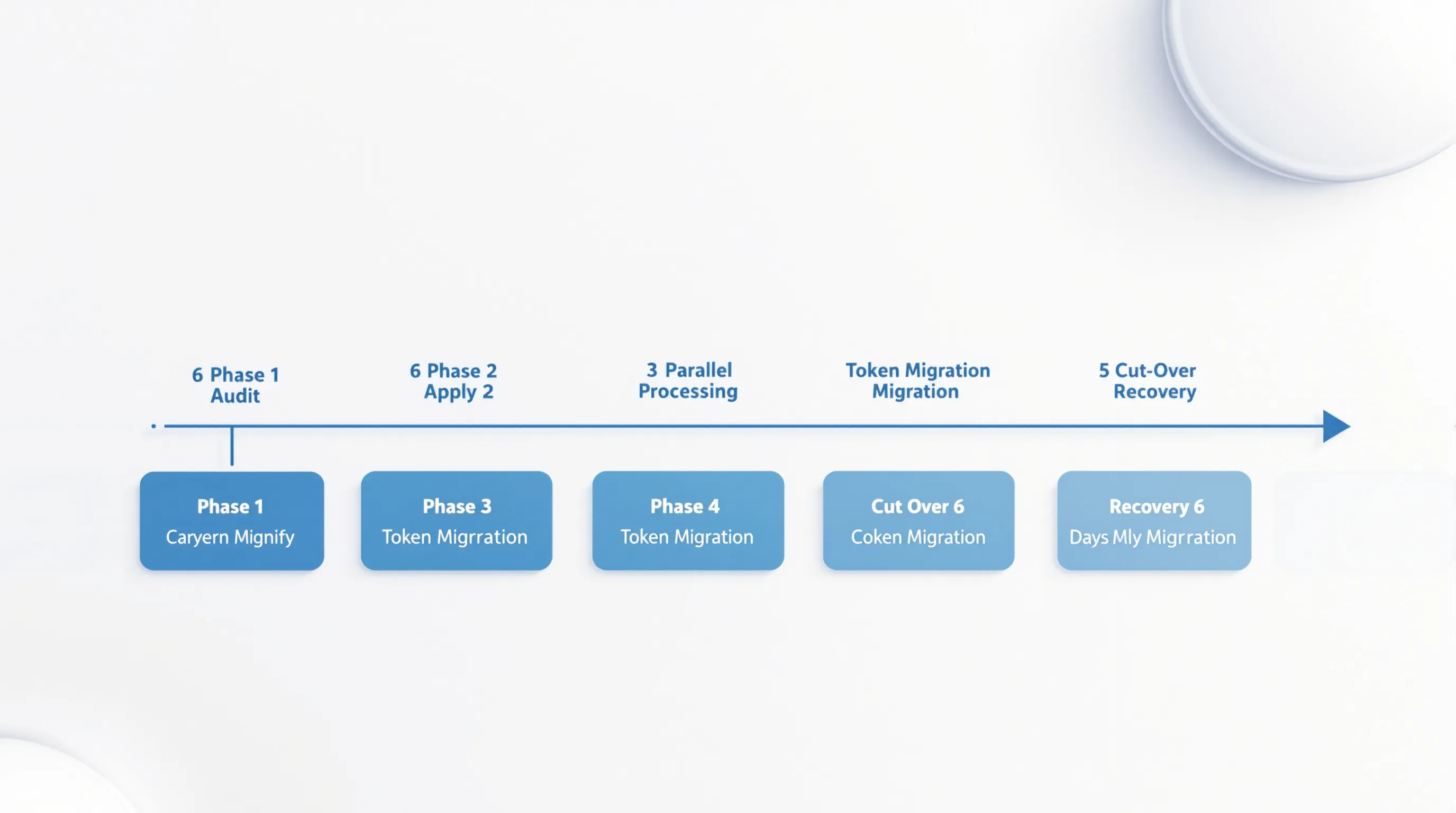
The Step-by-Step Processor Migration Playbook
The safest transitions are not rushed: they are staged. This is the sequence I recommend to every merchant switching processors, whether they have been terminated or are leaving voluntarily.
The goal is straightforward: keep both processors active simultaneously until the new one is fully tested and verified, then cut over cleanly. Running two payment providers simultaneously is both allowed and completely legal, and it means you have a backup ready to go at all times. Most merchants using this approach complete the full migration in 3 to 5 business days without interrupting a single payment.
Phase 1: Audit Your Current Payment Infrastructure (Days 1-2)
Before anything else, document everything that will need to move. Do not wait for an imminent termination date to trigger this step. Start immediately upon receiving any notice or when you decide to switch voluntarily:
- Stored payment tokens: Export a list of all active stored cards on file, including associated customer IDs, billing schedules, and last-four digits. Your processor should provide this as a data export. This list is your baseline for verifying the token migration is complete and for recovering any customers whose cards do not transfer.
- Recurring billing schedules: Document every active subscription: amount, frequency, next charge date, and customer contact information. This list is your insurance policy. If any recurring charges fail during the transition, you have the data needed to recover them manually.
- In-flight transactions: Pull a report of all authorized but unsettled transactions. Contact the processor's merchant support team to clarify what will happen to pending settlements if the account closes before they fund.
- Gateway integrations: List every system connected to your current payment gateway: your e-commerce platform, subscription management software, CRM, and accounting system. Each will need to be updated with the new gateway credentials at cut-over time.
- Contract review: Check your current processor agreement for early termination fees and notice period requirements. Some processors require 60 or 90 days' notice before cancellation; others charge a penalty for early exit.
Phase 2: Apply to the New Processor Immediately (Days 1-3)
Apply for the new merchant account on day one. Do not wait until the audit is complete. SeamlessChex provides same-day approval for established businesses processing $25,000 or more per month. The new account does not need to go live immediately; you simply need it approved and configured while the audit and token migration are underway. Every day you wait narrows the window for a clean parallel run before the old account closes.
Phase 3: Parallel Processing Period (Days 3-7)
Once the new account is approved, configure it in your payment systems alongside the existing processor, not instead of it. Route new transactions to the new processor while the old account continues to handle existing recurring charges and in-flight settlements. This parallel period is the core of the strategy. It lets you validate the new processor's approval rates, funding speed, and gateway performance with real transactions, before you depend on it exclusively. Most small businesses in active switching situations benefit from running both providers for at least several days before fully committing.
Phase 4: Token Vault Migration (Days 3-7, Concurrent with Phase 3)
Submit a formal token migration request to both the departing and receiving processors. This requires both parties to execute a token exchange: the departing processor exports encrypted vault data and the receiving processor imports it. The process is governed by PCI DSS requirements and handled between the processors' compliance teams. Initiate this as early as possible. Once your current processor knows you are leaving, there is an incentive to slow-walk the process, so earlier is always better. SeamlessChex initiates and coordinates this exchange on behalf of the merchant as part of the onboarding process.
Phase 5: Verify and Cut Over (Days 7-10)
Once the vault migration is confirmed and the new processor has been running in parallel for at least 3 to 5 days without issues, complete the cut-over:
- Update all gateway integrations to route exclusively to the new processor
- Verify that all migrated recurring billing schedules are loading correctly
- Run a test charge on a migrated token to confirm the transfer was successful
- Monitor the first full billing cycle after cut-over for unexpected failures
- Request account closure on the original processor only after all pending settlements have funded
Phase 6: Post-Migration Recovery (Days 10-30)
Even with a well-executed migration, some tokens will not transfer. Network failures, expired cards, and processor-side limitations typically result in a 5 to 10% token loss rate. For those customers, trigger an automated email sequence requesting card re-entry, using the customer list from Phase 1. Act quickly: customers who receive an update request within 24 hours of a failed charge re-enroll at a significantly higher rate than those contacted several days later.
Migrating Recurring Billing Customers: The Hard Part Explained
Recurring billing migration is where most processor switches go wrong. The fundamental problem is that payment tokens, the encrypted references to a customer's stored card, are specific to the processor that created them.
A Stripe token only works in Stripe. A Braintree token only works in Braintree. When you switch processors, all of those tokens become worthless unless you execute a formal token migration or have been using network tokenization from the start.
Understanding the Token Problem
When a customer enters their card details on your checkout page, your payment gateway encrypts the card number and stores it in a secure vault. You receive back a token: a string of characters that references the card but contains no sensitive data. Every time you charge that customer again, you pass the token to the gateway and it looks up the card in the vault.
If you switch gateways without migrating the vault, your tokens are pointing to a system that no longer accepts them. The charge fails. The customer does not know why. Your recurring revenue stops, silently. From my experience managing migrations for merchants in high-risk verticals, this is the single costliest mistake a business can make during a processor switch. Recovering recurring customers after a silent payment failure is significantly harder than migrating them proactively before the switch.
One important clarification on data ownership: tokenized card data is legally your property, even though many processors will initially claim it is non-transferable. In practice, token migration is very common and usually possible. The practical challenge is timing and cooperation: once your current processor knows you are leaving, they may slow the export process. Industry practitioners describe this as a known pattern: "they know you are leaving and can drag their feet," which is why early initiation is critical.
Token export fees can also appear unexpectedly. In some cases, merchants have reported fees charged to export large token vaults. One documented case involved a fee of approximately 5,000 euros to export 80,000 tokens. Factor this possibility into your migration budget and ask the departing processor directly about any token export fees before initiating the process.
Three Methods to Migrate Recurring Customers
| Method | How It Works | Token Retention Rate | Customer Action Required |
|---|---|---|---|
| Formal Vault Migration | Processors exchange encrypted vault data through a PCI-compliant transfer. Tokens are re-mapped to the new vault. | 85-95% | None for successfully transferred cards |
| Network Tokenization (VTS/MDES) | Cards are tokenized at the card-network level via Visa Token Service or Mastercard MDES. Tokens are processor-agnostic and portable across gateways. | 95-99% | None |
| Account Updater Service | Processor queries card networks for updated account numbers on stored cards. Catches expired or reissued cards that would otherwise fail silently. | Varies (supplements other methods) | None |
| Customer Re-enrollment | Customers are asked to re-enter payment details via an automated email sequence with a frictionless update link. | 40-60% recovery rate | Required: customer must re-enter card details |
A Note on Gateway Choice and Future Portability
Not all gateways are equally portable. If you want the ability to switch processors in the future without starting this process over, gateway selection matters now. Industry practitioners consistently recommend Authorize.net and Cybersource over proprietary gateway solutions for merchants who want long-term token portability. PayPal's gateway, by contrast, is less commonly recommended for merchants who anticipate switching processors later. One practical alternative: keep the gateway constant and swap processors underneath it, rather than switching both at once. This eliminates the vault migration problem entirely because the tokens remain tied to the same gateway, not the processor.
When Token Migration Is Not Possible
Some processors will not cooperate with a formal vault migration, particularly when the account has been terminated for cause. In these situations, the best path is three recovery tactics executed simultaneously:
- Account updater service on the new processor: queries the card networks for updated card data on every stored card, effective for cards reissued due to fraud or expiration.
- Subscription recovery email sequence launched immediately after the failed charge: include a frictionless payment update link and at least three follow-up touchpoints over 10 days. The 24-hour contact window is the most critical variable in recovery rate.
- Personal outreach for high-value subscribers: phone calls and personalized messages recover a much higher percentage than automated sequences for top-tier accounts.
Merchants who execute all three methods simultaneously typically recover 75 to 85% of affected recurring customers within 30 days, even without a successful vault migration. It is not the ideal outcome, but it is a recoverable one if the work begins immediately after the failed charges are identified.
What Will Matter Most When Evaluating a Replacement Processor
Not every processor is built for the migration scenario. Standard processors (Stripe, Square, Shopify Payments) require lengthy underwriting for high-risk businesses, and many decline them outright. For a merchant who needs to be processing within days, the processor's onboarding timeline is as important as its rates and features. I want to be direct about what actually matters in the first 30 days of a migration, because the criteria shift significantly from what matters long-term.
Same-Day Onboarding Is the Highest-Priority Criterion
Standard processor onboarding takes 3 to 7 business days. For a merchant with a 14-day termination window, that leaves almost no runway for parallel processing before the old account closes. SeamlessChex provides same-day merchant account approval for qualified businesses processing $25,000 or more per month with an established operating history. Same-day approval means the parallel processing window can begin immediately, which is the single most important factor in a successful migration. Every day of delay is a day of parallel processing runway you cannot recover.
Token Vault Migration Support
Ask any prospective processor directly: "Can you import stored payment tokens from my current processor's vault?" Many processors cannot. Those that do support vault migration typically require a formal token migration request submitted between the two processors' compliance teams. The process can take anywhere from 24 hours to several days depending on how cooperative the departing processor is. SeamlessChex handles this coordination directly as part of the onboarding process: the merchant does not have to manage the compliance exchange between the two parties.
Recurring Billing Architecture and Network Tokenization
Processors differ significantly in how they handle recurring billing. Some use proprietary gateway tokens that are completely non-portable. Others support network tokenization (a card-network-level token issued by Visa Token Service or Mastercard Digital Enablement Service) that can move between processors without a vault migration. For businesses with large subscription books, choosing a processor that supports network tokenization from day one protects against future migration headaches as well as the current one. It is also worth asking about an Account Updater service, which queries card networks for updated card data on stored accounts and reduces the decay rate of stored cards over time.
Established Experience in Your Specific Vertical
A processor that has never handled a nutraceutical brand, gaming platform, or subscription business will struggle to approve and support those businesses correctly. The underwriting templates are different, the chargeback mitigation programs are different, and the compliance requirements are different. Beyond approval, there is the BIN seasoning issue mentioned earlier: a processor whose BINs have no transaction history in your vertical may see elevated decline rates in the first weeks, even when everything else goes smoothly. Working with a processor that has established volume in your business category means their BINs are already recognized and trusted by the major issuing banks.
What Matters Less in the First 30 Days
- Rates and interchange optimization: Important long-term, but not the deciding factor when you need to be processing within the week. The cost of downtime or recurring customer loss far exceeds modest rate differences during a 30-day migration window.
- Advanced analytics and reporting: Your existing processor data can be exported before the account closes. Basic transaction reporting is sufficient for the migration period.
- Integration ecosystem: Updating a gateway integration in most modern e-commerce and subscription platforms is a one-time task that takes a few hours. It should not drive processor selection during an emergency migration.
The right processor for a migration scenario is one that can approve you today, support token migration, and has demonstrated experience in your vertical. Everything else, rates, dashboards, integrations, is secondary until the switch is complete and revenue is flowing uninterrupted.
What 12-24 months May Bring
Where Payment Processor Switching Is Headed
Three forecasts on how businesses will avoid downtime, friction, and forced migrations when changing payment processors.
What To Expect When Switching Processors
Use these forecasts to weigh migration timing, processor stability, and high-risk account risk before switching.
Demand for processors built to serve high-risk categories -- gambling, credit repair, nutraceuticals, and other frequently-reviewed e-commerce segments -- will keep growing as periodic account reviews continue to force unplanned migrations for these merchants.
More businesses switching processors will run old and new systems in parallel, migrate tokenized card data early, and test real transactions before full cutover, rather than attempting an instant switch.
As issuer processing infrastructure keeps consolidating -- FIS acquiring Global Payments' Issuer Solutions for $13.5 billion in 2025, on top of the $43 billion FIS-Worldpay and $22 billion Fiserv-First Data deals -- more merchants will be pushed into unplanned processor switches when platforms they depend on are absorbed or wound down.
Weak Signals Worth Watching Community guidance already converges on overlapping systems, early token migration requests, and monitoring the first few weeks post-switch as standard steps. One SaaS merchant was already forced to switch after its processor stopped supporting its integration standard, and the resulting decline rate doubled from 3% to 6%. AMP Payment Systems already markets itself around high-risk industries like gambling and credit repair, while merchants elsewhere report account reviews every 6-9 months triggering forced processor changes; unanswered buyer questions about high-risk providers and chargeback reduction are common in this market.
Supporting And Contrary Evidence
Each forecast is paired with sources that back it and sources that complicate it.
- Backing it: AMP Payment Systems Reviews | amppaymentsystems.com. [Industry Publication]AMP Payment Systems holds a 4.3 rating from 27 reviews, with 81% of reviewers recommending the company. “The absence of regular updates left me uncertain about the outcome.”
- How can we eliminate the constant account reviews and instability points the same way. [Community / Forum]Original poster reports their e-commerce store undergoes an "in-depth review" every 6-9 months, resulting in stricter terms or account closure and forced migration to a new payment processor. “Respectfully, u/KsmHD, there's something about your business that's triggering this.”
- If decline-rate spikes after a switch (like the jump from 3% to 6% reported after one forced processor change) become rare rather than common, or if consolidating processors demonstrate stable service continuity through their platform transitions, the elevated switching-risk forecast would no longer hold.
- Switching payment processors doesn't have to break your business is the strongest public backing for this call. [Community / Forum]Engagement was minimal: one visible comment ("Existing-Ad5972") reading only "This is a great post!". “A lot of businesses stick with a processor longer than they should because they're afraid of downtime, confused customers, or cash flow issues.”
- Backing it: Switching Payment Processor: Questions for business owners. [Community / Forum]OP (u/jdrumpfl) currently runs two stores on different POS/payment setups: one on Lightspeed, one on Square; payments are in-store only. “Payments professional of 15 years here. Lightspeed will charge you a penalty for using outside processing and Square won't work with anything else.”
- How do you migrate a scaling payment platform off a legacy core points the same way. [Community / Forum]Post is dated "10d ago" (10 days before scrape); thread includes replies dated 9d, 7d, 6d ago. “No, migrations always suck. It is part of the cost of doing a migration. Just pray that you don't have to invariably re-KYC/KYB your customers as part of it.”
- Desperate for ideas - increased declines since switching processors complicates the call. [Community / Forum]Business is a niche SaaS company (6 employees) providing tech/admin automation tools for performing arts schools, processing tuition payments through their app. “There are currently ~ $40k in payments tied up by these unnecessary declines.”
- The case rests on Modern Issuer Processing. [Substack / Newsletter]Modern issuer processors grew from near-zero market share in 2015 to 6.2% of total issuer processing revenue by 2022, growing five times faster than legacy systems. “These platforms compressed what used to take 12 months and cost millions into 3-week implementations with pay-as-you-go pricing.”
- Desperate for ideas - increased declines since switching processors is what puts this forecast on the board. [Community / Forum]Company was forced to switch payment processors after their old processor stopped supporting ISV infrastructure "to our standards.".
- How can we eliminate the constant account reviews and instability cuts the other way. [Community / Forum]Commenter u/pjmg2020 states 13 years of e-commerce experience, having worked with "dozens of brands and hundreds of stores across the globe," with "precisely zero issues" with payment processors.
What Could Change These Forecasts
These scenarios describe the market shifts that would alter the switching outlook.
Confidence, With Limits
We hold 95 with the most confidence, while 57 is the one we would flag as most likely to shift.
- High-risk merchants drive demand for specialized switching options. That call weakens first if regulators or buyers move in the opposite direction.
- Infrastructure consolidation raises forced-switching risk. That one becomes the more durable forecast if the source mix shifts toward stronger contrary evidence.
Switching Processors Does Not Have to Mean Downtime
Switching payment processors is a business-critical operation, but it does not have to be a crisis. The merchants who navigate it best treat the migration as a structured project: a documented audit phase, a parallel processing window, a formal vault migration request, and a fallback plan for the customers whose tokens do not transfer cleanly.
At SeamlessChex, we have built our onboarding process specifically for merchants who need to move quickly without sacrificing continuity. Same-day approval, a dedicated migration team, and experience across high-risk verticals (from nutraceuticals to gaming platforms to subscription businesses) means we have seen every variation of this problem. We know what breaks, and we know how to prevent it.
The fundamentals are consistent regardless of which processor you are leaving or which vertical you are in. Run both processors in parallel. Initiate the token vault migration as early as possible. Choose a new processor with an established track record in your industry, not just one that will accept the application. And build your recovery plan for the 5 to 10% of tokens that will not transfer cleanly before the old account closes, so you are not scrambling when those customers show up with failed charges.
If your business processes $25,000 or more per month and you are facing a processor termination or a voluntary switch, I'd encourage you to reach out before the window narrows. The longer you wait, the less runway you have for a clean parallel run. Most merchants can be fully operational on SeamlessChex within 3 to 5 business days, processing new transactions, migrating recurring customers, and maintaining revenue continuity the entire time.
The switch does not have to mean downtime. With the right sequence and the right partner, it does not.
Written by
Jonathan Albert
Co-Founder, SeamlessChex
Jonathan Albert is Co-Founder of SeamlessChex, a credit card processing and fintech payments platform recognized on the Inc. 5000.
Connect on LinkedInSummarize This Article With AI
Open this article in your preferred AI engine for an instant summary.
Frequently Asked Questions
How long does it take to switch payment processors without losing revenue?
With proper planning and a processor that offers same-day or next-day onboarding, most merchants can be fully operational on a new processor within 3 to 5 business days. The timeline depends on how quickly the new account is approved, how long the token vault migration takes, and how many systems need to be updated with new gateway credentials. SeamlessChex provides same-day approval for qualified merchants, giving the maximum possible window for parallel processing before the old account closes.
Will my recurring customers stop getting charged if I switch processors?
They will stop getting charged if you do not migrate your stored payment tokens to the new processor. However, with a formal vault migration or network tokenization, most recurring customers can be transferred without any interruption and without the customer needing to re-enter their payment information. Merchants who complete a full vault migration typically retain 85 to 95% of their recurring billing customers automatically. Network tokenization through Visa Token Service or Mastercard MDES achieves retention rates of 95 to 99%.
Can I switch processors if I've been terminated by Stripe or Shopify?
Yes. A termination from Stripe, Shopify Payments, or PayPal does not prevent you from opening a merchant account elsewhere. High-risk processors like SeamlessChex regularly onboard merchants who have been terminated by mainstream platforms, and in many cases a previous termination is not a disqualifying factor. The key is working with a processor that has experience in your business vertical and that can approve your account quickly enough to begin parallel processing before your current account closes. SeamlessChex works with established businesses processing $25,000 or more per month.
What is parallel processing and why does it matter?
Parallel processing means running your new processor alongside your old one for a period of 3 to 7 days before fully switching over. New transactions flow to the new processor while the old one continues to handle in-flight settlements and existing recurring charges. This eliminates the payment gap that occurs when merchants switch processors abruptly and ensures that any issues with the new setup are caught before the old account is closed. Running two payment providers simultaneously is both allowed and completely legal.
What is token migration and how does it work?
Token migration is the process of transferring stored payment tokens from one processor's vault to another. When a customer saves their card with your business, the card number is encrypted and replaced with a token that only works with the processor that created it. Token migration involves both processors' compliance teams executing a PCI-compliant encrypted vault exchange, re-mapping the tokens to the new processor's system. This is a very common process, typically taking 24 to 48 hours for cooperative departures. Tokenized card data is legally your property, even when processors initially claim otherwise.
What happens to money still being processed when I switch?
Authorized transactions that have not yet settled at the time of your account closure depend on the processor's policies and the circumstances of the closure. Voluntary departures generally allow all pending settlements to fund normally. Terminated accounts, particularly those closed for cause, may face holds on unsettled funds that can last weeks. Document all in-flight transactions before initiating the switch and work with your current processor's merchant support team to clarify what will happen to pending settlements before you take action.
How can I protect myself from processor terminations in the future?
The most effective protection is proactive chargeback management (keeping your ratio below 0.9% for Visa and 1.5% for Mastercard) and working with a processor that specializes in your vertical rather than a platform processor that uses automated risk triggers. High-risk specialist processors like SeamlessChex have underwriting models designed for subscription businesses, nutraceutical brands, gaming platforms, and other verticals that mainstream processors routinely exit. Choosing network tokenization (Visa Token Service or Mastercard MDES) for stored customer cards also future-proofs your billing infrastructure against the next forced migration, since network tokens are processor-agnostic and can move freely between gateways.
SeamlessChex onboards established merchants; the practical minimum is $25,000 in monthly payment volume.