



Quick Answer
Quick Answer: Same-Day Settlement for High-Risk Merchants
Same-day settlement (T+0) means credit card funds captured before your processor's daily cutoff (typically 5 to 8 pm) are deposited to your merchant bank account the same business day. High-risk merchants are generally not eligible for T+0 on opening, starting instead at T+3 to T+5. The path to faster settlement runs through a dedicated high-risk credit card merchant account with a specialist processor, not a generic payment aggregator. For a merchant processing $100,000 per month, moving from T+3 to T+0 frees $10,000 in permanent working capital, more financial value than a 60-basis-point rate reduction.
Most merchants negotiate rate. The merchants who recover the most working capital negotiate settlement speed. If you are processing $100,000 per month at T+3 (the default for most high-risk accounts), you have $10,000 in earned revenue permanently locked in transit. Rolling reserves add another layer on top. This article quantifies the working-capital impact of same-day settlement for high-risk merchants and explains what it actually takes to access T+0 funding outside of enterprise contracts.
Questions this article answers
- How does same-day settlement (T+0) work for high-risk credit card payments, and who controls the funding timeline?
- What is the actual working-capital cost of T+2 or T+3 settlement, and how does it compare to paying a higher processing rate?
- What do high-risk merchants need to qualify for faster settlement, and how does a specialist processor differ from Stripe or Shopify Payments?
For a high-risk merchant processing $180,000 per month at T+3 settlement with a 10 percent rolling reserve, more than $36,000 in earned revenue is unavailable at any given moment, locked in transit and reserve simultaneously. Moving to T+1 through a dedicated credit card merchant account frees approximately $12,000 of that capital in the first billing cycle, without changing a single basis point of processing rate. Same-day settlement is not a premium add-on for enterprise brands; it is the mechanism by which high-risk merchants close the working-capital gap that aggregator processors create and never acknowledge.
Same-day settlement, or T+0, means credit card funds captured before a daily cutoff time reach your merchant bank account before the close of that business day. For standard low-risk merchants, the default is T+2. For high-risk merchants (those processing nutraceuticals, peptides, subscriptions, or online gaming), the default is typically T+3 to T+5. The difference is not a processing fee line item. It is a permanent revolving drag on working capital that compounds with rolling reserves. A dedicated high-risk credit card merchant account through a specialist processor is the primary path to compressing that settlement window, and to moving money on terms that reflect your actual business, not an aggregator's risk management posture.
What Is Same-Day Settlement and How Does the T+0 Funding Cycle Work?
Settlement timing notation describes how many business days elapse between when a credit card transaction is captured and when the funds actually reach your bank account.
T+0 means zero days: authorization and funding happen within the same business day. T+2, the industry default for most merchants, means the money arrives two business days after the transaction date. And for high-risk merchants, the starting point is often T+3 to T+5, before any negotiation even begins, as of .
To understand why this gap exists, it helps to trace a card transaction through its full lifecycle. Most merchants think of a payment as a single event. It is actually four distinct stages, and each one adds latency between the sale and when the money is actually available.
The Four Stages of Every Credit Card Settlement
- Authorization: The cardholder's issuing bank verifies the card is valid and funds or credit are available. This happens in seconds and does not move money: it places a temporary hold on the account.
- Capture: You or your payment gateway submit the authorized transaction as final, typically at end of day in a settlement batch. Until capture, the transaction is not finalized and cannot proceed to clearing.
- Interchange clearing: Visa or Mastercard processes the batch through their network, debiting the issuing bank and crediting the acquiring bank. According to Stripe's own documentation, this step takes one to three business days under standard rails, though infrastructure investment by both networks has made same-day clearing technically feasible on their side for many transaction types.
- Funding: Your acquiring bank releases net proceeds (gross amount minus interchange fees, processing fees, and any applicable reserves) to your merchant bank account. This is the stage that varies most across processor types, and the stage that T+0 compresses to same-day.
Under T+2, capturing transactions on Monday means funds arrive Wednesday. Under T+0, a batch submitted before the cutoff time (typically between 5 and 8 pm depending on the acquiring bank) settles to your account before business day's end.
One important distinction: your payout schedule and your settlement timeline are not the same thing. As Stripe's own payout documentation explains, choosing a daily payout schedule does not change how long it takes funds to become available: it only controls when payouts are sent after the settlement window closes. A merchant on a daily payout schedule with T+3 settlement still waits three business days. Schedule frequency and settlement speed operate independently.
How Settlement Timelines Compare Across Merchant Types
Settlement speed is not uniform. Your funding timeline depends on your risk category, acquiring bank, gateway, and processing history. Here is how funding timelines typically break out:
| Settlement Type | Funds Available | Typical Merchant Category |
|---|---|---|
| T+0 (Same-Day) | Same business day as capture | Enterprise accounts, high-volume merchants with dedicated acquiring relationships |
| T+1 | Next business day | Established low-risk merchants with 12+ months of clean processing history |
| T+2 | Two business days | Standard default for most low-risk merchants |
| T+3 | Three business days | New merchants, moderate-risk categories, high-risk merchants with established history |
| T+4 or longer | Four or more business days | High-risk verticals in first year, merchants coming off payment aggregators, MATCH list recoveries |
Weekends and federal bank holidays do not count as business days. A T+2 settlement from a Friday batch does not arrive until Tuesday. For a high-risk merchant already at T+3, a Friday capture means the money arrives the following Wednesday, five calendar days later. The effective settlement lag is consistently worse than the notation suggests.
Who Actually Controls Your Settlement Speed?
Three parties influence your funding timeline, and most merchants interact with only one of them directly.
Card networks (Visa and Mastercard) set the baseline interchange clearing standard. Both have invested heavily in accelerating this step, and same-day interchange clearing is technically available on their rails for many transaction types. The infrastructure for T+0 exists at the network level.
Acquiring banks control the actual funding window. They determine when they release settled funds and whether they offer accelerated funding programs for specific merchant categories. Most acquirers default to T+2 for standard accounts and charge a fee or rate premium for T+0 access. For high-risk categories, many acquirers simply do not offer sub-T+3 funding until a merchant has established months of clean processing data with them.
Processors and gateways sit between you and the acquirer. They negotiate funding terms with their banking partners and pass those terms to their merchant portfolio. As one Reddit commenter in r/PaymentProcessing summarized it, dedicated merchant accounts with direct acquiring relationships "can do T+0/T+1 and tune fraud rules without auto-blocking half your revenue", in contrast to generic payment facilitators like Stripe, whose risk model "prioritizes the processor's balance sheet, not your cash flow."
Your processor choice determines which acquirer relationship backs your account. That, more than almost any other factor, determines how fast you get paid.
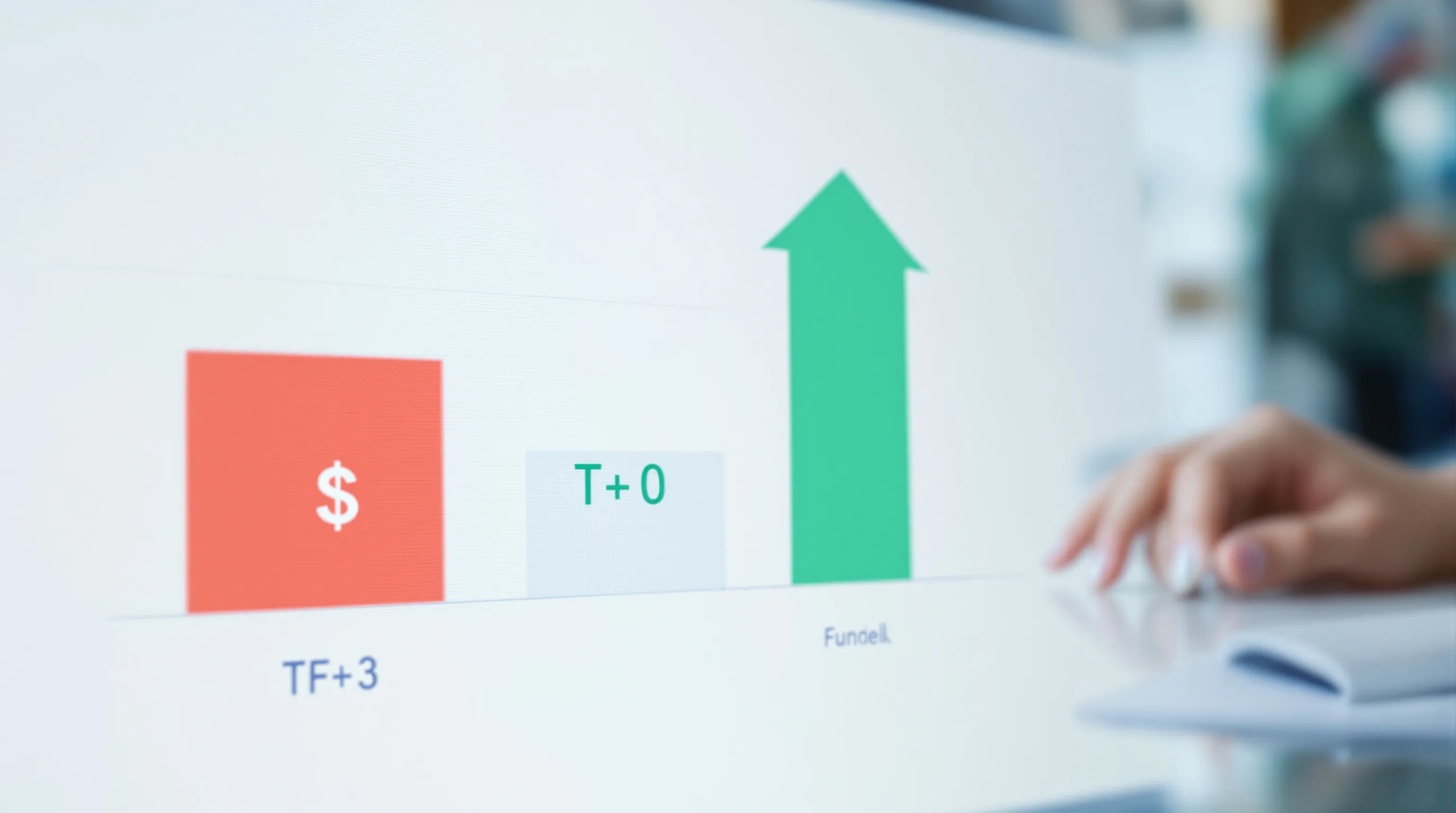
The Working-Capital Math: What T+2 Costs Your Business Every Month
Most merchants evaluate payment processors by rate: the percentage and per-transaction fee that appears in the proposal.
That number is visible, comparable, and easy to put into a spreadsheet. What almost never appears in the proposal is the cost of carrying receivables float: the money you have earned but cannot spend because it is in transit between the card network and your bank account.
I have seen merchants negotiate a processing rate down by 30 basis points and feel like they won the conversation, while their settlement window stayed at T+3. In most cases, the faster settlement would have been worth considerably more. A 30-basis-point reduction on $100,000 per month saves $300. Recovering the T+3 float on that same volume frees $10,000 in working capital permanently.
Calculating Your Settlement Float
The formula is straightforward. Your daily revenue equals your monthly processing volume divided by 30. Your receivables float under any settlement timing equals daily revenue multiplied by the settlement days. That float does not disappear: it regenerates every business day you process, because each day's batch creates a new period of transit before that money lands.
| Monthly Processing Volume | Daily Revenue (÷30) | T+2 Float | T+3 Float | Working Capital Recovered Moving to T+0 |
|---|---|---|---|---|
| $25,000 | $833 | $1,667 | $2,500 | $1,667 to $2,500 |
| $100,000 | $3,333 | $6,667 | $10,000 | $6,667 to $10,000 |
| $250,000 | $8,333 | $16,667 | $25,000 | $16,667 to $25,000 |
| $500,000 | $16,667 | $33,333 | $50,000 | $33,333 to $50,000 |
For a $100,000-per-month merchant, T+2 means $6,667 is permanently in transit at any given moment. That is not a one-time delay: it is a revolving capital lock that resets daily. Moving to T+0 does not eliminate lag on individual transactions; it means each day's batch funds the same day it is captured, so the revolving float balance drops to near zero.
How Rolling Reserves Compound the Float Problem
High-risk merchants do not start from T+2. They typically open at T+3 or T+4, and they carry rolling reserves on top of the settlement float. A rolling reserve is a percentage of gross processing volume (generally 10 to 15 percent for high-risk accounts) held by the acquiring bank for 90 to 180 days as a chargeback buffer. It operates separately from settlement timing, but the two combine to create a significant working capital drain.
Consider a nutraceutical merchant processing $180,000 per month with a 10 percent rolling reserve and T+3 settlement:
- T+3 settlement float: $180,000 ÷ 30 × 3 = $18,000 permanently in transit
- Rolling reserve at 10%: $18,000 per month held for 180 days on a rolling basis
- Total unavailable working capital: $36,000 or more at any given time
A merchant in this position who moved to T+1 settlement through a dedicated high-risk merchant account, without changing their reserve rate, would see the settlement float compress from $18,000 to $6,000. That frees $12,000 in working capital in the first billing cycle, recoverable immediately and available to fund inventory, customer acquisition, or operations without drawing on a credit line at 9 to 12 percent APR.
Modeling Rate vs. Speed: The Comparison Most Processors Never Show You
When merchants compare processors, they almost always compare rates. Settlement timing rarely appears in the same table. Here is what that comparison actually looks like for a $100,000-per-month high-risk merchant choosing between two options:
| Scenario | Rate | Settlement | Monthly Processing Fee | Float Opportunity Cost (10% APR credit line) | Total Effective Monthly Cost |
|---|---|---|---|---|---|
| Aggregator (Stripe-type) | 2.9% + $0.30 | T+2 (if available) | $2,900 | $56/month ($6,667 × 10% ÷ 12) | $2,956 |
| High-risk specialist | 3.5% + $0.30 | T+1 | $3,500 | $28/month ($3,333 × 10% ÷ 12) | $3,528 |
| High-risk specialist | 3.5% + $0.30 | T+0 | $3,500 | $0 | $3,500 |
The rate difference between the aggregator and the specialist is $600 per month. But this comparison assumes the aggregator option is available to you at all. If you are processing nutraceuticals, peptides, subscription boxes, or any vertical that a generic aggregator treats as high-risk, you are not eligible for that 2.9 percent rate. Your realistic starting point on Stripe or Shopify Payments, if your account has not already been closed, is a pending review, a rolling reserve with no defined timeline, or worse, a termination with funds held.
For a high-risk merchant already paying 3.5 percent and sitting at T+3, moving to T+0 at the same rate does not cost an extra dollar in fees. It recovers $10,000 in working capital permanently. That recovery is the financial case for prioritizing settlement speed over rate negotiation, and it's why the merchants I have seen benefit most from changing processors are not the ones who got the rate down, but the ones who got their money faster.
Why High-Risk Merchants Face Longer Settlement Delays (and How to Close the Gap)
High-risk merchants do not get T+2 by default. The standard starting point for high-risk payment processing is T+3 to T+5, and some acquiring banks push new high-risk accounts to weekly settlement batches for the first 90 days. Understanding why this happens, and what a processor can and cannot change, is the first step toward negotiating better terms and finding a same-day settlement payment gateway that can actually deliver for your category.
Why Acquirers Default to Longer Holds for High-Risk Categories
Acquiring banks hold funds longer for high-risk merchants because the chargeback dispute window extends well beyond the settlement date. A customer can dispute a card charge up to 120 days after the transaction on Visa and Mastercard networks, and longer in cases involving recurring subscription billing or suspected fraud. If an acquirer settles funds on T+2 and a chargeback wave arrives at day 90, the merchant may not have liquidity to cover the reversals. The longer settlement window is the acquirer's built-in risk hedge. The merchant absorbs the working capital cost.
Three factors typically extend settlement timelines for high-risk accounts:
- Merchant category code (MCC): Card networks assign risk ratings to transaction categories. Subscription billing, nutraceuticals, telehealth, and online gaming each carry elevated risk classifications that trigger longer default holds at most acquiring banks, regardless of the individual merchant's actual dispute history.
- Processing history: A new high-risk merchant with no track record cannot demonstrate a low chargeback rate. Acquirers price in that uncertainty through extended settlement windows until the merchant accumulates several months of clean data.
- Chargeback ratio: Merchants above Visa's VAMP program dispute threshold of 1 percent may face mandatory extended holds as a condition of continued processing. Exceeding 1.5 percent can move settlement from T+3 back to T+5 or trigger a shift to weekly batch settlement.
What to Look for in a Same-Day Settlement Payment Gateway for High-Risk
Not every processor that advertises fast settlement can deliver it for high-risk merchants. Generic payment facilitators (Stripe, Shopify Payments, Square, PayPal) are not structured to offer negotiated settlement terms for subscription businesses or high-risk verticals. They are also the processors most likely to suspend accounts without notice and hold in-transit funds during their review process. What high-risk merchants need is structurally different from what aggregators offer:
- Dedicated acquiring relationships in your vertical: A processor with an existing bank partnership in your merchant category can negotiate settlement terms that a general-purpose aggregator cannot. The acquirer's willingness to offer faster funding depends on their existing portfolio exposure to your category: a bank that already underwrites hundreds of nutraceutical merchants understands the risk profile differently than one that is seeing it for the first time.
- Credit card processing as the primary rail: Some processors serving high-risk merchants pivot toward ACH-only solutions when card underwriting becomes difficult. ACH typically clears in one to three business days under standard rails, making it a useful secondary option but not a path to T+0 card settlement. Look for a processor that maintains genuine credit card acquiring access for your category.
- Transparent reserve terms in writing: Vague contract language around "risk holds" or "discretionary reserves" is a warning sign. Acceptable agreements specify the reserve percentage, the hold period, and a defined release schedule tied to processing volume and chargeback performance. An undefined reserve is, as one payment professional put it, "not always bad, an undefined or surprise reserve is."
- A documented path toward faster settlement: The processors that serve high-risk merchants well are ones that build a mechanism for improving terms as your history strengthens. Ask before signing: at what chargeback ratio and after how many months does T+3 become T+2, and T+2 become T+1?
- Account stability over rate promises: A processor with years of experience in your vertical and existing banking relationships is more valuable than one offering unusually favorable settlement terms as a sign-up incentive. Fast terms that disappear after the first chargeback review are worse than honest T+2.
How SeamlessChex Approaches Settlement for Established High-Risk Merchants
SeamlessChex works with established businesses processing a minimum of $25,000 per month, including merchants in nutraceuticals, peptides, GLP-1 distribution, subscription businesses, online gaming, and companies that have been displaced from Stripe, PayPal, or Shopify Payments. Our primary solution is a dedicated credit card merchant account backed by acquiring relationships built for high-risk volume, not a generic aggregator pipeline that can terminate accounts without notice.
From what I have observed across merchants who make this transition, the improvement in settlement timing relative to a flagged aggregator account is almost always immediate. The more time-intensive work is reducing the reserve percentage and accessing sub-T+2 funding, both of which require processing history. And processing history only accumulates on a live, stable account with defined terms.
If your current processor is holding funds without a clear release timeline, or your settlement window is costing you more in working capital than the rate conversation ever acknowledged, that is the conversation worth starting with a specialist. Learn more about SeamlessChex merchant services or apply for a high-risk merchant account today.
What Will Matter Most for Same-Day Settlement Access in the Next 12 Months
The infrastructure for T+0 card settlement already exists. Visa and Mastercard have made the network investments. Real-time payment rails (FedNow, RTP, Visa Direct, Mastercard Send) are operational. The bottleneck is not technology. It is acquiring bank appetite for high-risk merchant categories and the underwriting data required to justify faster funding. What changes that appetite is merchant-side behavior and broader industry shifts that are already underway.
The Chargeback Threshold Is the Lever That Unlocks Faster Settlement
Acquirers do not release accelerated funding to merchants they do not trust. The signal they trust most is chargeback ratio over time. Visa's VAMP program set a 1 percent dispute threshold as the line at which merchants face enhanced scrutiny. Merchants who build and maintain a dispute ratio below 0.5 percent, through clear billing descriptors, responsive customer service, and fraud prevention tooling, are meaningfully better positioned to negotiate sub-T+2 terms after six to twelve months of history.
This matters more than rate negotiation because chargeback management is a business behavior change, not a contract term. A processor can offer better settlement terms. Only the merchant can earn the underwriting trust that unlocks them on an ongoing basis.
Real-Time Payment Rails Are Expanding, But Card Processing Remains Dominant
FedNow launched in 2023 and has added roughly 1,000 participating financial institutions. The network handles instant transfers 24 hours a day, 7 days a week, 365 days a year, eliminating the business-day restriction that extends T+2 into a T+4 calendar window on weekends. For ACH-eligible high-risk transactions, same-day and next-day ACH under NACHA's expanded rules represent a legitimate secondary rail.
But card processing is not being replaced by real-time rails in the near term. Cards carry consumer protections, chargeback rights, and fraud liability frameworks that ACH does not. Merchants in high-risk verticals (nutraceuticals, peptides, subscription billing) will continue to see the majority of their consumer volume on credit and debit cards. The path to T+0 for card transactions runs through acquiring bank relationships and processor terms, not payment rail shifts.
What will shift is acquiring bank willingness to leverage real-time settlement infrastructure on the back end of card transactions, particularly for established merchants with clean history. The merchant who builds a track record of low disputes and consistent volume is positioned to benefit from this as it becomes more broadly available.
Subscription Businesses Leaving Aggregators Will Drive Demand for Dedicated Settlement Terms
Stripe, Shopify Payments, and PayPal have been systematically closing subscription businesses in high-risk categories. This is not new, but the rate of closures has accelerated, and more merchants are arriving at high-risk specialists with processing history (often strong history) and an immediate need for stable, defined terms.
For processors like SeamlessChex, this creates an opportunity to underwrite merchants with actual data rather than theoretical risk. A nutraceutical subscription business with 24 months of clean Stripe processing, now terminated, is a meaningfully different underwriting profile than a new merchant with no history. That historical data is portable and relevant, and it is the primary argument for faster settlement terms at account opening rather than after months of re-establishing history.
If you are in this position, bring your processing statements. The conversation about T+1 or T+0 access is different when you can demonstrate a dispute rate under 0.5 percent across 24 months of volume.
Forecast: 12-24 months
Where Settlement Speed and Fund Access Are Headed
Three forecasts on how fast trades and payments will settle and when businesses actually get cash.
Settlement Speed Forecasts
Use these forecasts to gauge how soon faster settlement will actually change your cash access.
Buyer demand for payment processing that pairs faster settlement with tolerance for higher-risk categories - e-commerce, recurring billing, specialty goods - will keep rising over the next 12-24 months, pushing more providers to build underwriting suited to these merchants.
Securities settlement will stay anchored at T+1 through the forecast window rather than advancing to same-day settlement, even as FINRA continues aligning options and government securities to the current cycle.
Even as mainstream payout speeds improve, higher-risk and cross-border sellers will continue facing multi-day fund holds and reserve-based delays over the next 12-24 months, regardless of same-day transfer options becoming standard elsewhere.
Early Indicators The SEC's T+1 rule change (effective May 28, 2024) required a major industry-wide operational effort, and real-time settlement has been discussed in the industry for over 50 years without being adopted. A freight broker reported Stripe's Radar flagging close to half of invoices with funds held under a payment facilitator risk model, while a payments founder cited 2-7 day cross-border settlement delays plus an added 1.5% cross-border fee on top of standard Stripe rates. Recurring buyer questions about the best processing for high-risk e-commerce, high-risk merchants generally, and specialty categories like peptides and SARMs point to persistent, unmet demand for faster, risk-aware settlement options.
Supporting and Contrary Evidence
Sources shown include data points that support each forecast and others that complicate it.
- Funding delays are killing my cash flow - URGENT is the clearest counter-signal. [Community / Forum]Original poster (u/Conscious-Day5983) is an FMCSA-registered freight broker, in business approximately 3 years. “Cash flow is critical in my industry because carriers have to be paid on time or you get penalized and lose reputation fast.”
- Real Time Settlement yes or no supports this forecast. [Community / Forum]Original poster references a congressional hearing (implied: the Feb 2021 GameStop/Robinhood hearings) at which Robinhood CEO Vlad Tenev advocated for real-time trade settlement. “That is gibberish. How does instant settlement turn a cash account into a 'margin [account] in nature?' Margin is borrowed money, cash is your money. Apples…”
- Confused by how "T+1" settlement actually works. is what puts this forecast on the board. [Community / Forum]Original poster's (u/DeeDee_Z) limit order triggered Thursday at 11 a.m.; resulting cash showed as "Pending" for the rest of that day. “If it takes 48 hours for cash to become available, that's T+2.”
- Pushing back: The trade settlement period will be shorten to one day (T+1). [Community / Forum]The U.S. settlement cycle shortened from T+2 to T+1 effective Tuesday, May 28, 2024, per SEC amendment to Rule 15c6-1(a) of the Securities Exchange Act, cited in Nasdaq filing 34-98954 (SEC.gov). “The only account you will notice the change on is the cash account, where your trade will settle the next day after you did them.”
- Why is everybody saying that options are T+2 when FINRA clearly complicates the call. [Community / Forum]FINRA's official settlement-cycle page states the T+1 rule amendment applies to the same securities currently covered by T+2 - stocks, bonds, municipal securities, ETFs, certain mutual funds, and exchange-traded limited partnerships. “That's a good question for sure. Penalties always seem so low, they actively encourage people to break the rules.”
- Funding delays are killing my cash flow - URGENT is the strongest public backing for this call. [Community / Forum]Poster also sells autoparts for luxury vehicles through a large network of dealers and yards, serving a recurring customer base of car enthusiasts.
- Processing Fees and Settlement Delays Solution supports this forecast. [Community / Forum]“Settlement delays are definitely annoying but most of us just factor it into cash flow planning at this point. The real pain is when customers dispute charges…”
What Could Change These Forecasts
Regulatory action or shifts in merchant risk underwriting could move these timelines earlier or later.
Confidence, With Limits
84 reflects our strongest conviction, while 52 is where we are most prepared to be wrong.
- Demand grows for fast settlement built for higher-risk categories. That call weakens first if regulators or buyers move in the opposite direction.
- T+1 becomes the settled floor, not a step toward T+0. That one becomes the more durable forecast if the source mix shifts toward stronger contrary evidence.
The Bottom Line on T+0 and Cash Flow for High-Risk Merchants
Same-day settlement is not a feature reserved for enterprise brands with leverage over their acquiring bank. It is a negotiable term, and for merchants who have been sitting at T+3 or T+4 on an aggregator platform, the transition to a dedicated high-risk credit card merchant account is often the fastest way to unlock working capital that is already theirs.
The math is not complicated. For every $100,000 in monthly processing volume, T+3 settlement means $10,000 in permanent float. At T+0, that money is in your account the same day you earn it, available to fund inventory, payroll, or customer acquisition without borrowing. The float you recover from faster settlement frequently exceeds the value of a rate negotiation by three to one, and unlike a rate cut, a settlement improvement does not shrink at higher volume.
The path to faster settlement runs through the right processor, not a better rate sheet from your current one. If your business processes $25,000 or more per month and you are operating in a high-risk vertical (nutraceuticals, peptides, subscription billing, online gaming, or a category that has already been flagged or closed by Stripe, PayPal, or Shopify Payments), a dedicated high-risk merchant account with defined settlement terms is worth evaluating with the same rigor you apply to your processing rate.
SeamlessChex specializes in exactly this: credit card merchant accounts for high-risk businesses that need stable processing, defined reserve terms, and a realistic roadmap toward faster funding. Start the application today.
Written by
Jonathan Albert
Co-Founder, SeamlessChex
Jonathan Albert is Co-Founder of SeamlessChex, a credit card processing and fintech payments platform recognized on the Inc. 5000.
Connect on LinkedInStop Leaving $10,000 or More in Working Capital on the Table
If you are processing $100,000 per month at T+3, you have $10,000 in earned revenue locked in transit, every single month. SeamlessChex works with established high-risk merchants processing $25,000+ per month to set up dedicated credit card merchant accounts with defined settlement terms, transparent reserves, and a documented path toward faster funding.
Apply for a high-risk merchant account today and start the conversation about moving your settlement window forward.
Frequently Asked Questions About Same-Day Settlement
What is T+0 settlement and how does it differ from standard T+2?
T+0 settlement means credit card funds captured before your processor's daily cutoff are deposited to your merchant bank account within the same business day. T+2, the industry standard for most low-risk merchants, means funds arrive two business days after the transaction date. High-risk merchants typically start at T+3 to T+5. Weekends and bank holidays extend these windows further: a T+2 settlement from a Friday batch arrives Tuesday, and a T+3 from the same Friday arrives Wednesday.
Can high-risk merchants access same-day settlement?
Yes, but not on opening and not through generic payment aggregators like Stripe or Shopify Payments. High-risk merchants typically need three to six months of clean processing history on a dedicated merchant account before an acquiring bank will consider accelerated funding. A specialist processor with existing banking relationships in your vertical (nutraceuticals, peptides, subscription billing, online gaming) is the starting point. Settlement terms improve as your chargeback history strengthens.
How much working capital does faster settlement actually free up?
The formula is: monthly volume ÷ 30 × settlement days = float locked in transit. At $100,000 per month, T+3 settlement locks $10,000 in permanent revolving float. T+0 reduces that to near zero. High-risk merchants compound this with rolling reserves of 10 to 15 percent held 90 to 180 days. Moving from T+3 to T+1 on a $180,000-per-month account typically frees approximately $12,000 in working capital in the first billing cycle.
Is T+0 settlement better than negotiating a lower processing rate?
For most high-risk merchants, faster settlement recovers more value than rate reduction. A 30-basis-point rate cut on $100,000 per month saves $300. Recovering T+3 float at the same volume returns $10,000 in working capital permanently, with no additional cost. The comparison only shifts when rate premiums for T+0 access exceed the float recovery, which typically requires processing well above $500,000 per month.
What does Stripe's settlement timeline look like for high-risk accounts?
Stripe's standard settlement takes one to three business days for low-risk merchants. New accounts, regardless of volume, are subject to initial payout delays of 7 to 14 days per Stripe's own documentation. High-risk verticals on Stripe face additional manual review periods, and accounts can be suspended without notice with funds held for up to 90 days or longer during investigation. These are structural features of the aggregator model, not exceptions.
What is the minimum volume to qualify for a high-risk merchant account with faster settlement?
SeamlessChex works with established businesses processing a minimum of $25,000 per month. Processing history, business age, and chargeback ratio all factor into underwriting and settlement terms. Merchants with existing volume and a clean dispute history in a high-risk vertical typically qualify for defined settlement terms on approval, with a path toward accelerated funding after demonstrating consistent processing performance.
Why do high-risk merchants carry rolling reserves on top of settlement delays?
Rolling reserves are a separate mechanism from settlement timing. Acquiring banks require high-risk merchants to hold 10 to 15 percent of gross processing volume as a chargeback buffer, typically for 90 to 180 days on a rolling basis. Settlement timing controls when individual batches fund. Rolling reserves control what percentage of that funding is immediately accessible. Both affect working capital, and both improve as processing history strengthens and chargeback ratios fall.
SeamlessChex onboards established merchants; the practical minimum is $25,000 in monthly payment volume.