



Quick Answer
Network tokens, issued by Visa (Visa Token Service) and Mastercard (MDES), are tied to the card itself and can survive a move to a new acquirer, making them the more portable architecture for subscription billing. Vault-hosted tokens from processors like Stripe, Braintree, and PayPal are proprietary identifiers that become worthless the moment the processor relationship ends. For a high-risk subscription business facing an acquirer termination, vault tokens mean either a lengthy PAN data migration (typically 14-45 days, requiring PCI Level 1 compliance at the receiving processor) or a customer re-engagement campaign that loses a meaningful portion of the subscriber base. High-risk merchants should demand clarity on their token architecture before they need it, not after a termination notice has arrived.
The card-on-file architecture a subscription business chose when it first signed up with a processor (network tokens or a processor-hosted vault) is the single most important factor in whether its recurring credit card billing survives an acquirer termination. Most subscription businesses running on Stripe, PayPal, or Braintree are operating on vault-hosted token architectures that become worthless the moment those processor relationships end. Network tokens, issued directly by Visa and Mastercard, are portable across acquirers. Vault tokens are not.
For high-risk subscription merchants (the businesses most likely to face involuntary processor terminations), understanding this distinction is not a technical detail. It is the difference between a billing operation that migrates cleanly to a new acquirer and one that forces every subscriber to re-enter their payment details, losing a significant portion of the customer base in the process.
Questions this article answers
- What is the difference between a network token and a vault-hosted token for subscription billing?
- What happens to my Stripe card-on-file tokens if my account is terminated?
- How can a high-risk subscription business migrate its card-on-file portfolio to a new acquirer without losing subscribers?
Quick Answer
The payment architecture a subscription business builds at launch (specifically, whether it stores customer cards as network tokens or processor-hosted vault tokens) determines whether that business can keep billing through an acquirer switch. For high-risk subscription merchants, who face processor terminations at rates 3-5 times higher than standard merchants, this is not an edge case. It is the central infrastructure risk in their payment operation.
I have worked with high-risk subscription businesses for more than a decade, and the card-on-file architecture question is one that almost never gets asked before a termination, and almost always gets asked after one. A Stripe termination notice lands on a Friday. The merchant has 30, sometimes 60 days to migrate. They call us. The first question I ask is: what kind of tokens do you have in your vault? The answer determines everything about what we can do for them and how fast.
The distinction between network tokens (issued by Visa and Mastercard and architecturally portable across acquirers) and vault-hosted tokens (issued by the processor and useless outside it) is the single most consequential technical decision in subscription payment infrastructure. Most businesses make it by accident, simply by signing up with whatever processor approved them first. This piece explains what each architecture actually means, how the migration moment plays out under each, and what high-risk subscription merchants should demand from their processor before they need it.
What Card-on-File Tokenization Actually Means for Subscription Merchants
Card-on-file tokenization is the process of replacing a customer's actual credit card number (the Primary Account Number, or PAN) with a substitute string that the billing system stores and uses for future charges. For a subscription business, this is the mechanism behind every recurring charge you run without asking a customer to re-enter their card details.
The concept sounds simple, and operationally it is. The complexity lives one layer deeper: who issued the token, and what happens to it when your processor relationship ends. Those two questions have entirely different answers depending on which tokenization architecture your current payment stack relies on, and most merchants never find out the answer until they are sitting across from a termination notice, as of .
As one payment professional described it: tokenization is like a cloakroom ticket at a theater. You hand over your coat (the real card) and in return you get a slip with a number. The cloakroom keeps the coat. The problem for high-risk subscription merchants is that different cloakrooms run entirely incompatible ticketing systems, and switching cloakrooms does not transfer the coats.
There are two fundamentally different architectures in production today:
- Network tokens: issued by Visa (Visa Token Service, or VTS) or Mastercard (Mastercard Digital Enablement Service, or MDES). The token is assigned to the card credential itself, managed at the card network level.
- Vault-hosted tokens: issued by your payment processor or PSP. Stripe's
tok_strings, Braintree's payment method nonces, Adyen's shopper references. The token maps to a PAN stored inside that processor's own PCI-compliant vault.
For a subscription business running a stable, long-term relationship with a processor that supports its business type, this distinction is largely invisible. But for high-risk subscription merchants (those who face elevated chargeback profiles, operate in flagged verticals like nutraceuticals or GLP-1 programs, or run the kind of recurring billing that makes standard processors nervous), the architecture of your token is potentially the difference between a smooth acquirer migration and a catastrophic revenue disruption.
Network Tokens vs. Processor Vault Tokens: The Architecture Difference
A network token is a credential that travels with the card, not with the processor. Visa Token Service and Mastercard Digital Enablement Service issue tokens that represent a card's lifecycle: when the physical card is reissued with a new expiration date or replacement number, the network token automatically updates through the card network's built-in Account Updater framework. According to Visa and Mastercard data, authorization rates for network tokens run 2-5% higher than raw PANs because issuers trust a credential they own and manage rather than one stored by a third party.
A vault-hosted token is a credential that lives and dies with your processor. When Stripe issues a token reference for a card, that string is meaningful only inside Stripe's infrastructure. It maps to a PAN stored in Stripe's vault. No other processor can use that token to charge the card. As one payment industry analysis summarized it: vault tokens reduce PCI DSS scope for merchants but lack network-wide lifecycle intelligence and portability.
Netflix is an example of a subscription business that stores network tokens for recurring billing. When a subscriber's card is reissued (whether due to expiry, loss, or theft), the subscription keeps running without the customer needing to update payment details. That automatic continuity is a built-in property of network tokenization, not available through most vault-hosted implementations without a separate Account Updater subscription.
The practical difference becomes visible the moment you try to move your billing to a different acquirer:
| Dimension | Network Tokens (VTS / MDES) | Vault-Hosted Tokens (Stripe, Braintree, etc.) |
|---|---|---|
| Issued by | Visa or Mastercard (card network) | Your payment processor / PSP |
| Portability across acquirers | High: portable credential; new acquirer can present to network | None: token is useless outside issuing processor |
| Account Updater | Built-in automatic (via card network) | Manual or separate paid service required |
| Authorization rate lift | +2-5% vs raw PAN | Standard PAN-equivalent rates |
| Migration path when processor terminates | Token reference migrates; new acquirer presents to network | PAN extraction required (typically 14-45 days); PCI Level 1 receiving processor mandatory |
| Setup complexity | Higher: requires network API integration and certification | Lower: handled by PSP automatically at signup |
| Card-on-file decay over 12 months | Lower (auto-updates on reissue) | Higher without a manual Account Updater service |
The ease of setup is the reason most merchants end up in a vault-hosted architecture by default. When you sign up with Stripe, Braintree, or PayPal and store a customer's card, their vault handles tokenization invisibly. The result is a frictionless start and a locked-in card-on-file portfolio, one that carries no portability value outside the processor's own environment. As a direct industry observation from Reddit's PaymentProcessing community confirmed: "Stripe - if you leave they have your data and then you have to migrate it or worse they shut you off and hold your data and money."
For low-risk merchants with stable processor relationships, that trade-off is entirely reasonable. For high-risk subscription merchants who should always be operating with a contingency plan for acquirer termination, it is a structural vulnerability built into the foundation of their billing engine from day one.
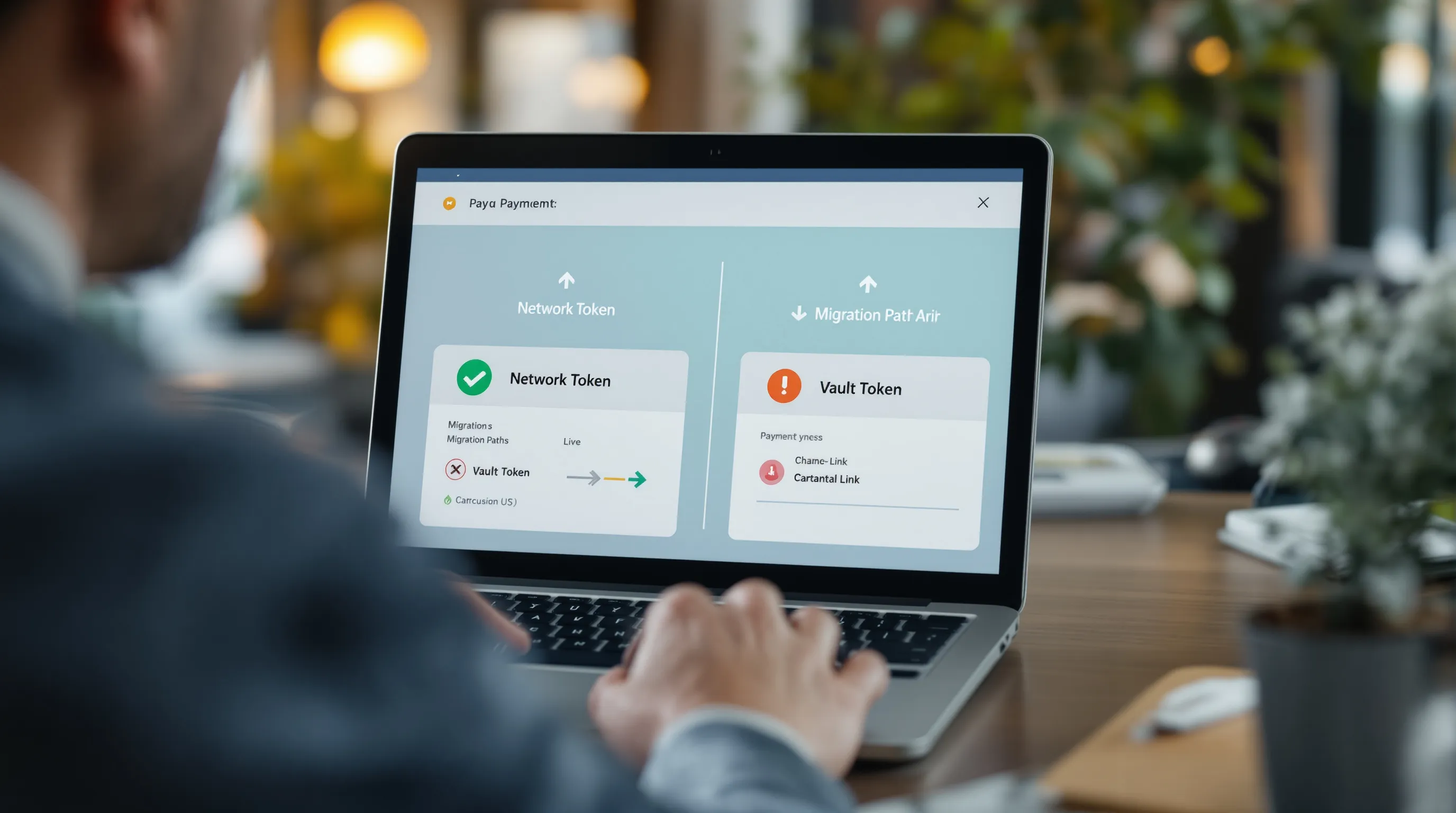
The Migration Moment: What Happens to Your Cards When Your Processor Drops You
The moment a processor terminates a high-risk subscription merchant, the billing engine faces an immediate crisis that most business owners did not anticipate when they first built their payment stack.
If the cards on file are stored as vault-hosted tokens, every single one of those tokens becomes nonfunctional the instant the account is closed. You cannot charge them. You cannot port them. They are internal identifiers tied to a relationship that no longer exists.
In my experience working with high-risk subscription merchants who contact SeamlessChex after a processor termination, roughly seven in ten businesses assume their card-on-file data is portable: their customers' payment credentials can simply be transferred to a new processor the way a contact list moves between CRM platforms. That assumption is wrong for almost every merchant running on a vault-hosted architecture, and it is one of the most expensive misconceptions in subscription commerce today.
Here is what actually happens at the migration moment under each architecture:
Vault-Hosted Token Migration: The Three Paths
When a processor holding vault-hosted tokens terminates your account, you face three options, none of them simple:
- Request a PAN data export from your former processor. Stripe, Braintree, and most large PSPs do have a formal data portability process. Stripe will transmit your raw PANs to a new processor, but the receiving processor must hold PCI DSS Level 1 or SAQ-D certification to accept the data. The timeline runs 14-45 business days in typical cases, assuming no disputes arise and the new processor is ready to receive. During that window, your subscription billing is frozen.
- Run a card re-engagement campaign. Ask your subscribers to re-enter their payment details. This is the option most merchants end up with when a PAN migration is too slow or the new processor cannot qualify for the data transfer. Industry data on involuntary churn suggests re-engagement campaigns recover roughly 40-60% of affected subscribers over a 30-90 day effort, meaning 40-60% of your card-on-file portfolio is gone permanently.
- Accept the revenue loss and rebuild. For some businesses, particularly those terminated during a high-chargeback period, neither path above is fast enough. The subscription cycle runs, the cards decline, and customers who do not re-engage are lost.
For a subscription business processing $50,000 per month in recurring revenue, a 15-25% card-on-file loss during a vault migration means $7,500 to $12,500 in permanently lost monthly billing, compounding across every month until those customers are replaced. This is not a hypothetical. It is the recurring pattern I see in businesses that arrive at SeamlessChex after a Stripe or PayPal termination with a partially intact customer base and a billing engine that stopped working overnight.
Network Token Migration: A More Survivable Path
Under a network token architecture, the migration path is meaningfully different. Because the token was issued by Visa or Mastercard (not by the terminated processor), the credential reference does not expire with the processor relationship. A new acquirer that participates in VTS or MDES can present the token reference to the card network and complete an authorization. The card network bridges the credential gap that would otherwise strand a vault-hosted portfolio.
This does not mean network token migration is frictionless: there is still an onboarding period, API reconfiguration, and coordination between the departing and arriving processors. But the card credentials themselves survive the transition, which is the critical difference. Merchants on network token architectures who migrate to a compatible acquirer retain the ability to bill their subscriber base without requiring customers to re-enter payment details.
Why High-Risk Subscription Merchants Face the Greatest Token Lock-In Risk
High-risk subscription merchants are disproportionately exposed to the vault token portability gap for two reasons that compound each other.
First, they are more likely to face involuntary processor terminations. High-risk verticals (nutraceuticals, GLP-1 and peptide sellers, online gaming, telemedicine, subscription box businesses with high refund rates) face elevated chargeback profiles and category restrictions at standard processors. A merchant processing $50,000 per month in a flagged vertical can be terminated with 30 days' notice or less. Stripe and PayPal in particular have tightened category enforcement since 2024, terminating subscription businesses at a rate that has driven significant volume toward dedicated high-risk processors.
Second, high-risk merchants overwhelmingly built their original payment stacks on the easiest-to-access processors, precisely because high-risk merchant account approval is harder to obtain. Stripe and PayPal accept most businesses at signup with no underwriting review. The merchant builds their subscription billing on that platform, accrues years of card-on-file data in a vault-hosted architecture, and then faces termination with a token portfolio they cannot move. As one Reddit commenter directly in the PaymentProcessing community noted: "Most processors don't give you the nice subscription stack - account updater, retries, proration - because they're focused on just keeping the card rails alive."
The combination (higher termination risk, larger reliance on vault-locked tokens, and less time to execute a clean PAN migration) means that high-risk subscription merchants bear the highest token lock-in cost in the payments ecosystem. The architecture decision made at the beginning of the business, often by a developer who simply used the first processor that approved them, becomes the decisive factor in whether the business survives an acquirer switch.
How to Audit Your Card-on-File Architecture Before You Need To
Most high-risk subscription merchants discover their tokenization architecture the hard way. The right time to audit is now, before a termination notice triggers a scramble. Here is how to determine what you actually have.
Step 1: Identify your token issuer
Look at how your current processor stores payment methods. If you are on Stripe, your saved payment methods appear as pm_ or legacy tok_ references in your Stripe dashboard. These are vault-hosted tokens: they are Stripe's internal identifiers. If you are on Braintree, look for payment method nonces or customer vault records. If the token is readable only inside your processor's dashboard and API, it is vault-hosted. It will not transfer.
If your processor has enabled Visa Token Service or Mastercard Digital Enablement Service on your account, you may see network token references alongside the payment method records. This is rare among standard commercial accounts and more common in enterprise integrations or with processors specifically built for recurring billing resilience.
Step 2: Ask your processor three direct questions
- "Are our stored payment methods vault-hosted tokens or network tokens?" Many processors will not volunteer this distinction. You have to ask directly.
- "If our account were terminated today, what is your PAN data export process and timeline?" The answer reveals how practical a migration would be under pressure. A 45-day timeline is very different from a 10-day one.
- "What PCI certification level does a receiving processor need to accept our card data?" PCI DSS Level 1 or SAQ-D compliance is the standard requirement. Not every new processor can qualify, which limits your options.
Step 3: Evaluate the Account Updater situation
If your cards are vault-hosted, check whether your processor includes Account Updater as part of your plan or charges for it separately. Stripe includes limited card update functionality, but it operates through Stripe's own network relationships (it does not give you network-level lifecycle management). If you are already seeing card decline rates above 8-10% annually, that is a signal your cards are decaying faster than your Account Updater is catching them.
Step 4: Assess your migration timeline risk
Consider how quickly your business could survive a billing freeze. Subscription businesses with monthly billing cycles face a 30-day window before the first missed cycle becomes visible to subscribers. Quarterly billed subscriptions have more runway. Annual billing contracts provide the most time to execute a migration. If your billing cycle is monthly and your card-on-file portfolio is entirely vault-hosted, your migration risk is acute: a 30-45 day PAN transfer timeline means at least one billing cycle fails before the new processor is live.
How SeamlessChex Supports Portable Credit Card Billing for High-Risk Merchants
SeamlessChex is a credit card processing and fintech payments platform built specifically for businesses that standard processors decline or terminate. For more than a decade, we have worked with subscription merchants in high-risk verticals (nutraceuticals, GLP-1 and peptide programs, online gaming, telemedicine, and high-volume recurring billing operations), helping them maintain uninterrupted credit card billing through acquirer transitions.
Our merchant accounts are designed for established businesses processing a minimum of $25,000 per month, and we prioritize recurring billing stability as a core feature of the relationship, not an afterthought. When a subscription business comes to us after a Stripe or PayPal termination, our onboarding team assesses the card-on-file architecture immediately to determine which migration path is viable.
For merchants migrating from vault-hosted architectures, we can coordinate directly with the departing processor on PAN data transfer to minimize the billing freeze window. Our goal is to get your recurring credit card billing live on our platform as quickly as the compliance requirements allow, with as little subscriber re-engagement burden as possible.
For merchants building new subscription billing operations, we advise on processor selection and tokenization architecture before the first card is stored, so that a future acquirer switch, if ever needed, does not strand the entire card-on-file portfolio. The architecture conversation belongs at the beginning of the merchant account relationship, not after a termination notice has been issued.
Businesses that process subscriptions and recurring billing at scale, across high-risk verticals, need a processor that understands the difference between a smooth migration and a catastrophic one. That understanding starts with knowing exactly what kind of tokens are sitting in your billing engine today.
What Will Matter Most in the Next 12-24 Months for Subscription Token Architecture
The card-on-file tokenization landscape is not static. Card networks, regulators, and major processors are actively reshaping the rules around how subscription payment credentials are stored, managed, and transferred. High-risk subscription merchants planning their payment infrastructure today need to understand where the regulatory and technical environment is heading, because the options available in 2027 will be meaningfully different from those available today.
Network Token Adoption Is Accelerating
Visa and Mastercard have both stated publicly that network tokenization is their preferred architecture for card-on-file and recurring billing transactions. Visa Token Service has expanded its merchant access programs, making network tokenization available through more acquiring partners than it was three years ago. Mastercard's Digital Enablement Service has followed a similar trajectory. The direction of travel is clear: network tokens are becoming the industry standard for recurring billing, particularly as card networks pursue higher authorization rates and lower fraud rates on card-not-present transactions, both of which network tokens demonstrably improve.
For high-risk subscription merchants, this shift is good news on the architecture question, but timing matters. Processors are adopting network tokenization at different rates. Some high-risk-specialized acquirers already offer network token support as part of their recurring billing stack. Others still operate entirely on vault-hosted architectures. When evaluating a new processor relationship, asking specifically whether the platform supports VTS and MDES network tokenization is now a meaningful part of the due diligence process.
Regulatory Pressure on Payment Data Portability Is Building
Open banking regulations in the European Union have established precedents for payment data portability that are influencing policy discussions in the United States and United Kingdom. While card-on-file tokenization is not directly covered by existing open banking frameworks, the direction of regulatory intent (that consumers and merchants should not be permanently locked into a provider by virtue of data custody) is increasingly relevant to the vault token portability question.
Stripe has responded to portability pressure by formalizing its PAN data export process. PayPal and Braintree have similar mechanisms. The practical barriers to PAN migration have not disappeared: PCI Level 1 compliance requirements at the receiving processor remain a genuine constraint, but the regulatory environment is moving toward making those barriers lower, not higher.
Chargeback Thresholds and Termination Risk Are Not Declining for High-Risk Merchants
The category enforcement environment at standard processors is not softening. Stripe's updated Restricted Businesses policy, PayPal's ongoing risk review programs, and Shopify's merchant category restrictions have all tightened since 2024. High-risk subscription merchants in nutraceutical, GLP-1, peptide, and online gaming verticals continue to face elevated termination risk regardless of their individual chargeback performance.
This means the migration risk that makes token portability important is not going away. If anything, it is intensifying. The businesses most likely to face an unplanned acquirer switch in the next 24 months are the same ones that built their original billing infrastructure on the easiest-to-access platforms, the ones with vault-locked token portfolios and no migration plan.
The Right Infrastructure Decision Is a Front-End Choice, Not a Recovery Choice
The businesses that navigate acquirer transitions smoothly are the ones that treated token architecture as an infrastructure decision at the beginning of the relationship (asking their processor what kind of tokens they issue, what the migration path looks like, and whether the platform supports network tokenization) rather than treating it as a recovery question after a termination notice has arrived.
In the next 12-24 months, as network token adoption continues to expand and regulatory pressure on data portability builds, the gap between merchants who asked those questions early and those who did not will become more visible. The subscriptions that keep billing uninterrupted through an acquirer switch will belong to the businesses that understood the architecture. The ones that lose 20% of their subscriber base during a vault migration will belong to the ones that assumed the tokens were portable.
Forecast: 12-24 months
Where Card-on-File Tokenization Is Headed
Three forecasts on how tokenized and vault-hosted card storage will evolve for high-risk subscription billing.
Card-on-File Forecasts for High-Risk Billing
Use these forecasts to weigh token portability, compliance cost, and approval speed when choosing a high-risk processor.
Buyer demand for fast-approval, contract-free high-risk processing will keep rising over the next 12-24 months as more subscription and recurring-billing businesses look for alternatives to the compliance burden of self-hosting card data.
Over the next 12-24 months, network-issued tokens (Visa, Mastercard, Amex) will increasingly replace gateway-locked vault tokens as the default mechanism for keeping recurring subscriptions charging through card expirations and reissues, because networks automatically refresh the token instead of requiring merchants to re-collect card data.
Despite the broader shift toward network tokenization, high-risk subscription merchants in restricted categories will keep depending on vault-hosted, gateway-specific tokens processed under an aggregator's own merchant ID rather than portable network tokens, because that MID structure is what makes high-risk approval possible in the first place.
Supporting and contrary evidence
Each forecast lists market evidence that supports it alongside sources that complicate the picture.
- Questions about Storing Credit Card info on website? is what puts this forecast on the board. [Community / Forum]Original poster (yeezusKeroro) is building a site for a client (a relative's friend) using MySQL/PHP, intending to store credit card info to charge users later. “I signed up for Reddit just so I could answer this question, because the responses I've seen were unnecessarily harsh and dismissive.”
- A Guide to Credit Card Tokenization is the strongest argument against it. [Video]Credit card tokenization replaces sensitive card data with a nonsensitive token that holds no relationship to the actual data and cannot be reversed to retrieve the original information. “None with named human attribution; content is narrated ad copy without an identified speaker/source beyond the Fortanix brand.”
- The case rests on Building the Tokenized Payments Stack: Securing Cards, Accounts. [Blog]Payment tokens are surrogate identifiers that replace sensitive data like PANs (Primary Account Numbers) and bank account numbers.
- Tokenization in Card Payments - A Guide for Developers and is what puts this forecast on the board. [Blog]Tokenization replaces a card's PAN (Primary Account Number) with a random non-sensitive token; the real PAN is stored in a secure vault managed by a payment provider, card network (Visa, Mastercard), or Token Service Provider (TSP). “Think of it like cloakroom tickets at a theater: you hand over your coat (the real card) and in return you get a token (a slip with a number).”
- The case rests on Learned the hard way that merchants can obtain your new card. [Community / Forum]Original poster (u/Capable_Tax_8220) deliberately let a debit card expire to avoid a streaming subscription, but was still charged on the new card and had to contact customer support for a refund and cancellation. “I feel like this should be illegal. Anyway, now you know.”
- Pushing back: How to manage subscriptions with high-risk processors. [Community / Forum]
- Customer requires some type of form they can add on the website to is the clearest counter-signal. [Community / Forum]If a website accepts, transmits, or even briefly stores card number/expiry/CVV, it falls into full PCI DSS scope under SAQ-D - described by multiple commenters as "expensive, complex and not realistic for most web shops"…
- How to manage subscriptions with high-risk processors is what puts this forecast on the board. [Community / Forum]
- Tokenization in Card Payments - A Guide for Developers and is the clearest counter-signal. [Blog]Example given: PAN 4242 4242 4242 4242 becomes token 4895 0010 0023 4567.
What could change these forecasts
Watch for shifts in card network rules or new high-risk processor entrants that could alter this outlook.
Our Margin for Error
Of everything here, 84 rests on the firmest ground, and 71 carries the most open questions.
- Demand grows for fast-approval, low-friction high-risk processing. That call weakens first if regulators or buyers move in the opposite direction.
- High-risk merchants stay on vault/aggregator tokens, not network tokens. That one becomes the more durable forecast if the source mix shifts toward stronger contrary evidence.
The gap between network tokens and vault-hosted tokens is not going to close on its own. Standard processors have no incentive to make their token architecture portable: their business model depends on the switching costs that vault lock-in creates. For high-risk subscription merchants, that means the portability question must be asked and answered before you build your billing operation on any platform, not after you receive a termination notice.
What I tell merchants who come to us after a Stripe or PayPal shutdown is this: the card-on-file situation is recoverable, but the timeline and the recovery rate depend almost entirely on the token architecture in place at the time of termination. Vault-hosted portfolios require PAN migrations, re-engagement campaigns, and revenue patience. Network token portfolios survive the transition with far less subscriber attrition.
SeamlessChex works with established subscription businesses processing $25,000 or more per month. We approve merchants that standard processors decline, and we support recurring credit card billing across high-risk verticals with the infrastructure stability those businesses require. If your billing operation is currently on a platform that could terminate your account (and for most high-risk subscription businesses, that risk is ongoing), the architecture conversation is worth having now, while you have time to act on it.
Written by
Jonathan Albert
Co-Founder, SeamlessChex
Jonathan Albert is Co-Founder of SeamlessChex, a credit card processing and fintech payments platform recognized on the Inc. 5000.
Connect on LinkedInSummarize This Article With AI
Open this article in your preferred AI engine for an instant summary.
Frequently Asked Questions
What happens to my Stripe card-on-file tokens if my account is terminated?
Stripe vault tokens become nonfunctional the moment your merchant account is closed. They are internal identifiers tied to Stripe's infrastructure: no other processor can use them to charge a card. Your options are: request a PAN data export from Stripe (requires the receiving processor to be PCI DSS Level 1 or SAQ-D compliant, typically takes 14-45 days), run a card re-engagement campaign asking subscribers to re-enter payment details, or accept the subscriber attrition. None of these options are instant, which is why auditing your token architecture before a termination is critical.
What is the difference between a network token and a processor vault token?
A network token is issued by Visa (Visa Token Service) or Mastercard (MDES) and is tied to the card credential itself, not to any specific processor. When you migrate to a new acquirer, the token credential can travel with you because it is managed at the card network level. A processor vault token is an internal identifier issued by your PSP (Stripe, Braintree, PayPal, etc.) that maps to a PAN stored in their proprietary vault. It carries no portability outside that processor's own system.
Can I migrate my card-on-file portfolio when switching high-risk processors?
Yes, but the process depends on your current token architecture. Network token portfolios migrate with significantly less friction: the credential reference travels to the new acquirer through the card network. Vault-hosted portfolios require a formal PAN data migration, which requires PCI Level 1 certification at the receiving processor and takes weeks under the best circumstances. During that window, subscription billing is frozen. Working with a processor that has experience in high-risk migrations shortens the timeline and reduces subscriber loss.
How do subscription businesses get approved for recurring billing merchant accounts?
Dedicated high-risk processors like SeamlessChex underwrite recurring billing accounts based on business history, processing volume, chargeback ratio, and vertical classification. The approval process is more rigorous than signing up with Stripe or PayPal, because it results in a stable, long-term merchant account rather than an aggregated arrangement that can be shut down without specific underwriting review. SeamlessChex works with established businesses processing $25,000 or more per month.
Does network tokenization cost more to implement?
Network tokenization requires more setup than vault-hosted tokenization. It needs API certification with the card networks and is typically accessed through a processor that has already built the integration, rather than being available as an open signup. The implementation overhead is higher, but for subscription businesses with large card-on-file portfolios, the portability and authorization rate advantages typically outweigh the setup complexity. The cost of losing 20% of a card portfolio during an unplanned migration is almost always larger than the cost of implementing network tokenization correctly from the start.
What is the best credit card processing option for high-risk subscription businesses in 2026?
High-risk subscription businesses need a dedicated merchant account with an acquirer that specializes in their vertical, not an aggregated account with a standard PSP that can terminate without industry-specific underwriting review. Key features to require: stable recurring billing support, Account Updater functionality, transparent chargeback management, and clarity on the token architecture in use. SeamlessChex provides credit card merchant accounts for high-risk subscription businesses operating across nutraceuticals, GLP-1 and peptide programs, online gaming, telemedicine, and other high-risk verticals.
SeamlessChex onboards established merchants; the practical minimum is $25,000 in monthly payment volume.