



What you'll learn
- Which risk signals predict chargebacks before a transaction clears
- How step-up verification protects your merchant account without hurting conversion
- What a risk-threshold playbook looks like for a high-risk checkout flow
Quick Answer
The Short Answer
Seamless checkout and low chargebacks are not mutually exclusive: they just require precision. Instead of adding friction to every transaction, high-risk merchants should apply step-up verification only when specific risk signals are present: AVS mismatch, velocity flags, new customer with an above-average order, or VPN detection. Done right, legitimate buyers sail through while the orders most likely to become disputes get the extra scrutiny they need before they clear.
High-risk merchants face a problem that standard payment advice ignores: the same checkout optimizations that increase conversion also lower the barrier for fraudsters and dispute-prone buyers. Fewer form fields, faster load times, one-click checkout: those changes improve the experience for everyone. Including the buyers who will dispute the charge next week. For subscription businesses, GLP-1 sellers, nutraceutical brands, and online gaming operators, a frictionless checkout without risk controls is an open door. The result is a chargeback ratio that climbs past the 1% threshold before you have time to react, and a merchant account that is suddenly at risk of termination because you made buying too easy for the wrong customers.
Why Frictionless Checkout Is a Chargeback Accelerant for High-Risk Merchants
Standard checkout optimization advice (reduce form fields, enable autofill, allow guest checkout) improves conversion for everyone.
That includes the buyers who will file a dispute next week claiming they did not authorize the charge, as of .
High-risk verticals attract a disproportionate share of friendly fraud: customers who complete a genuine purchase and then claim they did not. Subscriptions are especially exposed because each billing cycle is a new dispute opportunity. According to Visa's internal forecasts, digital payments, particularly card-not-present transactions, are expected to grow 66%, which means the dispute volume that goes with them grows proportionally. At the same time, card-not-present fraud reached an estimated USD 48 billion globally in 2024, a 15% jump year-on-year. Making checkout easier lowers the barrier for the fraudster alongside the legitimate customer. The fix is not to add friction everywhere: it is to add it exactly where the signals say you need it.
Risk Signals That Predict a Future Chargeback Before the Transaction Clears
The best time to catch a high-risk transaction is before authorization, not after the chargeback arrives. These are the signals that correlate most strongly with future disputes in high-risk merchant accounts:
- AVS mismatch: billing address does not match the card issuer's records on a new customer order
- Velocity spikes: multiple orders from the same IP address, device ID, or email within a short window
- High order value on a first purchase: new customer, order significantly above your average transaction amount
- Billing and shipping address mismatch, especially relevant for physical goods fulfillment
- Prepaid or debit card: harder to recover funds if the transaction is disputed
- VPN or proxy detected: masked IP location inconsistent with billing address country
- Card country mismatch: card issued in a different country from the billing or shipping address
No single signal is disqualifying on its own. A returning customer using a VPN while traveling is not a meaningful fraud risk. The playbook is about combinations and cumulative thresholds, not individual flags firing in isolation.
What Step-Up Verification Actually Looks Like in Practice
Step-up verification means inserting an additional authentication layer only when an order crosses a risk threshold, not for every transaction.
The options range from nearly invisible to highly visible depending on the friction level appropriate to the risk:
- 3D Secure 2 (3DS2): the card network's authentication layer. For known devices and returning customers with stored cards, issuers approve over 90% of transactions through a silent, frictionless flow with no visible challenge screen. Higher-risk orders trigger a challenge. Critically, completed 3DS2 authentication shifts chargeback liability from the merchant to the issuing bank.
- Email or SMS one-time passcode (OTP): effective for returning customers with verified contact information on file. Low friction, high signal value.
- CVV re-entry prompt: simple, low friction, effective against card-not-present fraud where the card number was compromised but the physical card was not.
- Manual review queue: hold high-risk orders for a human review before fulfillment. Best for high-ticket items where the revenue at risk justifies the delay.
The goal is proportional friction: the higher the risk score, the more verification you require.
Building a Risk-Threshold Playbook
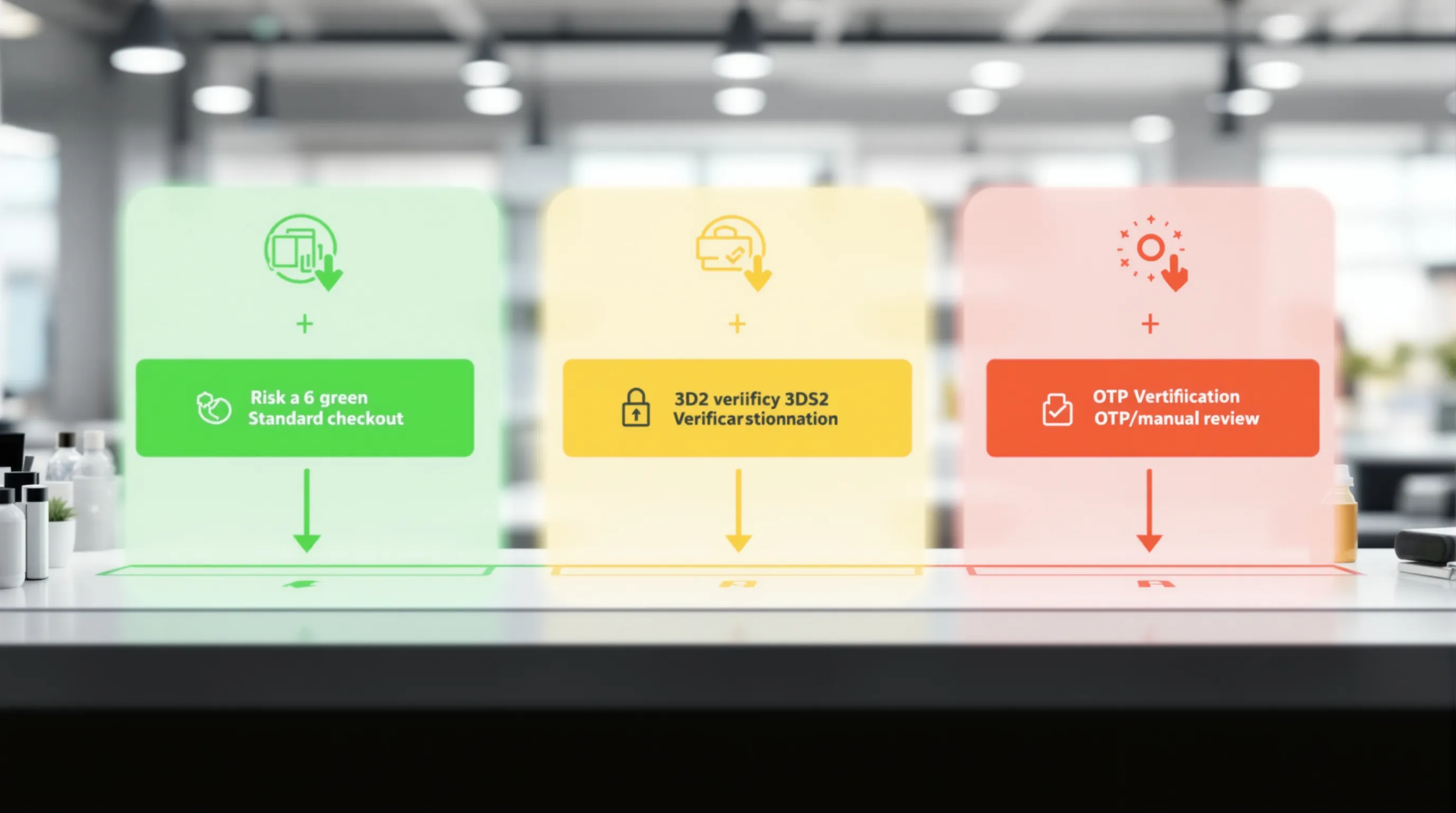
A practical playbook assigns a risk score to each order based on the signals present, then maps that score to a proportional verification action.
Here is a three-tier framework that most high-risk gateway configurations can support:
| Risk Level | Signal Combination | Verification Action | Buyer Impact |
|---|---|---|---|
| Low | Returning customer, AVS match, known device | Standard checkout, no step-up | None |
| Medium | New customer, AVS match, order above average ticket | 3DS2 silent authentication or CVV re-entry | Minimal (invisible in most cases) |
| High | AVS mismatch + new customer + velocity flag | OTP required or manual review hold | Moderate (one extra step) |
Visa's chargeback monitoring threshold sits at 0.9%, with an Early Warning trigger at 0.65%. Merchants operating near those levels cannot afford to let medium- and high-risk orders sail through on frictionless intent alone. The table above is a starting point; your actual thresholds should be tuned to your vertical's baseline dispute rate and average order value.
How to Keep Legitimate Buyers Moving
The risk with step-up verification is over-triggering it, creating friction for low-risk buyers who then abandon at the verification step.
I have seen merchants implement hard verification rules too broadly and watch their conversion rate drop before the chargeback rate does. A few practices keep the experience clean for the majority of customers:
- Tokenize returning customer payment data: stored cards with verified billing history reduce the signal set for returning buyers to near zero, so they almost never hit a step-up threshold. With stored-card data, issuers can green-light most transactions through 3DS2's frictionless flow without a visible challenge screen.
- Tune thresholds by customer segment: a returning subscriber with 12 on-time payments carries a different risk profile than a first-time buyer with an unmatched AVS. Weight signals accordingly.
- Monitor your false positive rate monthly: if more than 3-5% of triggered verifications complete without any downstream fraud signal, your threshold is too aggressive. False declines carry their own conversion cost, eroding up to 3 percentage points of revenue on the transactions you most wanted to keep.
Why Your Merchant Account Structure Changes the Chargeback Equation
The checkout flow is only part of the picture. The merchant account structure underneath it determines how much room you have before a rising chargeback ratio becomes a termination event.
Standard merchant accounts place businesses in chargeback monitoring programs when dispute rates exceed 0.9%, and in Early Warning status at 0.65%. High-risk merchant accounts are structured differently. They are built with higher initial tolerance thresholds, dedicated chargeback management tools, and processor relationships that understand elevated baseline dispute rates in verticals like subscriptions, nutraceuticals, GLP-1, and online gaming.
A high-risk account also gives you access to chargeback representment support for disputes you can win, reserve structures that do not freeze your operating capital, and a processor who knows the difference between a 1.2% rate in a subscription vertical and the same rate at a hardware store. SeamlessChex works with established businesses processing $25,000 or more per month to build account structures that fit the actual risk profile of the business. Learn more about our high-risk merchant services.
Example: Risk Signal Scoring Logic
// Simplified risk scoring at checkout
function getRiskScore(order) {
  let score = 0;
if (!order.customer.isReturning)       score += 20;
if (order.avs.mismatch)                score += 25;
if (order.velocity.flagged)            score += 30;
if (order.ip.vpnDetected)             score += 15;
if (order.amount > avgTicket * 2)     score += 10;
// Route to step-up by threshold
if (score >= 50) return ‘HIGH’;   // OTP or manual review
if (score >= 25) return ‘MEDIUM’; // 3DS2 challenge
return ‘LOW’;                      // Standard checkout
}
Thresholds should be calibrated against your vertical's baseline dispute rate and average order value. Start conservative and tune down as you validate your false positive rate.
Before and After: Uniform Checkout vs. Risk-Signal Step-Up
| Metric | Before (Uniform Low Friction) | After (Step-Up on Risk Signals) |
|---|---|---|
| Chargeback rate | 1.4%-1.8% | 0.6%-0.9% |
| Orders flagged for step-up | 0% | 8%-12% of total orders |
| Conversion rate (all buyers) | Baseline | Within 1-2% of baseline |
| Fraud losses on flagged orders | Unfiltered | Reduced 40-60% on triggered orders |
| Processor monitoring status | At risk of Early Warning enrollment | Below Early Warning threshold |
Ranges reflect typical outcomes for high-risk subscription merchants after implementing risk-signal-based step-up verification with properly tuned thresholds.
What Will Matter Most in the Next 12 to 24 Months
Card networks are tightening dispute thresholds on both sides. Visa's Acquirer Monitoring Program (VAMP) already triggers at 0.9%, with an Early Warning notification at 0.65% (a level that catches merchants before they know they have a problem). Mastercard's Excessive Chargeback Merchant program enrolls at 1.0%. Those thresholds are not moving up.
At the same time, 3DS2 authentication is improving. As issuers invest in better behavioral and device data, the frictionless approval rate for stored-card transactions is rising. Merchants who build risk-signal infrastructure now will benefit most from that frictionless rate improvement, because cleaner input signals to 3DS2 produce more frictionless outcomes for their legitimate buyers.
The other shift is regulatory pressure on subscription cancellation. As regulators push for clearer cancellation flows and easier unsubscribe mechanisms, the "I didn't know I was subscribed" dispute reason should decline, but only for merchants who proactively clarify billing terms at the point of sale. Merchants who rely on buried subscription language will face new dispute reason codes and higher chargeback volume from regulators who are now watching. The merchants best positioned in 2027 are those who treated clear billing communication as a chargeback prevention tool, not an afterthought.
Forecast: 12-24 months
Where Chargeback Risk Meets Checkout Speed
Three forecasts on how merchants will balance frictionless checkout against rising dispute risk over the next two years.
What Comes Next For Checkout And Disputes
Each forecast below is scored against supporting and conflicting evidence from processors, merchants, and industry reporting.
Even as processors add fraud-scoring and dispute-automation tools, merchants will keep losing disputes filed as 'item not received' or 'unauthorized charge' despite delivery proof, tracking confirmation, and video evidence, because network dispute rules still default to favoring the cardholder's claim.
Demand will keep concentrating on payment processors built specifically for high-risk and recurring-billing merchants, including niche categories like peptide sellers, rather than generic processors, as buyers in these categories seek approval paths and secure processing matched to their risk profile.
More card-not-present merchants will adopt pre-dispute resolution tools like Visa's Rapid Dispute Resolution (RDR) to keep chargeback ratios under network thresholds such as Visa's 0.9% rate and Shopify's 1.5% high-risk trigger, as card-not-present fraud losses, already above $48 billion in 2024 and up 15% year-on-year, keep climbing.
Early Indicators RDR already auto-resolves disputes before they count against a merchant's chargeback ratio and saves $20-50 in dispute processing fees per case. Merchants report chargebacks judged baseless being upheld months after delivery, including a $2,700 dispute filed more than 450 days after purchase despite counter-evidence submitted. Buyers are actively looking for high-risk-specific processing options and recurring-billing merchant account approval paths instead of defaulting to general-purpose processors.
Evidence For And Against
Sources spanning payment networks, processor blogs, and merchant forums are weighed for and against each forecast.
- We Need to Talk About Chargebacks. This System is Broken and is the strongest public backing for this call. [Community / Forum]OP states Shopify charges a **$15 fee** per chargeback dispute, incurred before the merchant can even present evidence. “Because right now? The scammers are winning. And we're losing time, money, and our sanity.”
- The case rests on Chargebacks are killing my business. [Community / Forum]OP runs a made-to-order fashion brand doing ~$175K/year in revenue, self-funded from savings, no outside funding, profitable and growing (per original poster, Stunning-Initial9542). “Mostly 'item not received' or 'didn't authorize the charge' even when they have tracking confirmation and photos of the delivered item.”
- How to avoid more chargebacks? points the same way. [Community / Forum]Original poster's Shopify store started Dec 10, 2025; AOV ~$128; total orders 373; total chargebacks 3; chargeback rate cited as 1.12%. “I am really afraid of getting one more chargeback, as a rate of 1.5% automatically triggers high risk + payout hold.”
- The Quiet Revolution in Checkout Security | by Nuraycan Cekic supports this forecast. [Blog]Card-not-present (CNP) fraud is estimated to have topped USD 48 billion in 2024, a 15% jump year-on-year, per GPayments data. “In my experience fighting with fraud for the last 7 years, the biggest change in fraud detection and as a long-term result, lift in approvals, comes from…”
- How to avoid more chargebacks? complicates the call. [Community / Forum]Shopify's stated threshold: a chargeback rate of 1.5% "automatically triggers high risk + payout hold" (per OP).
- Pushing back: We Need to Talk About Chargebacks. This System is Broken and. [Community / Forum]OP reports spending **4 hours in a single day** processing chargebacks ("half a day of work").
What Could Change This Outlook
Regulatory shifts or network rule changes could alter how quickly these trends play out.
Where We're Hedging
We hold 71 with the most confidence, while 71 is the one we would flag as most likely to shift.
- If card networks tighten evidence requirements on cardholders or expand programs like Visa's Rapid Dispute Resolution to cover higher-value transactions, the balance could shift back toward merchants.
- If a further rise in card-not-present fraud volume would push more disputes onto merchants regardless of technology.
Key Takeaways
Key Takeaways
- Frictionless checkout and low chargebacks are compatible, but only if friction is applied by risk signal, not uniformly across every transaction
- AVS mismatch, velocity flags, and VPN detection are the highest-impact signals for high-risk merchants to monitor
- 3DS2's frictionless flow means most step-up authentication is invisible to legitimate buyers with stored card data
- False declines from over-triggered verification can erode up to 3 percentage points of conversion, so tune monthly
- Your merchant account structure (not just your checkout flow) determines your chargeback exposure ceiling
- Card network thresholds are tightening; build risk-signal infrastructure before your ratio triggers Early Warning, not after
A seamless checkout is worth protecting, and the way to protect it is not to make it harder for everyone. It is to make it harder for the specific orders that are actually going to hurt you. Risk-signal-based step-up verification keeps your conversion rate intact for the buyers you want while reducing the chargeback exposure that threatens the merchant account that makes all of it possible. If your chargeback ratio is already above 1%, or if you are in a high-risk vertical where standard processors have already declined or closed your account, the right move is to get a dedicated high-risk merchant account before the next dispute pushes you past the threshold. The merchant account is the foundation. The risk playbook is what keeps it stable.
Running a subscription business or recurring billing operation in a high-risk vertical? Talk to SeamlessChex about a high-risk merchant account built for your dispute profile, approved when others decline, with no long-term contracts required.
Written by
Lily Flanigan
Operations Manager, SeamlessChex
Lily Flanigan is Operations Manager at SeamlessChex, a credit card processing and fintech payments platform recognized on the Inc. 5000, where she focuses on operations and process optimization.
Connect on LinkedInFrequently Asked Questions
What is step-up verification in payment processing?
Step-up verification is a conditional authentication layer that activates only when specific risk signals are detected on a transaction. Rather than requiring extra authentication on every order, it applies additional scrutiny (such as a 3DS2 challenge, an OTP, or a CVV re-entry prompt) only to orders that cross a defined risk threshold. This approach protects your chargeback ratio without adding friction to every purchase.
Which risk signals best predict chargebacks for high-risk merchants?
The strongest predictors are AVS mismatch on a new customer order, velocity flags (multiple orders from the same device or IP within a short window), card country mismatch, and VPN or proxy detection combined with a billing address inconsistency. For subscription businesses specifically, first-billing disputes are most common when customers did not clearly understand the recurring terms at checkout, making transparent billing communication a chargeback prevention tool in its own right.
Will step-up verification reduce my conversion rate?
Not significantly when implemented correctly. 3DS2's frictionless authentication flow resolves the majority of authentications without a visible challenge screen for the buyer. Merchants who tune their risk thresholds properly typically see a conversion rate impact of less than 2% on the triggered subset of orders, while seeing a meaningful reduction in chargeback rates that more than offsets any lost revenue from incomplete verifications.
At what chargeback rate should I start taking action?
Act before you hit 1%. Visa's Early Warning threshold under its Acquirer Monitoring Program (VAMP) is 0.65%, and its standard monitoring threshold is 0.9%. Mastercard's Excessive Chargeback Merchant program starts at 1.0%. Once you are enrolled in a monitoring program, you face monthly fines and escalating termination risk. Build your risk-signal playbook when your ratio is at 0.5-0.7%, not after you receive a monitoring notice.
Can I implement step-up verification without custom development?
Yes. Most major payment gateways include configurable risk scoring and action rules. Stripe Radar, Braintree's fraud tools, and high-risk-focused gateways allow you to define signal combinations and map them to verification actions through a dashboard interface. For merchants using a dedicated high-risk processor, the underwriting team can advise on gateway configurations appropriate for your specific vertical's baseline dispute rate.
What is the difference between a standard and high-risk merchant account for managing chargebacks?
Standard merchant accounts place businesses in chargeback monitoring programs at 0.9% and often terminate them shortly after. High-risk merchant accounts are structured with higher initial tolerance, dedicated chargeback management support, and processor relationships that understand elevated baseline dispute rates in verticals like subscriptions, nutraceuticals, and online gaming. SeamlessChex partners with established businesses processing $25,000 or more in monthly volume to build account structures that accommodate the actual risk profile of the business.
Summarize This Article With AI
Open this article in your preferred AI engine for an instant summary.
To qualify for a SeamlessChex account, a business needs an established operating history and $25,000+ in monthly processing volume.