


Key Points
- With all three documents submitted upfront, FFL approvals at a high-risk processor typically take 2-5 business days instead of 2-4 weeks.
- Type 01 (dealer) and Type 07 (manufacturer) are the most common FFL license types that clear standard high-risk card underwriting.
- Visa and Mastercard introduced MCC 5723 for firearms retailers in 2022, making documentation review the central underwriting step for FFL merchants.

Quick Answer
FFL dealers clear card underwriting fastest by submitting three documents together: a current copy of their ATF FFL license, a written age-verification and FFL-to-FFL transfer policy, and product page screenshots confirming no NFA or prohibited items are sold.
If you run an FFL dealership and you have applied for a credit card merchant account recently, there is a good chance the answer was no, or you are still waiting. The frustrating part is that many of those declines are not category rejections. The processor is not saying "we do not work with gun dealers." They are saying "we do not have enough information to approve this specific applicant."
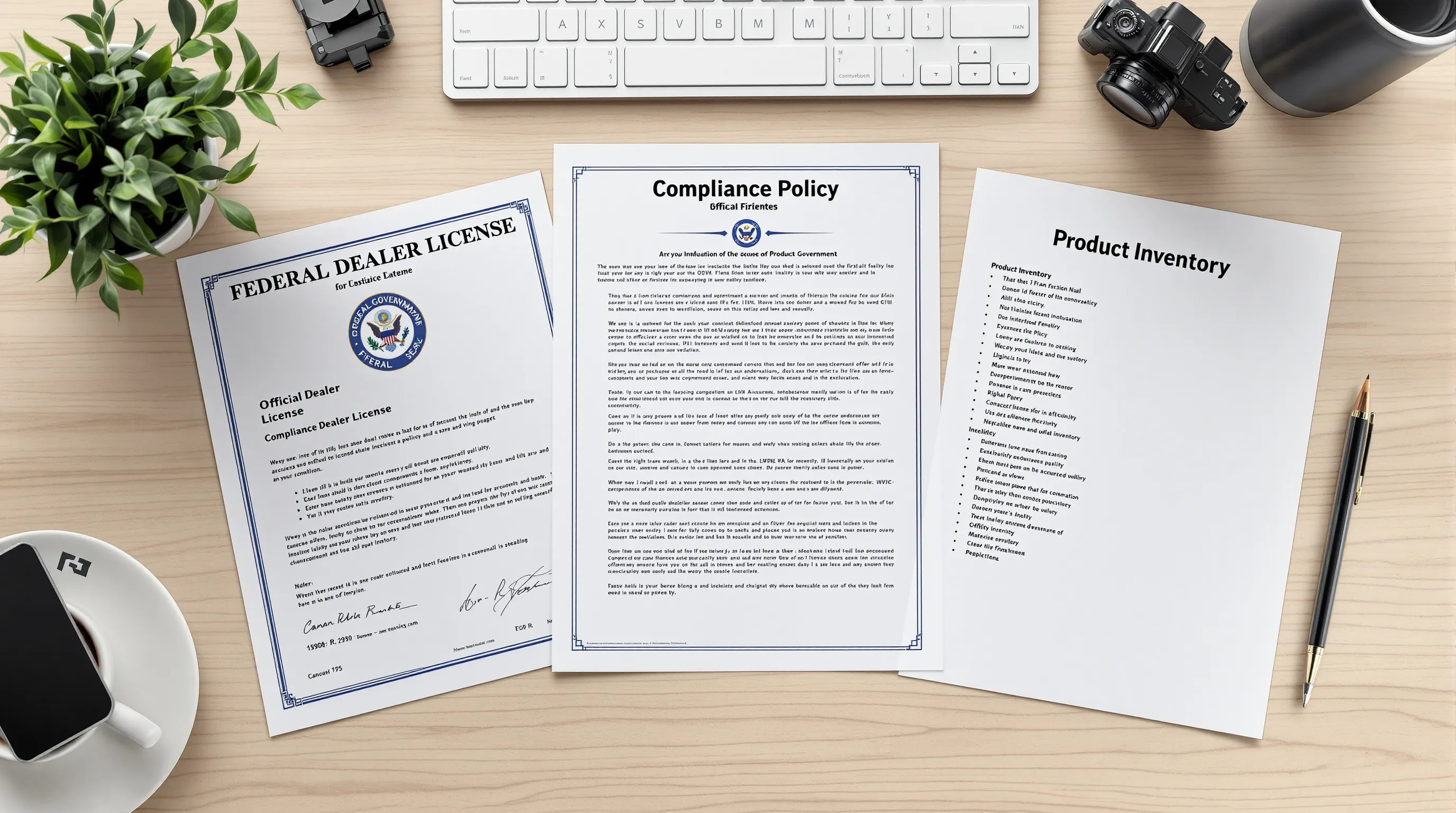
Three documents, submitted together at the start, resolve most of what underwriters are looking for. Here is what they are and exactly what to include in each.
Most FFL dealers who get declined for credit card processing are not declined because they are firearms dealers. They are declined because their application arrived incomplete. In my experience reviewing high-risk merchant applications, the gap between a fast approval and a frustrating back-and-forth almost always comes down to three specific documents. Submit all three upfront, and underwriting moves in days, not weeks.
Questions this article answers
- Why do most FFL dealer credit card applications get declined?
- What three documents do I need to get card processing approved as an FFL?
- How long does FFL payment processing underwriting take with complete documentation?
What Will Matter Most for FFL Card Processing in the Next 12-24 Months
Card network policies on firearms merchants have tightened since 2022, when Visa and Mastercard introduced merchant category code MCC 5723 specifically for firearms retailers. That shift did not close the door for FFLs, but it added a layer of documentation scrutiny that did not exist before.
Over the next 12 to 24 months, two trends are worth watching:
- Tighter policy enforcement at standard processors - large platforms are more likely to freeze or close FFL accounts without warning, making a dedicated high-risk processor the more stable long-term choice for any firearms dealer
- More upfront documentation requirements - the three-document set described here is already standard practice at specialized processors; annual FFL renewal confirmations and updated compliance policy attestations are becoming more common as part of ongoing account maintenance
Dealers who build the documentation habit now will find renewals and account maintenance easier as requirements increase. The compliance burden is not going away. Getting structured around it early is the practical advantage.
Our Outlook for 6-12 months
Where FFL Dealer-Card Document Rules Head Next
Three evidence-based forecasts on which paperwork will decide dealer-card approval speed over the next 6 to 12 months.
Forecasts For Dealer-Card Document Requirements
Use these forecasts to see which documents and state add-ons will most affect approval timing.
Over the next 6-12 months, more states will follow Illinois, California, and Colorado in requiring bank account details, Tax ID numbers, training certification, or extra permits before a dealer card is issued, even after federal FFL approval is complete.
The federal approval packet will remain anchored to ATF Form 7, fingerprints, a photograph, and the Responsible Person background check, with the 60-day statutory window and roughly 3-6 month real-world timeline holding steady through the horizon.
Even with tens of thousands of new licenses issued annually, the total active FFL count is likely to keep trending down or stay flat rather than recover to prior levels over the next 6-12 months.
Signals We're Still Testing Illinois now requires ACH bank routing/account details and completed Firearm Dealer License Certification Training before its state review even begins, on top of the federal FFL. ATF's active licensee count dropped from 135,550 in October 2017 to 128,690 despite issuing 43,956 new licenses in FY2024 alone. ATF's own process still centers on three physical items - the application form, a photograph, and fingerprints - per current applicant guidance.
Supporting And Contrary Evidence
Each forecast pairs the federal and state sources that back it with the sources that complicate it.
- FDLC - Checklist - Illinois State Police supports this forecast. [Government]“A residential dealer who is not open to the public, who conducts firearm transfers with individuals known to the dealer or who sets appointments for firearms…”
- Frequently Asked Questions | State of California points the same way. [Government]Dealers apply for the Centralized List via Application for Centralized List of Firearms Dealers (BOF 4080), submitted to DOJ. “None; the source is an FAQ/regulatory reference document with no individual speaker quotes.”
- Federal Firearm Licensee (FFL) Information supports this forecast. [Government]New FFLs must email a copy of their FFL license (with a clearly visible ATF seal) plus at least one business phone number to [email protected]. “Currently, Colorado Concealed Handgun permits do not constitute a valid ID for the purposes of the firearms background check.”
- Apply for a License - ATF is what puts this forecast on the board. [Government]Page carries a recent update timestamp (January 13, 2026), indicating this is ATF's current, active guidance rather than archival content. “None attributed to a named individual; all content is institutional/regulatory language issued by ATF.”
- How to Get an FFL | FFL License Requirements - Gearfire supports this forecast. [Industry Publication]ATF is required to act on a completed FFL application within 60 days of receipt. “Getting an FFL means completing the federal application, passing background checks, and meeting state and local law requirements.”
- How to get your FFL (It isn't that hard) is the strongest public backing for this call. [Video]Speaker holds an 06 FFL (manufacturer of small arms ammunition under 50 caliber, non-armor-piercing). “if you have questions about what you can and can't do contact the atf directly your your contact there”
- FFL License Facts, Figures, and Findings - Alien Gear Holsters supports this forecast. [Industry Publication]The Gun Control Act of 1968 (H.R. 17735) created the FFL system; ATF's Federal Firearms Licensing Center (FFLC) issues the licenses. “These licensees are allowed to ship firearms in interstate commerce among themselves, and are required to abide by State laws and local ordinances in their…”
- How to Get an FFL | FFL License Requirements - Gearfire points the same way. [Industry Publication]Most applicants spend three to six months total from preparation to license in hand, including state and local approvals.
What Could Change These Forecasts
These scenarios describe the real-world shifts that would push document and approval trends in a different direction.
Confidence, With Limits
Of everything here, 95 rests on the firmest ground, and 70 carries the most open questions.
- State agencies keep stacking financial and training documents on top of the federal FFL. That is the first forecast to break if the regulatory or buying picture flips.
- Total licensed dealers keep shrinking despite strong new-license issuance. Mounting evidence on the other side would move that one to the front.
Document 1: A Current Copy of Your FFL License
This one is straightforward, but a surprising number of applications arrive without it. Your Federal Firearms License, issued by the ATF, is what separates a legal FFL dealer from an unlicensed seller in an underwriter's eyes. Submit a clean, readable copy of the full license document - not just the license number typed into a form field.
What underwriters look for when they review it:
- Expiration date - a license expiring within three months will flag a review; if yours is close, submit proof of renewal alongside it
- License type - Type 01 (dealer) and Type 02 (pawnbroker) are the most common types and clear standard high-risk card underwriting; Type 07 (manufacturer) also qualifies; confirm the type on your license matches your described business activity
- Business name match - the name on the FFL must match the legal entity name on the processing application exactly
Processors that regularly work with FFLs will verify your license directly against the ATF's public database. Getting ahead of that check by including the document upfront cuts days off your approval timeline. I have seen applications stall for over a week over something as simple as an expired license the dealer had already renewed but forgot to resubmit.
Document 2: A Written Age-Verification and Transfer Policy
Underwriters approve or decline FFL merchants largely based on risk exposure. The two biggest red flags for firearms dealers are underage sales and direct-to-consumer firearms shipping - both federal violations.
A written policy that addresses both removes the underwriter's need to guess about your compliance posture.
This does not need to be a lengthy legal document. A single-page policy that covers these points is sufficient:
- Age verification at checkout - describe how you confirm buyers are 18+ for long guns or 21+ for handguns before processing payment
- FFL-to-FFL transfer requirement - state explicitly that firearms ship only to a licensed FFL dealer for local pickup, never direct to the end buyer
- Background check acknowledgment - note that all transfers go through a NICS check at the receiving FFL location
Processors see dozens of FFL applications monthly. The ones with a clear compliance policy move through underwriting in days rather than weeks. Without this document, every question gets answered by the underwriter's imagination, and that imagination tends to run toward worst-case scenarios.
Document 3: Product Page Screenshots Confirming Your Inventory
This is the document most FFL dealers overlook entirely, and it is often the one that makes the difference.
An underwriter reviewing a firearms application has one primary concern beyond compliance: are you selling items that cannot be cleared? NFA-regulated items and prohibited products create liability exposure that most payment processors will not accept.
Provide screenshots of your active product pages or a current inventory list that demonstrates:
- No suppressors or silencers listed for standard civilian sale
- No machine guns or fully automatic weapons available for civilian purchase
- No short-barrel rifles or short-barrel shotguns sold without proper NFA transfer documentation
- No items prohibited under 18 U.S.C. § 922
If you do sell NFA-regulated items through proper legal channels, include documentation of your SOT (Special Occupational Taxpayer) designation. SOT has three classes: Class 1 (import and deal NFA items), Class 2 (manufacture and deal NFA items), and Class 3 (deal NFA items only). That documentation actually flips the risk signal in your favor: it shows you are operating within a tightly regulated framework. Most standard FFL dealers do not sell NFA items, so a clean product screenshot is usually all that is needed.
The pattern we see consistently: FFL dealers who submit all three documents with their initial application are approved significantly faster than those who wait for the underwriter to request each piece individually. If you are ready to apply for a firearms merchant account, contact SeamlessChex to start the process with the right documentation from the beginning. SeamlessChex works with established businesses processing a minimum of $25,000 per month.
Written by
Lily Flanigan
Operations Manager, SeamlessChex
Lily Flanigan is Operations Manager at SeamlessChex, a credit card processing and fintech payments platform recognized on the Inc. 5000, where she focuses on operations and process optimization.
Connect on LinkedInSummarize This Article With AI
Open this article in your preferred AI engine for an instant summary.
Frequently Asked Questions
Do all credit card processors decline FFL dealers?
No. Standard processors like Stripe often restrict or close FFL accounts, but high-risk payment processors that specialize in firearms merchants can approve licensed dealers. The key is applying to the right processor with complete documentation.
How long does FFL card processing approval take?
With all three required documents submitted upfront, FFL approvals typically take two to five business days. Incomplete applications that require back-and-forth document requests can take two to four weeks.
Do I need a special license to sell firearms and accept credit cards?
Your standard FFL license is sufficient for most dealers. The credit card processor verifies your FFL directly with the ATF's public database as part of standard underwriting. No additional federal license is required for standard retail card acceptance.
What if my FFL is close to expiration?
Submit proof of renewal alongside your current license. Most underwriters will flag a license expiring within 90 days. Renewing early and including both documents in your application removes this concern entirely.
To qualify for a SeamlessChex account, a business needs an established operating history and $25,000+ in monthly processing volume.