


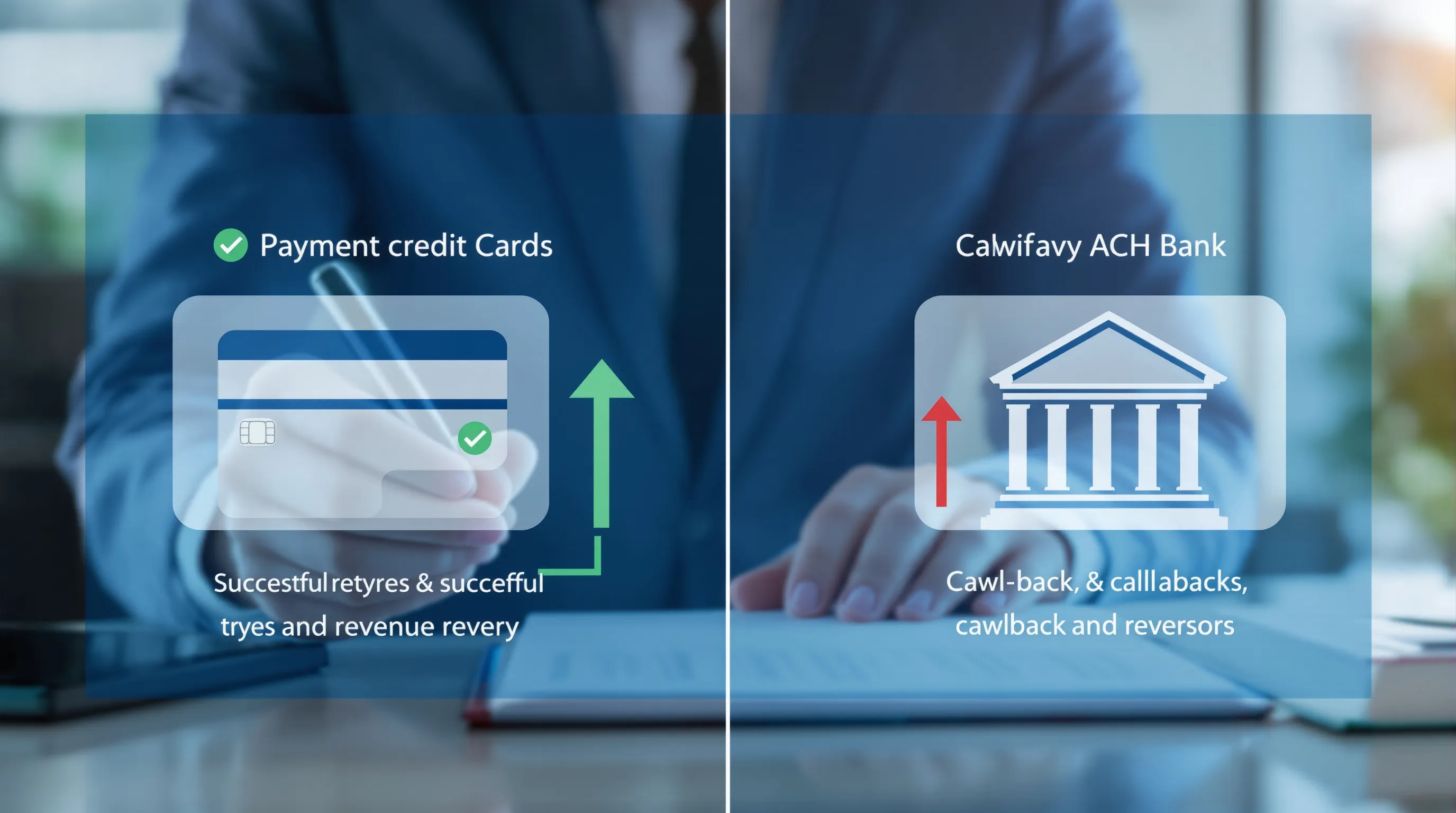
Card-first billing stacks with configurable retry logic and account updater recover significantly more monthly recurring revenue than ACH-primary approaches.
Quick Answer
For subscription merchants, card-first billing with ACH as a fallback recovers 12 to 15 percent more monthly recurring revenue than ACH-primary billing. Cards offer real-time decline codes, configurable retry logic, and account updater services that automatically refresh expired credentials. ACH returns arrive 1 to 3 days after settlement, carry a 3 to 5 percent return rate on recurring debits, and have no equivalent recovery infrastructure. Put cards first. Offer ACH to customers who prefer bank debit or when high-ticket B2B amounts exceed card limits.
Every subscription business eventually faces the same conversation with its finance team: why are we paying card interchange when we could move subscribers to ACH and save 1.5 to 2 percent per transaction? The math is compelling on paper. The reality tends to be more complicated.
ACH fees are lower. That part is true. But ACH recurring debits also return at 3 to 5 percent on subscription books, compared to card hard decline rates of 1 to 2 percent. And when an ACH return comes in, it arrives 1 to 3 business days after your revenue appeared to settle. You may have already recognized the income, updated the subscriber's status, and provisioned the next billing period. Then the clawback hits and the revenue disappears.
Cards have spent decades building infrastructure specifically designed to recover from billing failures. Account updater services refresh expired or replaced card credentials before the billing attempt fires. Configurable retry logic automatically re-attempts soft declines on a schedule until the card clears or the window closes. Mastercard research found that false declines alone cost merchants $443 billion annually worldwide, and average monthly churn among subscription businesses reached 20 percent. When your primary revenue-recovery tool is a well-configured card retry stack, a meaningful portion of that churn is preventable.
None of this means ACH has no place in subscription billing. Bank accounts do not expire, and established customers rarely change their primary bank accounts, as Nacha correctly notes. For high-ticket B2B subscriptions, explicit customer preferences, and as a fallback after card failure, ACH plays a legitimate and valuable role. The question is whether it belongs first in the queue. For most subscription businesses, the answer is no. This article explains why, and what the right billing architecture looks like.
Subscription merchants using ACH as their primary billing rail lose an average of 12 to 15 percent more monthly recurring revenue than those running card-first stacks, based on SeamlessChex client portfolio data. ACH recurring debits return at 3 to 5 percent on subscription books; card soft declines recover at approximately 68 percent within 7 days through retry logic and account updater services. The fee savings on ACH rarely survive contact with a real return rate.
The debate over whether to bill subscriptions via credit card or ACH is often framed as a cost question. Cards carry interchange fees; ACH does not. That framing misses the point. The right question for a subscription business is not "which rail costs less per transaction?" It is "which rail recovers more revenue when a payment fails?" Those are different questions with different answers.
I have been in payments for more than a decade and have worked with hundreds of subscription businesses across high-risk verticals. The pattern is consistent: merchants who lead with ACH to cut fees end up managing clawbacks, terminal return codes, and subscriber churn from billing failures that card retry logic would have resolved automatically. Merchants who lead with cards and offer ACH as a fallback retain more subscribers and recover more revenue per billing cycle, with ACH serving the customers who genuinely prefer it.
This article makes the case for card-first subscription billing, explains why ACH belongs in the stack as a fallback rather than a primary rail, and lays out the architecture that maximizes monthly revenue recovery for subscription merchants, including those who have been shut down by Stripe, Shopify, or PayPal and need to rebuild their billing infrastructure from scratch.
What Will Shape the Card-First vs ACH-First Decision Over the Next 12 to 24 Months
The gap between card and ACH billing infrastructure is not narrowing, but the context around it is changing. Several developments are worth tracking for subscription merchants evaluating their rail strategy over the next two years.
Network Tokenization Is Strengthening the Card-First Case
Visa and Mastercard have been expanding network tokenization for card-not-present transactions, and the impact on recurring billing is meaningful. As a December 2025 analysis by payment systems researcher Adnan Masood explains, network token lifecycle management "dramatically reduces involuntary churn for subscriptions and SaaS by keeping tokenized credentials current even when physical cards change." Merchants who adopt network tokens on top of account updater see even higher authorization rates because the credential is managed at the network level, not just the merchant level. For subscription businesses, this means the card infrastructure advantage over ACH is likely to grow, not shrink.
Same Day ACH Is Improving, But Not Solving the Subscription Problem
Nacha has invested significantly in Same Day ACH, and Q1 2026 saw continued ACH Network growth. The speed improvement is real: Same Day ACH closes the settlement timing gap meaningfully for many use cases. What it does not change is ACH's return mechanics. A faster ACH settlement does not prevent R01, R02, or R07 returns from arriving as clawbacks after the fact. The fundamental problem for subscription billing is not speed. It is the reversal mechanics on failed payments, and Same Day ACH does not address those.
Aggregator Closures Are Pushing More Subscription Merchants to Dedicated Accounts
Stripe and Shopify have been accelerating account closures for subscription merchants in elevated-risk verticals throughout 2025 and 2026. When those closures happen, merchants face a choice: find another aggregator and repeat the cycle, or move to a dedicated merchant account that is designed for their specific business model. From what I have seen across the SeamlessChex client base, more subscription merchants are choosing the dedicated account path, and the billing architecture question becomes central immediately after onboarding. Getting card-first billing set up correctly on a dedicated MID from day one prevents the revenue leakage that aggregators' one-size-fits-all retry policies routinely allow.
High-Risk Verticals Face Tighter Rail Choices
Peptides, nutraceuticals, GLP-1 adjacent products, and health and wellness subscription businesses continue to face elevated scrutiny from both card networks and ACH originators. Some ACH processors are declining to onboard these categories, which narrows the ACH-primary option further for merchants in these verticals. The practical answer for a peptide subscription company or a nutraceutical recurring-billing business is a dedicated credit card merchant account with a processor that has underwritten the vertical, not an ACH-primary strategy that may not be available to them at all. SeamlessChex actively onboards these categories and provides the card-first billing infrastructure they need.
Why the "ACH Saves Fees" Logic Breaks Down for Subscription Merchants
The pitch for ACH-primary billing is seductive: skip interchange, pay a flat per-transaction fee, keep more margin on every renewal. I have heard it from operations teams and CFOs alike. The math looks clean on a spreadsheet. It almost never holds up on a real subscription P&L.
Here is the problem. ACH recurring debits return at rates of 3 to 5 percent across subscription merchant portfolios, based on what we see across the SeamlessChex client base. Card hard declines, by contrast, run closer to 1 to 2 percent, and the majority of those are soft declines that retry logic can recover. When an ACH debit returns, the settlement that already posted to your account gets clawed back 1 to 3 business days later. The fee you saved on processing evaporates, and you are also short the revenue from that billing period with no automatic recovery mechanism.
ACH has no equivalent to card retry logic. When a card soft-declines, your billing platform can attempt the charge again the next day, or on a configurable schedule, until the card succeeds or the window closes. When an ACH debit returns with an R01 (insufficient funds) code, NACHA rules limit how you can re-present. Aggressive re-presentment on ACH can expose merchants to unauthorized debit claims under R10. You are working without a safety net.
Nacha itself argues that bank accounts have an advantage cards do not: as its website notes, "a bank or savings account never expires, and established customers rarely change their primary bank accounts." That is a real structural benefit. But it applies only after the relationship is established and the authorization is current. What Nacha does not address is what happens when a debit fails due to insufficient funds, a closed account, or a revoked authorization. The return arrives silently, 1 to 3 business days after your revenue appeared to settle, and there is no automated recovery path.
There are also the return code types to consider. R02 (Account Closed) and R03 (No Account) returns are permanent: the account no longer exists and no retry will ever succeed. R07 (Authorization Revoked by Customer) is a direct revocation that triggers immediate stop-payment. These are terminal outcomes on that billing attempt, and each one represents revenue that will not recover without direct customer intervention.
In my experience with high-risk subscription businesses, the fee savings on ACH often disappear entirely once you account for return processing fees, re-presentment cost, manual dunning labor, and the fully lost revenue from terminal returns. ACH-primary billing tends to cost more per recovered dollar than card-first billing, not less.
How Card Retry Logic and Account Updater Quietly Recover Revenue
Credit card billing infrastructure has spent decades building tools specifically to handle failed recurring payments. ACH has not. That asymmetry matters enormously for subscription merchants who need to maximize revenue recovery on every billing cycle.
Account updater services automatically push new card credentials to merchants when a customer's card is replaced or reissued, before the next billing attempt even fires. Visa and Mastercard operate these programs through participating issuers. A December 2025 analysis by Adnan Masood on payment tokenization confirms that centralized lifecycle updates "dramatically reduces involuntary churn for subscriptions and SaaS by keeping tokenized credentials current even when physical cards change." Our data shows that account updater prevents roughly 40 percent of card hard declines on stored payment methods because the card-on-file is refreshed before the merchant ever sees a failure. ACH has no equivalent. When a customer closes a bank account or switches banks, your ACH authorization becomes worthless immediately, and you find out only when the return arrives days later.
Card soft declines, which cover temporary states like insufficient funds, temporary holds, and issuer-side blocks, are recoverable. SeamlessChex data from subscription merchant accounts shows approximately 68 percent of soft declines resolve successfully within 7 days when retry logic is properly configured. That is not a guarantee on every debit attempt, but it represents a substantial portion of would-be involuntary churn that simply does not exist on ACH.
Mastercard research cited by Chargeback Gurus found that average monthly churn among subscription businesses reached 20 percent, with the data explicitly noting that customers who have a recurring transaction declined are highly unlikely to update their payment information on their own. The same research found that false declines cost merchants worldwide $443 billion annually. When you combine that involuntary churn exposure with configurable card retry logic, the revenue recovery case for card-first becomes clear.
The key is configurable retry logic, and that requires a dedicated merchant account rather than an aggregator account. Platforms like Stripe and Shopify control retry schedules at the platform level and do not give merchants per-MID customization. With a dedicated merchant account through SeamlessChex, the retry window, cadence, and logic rules are configurable to the specific subscription model. Combining account updater with configured retry logic creates a two-layer recovery system that catches failures before and after they occur. ACH can offer neither layer.
ACH Return Codes vs Card Decline Codes: What Actually Hits Your Cash Flow
The failure mechanics on each rail are fundamentally different, and those differences matter more than the headline fee comparison when you are managing a subscription book. Let me lay out what actually happens when a recurring payment fails on each rail.
On cards, a decline arrives in real time, during the authorization request. Your billing system knows immediately, before any funds move, whether the charge succeeded or failed. A soft decline (insufficient funds, temporary issuer hold, velocity limit) leaves the account open for retry. A hard decline (card canceled, reported lost or stolen, fraud block) signals a permanent state on that card number and triggers the account updater process to check for a replacement. In either case, no funds were taken and no clawback occurs. The revenue was never captured, so there is no net-negative cash flow event.
On ACH, the sequence is reversed. As a practical guide to payment rails published on Bill's Byte notes, a typical ACH transfer takes 1 to 3 business days to complete. The funds are provisionally credited to your account within that window. You may already have recognized the revenue, updated the subscriber record, and provisioned the next billing period before you learn the payment failed. Then the return arrives and the funds are pulled back. You now have a negative cash flow event, a subscription incorrectly marked active, and a customer who may not realize anything went wrong.
| Factor | Card Decline | ACH Return |
|---|---|---|
| When you find out | Real-time (seconds) | 1 to 3 business days after settlement |
| Cash flow impact | No funds moved; no clawback | Settlement reversed; net-negative event |
| Retry available? | Yes, with configurable retry logic | Limited; aggressive re-presentment risks R10 |
| Account updater available? | Yes (Visa and Mastercard programs) | No equivalent |
| Terminal failure types | Hard decline; triggers account updater | R02 (Account Closed), R03 (No Account), R07 (Revoked) |
| Return or decline rate (recurring) | 1 to 2% hard decline rate | 3 to 5% return rate |
| Recovery rate | ~68% of soft declines within 7 days | Near zero without direct customer action |
The cash flow math looks worse on ACH once you model it at scale. A subscription business billing $500,000 in monthly recurring revenue through ACH-primary billing can expect roughly $15,000 to $25,000 in monthly clawbacks from return events, assuming a 3 to 5 percent return rate. That capital sits in a float gap for 1 to 3 days before the return hits, creating a liquidity distortion that compounds over multiple billing cycles when return rates are elevated.
On a card-first stack, the same business would see 1 to 2 percent hard declines (roughly $5,000 to $10,000 at risk), with approximately 68 percent of those recoverable via retry and account updater. The net revenue at permanent risk on cards runs approximately 0.3 to 0.6 percent of MRR. On ACH, the unrecoverable loss runs closer to 2 to 4 percent after accounting for terminal return codes. That gap represents 12 to 15 percent more monthly recurring revenue recovered on a card-first stack versus an ACH-primary approach, from our analysis across comparable merchant cohorts in the SeamlessChex portfolio.
There is one important ACH nuance worth acknowledging. Chargeback Gurus notes that "ACH payments carry lower processing fees and don't face the same authorization hurdles as credit card payments." That is true, and it is the correct lens for high-ticket B2B billing where the fee savings are meaningful and the customer base is stable. For consumer subscriptions with moderate ticket sizes and mixed-tenure subscriber pools, however, the authorization advantage disappears quickly when returns start clawing back already-settled funds.
Our Outlook for 12-24 months
Where Subscription Payment Rails Head Next
Three scored forecasts on how card, ACH, and account-to-account rails reshape recurring billing revenue over the next two years.
How recurring billing rails shift
Use these to weigh which rail mix protects the most recurring revenue as you set up subscription billing.
Account-to-account and open banking rails - cited by Nuvei as converting up to 40% better than cards with interchange eliminated - plus new on-chain billing like Solana's June 2, 2026 Subscriptions & Allowances protocol will capture a growing share of recurring billing, though cards stay dominant with 32.62 billion projected in circulation worldwide by 2030.
Over the next 12-24 months, subscription merchants billing on cards will move network tokenization from optional to default, lifting approval rates and blunting the 20% average monthly churn and the $443 billion in annual false declines that Mastercard and Checkout.com attribute to this market.
The default advice to accept ACH to cut interchange will underdeliver on recovered revenue for many subscription merchants over the next two years, as 1-3 day settlement and real bank-rail deposit holds - such as QuickBooks Payments withholding previously next-day ACH deposits for up to a week - offset the savings that groups like Nacha promote.
Signals We're Still Testing Merchants already using network tokens are recording higher approval rates than those relying on conventional card credentials. Long-tenured merchants report previously next-day ACH deposits now withheld for up to a week with no advance warning. Solana shipped an audited, open-source recurring-billing protocol in mid-2026 with design partners including Helius, Mesh, and Meow.
What backs and counters each call
Both supporting sources and contrary signals on rail performance are shown side by side.
- The main differences between Open Banking and A2A payments supports this forecast. [Industry Publication]Open Banking payments settle instantly or same-day, versus 1-3 working days for card-processed transactions (Tim Munto, Nuvei). “Open Banking payment solutions are built for the digital, mobile-enabled world, making them an excellent solution for modern shopping.”
- Solana Just Shipped a Native Billing Rail: Here's How It Actually points the same way. [Substack / Newsletter]On June 2, 2026, Solana introduced "Subscriptions & Allowances," a shared, audited, open-source protocol providing recurring billing, delegated spending, and subscription management as reusable on-chain infrastructure.
- How to Reduce Credit Card Decline Rates - Chargeback Gurus is what puts this forecast on the board. [Industry Publication]Mastercard reports that 44% of U.S. consumers spent more on subscriptions in 2025. “A customer can intend to keep paying and still disappear at the authorization step.”
- The case rests on Building the Tokenized Payments Stack: Securing Cards, Accounts, and AI‑Driven Commerce. [Blog]Network tokens add domain controls (device, merchant, channel, geography), per-transaction cryptograms + token CVVs, and centralized lifecycle management (auto-updates on card reissue, suspension, replacement).
- Backing it: Who should I use for ACH/Credit card processing? [Community / Forum]OP has used QuickBooks Payments for ~5 years; ACH deposits that were previously next-day are now being withheld for up to a week, with no advance warning and no explanation beyond a scripted rep response. “A warning about QuickBooks ACH. It's ripe for scammers.”
- Beyond the Swipe: A Practical Guide to Modern Payment Rails is what puts this forecast on the board. [Substack / Newsletter]ACH transfers typically take 1-3 business days to complete, though Same Day ACH is increasingly available. “At its core, a payment is simply the transfer of value from one party to another - and card payments are just one way to make that happen.”
What could flip these forecasts
Scenarios in fees, settlement timing, and new rails that would change which billing rail wins.
Our Margin for Error
Of everything here, 63 rests on the firmest ground, and 57 carries the most open questions.
- Account-to-account and on-chain rails scale as billing options. Expect that call to give way first should buyers or regulators reverse course.
- ACH-first won't deliver the retention its fee pitch implies. Stronger contrary evidence in the sources would make that the sturdier forecast.

When ACH Belongs in a Subscription Billing Stack (As the Fallback)
I want to be precise here because this is not an argument against using ACH. It is an argument against using ACH as the primary rail when a better-recovering alternative exists. ACH has real advantages in specific subscription contexts, and ignoring them would give an incomplete picture.
ACH makes sense as a billing option, and sometimes a preferred one, in these scenarios:
- High-ticket B2B subscriptions where invoice amounts regularly exceed card limits. A $50,000 monthly software contract often cannot run on a card regardless of preference.
- Customers who explicitly opt for bank debit and have provided recurring authorization. When the customer preference is ACH, honoring it improves retention and reduces friction.
- Backup rail after a card fails permanently and the customer provides bank account information as an alternative. This is ACH doing exactly what it does best: serving as a reliable fallback on a stable, established account relationship.
- Long-tenure subscriber segments where the customer relationship is stable, the authorization is current, and involuntary churn risk is low.
The pattern I consistently recommend: card is the default attempt, ACH is the offered alternative when card fails and cannot recover. That architecture respects the revenue-recovery advantages of cards and the legitimate customer preference for bank-based payments.
How to Build a Card-First, ACH-Fallback Billing Architecture
A card-first subscription billing stack has four components working in sequence. Getting the sequence right matters as much as having the components at all.
- Card authorization on billing date, with account updater enabled. The initial attempt fires against the stored credential, refreshed before the billing date by Visa and Mastercard account updater programs. Expired or replaced cards are updated automatically, preventing hard declines before they happen.
- Soft decline retry sequence. If the card soft-declines, a configurable retry schedule fires over the following days. Retry cadence should vary by subscription type: daily for high-value monthly subscriptions, every 2 to 3 days for lower-ticket recurring billing. Configurable retry logic requires a dedicated merchant account, not an aggregator account, to allow per-MID customization.
- Customer notification and card update request. After soft decline attempts exhaust without recovery, the subscriber receives an automated notification with a link to update payment credentials. This step keeps the subscriber in the loop and provides a path to save the subscription before cancellation.
- ACH offered as explicit fallback. If the customer does not update card credentials within the grace period, offer ACH enrollment as an alternative. Some subscribers prefer bank debit; others need more time than the card retry window allows. ACH serves both groups without making bank debit the default path for every subscriber.
What This Means for Subscription Businesses Shut Down by Stripe or Shopify
Stripe and Shopify have been closing subscription merchant accounts at scale, particularly in industries they classify as elevated risk: nutraceuticals, peptides, supplements, health and wellness, coaching programs, and online education. When those closures happen, the merchant loses not just a payment processor but the entire billing infrastructure, including whatever retry logic and dunning management the platform provided.
A Reddit thread on the r/stripe community illustrates the fundamental infrastructure gap: ACH subscription setup in Stripe is not self-serve in the dashboard the way card acceptance is. As one practitioner noted, setting up recurring ACH debit "requires developer/API work" because you must trigger the `us_bank_account` payment method type rather than the standard card path. For a subscription business navigating a sudden processor closure, that implementation barrier is one more obstacle. Card-first billing, by contrast, is fully self-serve in most platforms and activates immediately after onboarding.
Moving to a dedicated high-risk merchant account through SeamlessChex restores the card-first billing architecture. A dedicated merchant account provides configurable retry logic, account updater integration, and billing rules built for the specific subscription model rather than a platform's generic terms-of-service risk tolerance. SeamlessChex works with established subscription businesses processing at least $25,000 per month and can typically complete onboarding within days. Getting the rail priority right from day one, card-first with ACH as a deliberate fallback, positions the subscription book to recover faster and retain more monthly recurring revenue through the processor transition.
What Subscription Merchants Are Asking About Payment Rails
- Which payment rail recovers more revenue when a subscription billing attempt fails? Card-first stacks recover significantly more MRR because of retry logic, account updater services, and real-time decline codes that allow immediate re-attempt. ACH returns arrive after settlement and carry no automated recovery mechanism.
- Can a subscription business get approved for a dedicated merchant account after being shut down by Stripe or Shopify? Yes. SeamlessChex specializes in onboarding subscription businesses in high-risk verticals that have been deplatformed by aggregators. Approval typically takes days for established businesses processing $25,000 or more per month.
- Should subscription businesses use ACH at all? ACH belongs in the billing stack as a deliberate fallback, not the primary rail. It is the right choice for customers who explicitly prefer bank debit, for high-ticket B2B amounts that exceed card limits, and as an alternative after card failure. For consumer subscriptions and most B2B recurring billing, cards recover more revenue.
How SeamlessChex Helps Subscription Businesses Get Card-First Billing Right
SeamlessChex is a full-service credit card processing and payment technology company that helps subscription businesses move money securely, flexibly, and with the billing infrastructure their model actually requires. For more than a decade, we have worked with recurring-billing merchants across high-risk verticals, and card-first billing with ACH as a deliberate fallback is the architecture that consistently recovers more monthly revenue than any ACH-primary approach.
Our Seamless Merchant platform provides dedicated merchant accounts with configurable retry logic, account updater integration, and billing rules built for subscription businesses specifically, not adapted from a general-purpose aggregator platform. We work with established businesses processing at least $25,000 per month, including subscription merchants that have been shut down by Stripe, Shopify, or PayPal and need to rebuild their payment infrastructure quickly.
If you are running subscriptions on ACH-primary billing and watching clawbacks eat into your cash flow, or if you are managing a processor transition after a platform closure, we can help you structure a card-first billing stack that recovers more revenue and runs on a dedicated account designed for your specific business. Contact us today to discuss onboarding, with approvals typically completed within days for established merchants.
Written by
Jonathan Albert
Co-Founder, SeamlessChex
Jonathan Albert is Co-Founder of SeamlessChex, a credit card processing and fintech payments platform recognized on the Inc. 5000.
Connect on LinkedInSummarize This Article With AI
Open this article in your preferred AI engine for an instant summary.
Frequently Asked Questions: Card-First vs ACH-First for Subscription Billing
What is the main difference between card and ACH billing for subscriptions?
Cards decline in real time before funds move, allowing immediate retry and account updater to recover the payment. ACH debits provisionally settle first, then return 1 to 3 business days later as a clawback if the account has insufficient funds or is closed. That timing difference means ACH failures arrive as revenue reversals rather than blocked charges, and there is no automated recovery mechanism comparable to card retry logic.
How much higher is the ACH return rate compared to card decline rates for recurring billing?
ACH recurring debit return rates run 3 to 5 percent across subscription merchant portfolios, based on SeamlessChex client data. Card hard decline rates run 1 to 2 percent on the same type of billing. The more important difference is that approximately 68 percent of card soft declines recover within 7 days through retry logic. ACH returns recover at near-zero rates without direct customer intervention.
What is account updater and how does it help subscription billing?
Account updater is a service offered by Visa and Mastercard that automatically pushes updated card credentials to merchants when a customer's card is replaced, reissued, or renewed. For subscription billing, this means the card on file is refreshed before the billing attempt fires, preventing hard declines from expired or replaced cards. Our data shows account updater prevents roughly 40 percent of card hard declines on stored payment methods.
Can my subscription business get a dedicated merchant account after being shut down by Stripe?
Yes. SeamlessChex specializes in onboarding subscription businesses in high-risk verticals that have been deplatformed by aggregators including Stripe, Shopify, and PayPal. We work with established businesses processing at least $25,000 per month and typically complete onboarding within days. A dedicated merchant account restores card-first billing with configurable retry logic and is not subject to an aggregator's blanket platform-wide risk policies.
Is ACH ever the right primary rail for subscription billing?
ACH is the right primary rail when invoice amounts regularly exceed card limits (common in high-ticket B2B subscriptions), when the customer explicitly prefers bank debit, or when the subscriber base is long-tenure and highly stable. For most consumer subscriptions and mixed-tenure B2B recurring billing, cards recover more revenue per billing cycle and ACH is better positioned as the fallback option after card failure.
Why does a dedicated merchant account improve subscription billing more than an aggregator account?
Aggregator platforms like Stripe and Shopify enforce platform-level retry policies that apply uniformly across all merchants. A dedicated merchant account through a processor like SeamlessChex allows per-MID configuration of retry windows, retry intervals, and fallback logic. This customization is materially different for subscription businesses with specific billing cadences, higher ticket sizes, or elevated involuntary churn rates.
What are the most common ACH return codes that subscription merchants see?
The most common ACH return codes on subscription recurring debits are R01 (Insufficient Funds), R02 (Account Closed), R03 (No Account), R07 (Authorization Revoked by Customer), and R10 (Unauthorized Debit). R01 is potentially retryable under NACHA rules but with limits. R02, R03, and R07 are terminal: no amount of re-presentment will recover revenue from those returns without direct customer action to provide updated payment information.
SeamlessChex onboards established merchants; the practical minimum is $25,000 in monthly payment volume.