


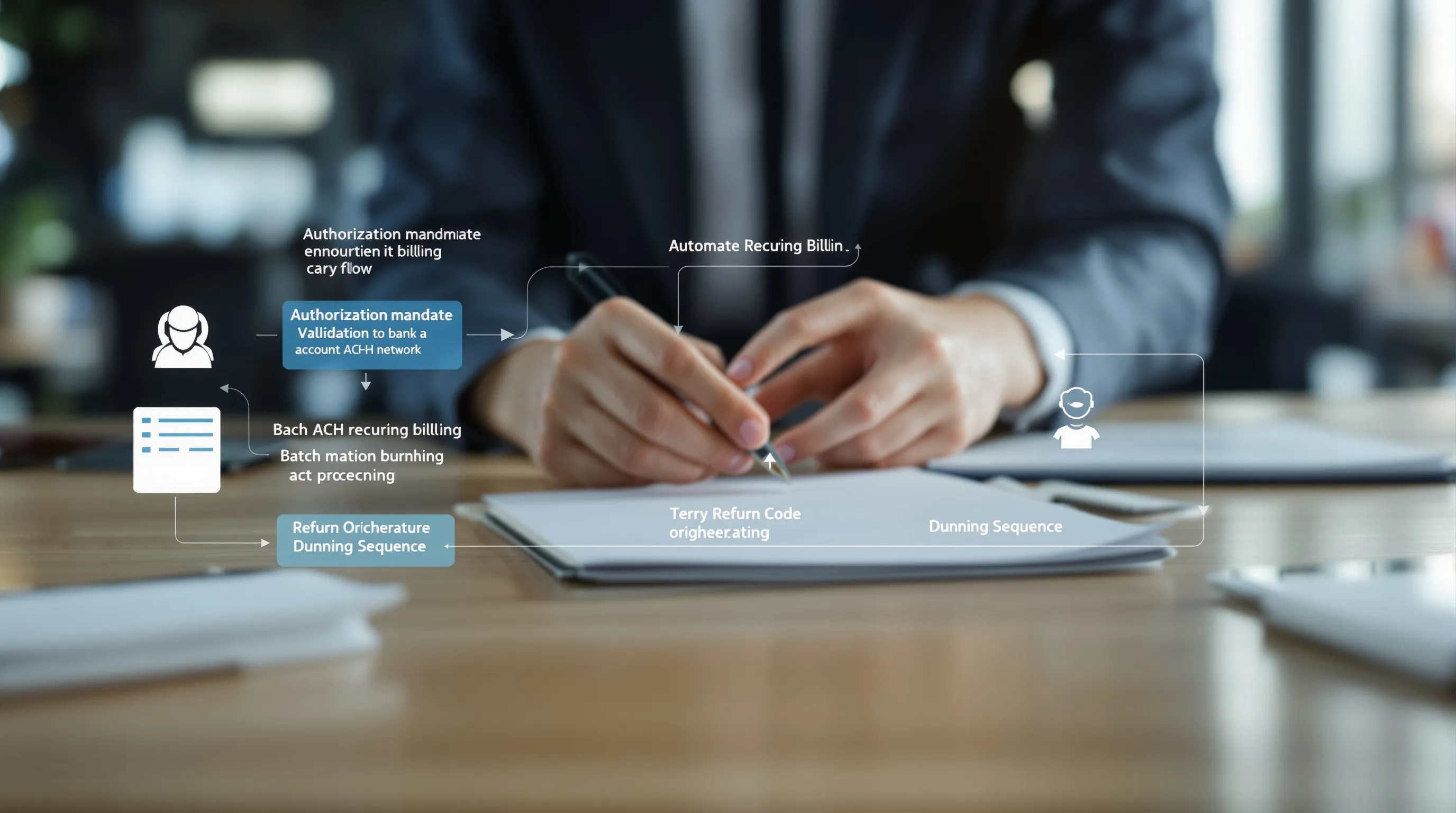
This guide covers the complete operational playbook for automating recurring ACH collections for subscriptions, from NACHA authorization mandates and bank account validation through return code triage, retry schedule design, and dunning sequences. It goes beyond what ACH is to cover the mechanics that determine whether subscription billing actually works: why first-pass success rates vary from 87% to 94% depending on setup, which return codes can be retried and which cannot, and how automated retry logic plus structured dunning consistently recovers 85-90% of all failed ACH transactions. If you process $25,000 or more per month in recurring billing, the systems covered here are the difference between 1-2% permanent payment loss and 6-8%. For most subscription businesses SeamlessChex approves, ACH runs as the secondary rail alongside a dedicated credit card merchant account: this playbook covers the ACH side of that stack.
Questions this article answers
- How many times can you retry a failed ACH payment under NACHA rules, and what is the optimal timing between each attempt to maximize recovery?
- Which ACH return codes can be retried automatically, and which ones require customer action and cannot be re-presented under any circumstances?
- What does a complete recurring ACH system need (mandate management, account validation, retry logic, dunning), and how do these components work together to recover 85-90% of all failed payments?
Quick Answer
The Short Answer
To automate recurring ACH collections for subscriptions, you need four components working together: a payment processor with recurring ACH origination support, a bank account validation layer to prevent returns before they happen, a retry orchestration engine that follows NACHA's three-attempt rule and optimizes timing, and a dunning sequence for payments the retry engine cannot collect. With these in place, established subscription businesses see first-pass success rates of 94%, recover 72-78% of R01 failures through automated retries, and bring total failed-payment recovery to 85-90% through dunning, reducing permanent payment loss from 6-8% to 1-2% of billing volume.
Quick Answer
Subscription businesses using automated recurring ACH collections with bank account validation see first-pass success rates of 94% (compared to 87-89% for businesses that skip pre-transaction validation). With a properly timed two-retry schedule, 72-78% of R01 (Insufficient Funds) failures are recovered before dunning begins. Add a structured dunning sequence and total recovery reaches 85-90% of all failed ACH transactions. Businesses that handle ACH collections manually, by contrast, permanently lose 6-8% of revenue to failed payments that never receive a second attempt.
This is the operational playbook for building a recurring ACH system that actually recovers what it is owed. The guide covers NACHA authorization mandate requirements, the five technical components of a complete recurring billing stack, return code triage (which failures to retry and which require customer action), the optimal retry schedule design, and the dunning sequence that converts failed-payment events into recovered revenue. If your subscription business processes $25,000 or more per month in recurring billing, these are the mechanics that determine whether your collection infrastructure is returning 92 cents on the dollar or 98 cents on the dollar, and the operational steps to get to the higher number.
What Is Recurring ACH Collection and Why Automation Matters
Recurring ACH collection is the process of automatically pulling payments from customer bank accounts on a scheduled basis (weekly, monthly, quarterly, or any custom interval) without requiring customer action at each billing cycle.
For subscription businesses, it is the backbone of predictable cash flow and the mechanism that converts an annual contract or a monthly plan into actual money in the operating account, as of .
Businesses that run ACH collections manually (exporting customer data, formatting NACHA files, uploading batches through a bank portal, and reconciling returns by hand) pay a hidden operational tax on every billing cycle. In the r/Bookkeeping community, one small accounting firm reported that manually processing all ACH payments consumes two to three days per billing cycle for a single staff member, and that is before accounting for any failed-payment follow-up. Automation eliminates that entirely.
But the real cost of manual ACH is not the staff hours. It is the failed payments that quietly slip through with no retry, no follow-up, and no recovery. In my experience working with subscription merchants, businesses relying on manual processes permanently lose 6-8% of revenue to failed transactions that never receive a systematic second attempt. The payment fails, it gets logged somewhere, and recovery depends on someone remembering to check the return file and manually reschedule the transaction. With a properly automated system (mandate management, bank account validation, smart retry scheduling, and dunning sequences), that permanent loss rate drops to 1-2%.
How Recurring ACH Differs From One-Time ACH
A one-time ACH debit requires a customer to authorize a specific transaction. A recurring ACH debit captures authorization once, upfront, and allows you to debit that account on an ongoing schedule without returning for fresh approval each billing cycle. This authorization structure is what makes subscription billing possible at scale, and it is also what makes NACHA compliance non-negotiable from day one.
- One-time ACH: Single authorization per transaction, common for invoice settlement and bill payment
- Recurring ACH: Standing authorization covering future scheduled debits, required for subscriptions, membership fees, and installment plans
- Variable-amount ACH: Recurring authorization with language covering amounts that change based on usage or consumption: the mandate must specify that amounts may vary
ACH is well-suited to subscription billing because it is, as one payment systems developer put it, "not instant, but reliable, low-cost, and highly scalable." That reliability at scale is exactly what subscription businesses need. Card-based recurring billing has higher per-transaction costs and card expiration events create involuntary churn that ACH on bank accounts does not.
Who Should Automate Recurring ACH Collections
ACH automation delivers the strongest return for businesses with predictable recurring revenue and monthly processing volumes above $25,000. At that scale, the setup investment pays for itself quickly, and the operational gap between manual and automated collection becomes tangible in both staff time and recovered revenue.
The industries where automation matters most are SaaS platforms, membership organizations, professional services with retainer billing, B2B suppliers running installment payment programs, and DTC subscription businesses. In each case, the combination of volume and repeat billing cycles makes automation not optional but operationally essential.
Automation also becomes urgent for businesses recently shut down by mainstream processors. Stripe, Shopify, and PayPal increasingly terminate subscription accounts without advance warning, and ACH-focused recurring billing infrastructure built for subscription merchants gives you stability those platforms cannot provide. That stability, combined with transaction costs significantly lower than card billing, makes recurring ACH the preferred payment rail for established subscription businesses ready to move past the limitations of general-purpose payment tools.
How to Set Up ACH Authorization Mandates the Right Way
An ACH authorization mandate is the legal instrument (written, electronic, or recorded) that gives you the right to debit a customer's bank account on a recurring basis.
NACHA requires this authorization before any recurring debit is initiated, and a missing or defective mandate is the single most common source of unauthorized-return claims that can put your ACH origination privileges at risk.
This is not administrative overhead. It is your financial safeguard. A strong mandate means an R10 dispute (Customer Advises Not Authorized) is resolved in your favor because you have the documentation to prove consent. A weak or missing mandate means automatic loss, every time.
What Every Recurring ACH Authorization Must Include
NACHA's operating rules prescribe specific required elements for a valid recurring debit authorization. The language does not need to be lengthy, but every element must be present:
- Company name as it appears in ACH origination: exactly as it will display on the customer's bank statement; discrepancies between the authorization name and transaction name are a leading source of R10 disputes
- Clear recurring billing disclosure: explicit language that future debits will occur on a schedule, not a one-time charge
- Amount or variable-amount clause: a specific dollar amount, or a statement that amounts may vary, with any relevant caps spelled out
- Billing frequency and schedule: monthly, weekly, annually, on the 1st of each month (specific and unambiguous)
- Cancellation instructions: how the customer can revoke authorization and the deadline before the next scheduled debit
- Customer agreement: a click-through checkbox with timestamp, a wet signature, or a recorded verbal agreement, each valid under different SEC code requirements
Missing or vague mandate language is the root cause of most R07 (Authorization Revoked by Customer) and R10 (Customer Advises Not Authorized) returns. Unlike R01 failures, which are a cash flow timing issue you can retry, these unauthorized-return codes cannot be re-presented. If they accumulate above your processor's threshold, you risk ODFI restrictions on your ACH origination privileges.
SEC Codes: Choosing the Right Entry Class
The SEC (Standard Entry Class) code on each ACH transaction tells the receiving bank what type of authorization was collected. Using the wrong code is a compliance violation (not just an administrative error) and can result in returns that should never have occurred.
- PPD (Prearranged Payment and Deposit): For debiting personal consumer bank accounts. Requires written or electronic authorization with all required elements. The standard for B2C subscription billing.
- CCD (Corporate Credit or Debit): For debiting business bank accounts. Used in B2B recurring billing, vendor payment programs, and business services. Authorization requirements are similar but the dispute process differs.
- WEB (Internet-Initiated Entry): When customers authorize via an online channel. Requires specific fraud detection controls and account ownership verification measures in addition to standard mandate elements.
Storing and Retaining Authorizations
NACHA requires you to retain proof of authorization for two years after the last debit under that authorization. This clock does not start at cancellation: it starts from the date of the final transaction. Practically, this means:
- Store electronic authorizations with an IP address log, timestamp, and the exact version of mandate language presented at authorization time
- Retain records even after account cancellation: the two-year clock runs from last transaction, not from cancellation date
- Be able to produce the authorization within two business days if your processor or ODFI requests documentation for a return investigation
- Link each transaction record to the specific mandate that authorized it
Payment platforms that offer only a payment API but no mandate management put the full compliance burden on you. Seamless ACH stores authorization records automatically (timestamped, IP-logged, and linked to every associated transaction), so when an R10 dispute arrives, you respond with documentation already in hand rather than scrambling through email archives.
Building the Technical Stack for Automated ACH Collections
Automated recurring ACH collection is not a single product: it is a system of interconnected components, each playing a distinct role in ensuring payments process reliably, failed transactions are caught promptly, and customers are billed correctly across every billing cycle. Understanding what each component does helps you evaluate vendors, identify gaps in your current setup, and know exactly what questions to ask a prospective payment partner.
The Five Core Components of a Recurring ACH System
A complete recurring ACH billing stack requires five capabilities. Some platforms bundle most of these together; others require integration across multiple vendors.
- ACH Originator / Payment Processor: The entity that submits your transactions into the ACH network through an Originating Depository Financial Institution (ODFI). This is your primary payment provider, and the relationship that determines your origination limits, return rate thresholds, and compliance standing. For subscription businesses, you need an originator that supports recurring billing specifically. As one business operator discovered after years of frustration with QuickBooks Payments, general-purpose processors have "risk filters that become the product" once you start pushing large recurring ACH volumes. You need a processor underwritten for that use case from the start.
- Bank Account Validation: Verifies that a bank account is real, open, and accessible before you attempt the first transaction. Reduces R02 (Account Closed) and R03 (No Account) returns substantially. Methods include micro-deposit verification, instant bank verification via open banking connections, and ACH prenotes (zero-dollar test entries that cycle through the network in 24-48 hours).
- Billing Schedule Engine: Determines when each transaction initiates and handles edge cases that break simple calendar logic (February 29, billing dates that fall on bank holidays, prorated first-period billing, and trial-period-to-paid conversions). Without a proper scheduler, billing errors accumulate over time as edge cases compound.
- Retry Orchestration Engine: When a transaction returns with a recoverable code (R01, R09), this system schedules re-presentation within NACHA's rules. Smart retry engines select optimal days and times based on the return type and available billing windows, without requiring any human intervention for individual failed transactions.
- Customer Communication Layer (Dunning): Sends automated emails and SMS notifications when payments fail, when retries are scheduled, and when customers need to update payment information. This is the dunning system: the revenue recovery mechanism that handles payments the retry engine cannot collect automatically.
Integration Approaches
How you connect these components depends on your existing systems and technical resources.
- Direct API integration: Your platform connects to the ACH processor's API to submit transactions, receive webhooks on returns, and trigger downstream workflows. Most flexible; requires the most technical implementation effort.
- Hosted recurring billing platform: A platform that handles mandate capture, transaction scheduling, retry logic, and dunning as a packaged service. Fastest to deploy, lowest implementation risk. This is where most subscription businesses land.
- NACHA file upload: The manual process of formatting transactions into a NACHA-spec file and uploading to your bank. No automation is possible; not viable at any meaningful subscription volume.
Bank Account Validation: The Highest-ROI Configuration Step
Most subscription businesses skip pre-transaction account validation and absorb elevated return rates as an unavoidable cost of doing business. But validation is the single highest-ROI configuration decision in a recurring ACH system. Businesses that validate bank accounts before the first debit see first-pass ACH success rates of 94% or higher. Without validation, that number drops to 87-89% as R02 and R03 returns accumulate across the billing cycle.
Instant verification through an open banking connection, where the customer authenticates directly to their bank to confirm account access, is the most effective method. It confirms account existence and customer authorization simultaneously, which also strengthens mandate defensibility against R10 disputes. Micro-deposit verification adds more friction but is equally reliable. ACH prenotes require no customer action and are natively supported within the ACH network, though they add a 24-48 hour cycle before your first transaction can proceed.
Seamless ACH includes bank account validation as part of the onboarding flow, along with mandate capture, billing schedule management, automated retry logic, and customer communication. Building this stack from components requires integrating across five vendors; working with a platform that provides all five capabilities is the faster, lower-risk path for most subscription businesses ready to scale recurring ACH collections.
Understanding ACH Return Codes and How to Prevent Failures Before They Happen
Every failed ACH transaction comes back with a return code that tells you exactly why it failed.
These codes are not just administrative labels: they tell you whether a payment is recoverable, whether you can retry it, and what customer action is needed. Understanding return codes is the operational foundation of any effective recurring ACH strategy.
The Return Codes That Matter Most for Subscription Billing
| Code | Description | Retryable? | Recovery Action |
|---|---|---|---|
| R01 | Insufficient Funds | Yes, max 3 total attempts | Retry on Days 3-5, then Days 7-10 |
| R02 | Account Closed | No | Contact customer for updated account information |
| R03 | No Account / Unable to Locate Account | No | Verify routing and account number; re-enroll customer |
| R07 | Authorization Revoked by Customer | No | Do not re-debit; contact customer to discuss reinstatement |
| R08 | Payment Stopped | No | Contact customer to remove the stop payment order |
| R09 | Uncollected Funds | Yes, treat like R01 | Retry after 3-5 days |
| R10 | Customer Advises Not Authorized | No | Produce authorization documentation immediately; do not retry |
| R29 | Corporate Customer Advises Not Authorized | No | Produce CCD authorization record; contact customer |
The most important distinction in this table: R01 and R09 can be retried; everything else requires customer action or documentation before any further debit is attempted. An automated retry system must never re-present R02, R07, R08, R10, or R29 returns: doing so violates NACHA rules and, for R10 and R07, compounds an unauthorized-debit dispute into a much more serious compliance problem.
Pre-Failure Prevention Strategies
The most cost-effective approach to ACH failure management is prevention (reducing the failure rate before transactions are initiated). Several configuration decisions at the system level have an outsize impact on return rates.
- Validate accounts before first debit: Use instant bank verification or micro-deposits to confirm accounts are active before the first charge. This eliminates R02, R03, and a meaningful portion of R10 returns entirely.
- Choose billing dates strategically: Mid-cycle billing (the 10th through the 20th of the month) correlates with higher first-pass success rates than billing on the 1st through the 3rd, when competing rent and recurring obligations deplete available balances. Avoid Mondays, when weekend transaction uncertainty creates balance ambiguity.
- Send pre-billing reminders: Notifying customers three to five days before a charge is initiated reduces NSF-related R01 failures by giving them time to ensure funds are available, particularly effective for variable-amount billing cycles.
- Monitor return rate thresholds actively: NACHA and your ODFI watch your return rates. Unauthorized returns (R07, R10) above 0.5% of total transactions are a compliance flag; overall administrative return rates above 3% will trigger inquiry. Tracking these metrics in real time lets you catch deteriorating trends before they become a processor relationship problem.
Why R10 Is the Most Operationally Serious Return Code
R10 (Customer Advises Not Authorized) is categorically different from other return codes. Unlike R01, which reflects a cash flow timing issue, an R10 means a customer contacted their bank and disputed the debit as unauthorized. Your bank must produce valid authorization documentation within two business days or credit the customer's account immediately.
If you cannot produce that documentation, because you did not collect a mandate, or because the mandate was missing required elements, you lose the dispute automatically. This is the mechanism through which weak mandate management translates directly into revenue loss. Strong, properly stored authorization records turn an R10 dispute into a two-day documentation exchange; missing or defective records turn it into a guaranteed loss.
The pattern I see most often: a subscription business with solid payment volumes runs into an R10 spike and discovers it never captured NACHA-compliant mandates during its early growth phase. The solution at that point is a full re-authorization campaign, contacting every customer to re-confirm standing billing consent. That is an avoidable operational crisis if mandate capture is built into onboarding from day one.
Designing the Optimal ACH Retry Strategy for Subscription Businesses
Retry logic is where most subscription businesses leave revenue on the table. The mechanics are constrained by NACHA rules (three attempts maximum for an R01 return), but within those constraints, when and how you retry has a significant impact on how much you recover. The gap between unmanaged failed payments and a properly scheduled retry sequence is substantial: businesses without retry automation permanently lose 6-8% of revenue to failed transactions, while a two-retry schedule recovers 72-78% of R01 failures before dunning even begins.
NACHA's Retry Rules: What You Can and Cannot Do
Before designing your retry schedule, the compliance boundaries must be clear:
- Maximum attempts for R01 and R09: Three total, your original attempt plus two re-presentations
- No retries for unauthorized returns: R07, R08, R10, and R29 cannot be re-presented under any circumstances
- No fixed waiting period required by NACHA: There is no mandatory gap between attempts, but practical recovery rates are highest with a 3-7 day gap between each retry
- All attempts must fall within 180 days of the original authorization date for standard recurring ACH entries
Recovery Rates by Retry Attempt
The recovery data below reflects our merchant portfolio experience. Not all R01 failures are equivalent: a customer who hit a momentary NSF because payroll had not posted is very different from a customer who is intentionally avoiding payment. Smart retry logic captures the former; dunning management addresses the latter.
| Attempt | Timing | Recovery Rate | Notes |
|---|---|---|---|
| Original | Billing date | 94% success (base rate) | For accounts validated before first debit, mid-cycle billing date |
| Retry 1 | Day 3-5 after failure | ~65% of R01 failures recovered | Best day: Tuesday or Wednesday morning batch |
| Retry 2 | Day 5-7 after Retry 1 | ~18% of remaining failures recovered | Final NACHA-allowed attempt; trigger dunning sequence simultaneously |
| Post-retry dunning | After all retries exhausted | Additional 35-45% via customer action | Email, SMS, self-service payment update portal |
The math matters for businesses evaluating the ROI of automation. A subscription business with $50,000 per month in failed ACH transactions (a realistic figure at meaningful volume) recovers $37,500-$39,000 of that per month with a properly scheduled two-retry system, before dunning adds another $4,000-$8,000 in customer-initiated updates. The unmanaged equivalent recovers perhaps $20,000. The difference is real revenue, not a theoretical optimization.
Day-of-Week and Timing Optimization
ACH is a batch settlement system, and timing submissions strategically within that structure produces measurably better recovery rates. From the patterns I see across our merchant portfolio:
- Best days for initial billing: Tuesday through Thursday. Avoid Mondays: weekend activity creates balance uncertainty. Avoid Fridays: weekend settlement delays reduce cash availability on the following business day.
- Best days for retry attempts: Tuesday or Wednesday morning batches consistently produce the highest recovery rates on re-presentations.
- Avoid billing the 1st-3rd of the month: Rent, mortgage, and other major recurring obligations compete for available balances in the first days of the month. Billing cycles set for the 10th-20th see materially better first-pass success rates.
- Avoid end-of-month: End-of-month billing coincides with heavy recurring obligations across consumer and business accounts, creating return rate spikes that mid-month billing sidesteps.
Why Manual Retry Scheduling Does Not Work at Scale
Manual retry scheduling is not operationally viable at any meaningful subscription volume. MSP and agency billing operators in the recurring-payments community consistently note that once ACH billing volume scales, the administrative burden of tracking failures, checking return file codes, and rescheduling each transaction individually becomes untenable. The solution is a retry orchestration engine that handles each step automatically.
Seamless ACH includes automated retry scheduling with configurable retry windows. When an R01 return arrives, the system flags the transaction, calculates the optimal retry date, queues the re-presentation, and triggers customer notification in the same workflow. No manual NACHA file editing, no spreadsheet tracking, no missed retries because a billing manager was out of office. The retry engine runs on schedule whether or not anyone is watching, and that consistency is what produces reliable recovery rates month over month.
Revenue Recovery After ACH Failure: Dunning Management and DSO Improvement
When retry logic has run its course (after two re-presentation attempts on an R01 return, or immediately for non-retryable returns like R02 or R07), recovery shifts from automated re-presentation to active customer engagement.
This is dunning: a systematic outreach sequence designed to prompt customers to update their payment method or resolve the underlying issue before their account is suspended.
According to QuickBooks' small business late payments research, over half of small businesses in the US end up using credit cards just to keep operations running when invoices are not paid on time. For subscription businesses, that cash flow pressure is a direct consequence of failed billing cycles that do not get recovered promptly. A well-designed dunning system converts that reactive cash crisis into a proactive collection process. In our experience, a structured dunning sequence recovers an additional 35-45% of failed payments that retry logic alone could not collect, through customer-initiated payment updates, alternative payment methods, and direct resolution of the underlying account issue.
A Dunning Sequence That Recovers Revenue
The most effective dunning sequences combine clear communication with minimal friction. The goal is to make it as easy as possible for customers who want to pay to do so, while creating clear service consequences for those who do not respond.
- Day 0 (Failure day): Automated email notifying the customer that their payment did not process and a retry is scheduled. Include a self-service payment update link (some customers prefer to resolve it themselves rather than wait for the retry). Tone should be informational, not alarming.
- Day 3-5 (After Retry 1): Second email noting the first retry was unsuccessful. Increase urgency language slightly. Make the payment update link prominent. Add an SMS notification if the account tier justifies it.
- Day 7-8 (After Retry 2): Final retry has failed. Email and SMS both sent. State clearly that service access will be affected if not resolved by a specific date. For accounts above a revenue threshold, a personal call from the account team is warranted and generally effective.
- Day 10-14: Suspend or downgrade service access. Use a "paused" state rather than full cancellation if your product supports it: customers who are paused rather than cancelled return at meaningfully higher rates than those who churn and need to resubscribe from scratch.
- Day 21-30: Win-back campaign for customers who have not resolved. A reduced-friction offer or flexible payment option can recover a segment of this group that would otherwise remain churned.
How Automated Collections Reduce Days Sales Outstanding
Days Sales Outstanding (DSO) measures how long it takes to collect payment after a billing event. For subscription businesses, failed payments that take two to three weeks to resolve inflate DSO substantially, turning what should be a same-day cash collection event into a multi-week accounts receivable item.
Businesses that implement automated ACH collections with structured dunning reduce DSO by an average of 18-24 days compared to businesses using manual billing processes. For a subscription business carrying $500,000 in average monthly recurring revenue, a 20-day DSO reduction represents approximately $328,000 in improved working capital availability annually, funds that were technically owed but practically inaccessible due to collection delays.
The mechanism is direct: automation removes human latency from every step. Manual processes mean failures sit in a queue until someone reviews them. Automated systems trigger retry logic within hours of a return arriving and send dunning emails within the same day. Every day removed from the collection cycle converts pending receivables into cash sooner.
Backup Payment Methods and Flexibility Options
The most effective dunning systems offer alternatives alongside the request to update bank information:
- Backup card on file: If the customer provided a credit or debit card during onboarding, offer to run a one-time card charge to cover the failed billing period while the ACH account issue is resolved
- Payment plans for accumulated balances: If a customer has missed multiple cycles, offering a structured catch-up plan recovers more than demanding the full balance immediately
- Pause rather than cancel: Preserving the subscription relationship through a pause protects lifetime customer value; customers who return from a pause churn at dramatically lower rates than those who must reacquire
These tactics transform a failed payment event into a customer retention conversation. With the right infrastructure (automated retry logic, a structured dunning sequence, and flexible recovery options), subscription businesses consistently recover 85-90% of all ACH failures and move money from receivable to available in a fraction of the time that manual processes allow. That is the operational case for automating recurring ACH collections.
NACHA ACH File Format: What Gets Submitted to the Network
When your recurring billing platform submits transactions to the ACH network, it generates a NACHA-formatted file consisting of fixed-width 94-character records. Understanding this structure helps you interpret what your processor does and what each transaction record contains. Your platform generates this automatically, but knowing the anatomy of an ACH file helps when reviewing transaction data or diagnosing return issues.
101 091000019YOURCOMPANY_ID  2607281200A094101ORIGINATING_BANK        YOUR COMPANY LLC


5200YOUR COMPANY LLC 1234567890PPD SUBSCRIPTION2607281           1091000010000001


627021000021123456789012345  0000014999SMITH JOHN             CUST-A1001        0091000010000001


8200000001000000000000000000014999YOUR_CO_ID                   091000010000001


9000001000001000000020000000000000000014999
Record breakdown for the Entry Detail line (Record Type 6):
- Transaction Code 27: Checking account debit (use 37 for savings)
- RDFI Routing Number: 9-digit routing number of the customer's bank
- Account Number: Customer's bank account number (up to 17 characters)
- Amount: 10-digit field in cents:
0000014999= $149.99 - Individual Name: Customer name as it should appear on bank statements
- Trace Number: Unique identifier used to track the transaction through the network
The SEC code in the Batch Header (PPD in this example) determines the authorization type required. CCD entries for business accounts follow the same file structure with a different code and authorization requirements. Your ACH processor validates this file against NACHA specifications before submission: any formatting error in the file can result in the entire batch being rejected, not just the affected transaction.

Before
Before and After: Manual vs. Automated Recurring ACH
After
| Process Stage | Manual ACH | Automated ACH (Seamless ACH) |
|---|---|---|
| Authorization capture | Paper forms or informal email consent; no structured storage | Click-through mandate with IP timestamp, stored and linked to every transaction |
| Account validation | None: first failure reveals bad account data | Pre-transaction instant verification or micro-deposit confirmation |
| Transaction submission | Manual NACHA file formatting and bank portal upload; 2-3 days of staff time per cycle | Automated batch submission via API; zero staff time per cycle |
| Failed payment handling | Return file reviewed manually; failed payments tracked in spreadsheet; retries missed when staff is unavailable | Return codes triaged automatically; R01/R09 retries scheduled immediately; non-retryable codes trigger dunning |
| Retry scheduling | Ad hoc or none; dependent on individual staff awareness | Optimized two-retry schedule with NACHA-compliant windows; runs automatically |
| Customer communication | Manual outreach when someone notices; inconsistent timing | Automated dunning sequence: email Day 0, email+SMS Day 3-8, escalation Day 14 |
| Permanent payment loss | 6-8% of billing volume | 1-2% of billing volume |
| DSO impact | Failed payments unresolved for 2-3 weeks on average | 18-24 day DSO reduction vs. manual baseline |
What Will Matter Most in Recurring ACH Over the Next 12-24 Months
The mechanics of recurring ACH (NACHA authorization rules, return code handling, retry windows, dunning sequences) are stable and unlikely to change dramatically. What is changing is the environment around those mechanics: the infrastructure options available, the competitive pressures driving businesses to maximize recovery rates, and the role ACH plays relative to newer payment rails.
Same-Day ACH Expanding Practical Options
Same-day ACH has been in gradual rollout, and its practical impact on subscription billing is becoming more tangible. Three settlement windows per day (morning, afternoon, and evening) mean that retry attempts can be scheduled with more precision than the once-per-day batch model allowed. For subscription businesses, this creates the opportunity to compress the retry cycle: an R01 failure received in the morning can have a retry submitted in the afternoon window, rather than waiting until the next business day's batch. Expect recurring billing platforms to build same-day ACH retry scheduling as a standard feature over the next 12-18 months rather than a premium option.
Account-to-Account Payments and Open Banking
The industry is watching account-to-account (A2A) payments carefully, particularly as Open Banking infrastructure develops in the US. The emerging pattern, where customers authenticate directly to their bank to authorize payment access rather than sharing routing and account numbers, strengthens authorization defensibility substantially. When a customer logs into their bank to confirm account access during mandate capture, the resulting authorization is dramatically harder to dispute as R10 than a routing number entered into a form. Subscription businesses that adopt Open Banking-based mandate capture in the next 12-24 months will see measurably lower unauthorized return rates and stronger dispute outcomes.
Processor Instability Driving ACH Demand
Stripe, Shopify, and PayPal have accelerated their termination of subscription businesses, particularly those in recurring billing models, high-ticket products, or industries classified as elevated-risk. This is pushing established subscription merchants toward ACH-native recurring billing infrastructure faster than the industry expected. The demand signal is clear: businesses that build on payment infrastructure designed for subscription billing, rather than bolted onto a general-purpose platform, are less exposed to the account closure risk that general-purpose processors increasingly represent. This trend accelerates over the next 24 months as mainstream processors continue tightening their acceptable use policies around recurring billing models.
AI-Assisted Dunning Optimization
The next frontier in failed-payment recovery is dynamic dunning: using payment history, account behavior, and billing patterns to optimize the timing, channel, and messaging of each customer outreach rather than sending identical sequences to every failed payment. Early data from billing platforms implementing dynamic dunning suggests measurable improvement in recovery rates over static sequences. For subscription businesses, this means the 85-90% recovery rate achievable today with well-designed static dunning has further upside: businesses that invest in dynamic dunning infrastructure over the next 12-24 months will have a demonstrable competitive advantage in working capital management.
Forecast window: 12-24 months
Where recurring ACH collection is headed next
Three forecasts on how automated recurring ACH collection for subscriptions is likely to evolve over the next two years.
Recurring ACH automation forecasts
Use these forecasts to gauge how much manual reconciliation and fraud friction to expect from recurring ACH collection.
Demand from restricted-category subscription sellers, including nutraceutical, peptide, and GLP-1 product stores, for dedicated payment processing that includes ACH-based collection will keep growing over the next 12-24 months as card networks remain a poor fit for these merchants.
Recurring ACH debits will face more, not fewer, security-driven blocks and stop-payment actions over the next 12-24 months as banks tighten fraud screening on subscription-style debits.
Bookkeeping and billing platforms will increasingly automate the invoice-to-ACH-collection loop over the next 12-24 months, but full straight-through processing with no manual touch stays the exception rather than the norm.
Early indicators on the radar: QuickBooks Online still requires manual ACH processing after auto-generating invoices, taking bookkeepers 2-3 days per billing cycle, while Zapier's leading AI models complete only 18-26% of multi-step workflow tasks end-to-end. QuickBooks already declines legitimate B2B ACH debits citing security concerns even with correct banking details, and a credit union permanently blocked a merchant's future ACH charges for a $29 stop-payment fee. Buyers are actively searching for merchant accounts and payment processing built specifically for GLP-1 stores, nutraceuticals, and other high-risk subscription businesses.
Supporting and contrary evidence
Each forecast is checked against sources that support it and sources that complicate it.
- How to set up recurring payments for my clients? is the clearest counter-signal. [Community / Forum]Original poster runs a small internet marketing business and currently invoices clients via PayPal Business, with manual customer payment (no auto-charge). “I believe you don't set up the recurring payment you offer that to your customer and then he aproves it.”
- Backing it: Getting Frustrated with QuickBooks Payments What Are You Using? [Community / Forum]Original poster (OP, u/CoatImpressive4073) runs a business lending brokerage; most invoices are B2B transactions ranging $5K-$50K+. “quickbooks payments is built for low-trust smb volume, not recurring $5k-$50k ach pulls. once you start pushing authorized debits, their risk filters become…”
- Need to stop an automated ACH withdrawal with no access points the same way. [Community / Forum]Original poster (OP) reports credit union (CU) successfully blocked a specific merchant from all future ACH charges of any amount; the service cost $29 (per OP's UPDATE). “Contact your bank and ask them to put a stop payment order on the merchant (they bank may charge a fee for this).”
- Fed ACH Issue this morning supports this forecast. [Community / Forum]This is not an isolated event: the thread references at least two other historical ACH outage incidents (PNC, 3 years prior; Chime, 9 months prior), suggesting recurring reliability issues in ACH transaction processing/settlement. “Missing an ACH transaction? Delays in processing at the Fed is more than likely to blame”
- What do you use for recurring billing? cuts the other way. [Community / Forum]Credit card processing fees for MSP payment platforms (Square/Stripe-type) typically run 2.9%-3.5%, per u/emeffinsteve. “Hopefully you've learned how 95% of MSPs handle payments / accounts receivable.”
- Automatic ACH Processing Software points the same way. [Community / Forum]Original poster (u/SeriousSwimmer5473) works at a smaller family-run accounting business handling monthly billing for bookkeeping, payroll, and sales tax clients at varying price points. “The problem we have, is that as we grow, we gain more monthly clients and the payments are not being automatically processed.”
- How businesses automate invoicing & set up recurring payments in supports this forecast. [Video]Per QuickBooks' latest small business late payments report, over half of small businesses in the US use credit cards just to keep operations running when invoices aren't paid on time. “Late payments used to stress me out a lot.”
- How to set up recurring payments for my clients? is the strongest public backing for this call. [Community / Forum]Woocommerce Subscriptions WordPress plugin costs $199 (per u/Tuck89); "Subscriptio" plugin is described as "a quarter of the price" (~$50), positioned as a cheaper/less robust alternative.
- Which AI models can you automate on Zapier? (GPT-5.6 Sol, Gemini 3.6 Flash, Opus 5, and m is the clearest counter-signal. [Industry Publication]Zapier's model benchmark is called AutomationBench; it tests multi-step workflow completion, not static prompts. “We couldn't find an AI benchmark that measured whether an AI model could do the messy, complicated work businesses actually rely on. Realizing that gap existed…”
- Against it: A/R Automation. [Community / Forum]Original poster (CyanLuis) reports receiving single lump-sum ACH payments from customers like Wayfair that must be manually applied against "20+ invoices with credits as well.". “Aggregated ACH credits are really hard if you don't have underlying invoice detail along side so you know where to credit it to.”
What could change these forecasts
These are the real-world shifts in bank policy, processing reliability, or high-risk underwriting that would reverse the forecasts above.
Read this with care
No forecast here is a sure thing. Even the strongest signal (84/100) has evidence pushing against it, and the contrarian read (71/100) exists because sources genuinely disagree.
- If a stretch of Fed ACH processing without outages, banks relaxing security-flagging on B2B ACH debits, or AI workflow tools reliably completing multi-step reconciliation tasks would accelerate hands-off automation.
- If another Fed ACH outage or a rise in disputed debits would slow it further.
Key Takeaways
Key Takeaways
- NACHA requires a valid written authorization before any recurring ACH debit: mandate management is both a legal requirement and your primary protection against R10 unauthorized-return disputes; mandates must be retained for two years after the last debit
- Bank account validation before the first transaction raises first-pass success rates from 87-89% to 94%: the single highest-ROI configuration step in any recurring ACH system
- Only R01 (Insufficient Funds) and R09 (Uncollected Funds) can be retried. R02, R07, R08, R10, and R29 require customer action and cannot be re-presented under NACHA rules
- Optimal retry timing is 3-5 days after failure on Tuesday-Wednesday batches, avoiding the 1st-3rd and last days of the month when competing obligations reduce available balances
- A two-retry schedule recovers 72-78% of R01 failures before dunning management begins; adding a structured dunning sequence brings total recovery to 85-90%
- Automated ACH collections reduce DSO by an average of 18-24 days: for a $500K MRR subscription business, a 20-day DSO reduction represents approximately $328,000 in improved working capital annually
- Businesses using manual ACH processes permanently lose 6-8% of revenue to failed transactions that never receive a systematic second attempt; automation reduces that to 1-2%
Putting It Together: The Full Recurring ACH Collection System
Automating recurring ACH collections is not a single technology purchase: it is a system of decisions that compound: mandate language that holds up in disputes, bank account validation that eliminates bad data before the first charge, billing dates chosen for maximum first-pass success, retry windows timed to capture funds when they become available, and a dunning sequence that converts failed-payment events into either collected revenue or deliberate customer decisions. Each element individually reduces losses; together they bring total recovery to 85-90% of all ACH failures.
For subscription businesses processing $25,000 or more per month, the operational gap between a properly automated system and manual or semi-automated billing is not a marginal efficiency gain. It is 4-6 percentage points of recovered revenue every billing cycle, a 18-24 day improvement in Days Sales Outstanding, and the removal of a fragile manual process that breaks when staff are unavailable. The businesses I see building durable subscription revenue streams are the ones that treat ACH collection infrastructure as a core operational investment, not a bank feature they use passively.
SeamlessChex works with established subscription businesses processing $25,000 or more per month, providing Seamless ACH recurring billing with mandate management, automated retry logic, NACHA compliance, and the payment infrastructure that subscription businesses need when general-purpose processors are not the right fit. If your recurring billing system is losing revenue it should be recovering, talk to our team about what a properly designed ACH collection system looks like for your billing volume and business model.
Subscription businesses processing $25,000 or more per month can apply for a Seamless ACH recurring billing account. Contact SeamlessChex to discuss your billing volume, retry configuration, and what the onboarding process looks like for your business.
Written by
Jonathan Albert
Co-Founder, SeamlessChex
Jonathan Albert is Co-Founder of SeamlessChex, a credit card processing and fintech payments platform recognized on the Inc. 5000.
Connect on LinkedInFrequently Asked Questions
How many times can I retry a failed ACH payment under NACHA rules?
Under NACHA rules, you can re-present an R01 (Insufficient Funds) or R09 (Uncollected Funds) return up to two times after the original failed attempt, for a maximum of three total attempts. Returns marked R07, R08, R10, or R29 cannot be retried under any circumstances: they indicate the customer has revoked authorization or disputed the debit, and re-presenting them would violate NACHA rules and compound any existing dispute.
What is the difference between R01 and R02 ACH return codes?
R01 means the account had insufficient funds at the time of the debit (the account exists and is active, but the available balance was too low). R01 is retryable up to two additional times. R02 means the bank account has been permanently closed. R02 cannot be retried and requires you to contact the customer to obtain updated banking information before any further billing attempt.
Do I need a new authorization for each billing cycle?
No. A valid recurring ACH authorization covers future billing cycles without requiring fresh authorization each period. The authorization must include a clear disclosure that debits will recur on the specified schedule, the company name as it appears in ACH origination, the billing amount or variable-amount language, and cancellation instructions. One authorization is sufficient for the life of the subscription, provided the mandate includes all required NACHA elements.
What SEC code should I use for subscription billing?
For consumer (personal) bank accounts, use PPD (Prearranged Payment and Deposit). For business bank accounts, use CCD (Corporate Credit or Debit). If authorization is collected via an online channel, some processors use WEB (Internet-Initiated Entry), which carries additional account verification requirements. Using the wrong SEC code is a compliance violation and can generate returns that should not have occurred.
How long must I retain ACH authorization records?
NACHA requires that you retain evidence of authorization for two years after the last debit under that authorization. This clock runs from the date of the final transaction, not from the customer's cancellation date. Your payment platform should store these records automatically and make them retrievable within two business days if your processor or ODFI requests documentation in connection with a return or dispute.
What return rate thresholds should I monitor for NACHA compliance?
NACHA monitors return rates across your ACH origination. Unauthorized return codes (R07, R10, R29) above 0.5% of total transactions are a compliance flag that will prompt inquiry from your ODFI. Overall administrative return rates above 3% are also a watch threshold. Keeping these below threshold is an active operational responsibility for subscription businesses running significant ACH volume.
Can I automate ACH collections through my bank directly without a payment processor?
Many banks allow qualifying businesses to originate ACH transactions directly if they meet the bank's underwriting requirements. However, a bank relationship alone does not provide retry orchestration, mandate management, return code triage, or dunning integration. For subscription billing at any meaningful volume, a dedicated recurring billing platform provides the full stack of capabilities (from authorization capture through recovery) that a bank account and NACHA file upload cannot deliver on their own.
What happens if my unauthorized ACH return rate gets too high?
If unauthorized return codes (R07, R10) exceed 0.5% of your transaction volume, your ODFI may impose restrictions on your ACH origination privileges, require additional reserves, or in severe cases terminate your origination agreement. Prevention through proper mandate language, account validation, and correct SEC codes is the only reliable mitigation. Remediation after threshold violations are flagged is significantly more difficult than building compliant processes from the start.
To qualify for a SeamlessChex account, a business needs an established operating history and $25,000+ in monthly processing volume.