



Quick Answer
When your acquirer drops you mid-settlement, pending transactions authorized before termination will typically clear within 2-5 business days, but new card transactions stop immediately. The 7-14 day gap between termination and new approval is bridgeable: ACH bank transfer processing can be set up in 24-48 hours through a separate network, keeping revenue flowing while a specialist high-risk credit card merchant account gets underwritten. The goal is to run ACH as a temporary bridge, then restore card processing as the primary rail once re-approved with the right processor.
Getting dropped by your acquirer mid-settlement is one of the most disorienting things that can happen to a payment-dependent business. Revenue stops. Customers decline at checkout. And the instinct to scramble for a Stripe or PayPal replacement leads most merchants straight into another wall. I have guided businesses through this situation more times than I can count, and the pattern is consistent: the merchants who recover fastest are the ones who understand what actually happens to their money, activate a bridge strategy inside the first 48 hours, and apply to the right processor for permanent card processing from the start. This guide covers all three steps, in the order that actually matters.
Merchants in this situation most often ask:
- Do I still get paid for transactions I already processed? Yes, pre-authorized batches typically settle within 2-5 business days, though your acquirer may withhold a rolling reserve for up to 180 days.
- Can I use Square or PayPal as a temporary bridge? No, both operate on the same acquiring risk infrastructure and will typically deny high-risk merchants within 24-72 hours of application.
- How fast can I get a new credit card merchant account? With a high-risk specialist and complete documentation, 5-7 business days is achievable.
When an acquiring bank terminates a merchant account mid-settlement, new card transactions stop immediately, but authorized transactions already in the pipeline typically clear within 2-5 business days. The 7-14 day gap before a replacement high-risk card merchant account is approved is the window where most businesses lose the most revenue. In our experience working with terminated merchants who process $25,000+ per month, businesses that activate ACH as a bridge within 48 hours of termination recover a significant portion of that would-be lost revenue while their card processing re-approval moves through underwriting.
The scenario follows a predictable arc. A subscription business, a nutraceutical brand, a telemedicine practice (or any merchant operating in a vertical mainstream processors treat as high-risk) receives a termination notice. Sometimes there is 30 days' warning. Often there is not. The account goes dark, card authorizations fail, and the business owner faces a painful question: how do I keep collecting revenue while I find a new processor?
That question has a two-part answer. First, there is a bridge strategy: using ACH bank transfers to keep revenue flowing through the gap. Second, there is a destination strategy: applying to a high-risk credit card processing specialist who can get a dedicated merchant account approved in 5-7 business days for a well-documented application. Running both in parallel, starting on day one, is how businesses minimize the damage. This guide explains exactly how to execute both.
What Actually Happens to Your Settlements When an Acquirer Drops You?
The moment an acquiring bank terminates your merchant account, two things happen simultaneously, and understanding the difference between them is critical to your next move.
New card transactions stop being authorized immediately, with no grace period. But authorized transactions that are already in the settlement pipeline follow a different path entirely, as of .
Here is how the settlement window actually works. When a customer uses a card, the transaction goes through two distinct stages: authorization (the instant approval) and settlement (when the funds actually move from the issuing bank to your account). These are separated by anywhere from 12 hours to 5 business days, depending on your batch configuration. On the day your account is terminated, any transaction that has been authorized but not yet settled sits in a queue. Your acquirer is contractually required by Visa and Mastercard rules to continue processing those settlements, though I have seen cases where acquirers manufactured reasons to delay batches already in flight.
One critical point that surprises many merchants: as a r/smallbusiness thread on independent merchant account providers makes clear, "your merchant account is tied to whichever processor underwrites you", and that processor "controls settlement, batching, dispute management, and funding." You cannot transfer your merchant account to a new processor mid-termination. Each processor requires its own separate account and underwriting relationship. The implication is that the clock starts immediately on building a replacement.
The settlement timeline after termination
| Timeline | What Happens | What You Need to Do |
|---|---|---|
| Day 0 (termination) | New authorizations rejected immediately | Document all pending batch amounts in writing |
| Days 1-5 | Pre-authorized batches continue to settle | Monitor bank account daily; escalate if batches miss |
| Days 5-30 | Reserve funds withheld from settlements | Request written confirmation of reserve amount and release date |
| Day 180+ | Rolling reserve eligible for release | Submit formal release request with supporting documentation |
Understanding rolling reserves after termination
The piece of this that catches most merchants off guard is the rolling reserve. Even after your pending settlements clear, your acquirer is almost certainly holding a portion of your processed volume as a chargeback buffer. Standard post-termination reserves range from 5% to 20% of your monthly processing volume, held for a minimum of 180 days. On a business processing $100,000 per month, that can mean $10,000 to $20,000 inaccessible for six months or more.
Get written confirmation of your reserve amount within 48 hours of termination (specifically the dollar amount held, the chargeback coverage calculation, and the projected release date). Verbal commitments from account representatives mean very little when reserves are involved. For a detailed walkthrough of how to pursue a release, see our guide on unfreezing reserves on a terminated account.
The MATCH list risk, and your timing window
The Mastercard MATCH database (the industry's Terminated Merchant File) is the list that all acquirers check before approving any new merchant account. MATCH list placement can happen within 3 business days of termination, and it creates a 5-year barrier to opening a standard merchant account in the card network. Not every termination triggers placement: it is reserved for excessive chargebacks, fraud, or willful policy violations, not merely operating in a high-risk category. But you need to know your status before applying anywhere, because an undisclosed MATCH listing discovered mid-underwriting is grounds for immediate denial and can damage your relationship with the specialist processor you need most. Our page on MATCH list merchant account recovery covers what to do if you are already listed.
The bottom line on settlements: your pre-authorized revenue will most likely clear, but your ability to process new card transactions stops the moment the account is terminated. That gap between termination and new approval is what the rest of this article is about closing.
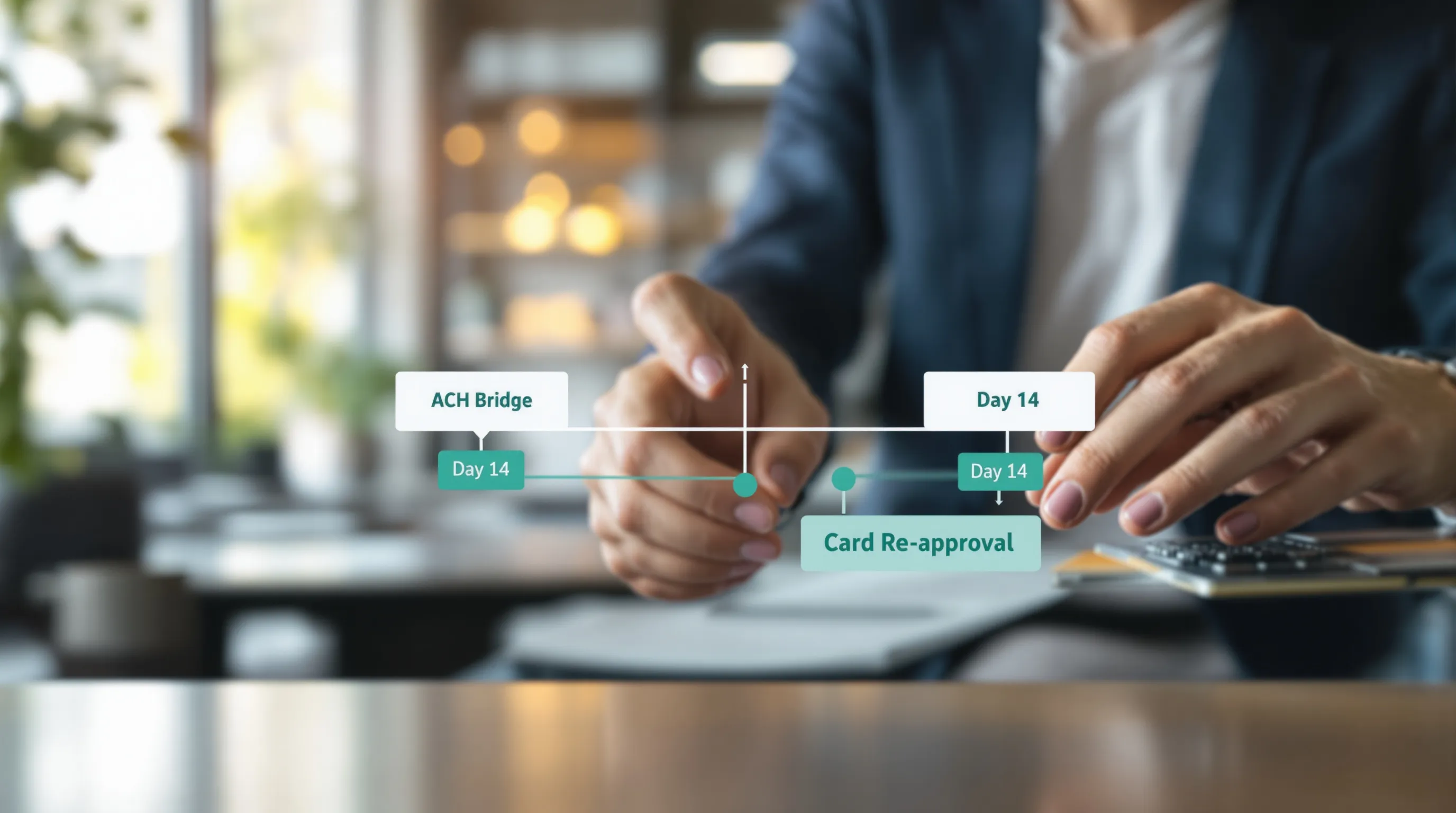
How Do You Keep Revenue Flowing During the 7-14 Day Gap?
This is where most businesses make a costly mistake: they stop all revenue collection while they scramble to find a new card processor.
They send urgent emails to Stripe asking to reconsider. They try Square or PayPal, and get declined within hours because those platforms run on the same risk signals that triggered the first termination. The r/stripe community captured this dynamic bluntly: when using Stripe, "you are playing in Stripe's sandbox and sharing their toys." Once Stripe decides you are out, you are out of their entire infrastructure. Meanwhile, days pass and revenue flatlines. The better move is to activate ACH processing as a revenue bridge while your permanent card solution gets approved.
ACH bank transfers can be live in as little as 24-48 hours, dramatically faster than the 5-10 business days a new card merchant account requires. Unlike card processing, ACH is governed by NACHA, a separate network. Your card processing history (including any termination) does not automatically disqualify you from ACH access. This is the core of the bridge strategy.
Why mainstream processors will not work as a bridge
Stripe, Square, PayPal, and Shopify Payments all use the payment facilitator model: they onboard merchants under their own pooled merchant account, not a dedicated account unique to your business. As one r/stripe thread noted, this means applying to these platforms after a termination essentially re-enters the same pooled risk ecosystem that flagged you. Applications to aggregate processors immediately after a high-risk termination typically result in denial within 24-72 hours, often with a permanent restriction on the email or business entity. The ACH bridge exists precisely because it operates on different rails with different underwriting logic.
Setting up ACH as a bridge processor
Seamless ACH allows businesses to accept bank-to-bank payments from customers using routing and account numbers, with settlement in 1-2 business days. For subscription businesses (the vertical most commonly hit by processor terminations), this approach is particularly effective because the payment relationship already exists. You are not asking customers to adopt an unfamiliar method; you are migrating an existing billing relationship to a different payment rail.
| Approach | Time to First Payment | Cost per Transaction | Works After Termination? |
|---|---|---|---|
| ACH bridge (Seamless ACH) | 24-48 hours | 0.5% - 1.5% | Yes: separate NACHA network |
| Mainstream processors (Stripe, Square, PayPal) | Denied within 24-72 hours | N/A | No: same risk infrastructure applies |
| Waiting for card re-approval only | 7-14 business days | 3.5% - 5% | Yes, but full revenue gap applies |
| ACH bridge + parallel card application | 24-48 hours (ACH) / 7-14 days (card) | ACH rates while bridging; card rates once live | Yes: optimal approach |
Converting existing customers to ACH billing
The conversion process for subscription businesses is more manageable than most merchants expect. Research on subscription payment behavior shows that bank debit collection achieves high first-attempt success rates specifically because "cards fail in ways bank accounts do not." For existing subscribers, the framing matters enormously: "We've upgraded our billing to direct bank transfer, which is more secure and reduces your exposure to card fraud" converts far better than a technical explanation of a processor change.
For new customers during the bridge period, offer bank transfer as the available payment method. You will lose some prospects who are card-only, but the revenue retained from existing subscribers vastly outweighs the brief conversion friction. Once your high-risk card account is approved, you restore card as the primary method and ACH becomes a lower-cost secondary rail: a permanent improvement to your payment stack rather than a temporary workaround.
One reality check worth naming: ACH is a bridge, not a destination. Card processing remains the dominant method for consumer payments, and a business that only accepts ACH long-term will face real cart abandonment and conversion challenges, particularly for acquiring new customers. The goal is to use ACH to maintain revenue continuity during the 7-14 day gap, not to replace card processing permanently.
How Do You Fast-Track Approval for a New High-Risk Credit Card Merchant Account?
Getting re-approved for card processing is not just about finding a willing processor: it is about finding the right one and giving them exactly what they need to move quickly.
In my experience, the difference between a 5-day approval and a 14-day approval almost always comes down to documentation. Applications that arrive complete, organized, and with no gaps move through underwriting efficiently. Applications that require back-and-forth to gather missing information sit idle while that back-and-forth happens.
A high-risk specialist processor can approve a well-documented application in 5-7 business days. That is meaningfully faster than the 10-21 days common when a merchant applies to the wrong processor or submits an incomplete file. Here is what that process looks like, and how to compress the timeline.
Why you need a high-risk specialist, not a general processor
The acquiring infrastructure that mainstream platforms plug into has visibility into termination events across member institutions. When a high-risk merchant is terminated for chargebacks or policy violations, that information flows through shared risk databases. Applying to another processor using the same acquiring infrastructure (effectively what happens when merchants hop from Stripe to another mainstream payment facilitator) puts you back in front of the same risk ecosystem, with the same likely outcome.
This distinction matters because of how merchant accounts actually work. As payments professionals note, "your merchant account is tied to whichever processor underwrites you," and that processor "controls settlement, batching, dispute management, and funding." A high-risk specialist works with a different set of acquiring banks: institutions underwritten specifically to handle elevated chargeback ratios, subscription models, and regulated verticals. These acquirers evaluate applications with underwriters who understand that a GLP-1 or peptide company, a telemedicine practice, or an online gaming operator has a fundamentally different risk profile than a standard retail merchant. That contextual understanding is what makes approval possible where a mainstream processor would decline.
The VAMP (Visa Acquirer Monitoring Program) rules that took effect October 2025 have also changed the underwriting landscape. With a 2.2% per-MID dispute ratio threshold now monitored at the acquirer level, specialist processors have become more precise about which merchants they onboard, but also more willing to work with merchants who can demonstrate proactive chargeback management. Coming in with clean data and a documented prevention strategy now carries more weight than it did before.
The five documents that speed up high-risk underwriting
Underwriters at high-risk acquirers are answering one core question: does this business have a sustainable model with manageable risk? Your documentation needs to answer that before they ask. Based on what underwriters actually prioritize, these are the five categories that accelerate review:
- Processing history (6-12 months): Statements showing monthly volume, chargeback ratio, and refund rate. Even if chargebacks triggered the termination, a downward trend demonstrates you are managing the problem.
- Business bank statements (3-6 months): Confirm revenue stability and that the business is operating as described. Underwriters verify that processing volume aligns with banking activity.
- Government-issued ID and business formation documents: LLC operating agreement or articles of incorporation, EIN confirmation, and photo ID for all beneficial owners with 25%+ ownership. Non-negotiable for KYC compliance.
- Website and product documentation: A live, compliant website with visible terms of service, refund policy, privacy policy, and accurate product descriptions. Underwriters will review your site; compliance gaps delay or deny.
- Chargeback dispute documentation: If your termination involved elevated chargebacks, include evidence of your prevention strategy (chargeback alert enrollment, customer service improvements, updated refund policies). Show that the root cause has been identified and addressed.
For the complete underwriter checklist, see our guide on what documentation high-risk underwriters actually need.
What slows your application down
The most common approval delays come from three sources: missing documents requiring back-and-forth (each round adds 2-3 business days); an undisclosed MATCH listing discovered during underwriting review; and a non-compliant website requiring remediation before the underwriter can sign off. The practical advice is straightforward: audit your own website before submitting. A 48-hour delay for compliance cleanup before submission is far better than a 7-day delay inside the underwriting queue.
SeamlessChex works with established businesses processing $25,000 or more per month in volume, including merchants who have been terminated by a previous processor. Our high-risk credit card processing is designed for businesses that need a processor who understands their vertical and can move efficiently from application to approval. For a clear picture of what high-risk card processing costs, our guide on high-risk merchant account pricing gives you real numbers without the vague disclaimers.
What Will Matter Most in the Next 12-24 Months for Payment Resilience?
The merchants I talk to who have been through a processor termination once almost universally say the same thing afterward: "I am never going to be in that position again." But building genuine resilience requires more than just finding a better processor. The landscape is shifting in ways that make payment stack redundancy not just smart, but increasingly necessary for any business operating in a high-risk vertical.
Card network risk programs are tightening
The Visa Acquirer Monitoring Program (VAMP), which took effect October 2025, has created a new layer of automated enforcement at the acquirer level. With a 2.2% per-MID dispute ratio threshold now triggering acquirer scrutiny (and enforcement fines scheduled to escalate), the algorithmic termination risk is real and increasing. As payments attorney Christopher Dryden noted about algorithm-driven terminations: "You've got a duty to operate in good faith... when you're considering the livelihood of a business and there's a computer algorithm making decisions... it's really black and white - has nothing to do with the gray in a contract of what actually constitutes good faith." The point is that algorithms don't negotiate. Businesses that are not proactively monitoring their chargeback ratio and TC40 counts will be the ones caught off guard when thresholds are crossed.
ACH as a permanent secondary rail, not just an emergency bridge
One of the clearest lessons from working with terminated merchants is that the businesses who recover fastest are often the ones who had ACH already set up as a secondary payment option before the crisis hit. ACH is not just a bridge for emergencies: it is a lower-cost, network-diverse payment rail that reduces your dependence on any single card acquirer. ACH transaction fees of 0.5%-1.5% compare favorably to the 3.5%-5% typical for high-risk card processing, and for subscription businesses where recurring billing is the core model, ACH offers higher reliability precisely because bank accounts do not expire or get reported lost/stolen the way cards do.
Retaining ACH as a permanent secondary rail after your card processing is restored means that any future termination event creates a revenue disruption, not a revenue shutdown.
The case for two card processors
For businesses processing significant monthly volume, a second card processing relationship is increasingly the standard to aim for. Not a PayFac backup: a second dedicated merchant account with a separate acquirer. This is more complex to maintain, but the cost of maintaining it is trivial compared to the cost of a 14-day revenue gap. When evaluating a specialist processor, ask explicitly whether they support multi-processor configurations and whether they can help you manage volume distribution between accounts.
What to look for in a termination-resilient processor relationship
The characteristics that distinguish a durable processor relationship from a fragile one are worth naming. Look for processors who assign a named account manager rather than routing everything through a generic support queue. Look for contract terms that require a minimum notice period before termination and specify the conditions under which termination is permitted. Look for processors who specialize in your vertical, not ones who approve you today and revisit that decision when volume grows. SeamlessChex's hands-on approach (where each established merchant has direct access to responsive support rather than an automated queue) is built specifically for businesses that cannot afford to discover a problem after it has already caused a shutdown.
The payment industry is not getting simpler. Network rules are tightening, monitoring programs are expanding, and the algorithmic risk scoring that drives PayFac terminations is becoming more sophisticated. The businesses that navigate this successfully are the ones who treat their payment stack as a strategic asset, not a commodity utility, and who build the redundancy and monitoring in before they need it.
Looking Ahead to 12-24 months
Where Acquirer Risk Is Headed Next
Three forecasts on how merchants, processors, and acquirers will manage account terminations and settlement risk over the next two years.
Forecasts For Merchant Account Stability
Use these forecasts to gauge how processor and acquirer relationships may shift before your next contract renewal.
As Visa's VAMP dispute-ratio threshold, currently 2.2% and expected to fall further, tightens, more ISOs will require merchants to enroll in Rapid Dispute Resolution and Ethoca verification before a merchant account is even issued, narrowing the approval path for subscription and higher-risk merchants.
Even large, established acquirers will continue to show financial strain that raises settlement risk for their merchants: Worldline's merchant-services net revenue fell 7% and EBITDA dropped 19% in H1 2025, triggering a €4.1 billion impairment, while Global Payments and Worldpay continue restructuring through a $24 billion combination.
Merchants crossing roughly $1 million in annual card volume will increasingly be required to move off shared Payment Facilitator accounts, the model used by Stripe, PayPal, and Square, into dedicated merchant accounts underwritten directly by an acquiring bank.
Early, Unconfirmed Signals Stripe already requires merchants to move to a dedicated merchant account once they process more than $1 million in transactions annually, a threshold set by Visa and Mastercard rather than by Stripe itself. Worldline took an additional €142 million write-down on its Ingenico stake and was downgraded by S&P, despite being one of the larger names in European acquiring. Some ISOs have already reversed the traditional order of operations, now requiring upfront RDR and Ethoca enrollment before granting a merchant account rather than after, with merchants already searching for how to keep accepting payments once an account like Stripe's is shut down.
Supporting And Contrary Evidence
Each forecast lists the sources that back it and the sources that complicate it.
- VAMP is Here: The Risk Game Just Changed: Are You Ready for is the strongest public backing for this call. [Video]Vamp's new rules took effect October 1st after a six-month extension. “A lot of them just kind of they want like a no exception type of rule because if they make an exception for one agent ISO, then there's going to be exceptions…”
- Backing it: Merchant Processing Gone Wrong: The Legal Risks ISOs Ignore. [Video]Law firm "Global Legal Law Firm" hosts the "Payments Experts" podcast and has shifted from representing primarily ISOs 10-15 years ago to representing a growing share of merchants directly. “I'm his hairdresser. He gave me 500 bucks if he could have my ID.”
- Do independent merchant account providers exist? Or are they is the strongest argument against it. [Community / Forum]The transaction chain described involves two financial organizations per transaction: the issuing bank (customer side) and the acquiring bank (seller side), per original poster (OP) u/earsocks. “You nailed the fact that the 'acquiring bank' isn't always a literal bank anymore.”
- The case rests on Business of Payments - September 2025 - Substack. [Substack / Newsletter]Worldline H1 2025: merchant services net revenue fell 7%, EBITDA dropped 19%, triggering a €4.1 billion impairment against a market cap of just under €1 billion. “Net revenue in the division fell 7%, while EBITDA dropped 19%, prompting a colossal €4.1 billion impairment, a remarkable figure considering Worldline's…”
- [Repost] Is Global Payments the next Adyen? - scuttleblurb is what puts this forecast on the board. [Substack / Newsletter]Global Payments announced (last April) a $24bn acquisition of Worldpay while simultaneously divesting its Issuer Processing business (originally obtained via the 2019 TSYS merger) to Fidelity National. “We are not a processor, we are not a payments company, we are not an acquirer. We are a technology provider to these customers who need to have these types of…”
- Backing it: some thoughts on Adyen - scuttleblurb. [Substack / Newsletter]“Adyen, more so than any other PSP, is very opinionated about owning the full stack.”
- PSA - Stripe is NOT the same as having your own Merchant Account is what puts this forecast on the board. [Community / Forum]Stripe (and similarly PayPal, Square) onboards small merchants under the Payment Facilitator (PayFac) model, shared with other PSPs, not unique to Stripe (per u/intheenditwillbefine). “Stripe (or PayPal & Square) are not providing you a real banking 'Merchant Account'. You are getting access to share in *their* merchant account.”
- Backing it: Do independent merchant account providers exist? Or are they. [Community / Forum]The acquiring bank "provides a merchant account to the seller after reviewing the business and underwriting the risk," per OP.
What Could Change These Forecasts
Regulatory shifts, acquirer financial health, and card network rule changes could alter this outlook.
Confidence, With Limits
69 reflects our strongest conviction, while 68 is where we are most prepared to be wrong.
- Dispute-Ratio Rules Tighten Onboarding For Higher-Risk Merchants. That call weakens first if regulators or buyers move in the opposite direction.
- Scale Doesn't Guarantee Settlement Stability. That one becomes the more durable forecast if the source mix shifts toward stronger contrary evidence.
Moving Forward After an Acquirer Termination
A processor termination is disruptive, but it is not a dead end: not for a business with legitimate volume, a documentable track record, and a clear-eyed understanding of the path forward. The merchants who come through this fastest are the ones who act in parallel: activating ACH on day one while submitting a complete, well-organized card processing application to a high-risk specialist at the same time.
The destination is a dedicated high-risk credit card merchant account that gives your business its own underwritten processing relationship, not a shared PayFac account that can be collapsed by an algorithm, but a real merchant account that controls your own settlement, batching, and dispute management. That is what SeamlessChex provides for established businesses processing $25,000 or more per month.
If you are in the middle of this situation right now, the priority order is: document your pending settlements, check your MATCH status, activate ACH, and get a complete documentation package to a high-risk specialist the same day. Every day that passes without a bridge or an active application is a day of potential revenue left on the table. Contact SeamlessChex to start the review process: we work with businesses that have been terminated by other processors, and we can move quickly for merchants who come in prepared.
Written by
Jonathan Albert
Co-Founder, SeamlessChex
Jonathan Albert is Co-Founder of SeamlessChex, a credit card processing and fintech payments platform recognized on the Inc. 5000.
Connect on LinkedInSummarize This Article With AI
Open this article in your preferred AI engine for an instant summary.
Frequently Asked Questions
Do I still get paid for transactions I already processed when my account is terminated?
Yes, in most cases. Card transactions that were already authorized before termination will continue through the settlement process and should fund to your bank account within 2-5 business days. However, your acquirer will typically withhold a rolling reserve (usually 5%-20% of your monthly volume) for up to 180 days as a chargeback buffer. Get written confirmation of the exact reserve amount and release date within 48 hours of termination.
How long does it take to get a new high-risk merchant account?
With a high-risk specialist and a complete documentation package, approval in 5-7 business days is achievable. Incomplete applications that require multiple rounds of back-and-forth typically take 10-21 days. The key variables are the completeness of your documentation, whether you have an active MATCH listing, and whether your website is compliant before you submit. SeamlessChex works with established merchants processing $25,000+ per month and can move efficiently through underwriting for well-prepared applications.
Can I use Square or PayPal as a bridge while I wait for a new merchant account?
No, and this is the single most common mistake merchants make in this situation. Square, PayPal, and Shopify Payments operate on the payment facilitator model, which shares the same acquiring infrastructure that flagged you with your previous processor. Applications to these platforms immediately after a high-risk termination are typically denied within 24-72 hours, often with a permanent restriction on the business entity. ACH processing through a separate network is the correct bridge approach.
Will I be placed on the MATCH list when my acquirer drops me?
Not automatically. MATCH list placement is reserved for specific termination reasons: excessive chargebacks (above 1%), fraud, money laundering, or willful violation of card network rules. A termination for operating in a high-risk vertical (without any of the above) may not result in MATCH placement. Check your status before applying for any new account, because an undisclosed MATCH listing discovered during underwriting is grounds for denial and damages your relationship with the specialist processor you need.
How do I convert my subscription customers to ACH billing during the bridge period?
Frame the transition as an upgrade, not a workaround: "We've moved to direct bank transfer billing, which is more secure and gives you greater protection against card fraud." Send the communication proactively, before the billing date, with clear instructions for providing bank account information. For existing subscribers with established payment histories, conversion rates are high when the messaging is clear and the transition is handled with minimal friction.
Does SeamlessChex work with merchants who have been terminated by another processor?
Yes. SeamlessChex works with established businesses processing $25,000 or more per month, including merchants who have been terminated by Stripe, PayPal, Shopify, or another acquirer. A prior termination does not automatically disqualify a merchant: underwriters evaluate the full picture, including your processing history, your chargeback trajectory, and your current compliance posture. Contact us to discuss your situation before submitting a full application.
SeamlessChex onboards established merchants; the practical minimum is $25,000 in monthly payment volume.