



Quick Answer
The Short Answer
Being on the TMF/MATCH list does not mean you cannot get credit card processing. Standard processors like Stripe, Square, and PayPal auto-decline MATCH-listed applications, but high-risk underwriters approach it differently. They review your specific reason code, evaluate your current business profile, and approve based on risk pricing: higher rates (3.5% to 5.5%) and a rolling reserve (typically 10% to 15% held for 90 to 180 days). For established businesses processing $25,000 or more per month, approval in 3 to 5 business days is realistic. The wait-five-years approach is not the only option.
A TMF/MATCH listing does not end your ability to accept credit cards: it redirects you to a different underwriting market. SeamlessChex has helped MATCH-listed businesses get approved for credit card processing in as few as 3 to 5 business days. Most MATCH-listed approvals we structure carry a rolling reserve of 10% to 15%, a 90- to 180-day hold period, and processing rates between 3.5% and 5.5% (a real cost premium over a standard account, but a fraction of the cost of five years without card revenue). For businesses processing at least $25,000 per month, the path forward is pricing the risk, not waiting out the clock.
Questions this article answers
- Can I actually get a merchant account if I'm on the MATCH list? Yes, through high-risk underwriters who price the listing rather than auto-decline it.
- How fast can I get approved with a MATCH listing? Most complete applications receive a decision in 3 to 5 business days.
- What will it cost me to process cards with a MATCH listing? Typically 3.5% to 5.5% plus a 10% to 15% rolling reserve held for 90 to 180 days.
I have had this conversation more times than I can count. A business owner contacts us after their processor closed their account, tells us they just found out they are on the TMF/MATCH list, and asks the question they are almost afraid to hear answered: "Is it over?" It is not over. Not even close.
The MATCH list (formally, the Member Alert to Control High-Risk Merchants) is a database maintained by Mastercard. It flags businesses whose merchant accounts have been terminated for reasons ranging from excessive chargebacks to PCI non-compliance to fraud. Standard processors check it automatically and decline listed merchants on sight. That much is accurate, and it is where most of the advice you find online stops.
What that advice misses is the distinction between standard processors and high-risk underwriters. Standard processors are not built to handle a MATCH listing: their risk models treat it as a hard stop. High-risk underwriters are built for exactly this situation. They review the reason code behind the listing, evaluate the business's current profile, and make an underwriting decision based on risk pricing, not a database flag. A listing under the most common reason (excessive chargebacks) is, in my experience, something that high-risk underwriters can work with in most cases.
This article covers what the MATCH list actually is, why the "wait five years" advice is wrong for most businesses, what high-risk card processing costs with a MATCH listing, and how to apply with the documentation that moves approvals forward. If your business processes at least $25,000 per month and you are on the MATCH list, read on: there is a concrete path forward here.
What Is the TMF/MATCH List (and Why Were You Added?)
The MATCH list, short for Member Alert to Control High-Risk Merchants, is a database maintained by Mastercard that acquiring banks and processors consult before onboarding new merchants.
You may also see it called the TMF (Terminated Merchant File), which is simply the older name for the same list. If your business appears on it, virtually every standard processor will see the flag and decline your application automatically, often without telling you why.
Listings remain on the MATCH file for exactly five years from the date of entry. That five-year window is where most merchants get stuck, because the mainstream advice online is to wait it out. I'd argue that advice is costing businesses real revenue, and in many cases it is simply wrong.
The 14 MATCH Reason Codes
Mastercard assigns every listing a reason code indicating why the merchant was added. Understanding your code matters, because underwriters at high-risk processors read it closely. The most workable code is reason code 4 (Excessive Chargebacks), which is also by far the most common. In my experience reviewing MATCH applications, the large majority of businesses that come to us are listed under code 4, and most of those qualify for approval.
Worth noting: Visa's chargeback monitoring threshold sits at 0.9%, while Mastercard's sits at 1%. Exceeding these ratios for consecutive months is the most common trigger for MATCH placement. But a processor must add a business to the list within one business day of account termination, meaning the listing often arrives before the merchant even knows the account is closed.
| Code | Reason | Approval Outlook with High-Risk Underwriting |
|---|---|---|
| 01 | Account Data Compromise | Moderate (documentation of remediation required) |
| 02 | Common Point of Purchase Fraud | Moderate (depends on scope and resolution) |
| 03 | Laundering | Very Low (most underwriters decline outright) |
| 04 | Excessive Chargebacks | High: most common listing; pricing solution available |
| 05 | Excessive Fraud | Low to Moderate (depends on pattern and controls in place) |
| 06 | Visa Fraud Monitoring Program | Moderate (time since incident and current controls matter) |
| 07 | Fraud Conviction | Very Low (criminal record typically blocks approval) |
| 08 | Mastercard Excessive Chargeback Program | Moderate (similar to code 04, assessed individually) |
| 09 | Bankruptcy / Insolvency | Moderate (depends on discharge and current financials) |
| 10 | Violation of Card Network Standards | Moderate (nature of violation matters significantly) |
| 11 | Merchant Collusion | Very Low (intentional fraud is a hard stop for most underwriters) |
| 12 | PCI Non-Compliance | Moderate to High (approvable once compliance is restored) |
| 13 | Illegal Transactions | Very Low (nature of transactions determines outcome) |
| 14 | Identity Theft | Moderate (distinguish between merchant as victim vs. perpetrator) |
How Merchants Find Out They Are Listed
Most merchants discover a MATCH listing the hard way: they apply for a new merchant account after their prior processor closes their account, and the new application comes back declined. As one payment processing consultant put it in a widely viewed explainer, "You could be told you were on MATCH, but you could have been placed a year before and just didn't know." The original processor is required to notify you that you were added, but that notification often arrives in dense legal language and gets missed entirely.
You can check your MATCH status by requesting a MATCH inquiry through an acquiring bank or by contacting Mastercard directly. If you believe you were listed in error (for instance, the chargeback ratio that triggered your listing was overstated or the account was opened fraudulently using stolen business credentials), you can formally dispute it. For identity-theft-based listings, that removal process typically takes 30 to 60 days for review. If the listing is accurate, finding the right processing partner is the faster path forward.
Does a MATCH Listing Actually Block You from Card Processing?
The conventional answer you will read almost everywhere is yes: a MATCH listing severely limits or eliminates your ability to accept credit cards.
That answer is accurate for the standard processing world. It is not accurate for the high-risk processing world, and that distinction is everything.
Here is the mechanism: when you apply with Stripe, Square, PayPal, or a traditional bank-issued merchant account, the underwriting system runs an automated MATCH check. If your business appears in the database, the system returns a decline: no human review, no appeal, no explanation. Aggregator processors in particular rely on algorithmic detection: "You fall within that algorithm and they just automatically place you on MATCH or terminate your account." Standard processors are not equipped to underwrite MATCH merchants, and their risk models do not allow for it.
High-risk processors operate under a fundamentally different model. The MATCH listing is not a dealbreaker: it is a data point. A trained underwriter reads your reason code, reviews how long you have been listed, examines your chargeback history before and after termination, and assesses what controls you now have in place. The question is not "should we approve this merchant?" but rather "at what price does this risk become acceptable?"
The 'Priced, Not Denied' Underwriting Thesis
This is the key concept most articles about MATCH processing miss: high-risk underwriting is fundamentally about pricing risk, not avoiding it. Every merchant account carries some probability of chargeback losses and fraud exposure. For a MATCH-listed business, that probability is higher and more documented. The underwriter's job is to set terms (rates, reserves, volume caps) that compensate the processor and sponsor bank for the additional exposure.
Card networks do not evaluate merchants in isolation: they look at ratios and patterns across accounts. What counts is the documented risk profile going forward, not just the past listing. A business that was listed under reason code 4 for excessive chargebacks can often get approved within days because the underwriter can quantify the risk and price it accordingly. The merchant accepts higher costs. The processor accepts a defined level of risk. Both parties move forward. That is not a workaround: it is how specialty merchant underwriting was designed to function.
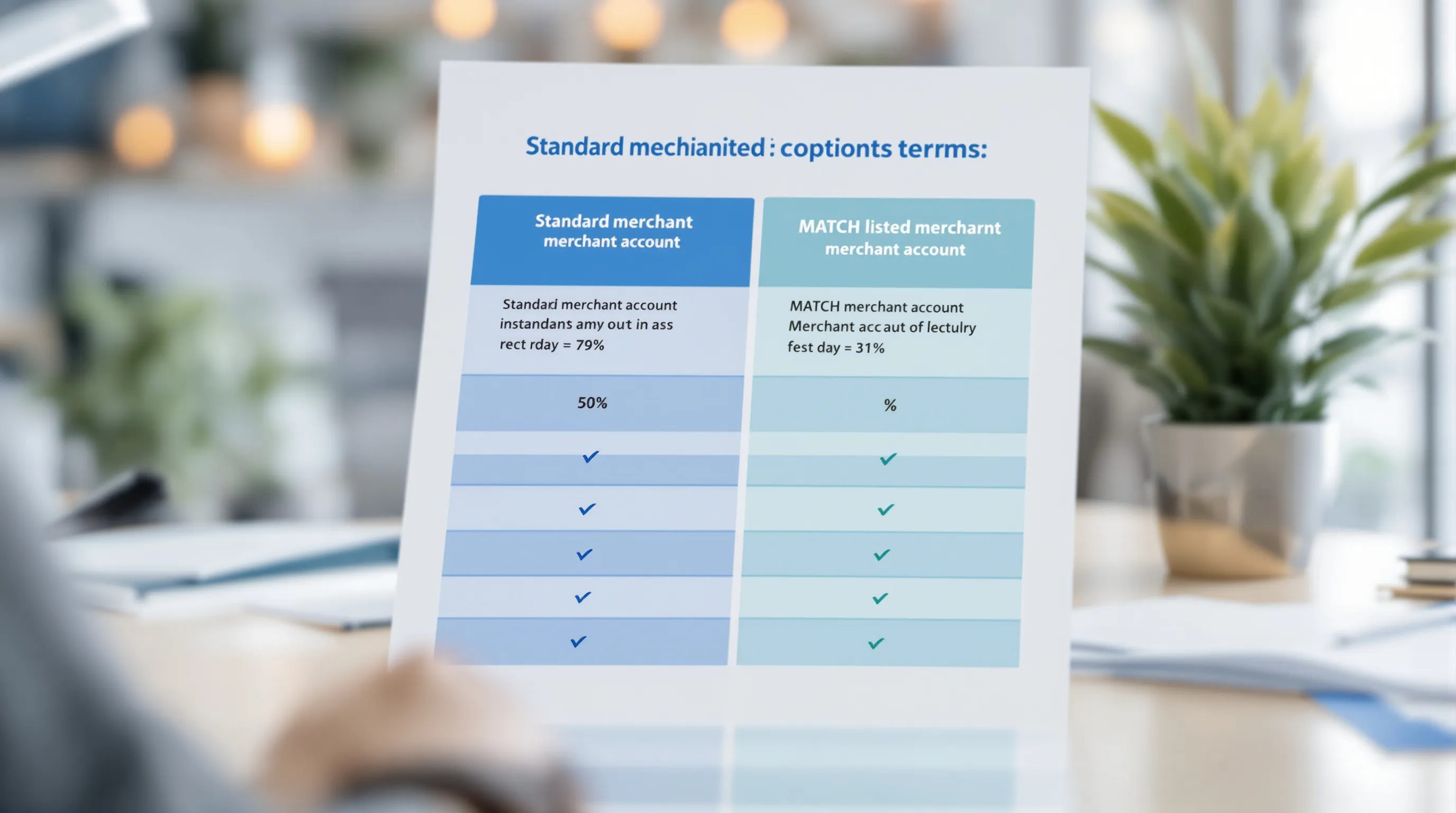
Standard vs. MATCH-Listed Merchant Account: What Changes
| Factor | Standard Merchant Account | MATCH-Listed Merchant Account |
|---|---|---|
| Processing rate | 1.5% to 2.5% + per-transaction fee | 3.5% to 5.5% + per-transaction fee |
| Rolling reserve | None or 0% to 5% | 10% to 25% of monthly volume |
| Reserve hold period | Not applicable | 90 to 180 days before release begins |
| Approval timeline | 1 to 3 business days | 3 to 7 business days with full documentation |
| Monthly volume cap | None (standard) | May apply initially; grows as history builds |
| Processor type required | Any processor | High-risk specialist only |
| Contract term | Month-to-month common | 1 to 3 year term possible; varies by underwriter |
What Documentation Speeds Approval
A MATCH-listed merchant who comes prepared moves significantly faster through underwriting. The documents that matter most:
- Chargeback history and root cause analysis: a clear-eyed account of what drove the chargebacks and what you have changed since
- Three to six months of recent bank statements: demonstrates current cash position and ongoing revenue
- Processing history if available: shows volume trends before and after termination
- Voided business check and articles of incorporation: standard business identity verification
- Government-issued ID for all principals with 20% or more ownership stake
- Website or business overview: shows the business is operational and the product or service is clearly described
- PCI compliance documentation if relevant to your listing reason
The single most persuasive document is a coherent chargeback remediation narrative. Underwriters want to see that you understand what went wrong and have taken concrete steps, whether that is clearer refund policies, better customer service, improved billing descriptors, or tighter subscription cancellation workflows. Evidence of change is more compelling than any justification for the past. You can see exactly what high-risk underwriters need in our documentation guide for high-risk applications.
What Does Card Processing Really Cost with a MATCH Listing?
The honest answer: more than a clean merchant account, and less than a five-year revenue gap.
MATCH-listed card processing carries a real cost premium, and businesses deserve a straight look at the numbers before they decide whether to pursue it.
Rate and Fee Structure
Processing rates for MATCH-listed merchants typically fall between 3.5% and 5.5% per transaction, depending on your industry, average ticket size, chargeback history, and specific reason code. Card-present transactions trend toward the lower end of that range. Card-not-present (meaning online, phone, or recurring billing) sits toward the higher end because the fraud profile is different. As the industry rightly recognizes, choosing the wrong processor costs far more than a higher rate: account reviews, held funds, unnecessary reserves, or termination all carry compounding costs that dwarf a percentage point difference in fees.
Per-transaction fees generally run $0.15 to $0.40 per transaction, compared to $0.10 to $0.20 at a standard merchant account. Monthly statement fees and PCI compliance fees apply as they would with any processor.
The Rolling Reserve Explained
The rolling reserve is the aspect of MATCH processing that surprises merchants most. Here is how it works: a percentage of each batch (in my experience structuring MATCH-listed accounts, typically 10% to 15% for most approvals) is held in a reserve account for a defined period, usually 90 to 180 days. After that hold period, funds release on a rolling basis. So if you process $100,000 in month one at a 10% reserve with a 90-day hold, that $10,000 releases in month four while a new 10% reserve accumulates from month four's volume.
The reserve is not a fee: you get that money back. But it does create a short-term cash flow gap when you first start processing. Businesses with strong cash reserves weather this comfortably. Businesses running lean may need to plan around it. If you have held funds from a prior termination, our guide on unfreezing reserves on a terminated account covers options worth exploring in parallel.
Real-World Cost Comparison: Standard vs. MATCH Processing
To make this concrete, consider a business processing $150,000 per month in credit card revenue:
| Cost Element | Standard Account (2.3%) | MATCH Account (4.2%) | Monthly Difference |
|---|---|---|---|
| Processing fees | $3,450 | $6,300 | $2,850 more |
| Reserve withheld (first 90 days) | $0 | $15,000 (10% held) | Cash flow timing only, returned after hold |
| Per-transaction fees (500 txn/mo) | $75 | $175 | $100 more |
| Total monthly premium vs. standard | $0 | ~$2,950 more per month | ~2% effective rate premium |
That roughly 2% effective premium is the real cost of the MATCH listing. Weighed against $150,000 in otherwise inaccessible monthly revenue, most businesses find the math straightforward. For a fuller look at what high-risk accounts cost at different tiers, see our breakdown of what to expect to pay for a high-risk merchant account.
How Quickly Can a MATCH-Listed Merchant Get Approved?
With complete documentation submitted upfront, most MATCH-listed merchants receive an underwriting decision in 3 to 5 business days. Incomplete applications (missing bank statements, unsigned agreements, no chargeback explanation) stretch that timeline to one to two weeks or result in a decline that could have been an approval with better preparation.
The factors that accelerate approval:
- Clean listing reason (code 4 or code 12 generally move fastest)
- Time elapsed since the listing event: six or more months of post-termination history helps significantly
- Demonstrated chargeback mitigation steps taken
- Business volume above $25,000 per month (established revenue history demonstrates viability)
- No criminal history for principals
The factors that slow approval or result in a decline:
- Laundering, fraud conviction, or collusion listing codes (03, 07, 11)
- Multiple MATCH listings across different business entities
- Ongoing chargeback disputes not yet resolved
- Business principals with felony convictions
- Inability to document what changed since termination
How SeamlessChex Works with MATCH-Listed Merchants
SeamlessChex specializes in high-risk credit card processing for TMF/MATCH-listed businesses that standard processors turn away. When a business comes to us with a MATCH listing, our underwriting team reads the reason code, reviews the documentation, and structures an account with terms calibrated to the actual risk profile, not a blanket rejection based on a database flag. Businesses we work with are established operations processing at least $25,000 per month. If your business meets that threshold and has a MATCH listing, the conversation is worth having.
What Will Matter Most in the Next 12 to 24 Months After Approval?
Getting approved for card processing as a MATCH-listed merchant is step one. What you do in the months after approval determines whether your account stays open, whether your reserve releases on schedule, and whether you have a path to better terms at renewal. In my experience, the merchants who manage this well treat the first 12 months as a probationary period worth taking seriously, because it is.
Chargeback Management Is the Non-Negotiable
Your chargeback ratio is the number your processor watches most closely after approval. Visa's monitoring threshold sits at 0.9% and Mastercard's at 1%. Exceed either of those for two or more consecutive months and you risk re-entering a monitoring program, which can trigger additional reserves or account termination. For a MATCH-listed merchant who already has one termination on record, a second event is significantly harder to recover from.
The controls worth prioritizing immediately after approval:
- Billing descriptor clarity: your business name as it appears on a customer's card statement should match what they recognize from the purchase. Unrecognized descriptors are the single most preventable chargeback trigger.
- Cancellation and refund policies clearly visible at checkout: disputes arise most often when customers feel they could not find the cancellation path. Make it obvious before the transaction, not buried in the terms.
- Proactive customer service: a customer who reaches your team before filing a dispute is a resolved issue. One who cannot reach you files a chargeback. Response time matters more than most merchants realize.
- Order confirmation and delivery confirmation emails: documentation that a transaction was fulfilled, sent to the customer at the time of fulfillment, is your first line of evidence if a dispute is filed.
- Fraud screening on card-not-present transactions: CVV matching, AVS (Address Verification System), and velocity filters reduce fraudulent transactions that would otherwise result in chargebacks you cannot win.
Reserve Release: What to Expect and When
Most MATCH-listed accounts are structured with a rolling reserve held for 90 to 180 days. The release process is not automatic in every case: some processors require you to formally request a reserve review. Track your reserve balance and the release schedule in your processing agreement from day one. After 90 to 120 days of clean processing, it is reasonable to contact your processor and ask for a reserve review, particularly if your chargeback ratio has been below 0.5% over that period.
At the 12-month mark, your processing history (volume, chargeback ratio, dispute win rate, returns rate) becomes the basis for renegotiating your reserve percentage and potentially your processing rate. A merchant who enters a MATCH account at 4.5% with a 15% reserve and maintains clean metrics for 12 months has real leverage to negotiate toward 3.8% with a 10% reserve at renewal. It is not guaranteed, but it happens, and it starts with the decisions you make in month one.
Protecting Against a Second Listing
If your MATCH listing expires at the five-year mark, avoid the pattern that created the first one. Card network monitoring programs are cumulative: a merchant who exits the five-year window and immediately returns to the same processing behaviors that triggered the original listing is at elevated risk of a new termination. The same chargeback management disciplines that protect your MATCH-listed account also protect any future standard account you may qualify for after the listing expires.
One structural consideration worth discussing with legal counsel: if your listing was applied at the entity level and not the individual principal level, a new business entity may have processing options that the listed entity does not. This is not a workaround to be pursued without professional guidance, but it is a legitimate consideration that some merchants in specific listing circumstances have used to maintain operational continuity.
Looking Ahead to 12-24 months
Where MATCH/TMF-Listed Merchants Get Processing Next
Three forecasts on how MATCH- and TMF-listed merchants will find and keep card processing over the next 12 to 24 months.
What Happens Next For MATCH-Listed Merchants
Use these forecasts to gauge how processing options, network enforcement, and alternative rails may shift for high-risk merchants.
Demand for tailored high-risk processing in categories like subscription/recurring billing and nutraceuticals will keep pushing processors to build vertical-specific approval paths over the next 12-24 months, even as card networks tighten ratio-based monitoring programs like MATCH, ECP, and VAMP.
Over the next 12-24 months, specialized high-risk payment providers will continue to approve MATCH- and TMF-listed merchants at higher fees, letting some businesses keep processing volumes like the reported $500k/month even while blacklisted.
As commercial Variable Recurring Payments and other account-to-account rails expand toward Bain's projected 'peak card' point in the US by 2029, MATCH/TMF listing will matter less for merchants able to shift recurring revenue off card rails, even though card networks keep enforcing MATCH/TMF rules strictly in the near term.
Early, Unconfirmed Signals Merchants on the MATCH list report processing $500k/month through specialized providers, and firms like Merchant Advice Service say they 'regularly' place business owners rejected elsewhere. cVRPs already cover about 80% of UK consumer bank accounts and settle same-day, while GoCardless finds 38% of consumers (60% of Gen Z) are open to using them, and average Direct Debit relationships already run 38 months versus 14 months on card. Buyers are actively asking how subscription businesses get approved for recurring billing merchant accounts and where to find processing for nutraceutical and high-risk e-commerce stores, while card networks now track merchants by dispute ratios rather than raw dispute counts.
Evidence Behind Each Forecast
Each forecast lists the merchant reports and industry data that support it alongside sources that point the other way.
- How to Stay Out of ECP, MATCH, and VAMP as a Shopify Store is the strongest public backing for this call. [Substack / Newsletter]Article published March 16, 2026 (paid/subscription post) by author "Amber the Chargeback Nerd" on Substack ("Chargeback Nerd" publication, © 2026). “You can follow Shopify's guidance, submit perfect evidence, and win disputes - and still end up in a card network monitoring program.”
- Business Identity Theft and the MATCH List (What Merchants Should is the strongest argument against it. [Video]Match reason code 14 = merchant account opened/used fraudulently using stolen data (identity theft category). “As a business owner, being matchlisted or being put on the TMF, terminated merchant file is equivalent to being bankrupt in the financial world.”
- Is there any hope when you land on the TMF? cuts the other way. [Community / Forum]Original poster (OP) states they were told by one bank that they were on the TMF (Terminated Merchant File), also referred to as the MATCH list, after being denied processing on the third attempt. “I'd love to submit my site as is and have the chance to fight the TMF decision but how can I learn more about this listing and how it effects me?”
- Backing it: Understanding the MATCH List. [Community / Forum]The MATCH List (Member Alert to Control High-Risk) is a database maintained by Mastercard. “There's a part of the payment world that doesn't get much attention until it becomes a serious problem: the MATCH List.”
- How I still process $500k/month on the MATCH list points the same way. [Video]MATCH is a blacklist maintained by Visa; TMF ("Terminated Merchant File") is Mastercard's equivalent version of the same list. “you could be told you were on Match but you could have been placed a year before but you just didn't know”
- The case rests on Although Widely Reported, Be Careful And Take An Honest And. [Blog]Libby James is co-founder of Merchant Advice Service, based in the UK. “I spent over a decade working in estate agency and then mortgage advice, in a highly regulated environment.”
- Against it: MATCH List Removal & Asset Protection Strategies. [Video]MATCH stands for Member Alert to Control High Risk Merchants, a database maintained by MasterCard that is checked by effectively every major processor before approving a new merchant. “That's not an inconvenience. That's the lights going out.”
- Business Identity Theft and the MATCH List (What Merchants Should complicates the call. [Video]Being matchlisted/placed on TMF (Terminated Merchant File) blocks a business from obtaining payment processing anywhere.
- Backing it: MPE Special - Business of Payments. [Substack / Newsletter]MPE (Merchant Payment Ecosystem) conference took place in Berlin, occupying the entire Berlin Intercontinental hotel for the first time. “Bain has predicted 'peak card' in 2029 in the US but probably a little earlier in Europe where national account to account (A2A) schemes are growing swiftly…”
- How to Stay Out of ECP, MATCH, and VAMP as a Shopify Store is the clearest counter-signal. [Substack / Newsletter]Piece is framed as a follow-up to a prior post about Shopify disputes ("responding correctly"), this one addressing long-term survival in card network monitoring programs.
- Pushing back: BS with Stripe and the merchant MATCH list. [Community / Forum]OP received an email from Stripe stating: "it looks like your website, [domain name], or a previous business you were associated with, is listed on MATCH or another terminated merchant file operated by the card networks," with account… “So unfortunately, if you're on the list, your other payment processors will eventually scan your account and kick you off too.”
What Could Change These Forecasts
Shifts in card network enforcement or payment rail adoption could speed up or slow down these outcomes.
Confidence, With Limits
77 reflects our strongest conviction, while 57 is where we are most prepared to be wrong.
- A reversal by regulators or buyers undercuts Vertical-specific high-risk onboarding keeps expanding before anything else.
- If the balance of sources tips against the consensus, Card network leverage may soften as A2A rails mature becomes the safer call.
A MATCH listing is a significant obstacle, I won't minimize that. It closes off the standard processing market entirely, it carries a real cost premium, and it requires more documentation and preparation than a typical merchant account application. But it is not a five-year sentence on your revenue. It is a classification that a segment of the payment processing market is specifically built to accommodate.
The businesses that navigate a MATCH listing successfully share a few things in common: they know their reason code, they understand what changed since the termination, they come to the application prepared, and they choose a processor with genuine high-risk underwriting experience rather than one that markets to MATCH merchants without the infrastructure to approve them. I have seen businesses on the MATCH list get approved, build solid processing history over 12 to 18 months, and reach a point where the listing is a smaller part of their story than their current chargeback management program.
If your business is on the MATCH list and you are ready to start the conversation, SeamlessChex reviews MATCH applications with a direct underwriting process: no forms submitted to a processor that already declined you, no runaround. You can reach us at seamlesschex.com/contact to get started. Established businesses processing $25,000 or more per month are eligible to apply, and we will tell you quickly whether we can help.
Written by
Jonathan Albert
Co-Founder, SeamlessChex
Jonathan Albert is Co-Founder of SeamlessChex, a credit card processing and fintech payments platform recognized on the Inc. 5000.
Connect on LinkedInFrequently Asked Questions
Can a business on the MATCH list get a credit card merchant account?
Yes. Standard processors (Stripe, Square, PayPal, most banks) will auto-decline a MATCH-listed application without human review. High-risk processors operate differently: they evaluate your specific reason code, review your current business profile, and make an underwriting decision based on what the risk costs to price, not whether to price it. Most businesses listed under reason code 4 (Excessive Chargebacks) qualify for approval through a high-risk underwriter. Codes tied to fraud conviction, laundering, or collusion are significantly harder to approve.
How long does it take to get approved for card processing with a MATCH listing?
With a complete application (recent bank statements, chargeback history, a written explanation of what changed, and standard identity documentation), most MATCH-listed merchants receive an underwriting decision in 3 to 5 business days. Incomplete applications extend that to one to two weeks. The single biggest delay factor is a missing or vague chargeback remediation narrative. Underwriters need to see that you understand what triggered the listing and what you have done differently since.
What does card processing cost when you're on the MATCH list?
Expect processing rates between 3.5% and 5.5% per transaction and a rolling reserve of 10% to 25% of monthly volume held for 90 to 180 days. Per-transaction fees typically run $0.15 to $0.40. The reserve is not a permanent fee: funds release on a rolling basis after the hold period. For a business processing $150,000 per month, the effective rate premium over a standard account is roughly 2% of volume, or about $2,950 per month more in processing costs.
What is a rolling reserve and do I have to pay it?
A rolling reserve is a percentage of each processing batch withheld in a reserve account for a defined period, typically 90 to 180 days, before releasing back to you. It is not a fee: you get the money back. It functions as collateral against chargeback losses during the early months of a new processing relationship. Most MATCH-listed accounts are structured with a 10% to 15% reserve. Once your account demonstrates clean chargeback history over several months, the reserve percentage can often be renegotiated at renewal.
Can I dispute or remove my MATCH listing?
Yes, in certain circumstances. If you believe the listing was applied in error (for example, your identity was stolen and a fraudulent merchant account was opened using your business credentials), you can dispute it by filing a police report and submitting documentation to the processor that placed you on the list. Identity-theft-based removals typically take 30 to 60 days. If the listing is accurate (for instance, you genuinely had excessive chargebacks), formal removal before the five-year mark is difficult. In that case, working with a high-risk underwriter is the faster path to resuming card processing.
Which MATCH reason codes are most likely to get approved for processing?
Reason code 4 (Excessive Chargebacks) is the most approvable and the most common: it is a business operations problem that can be priced. Reason code 12 (PCI Non-Compliance) is also workable once compliance is restored. Moderate approval likelihood applies to codes 01 (Account Data Compromise), 02, 06, 08, 09, and 10. Very low approval likelihood applies to codes 03 (Laundering), 07 (Fraud Conviction), 11 (Merchant Collusion), and 13 (Illegal Transactions), where most underwriters decline regardless of time elapsed.
Does SeamlessChex work with MATCH-listed businesses?
Yes. SeamlessChex reviews TMF/MATCH-listed applications through a direct high-risk underwriting process. We evaluate your reason code, review your current business profile, and structure account terms (rates, reserve, volume limits) that reflect the actual risk rather than simply declining because of the listing. Eligibility requires an established business processing at least $25,000 per month. You can start the process at seamlesschex.com/tmf-match-list-merchant-accounts or contact us directly through seamlesschex.com/contact.
SeamlessChex onboards established merchants; the practical minimum is $25,000 in monthly payment volume.