


Quick Answer
Renewals often decline after a processor switch because the original network transaction ID didn't migrate, so each charge reaches the issuer as an unanchored merchant-initiated payment, even when every card token transferred cleanly.
Carry the raw ID over. Flag every renewal as merchant-initiated. Then sort the declines by date and by who refused them, because a new processor's risk rules can stop renewals before any bank sees them, and insufficient funds keeps declining cards no matter which processor sends them.
Key Points
- A renewal missing the original network transaction ID reaches the issuer as an unanchored merchant-initiated charge, even when every card token transferred cleanly to the new processor.
- In a 2026 r/PaymentProcessing thread, practitioners noted that NMI returns a normalized network transaction ID, which one commenter said cannot be reused directly on Stripe.
- Beast Insights says about 15% of recurring transactions are declined, citing Visa and Mastercard data, so migration declines hide inside an already high baseline.
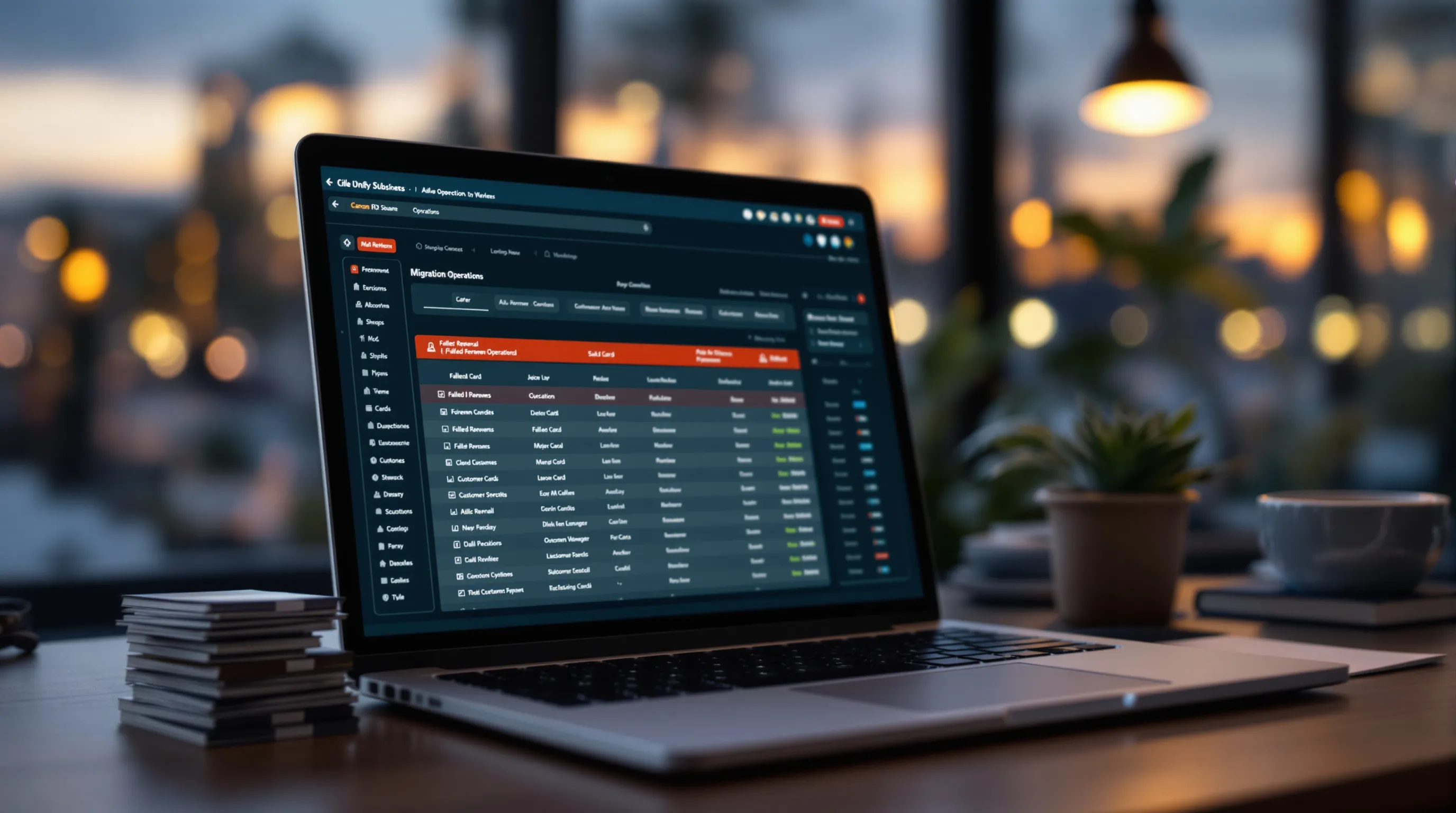
Renewal declines after a processor switch often trace back to a missing network transaction ID, not a broken card.
Your tokens moved. Your renewals still failed. If that sequence sounds familiar, the culprit is often something no migration export screen shows you: the network transaction ID that tied each subscription to the first charge the customer approved.
Most advice about switching processors fixates on whether card tokens survive the move. Often they do. What tends to get lost is the chain behind them, so the new processor sends each renewal as a merchant-initiated charge with no anchor, and issuers respond the way they respond to any unfamiliar merchant pulling money from a card on its own schedule.
The sections below cover:
- Why a clean token transfer can still produce a wave of renewal declines
- What a network transaction ID does, and why some gateways hand back a version another processor cannot reuse
- How to separate a migration decline from the ordinary baseline using the codes and dates you already have
- Where a new processor's own risk rules can block renewals before an issuer ever sees them
One caveat up front. Card network rules shift on their own calendar, and Visa and Mastercard tend to roll out rule and fee changes in spring or fall with no review period for merchants, so some declines would arrive with or without a switch. I'd still rule out the broken chain first, because it is the one piece of the problem a merchant can actually repair.
The figure that would settle the debate, renewal approval rates for migrated merchants with the original ID carried over against those without it, is not on record yet. What follows is built from practitioner accounts and payment industry sources instead.
A processor switch rarely breaks the card. So ask your team one plain question first: did anything besides the token come across? The research section below walks through why that kind of break hides among ordinary declines, and what your decline codes can and cannot tell you about it.
Practitioners in a 2026 r/PaymentProcessing discussion about migrating subscription cards laid out the mechanics plainly: "The first transaction in a subscription chain generates an NTID (Network Transaction ID) from the card brands." Later charges should carry that ID so the issuer knows they belong to the same chain, with no need to collect the security code again. The same thread flagged a catch. NMI returns a normalized version of the ID, which one commenter said cannot be reused directly on Stripe, and the thread offered no confirmed fix.
The trade-off deserves honesty. Recovering the original ID takes coordination across four parties (the merchant, the outgoing processor, the incoming processor and the billing platform), and living with the declines can look easier. I'd argue the math rarely favors walking away from your most loyal subscribers.
Most migration plans stop at the token. The sections below pick up exactly where they stop: what a renewal has to carry when it reaches the issuer.
Why do renewals decline after switching payment processors?
Renewals usually decline after a switch because each charge arrives without the history tying it to the customer's first approved payment, so issuers treat loyal subscribers like strangers.
Before you ask a single subscriber for a new card, work through these steps in order:
- Confirm whether the declined cards renewed successfully before the migration.
- Separate the first renewal after the switch from later renewals already processed on the new account.
- Find out whether the decline came from the issuing bank or from the new processor's own risk screening.
- Ask the new processor whether your renewals reference the original transaction from the old processor.
In 2025, a subscription merchant posting in the r/stripe community described about 10% of legitimate, vetted payments being declined after a year of virtually no declines at all. The cards were not expired. They had already cleared the card number, ZIP and security code on earlier charges, then failed on the second, third, or even seventh recurring payment. The reasons the merchant saw were the usual fog: "Generic decline," "Insufficient funds," "Do not honor," "Try again later." That merchant wasn't migrating. Their thread still shows exactly what a broken renewal looks like from the dashboard.
A 2022 thread in the same community showed the same shape from a different angle. The operator found no fraud and no pattern, yet some declined customers said they could pay other services that use Stripe without trouble.
That detail matters. A card that works elsewhere is not a dead card. The problem sits in how one merchant's charge reaches the issuer.
Two separate merchant threads, three years apart, describe that same pattern: proven cards, vague codes, and subscribers who can pay everywhere except one merchant's renewal run. Now add a processor switch on top of it, and the pattern gets sharper, because the switch is the moment the renewal loses its past.
The common assumption after a migration is that the card tokens broke. Sometimes they did. But when the card number arrived intact and the customer can still pay elsewhere, I don't think the token is your problem. What usually went missing is the reference back to the original approved payment, the piece of data that tells the issuer this charge belongs to a subscription the cardholder already agreed to.
Our underwriting team makes a related point about how processors read a business: the processor isn't really pricing the product on the application, it's pricing the shape of the operation underneath it. Issuers read a renewal in a similar way. A renewal carrying its history has one shape. The same charge stripped of that history has another, and it looks a lot more like an unexpected card-not-present payment from a merchant the bank has never seen before.
That is why I would hold off on any customer outreach until the four steps above are done. Re-carding a subscriber whose card is perfectly healthy spends goodwill to fix a problem that lives inside your own payment setup. If you are still choosing where to land after a closure, it pays to evaluate merchant payment processing solutions on how they handle recurring history, not only on rates and approval speed.
The next question is what that missing history actually is, and why issuers care about it so much on a renewal.
What is a network transaction ID and why does a renewal need one?
A network transaction ID is the reference the card brands issue on a subscription's first charge. Every later renewal should carry it, proving the charge belongs to an agreement the cardholder already approved.
Think of it as the receipt number for the customer's original consent. A practitioner in the r/PaymentProcessing community put the mechanics plainly in 2026: "The first transaction in a subscription chain generates an NTID (Network Transaction ID) from the card brands." That same commenter explained that the NTID should be passed with subsequent transactions to show they are part of the same chain, which removes the need to collect the card's security code again.
The ID only works if two kinds of charges are labeled correctly:
- Customer-initiated transaction (CIT): the first payment, made while the cardholder is present, entering details and agreeing to recurring billing.
- Merchant-initiated transaction (MIT): every renewal after that, charged by the business on a schedule while the cardholder is absent.
An MIT is supposed to point back to the CIT that authorized it. The NTID is that pointer. Without it, the renewal is just a card-not-present charge with no visible history.
| Charge type | Cardholder present? | What the issuer can see | How it tends to be read |
|---|---|---|---|
| First subscription payment (CIT) | Yes | Card details, security code, billing data entered live | Standard card-not-present review |
| Renewal carrying the original NTID (anchored MIT) | No | A link to the approved first charge in the same chain | Continuation of an agreement already approved |
| Renewal missing the NTID (unanchored MIT) | No | A stored card charged by a merchant, with no chain reference | An unexpected charge with nothing to vouch for it |
Issuers lean on that recurring context more than most merchants realize. In a 2023 consumer thread about a lapsed gaming subscription, commenters described banks accepting charges on replaced or expired cards when the charge carried a recurring indicator, while treating one-off purchases far more strictly. That is a consumer forum, not a rulebook. Still, it shows how heavily the recurring label can weigh in an issuer's decision.
Flip that around. If the label and the reference are what earn a renewal the benefit of the doubt, losing them costs you that benefit.
And the merchant isn't always the one who drops them. On a payments podcast hosted by Pagos, veteran payments lead Andy Barker described downgrades caused by wrong data in messages the processor itself formulated and sent, not data his company submitted. His summary: "So you may be charged for something the processor is doing wrong, or there might not even be a mechanism to fix it." That was about fees, not declines. The lesson carries over. What the issuer receives is whatever your processor builds, and you rarely see the raw message.
My advice is to treat the NTID as part of your customer record, as valuable as the card itself. When subscribers keep failing on cards after every reasonable fix, offering bank-account billing through ACH payment online gives them a second rail, though card renewals should stay your primary path.
Which raises the uncomfortable question for anyone who just finished a migration: if every token came across, where did the IDs go?
Why does a broken renewal chain look like an ordinary decline?
In 2026 a subscription business moved to a new processor, and its first recurring charge was refused on a card the customer had already paid with. The card had not changed. Something else had.
The merchant described it on Reddit in May 2026. The new processor marked that first renewal as high-risk, later renewals came back as generic issuer declines, and one-time invoices sent as a workaround failed too. When a card works once and then fails on renewal, one commenter wrote, it is "almost never a dead card." Another suggested the invoices failed because charges with no link to the original agreement "look like unauthenticated card-not-present payments."
How does a renewal lose that link? In a June 2026 practitioner thread, a commenter with experience across several orchestration platforms and vault providers explained that one widely used gateway returns a normalized network transaction ID instead of the raw ID the card brands issued, and another major processor cannot reuse it directly. Their note on the fix: "TBD." The step where the current processor updates the relationship ID with the card networks during a migration got a "TBD" too. A second commenter, who does migration work, said "processor migration and token migration need to be planned together," warning that merchants who skip it can end up "stuck in limbo for months."
The bank's response will not reveal any of this. In April 2025, a different subscription merchant, who did not describe switching processors, reported that about 10% of vetted payments were failing on the second, third or even seventh charge, on unexpired cards, with reasons that were "inconsistent and generic." Commenters noted that processors pass along whatever the issuer sends, and that the codes can be plainly wrong. One merchant's customer answered an "insufficient funds" decline with a screenshot of a five-digit bank balance. Another merchant got "do not honor" on a refund: "Their systems send bogus responses sometimes."
Ordinary declines are already common. Beast Insights, a payment analytics firm, says in a September 2026 roundup that about 15% of recurring transactions are declined, citing Visa and Mastercard data reported by Chargebacks911. The same roundup cites Ethoca research attributing 44.4% of card-not-present issuer declines to insufficient funds. In 2022, a merchant who put their own subscription decline rate near 15% was told the figure was "quite normal." Migration declines add to a rate that already looks alarming, and they arrive with the same codes.
| Possible cause after a switch | What you may see | What the sources suggest |
|---|---|---|
| Renewal not linked to the original agreement | Generic decline or do not honor, on a card that renewed cleanly before the move | Carry the original ID over and send renewals as merchant-initiated from the first cycle |
| The new processor's fraud screen | Renewal blocked as highest risk before it ever reaches the bank | Sort screen blocks from issuer declines. One commenter said allowing customers with a prior successful charge can clear many |
| Whole subscriber base moved overnight | Issuers grow "overly conservative" toward the new merchant account, one practitioner said | Move a small share first, then ramp up |
| Ordinary insufficient funds or a reissued card | Insufficient funds or a generic decline. One merchant reported much higher failure rates on debit cards | Time retries near paydays, and refresh stored cards with an account updater or network tokens |
The instinct to keep retrying until a charge clears runs into network rules. One practitioner warned that retrying immediately "reads as spam to the network." Beast Insights puts it more bluntly: "blind retry loops are now a cost center."
20 and 35
Visa allows up to 20 reattempts per card in a rolling 30-day window, raised from 15 in May 2025, and charges a fee from the 21st attempt. Mastercard allows 10 retries in 24 hours and 35 in 30 days on the same card and merchant. Some Mastercard advice codes mean do not retry at all.
Migration checklists miss the problem for a reason. A renewal that has lost its history fails with the same vague codes as a customer who was short of money that week, inside a decline rate that already looks high. The code cannot separate the two. The card's own record can: clean renewals on the old processor, then a refusal on the first cycle after the move. We set up merchant accounts for subscription businesses that switch processors, so we have a stake here. Most of this evidence comes from practitioners describing their own accounts, so test the pattern against your own data.
- Before you move, ask your outgoing processor whether it can export the raw network transaction IDs the card brands issued, not normalized references, and ask the incoming processor whether it can send them with the first renewal.
- Separate renewals blocked by the new processor's fraud screen from declines the issuer returned. Then split first charges, renewals and invoices before you change any settings.
- For every issuer decline after the switch, check whether that card renewed cleanly on the old processor. If a card with months of clean history comes back "insufficient funds," investigate before you accept the code.
- Record your renewal decline rate for several cycles before you migrate, so you have a real baseline to compare against afterward.
- Read the decline code before you retry, count attempts against the network caps, and ask the new processor whether you can move subscribers in batches.
How we checked this
We read four practitioner discussions on Reddit from 2022 to 2026, a payment analytics roundup and a chargeback vendor's guide to involuntary churn. No figures in this section come from our own data. The Reddit accounts are individual merchants and commenters describing their own experience, so they can show what happens but cannot show how often. The roughly 15% decline rate and the Ethoca figure are secondhand, cited by Beast Insights. Beast Insights sells payment analytics and Chargeflow sells chargeback recovery, and we set up merchant accounts for subscription businesses, so all three of us have a commercial stake. Still unknown: how many migrations lose the original ID, and how much of a decline spike after a switch that loss explains.
- Reddit, practitioner thread on migrating subscription card tokens, June 8, 2026.
- Reddit, merchant thread on renewal declines after a migration, May 29, 2026.
- Reddit, merchant thread on declines of vetted subscription cards, April 22, 2025.
- Reddit, merchant thread on subscription decline rates, October 19, 2022.
- Beast Insights, failed payment statistics roundup, September 10, 2026.
- Chargeflow, guide to involuntary churn and network retry limits, September 14, 2026.
How do you tell a migration decline from an ordinary decline?
Compare the declined renewals against the switch date. Cards that renewed cleanly before migrating and fail right after point to a broken chain, not an ordinary card problem.
Ordinary declines never go away. Figures from one payments analytics vendor, citing Visa and Mastercard data, put declines at approximately 15% of recurring transactions, and the same vendor cites Stripe's estimate that roughly 33 to 40% of cards are reissued in any given year. Some renewals were always going to fail. The job is to find the extra failures the migration added on top.
A 2026 thread in the r/stripe community shows how that looks in practice. A subscription software merchant moved to Stripe, and the first recurring charge after the migration was declined and deemed high-risk, on the same payment method the customer had used initially. When the merchant tried sending one-time invoices instead, those failed too. One commenter's read: "Your "same card worked the first time, then failed on the recurring charge" detail is the big tell; that's almost never a dead card." Another narrowed it further: "It's either Radar or the renewal not being linked to the original payment mandate."
That second line is the whole diagnosis in one sentence.
A third commenter suggested pulling 20 to 30 recent declines and sorting them before changing anything. I'd make that the first job of the week after any migration. Sort along four lines:
- Charge type: first charge, renewal, or manual invoice on a saved card.
- Who declined: the issuing bank, or the processor's own risk screening before the bank ever saw it.
- Card profile: brand, issuing country and BIN.
- Session: cardholder present (on-session) or absent (off-session).
| Signal | Points to a migration chain break | Points to an ordinary decline |
|---|---|---|
| Card history | Renewed cleanly on the old processor, fails on the first renewal after the switch | Fails regardless of when it migrated |
| Timing | Failures bunch up in the first billing cycle on the new account | Failures spread evenly across billing cycles |
| Workarounds | Manual invoices on the same saved card also fail | A retry or card update recovers the payment |
| Customer experience | Subscriber can pay other merchants with the same card | Card was replaced, closed or short on funds |
| Cluster | Concentrated in the migrated cohort, across brands and banks | Clustered by card brand, country or BIN |
The invoice detail deserves a second look. A manual invoice on a stored card has neither the customer present nor a reference to the original approval. Banks decline those more often, one commenter noted, because they look like unauthenticated card-not-present payments. So when invoices fail alongside renewals, the card is rarely at fault. The charge is.
Here's how I read the sort once it's done. If failures concentrate in the migrated cohort and on cards with clean history, the chain broke. If they follow card brands or countries, you are looking at an acceptance or issuer pattern that would have shown up anywhere. Merchants running high-volume credit card processing feel this split most, because a few points of misread declines turn into a large monthly number fast.
One bucket in that sort needs its own attention, though: the declines the issuer never saw.
Which processor should you choose after renewals start declining elsewhere?
Choose one that will import your original network transaction IDs, flag renewals as merchant-initiated from the first cycle, and report approval rates before you move your whole subscriber base.
A switch should not cost you your best customers. Yet one 2026 migration showed exactly that risk, when the first renewal on an unchanged card came back flagged as high-risk. Tokens moved. The chain did not.
Over the next year or two, I expect subscription merchants to treat the network ID as an asset they own rather than a field their old processor happens to hold. Practitioners who run these moves already say processor migration and token migration "need to be planned together," and that the token requestor ID should be "merchant-specific rather than PSP-specific." Both are portability questions. Ask them before you sign.
My blunt advice: if a prospective processor cannot explain how it accepts imported network IDs, keep looking.
One number is still missing from this debate. Renewal approval rates for migrated merchants that carried the original ID over, set against those that did not, are not on record yet, and I won't guess at them. Until that comparison exists, every renewal sent without its anchor asks an issuer to trust a merchant it has never seen, and the first billing cycle after go-live is where that request gets answered.
Frequently Asked Questions
What else do subscription businesses ask about renewal declines after a processor switch?
Most post-migration renewal questions come down to how the charge is flagged, what the decline code really means, and whether the card itself still works.
Should I ask subscribers for a new card after switching processors?
Usually not as a first move. When cards renewed cleanly before the switch and fail right after it, the problem most likely sits in how the new processor presents the renewal, not in the card. I'd hold that customer email until you have sorted the declines, because asking loyal subscribers to re-enter details spends goodwill you may not need to spend.
What is a merchant-initiated transaction?
A merchant-initiated transaction is a charge the business starts on its own schedule, under consent the customer gave on an earlier payment. Scheduled renewals belong in this category. Practitioners in a 2026 r/stripe discussion stressed that the first payment establishes consent and authentication, and that wrong indicators make issuers "more aggressive with declines."
Why do generic decline codes tell me so little?
They were never built to explain much. On the Pagos podcast Real Talk Payments, payments veteran Andy Barker recalled that in the late '90s there were only a handful of decline codes, and a generic catch-all his team called "the slush bucket" was the number two decline on his system. Insufficient funds was always number one. A generic code alone does not prove a migration fault.
Can a recurring flag cause problems on an old card?
Yes, in both directions. In a 2023 r/PlayStationPlus thread, one subscriber described a delayed renewal that went through on an old card, which their bank then treated as fraudulent and reversed through a chargeback. Recurring flags carry real weight with issuers. Getting them right matters as much as having them at all.
Will network tokens fix post-migration declines on their own?
They help, but they are not the whole answer. Albert Drought argued on the same podcast that network tokenization is underused for sending richer data to issuers, noting that "there is a spec that could be used." Tokens refresh card details. They do not rebuild a broken transaction chain.
How quickly can SeamlessChex onboard a subscription business?
We offer same-day onboarding with no contracts for established subscription and high-risk businesses, with credit card processing as the core service and ACH as a supporting option. Reach our team through the SeamlessChex contact page to start the conversation about your renewal history.
Written by
Jonathan Albert
Co-Founder, SeamlessChex
Jonathan Albert is Co-Founder of SeamlessChex, a credit card processing and fintech payments platform recognized on the Inc. 5000.
Connect on LinkedInSeamlessChex works with established businesses processing a minimum of $25,000 per month.