



Card authorization completes in roughly two seconds. The same card network that approved that transaction will take two to five business days to fund the merchant's account, and for high-risk merchants, that window routinely stretches to ten days or longer. US interchange fees totaled $111.2 billion in 2024, four times the 2009 level, and the float earned on funds held during the settlement window adds meaningfully to that figure. This is not a network problem. The delay is deliberate, and the economics of who earns during the wait explain almost everything.
The short answer: Card settlement is slow because multiple parties in the payment chain earn interest on float during the window between authorization and fund release, and processors layer risk holds on top of that baseline to buffer against chargebacks. The card networks themselves authorize in seconds and are actively building intraday and stablecoin settlement options. The slowness is in the economics, not the infrastructure.
I've spent years working with merchants across high-risk industries who absorb settlement delays that cost them real operating capital. Understanding where the delay actually originates is the first step toward negotiating it down, and the answer is not what most explainers tell you.
Questions this article answers
- Why do credit card payments take so long to reach my account?
- What is a rolling reserve and how long does my processor hold my funds?
- How can I get faster settlement as a high-risk merchant?
Why Your Transaction Clears in Seconds but Your Money Takes Days
The card authorization system is genuinely fast. When a customer swipes, taps, or enters card details online, an approval or decline returns in roughly two seconds.
That response travels from the merchant's acquiring bank through the card network to the customer's issuing bank, runs three simultaneous checks, and routes the answer back. No human reviews it. No queue holds it. The network does exactly what it was built to do.
What has not happened at that moment is any movement of money. Authorization is purely a data transaction. The issuing bank has reserved the amount against the cardholder's available balance, but the merchant's account has not received a single dollar. As one widely cited walkthrough of card payment mechanics puts it: "At authorization, the money usually hasn't moved yet. What's happened is a hold or authorization lock."
The card industry operates on what payment professionals call a two-message system. The first message is the authorization request and response, which moves at digital speed. The second message is clearing and settlement, and it runs on a completely different timeline. Merchants typically batch their daily transactions at the end of the business day and submit them through their processor to the acquiring bank, which routes them through the card network to each issuing bank for reconciliation. That batch process triggers the actual movement of funds.
This two-message design is not an accident or a legacy limitation. It exists because the flexibility between authorization and final posting amounts requires it. A hotel that pre-authorizes $500 for incidentals can post $0 if no extras are consumed. A restaurant adds a tip after authorization. A furniture retailer authorizes on order date but waits to post until the product ships weeks later. A payment industry veteran who spent 20 years in credit card processing explained it plainly: "In the case of credit transactions, the authorization amount can be different from the final posting amount. You can't do that with debit."
The two-message architecture explains the structure of the delay. It does not explain the timeline. If the posting message is a second, separate data transmission, why does it take two to five business days, and sometimes ten or more, to result in funded merchant accounts? The answer is not in the technology. It's in who benefits from the waiting period. To understand what actually holds the money, you need to follow the float.
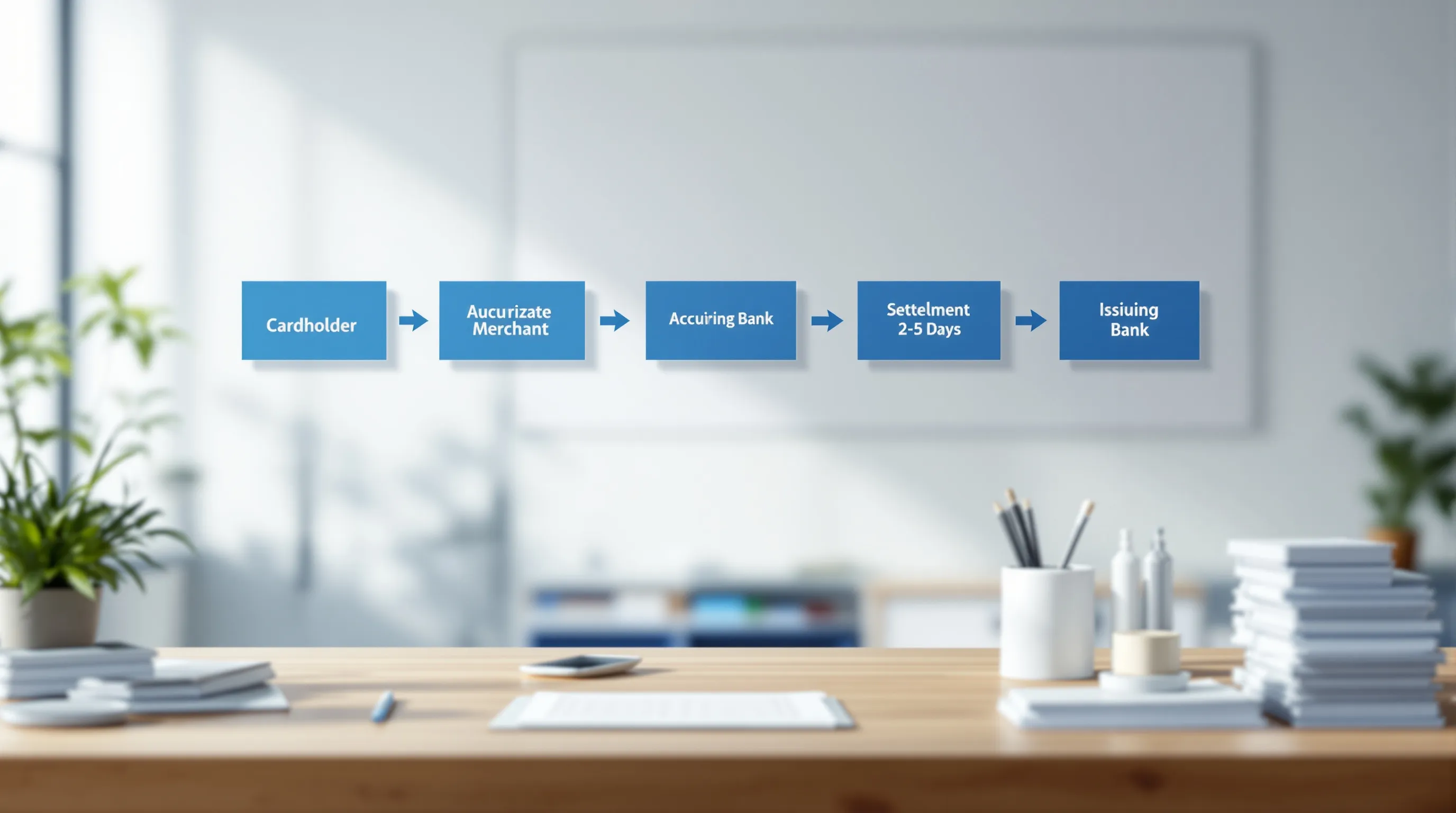
Float Is a Revenue Line, Not a Rail Limitation
Float is the gap between when money is obligated and when it is released. In every payment system, that gap has value, and that value accrues to whoever holds the funds during the wait.
In the card settlement chain, the entities holding the funds are the issuing bank, the processor, and sometimes the platform sitting between the processor and the merchant. All of them earn on the window. None of them advertise it.
Wilson Harmond, analyzing who profits from slow payments in the Financial Rewinds newsletter, put the dynamic plainly: "All the financial benefits of float are paid for by the payee, the one waiting on the funds." Merchants typically wait two to ten days before card funds are released, and sometimes longer for businesses in flagged categories. Float is not a neutral accounting technicality. It is a transfer of economic benefit from the merchant to the institutions holding funds in transit.
The scale of the underlying fee economy makes the float arithmetic easier to understand. US interchange fees totaled $111.2 billion in 2024, four times the 2009 level, according to the National Retail Federation. The average swipe fee ran 2.35 percent, typically ranging 2 to 2.5 percent. Issuing banks collect the majority of interchange and also earn on the settlement float layered on top. When a transaction is authorized but not yet settled, the issuer holds the obligation as a liability on its books while the corresponding reserves earn on overnight market operations, short-term Treasury positions, and interbank lending.
Closed-loop platform fintechs make this explicit. Venmo (owned by PayPal) and Cash App (owned by Block) generate significant revenue from interest earned on funds held within their networks. They also charge separately for instant payouts to linked bank accounts. The default delay is the revenue model. The faster option is the paid product. For merchants operating inside platforms like Stripe or PayPal, the same economics apply: the standard deposit timeline generates income for the platform, and accelerated funding requires paying for it.
Marketplace operators add another layer. Platforms hold seller and driver funds two to seven days specifically to protect against chargebacks and disputes before releasing to the underlying merchant. The platform earns on the window. The merchant does not.
For banks joining real-time payment rails like RTP or FedNow, this dynamic explains why adoption has lagged despite the infrastructure existing. Participating banks must pre-fund their settlement accounts, forgoing interest on those reserves. Real-time settlement is a genuine cost to the institution, not just an engineering challenge. The slow system generates revenue. The fast system requires giving it up. That gap in incentives is the real bottleneck in the payment system, not the card network's processing speed.
Processor Risk Holds: The Second Layer of Delay Nobody Explains
Float from standard settlement timing is one delay. Processor risk holds are a separate, compounding delay that most merchants don't encounter until they're already inside one.
Unlike float, which affects every merchant equally based on the batch timing, risk holds are targeted: they scale to the processor's assessment of how likely a given merchant is to generate chargebacks that exceed available reserves.
When a payment processor approves a high-risk merchant account, or any merchant in a category with elevated chargeback potential, they typically establish one or both of the following:
- Rolling reserve: A percentage of each day's processing volume, commonly 5 to 10 percent, held back and released on a rolling 90-day or 180-day cycle. If you process $50,000 in a month, up to $5,000 goes into reserve and won't be available for three to six months. This is not a fee. It's a performance bond against future chargebacks.
- Risk hold trigger: A conditional freeze on pending settlement funds if specific conditions occur: a chargeback rate spiking above threshold, an unusual volume surge, a new product category added without underwriting review, or a refund pattern that flags the risk algorithm. When triggered, the processor holds funds during investigation. The timeline for release can stretch days to weeks.
From what I've seen working with high-risk merchants, the risk hold is consistently the surprise, not the standard settlement delay. Merchants who expected two-day funding find themselves waiting 14 or 21 days because a month with elevated returns triggered a hold they didn't know was possible under the terms they signed.
The compounding effect is acute for subscription businesses. A recurring billing merchant might process $200,000 in a given month, have 5 percent ($10,000) held in rolling reserve, and then trigger a risk review that puts an additional 30 percent ($60,000) in temporary hold. That's $70,000 unavailable for operations while customer service costs continue, refunds process, and the business runs on a cash deficit. This is not a rail problem. This is a risk calculus problem.
Risk holds are also negotiable, but only at underwriting, not after the fact. Processors hold funds because their acquiring bank requires a risk buffer sized to the perceived risk of the merchant's category and processing history. Merchants with clean chargeback records, documented compliance programs, and stable month-over-month volume can negotiate smaller reserves and shorter hold periods before signing. Those same terms are much harder to renegotiate mid-relationship once a hold has already been triggered.
Understanding that two separate mechanics are at work (float from standard batch timing and risk holds from processor underwriting criteria) allows merchants to address them separately. Float is a systemic feature of the settlement chain. Risk holds are negotiable terms that respond to demonstrated merchant performance.
T+0 seconds    Customer taps card → Authorization approved (2 seconds)
               [No money moves. A hold reserves funds on cardholder's account.]

T+0 hours      Merchant batches day's transactions at close of business
               [First batch submitted to processor]

T+1 day        Processor routes batch through card network to issuing bank
               [Clearing phase - obligations recorded, still no merchant funding]

T+2 to T+5     Issuing bank releases funds → Acquirer credits merchant account
               [Settlement: actual money movement, minus interchange + processor fees]

T+90 to T+180  Rolling reserve portion released (high-risk merchants only)
               [5-10% of each transaction held back, released on rolling cycle]
How Settlement Timing Stacks Up by Merchant Risk Category
Settlement timing is not a flat experience across merchant types. Standard low-risk retail merchants processing commodity purchases often see next-day or two-day funding as a baseline.
The further a business moves from that baseline, the more layers of delay it accumulates. What follows is a realistic picture of how those layers stack, based on what merchants across risk categories actually experience.
| Merchant Category | Typical Settlement Baseline | Rolling Reserve | Reserve Release Cycle | Risk Hold Exposure |
|---|---|---|---|---|
| Standard low-risk retail | Next day to 2 days | None or minimal | N/A | Low |
| E-commerce, general online | 1 to 3 days | 0 to 5% | 90 days | Moderate |
| Subscription / recurring billing | 2 to 3 days | 5 to 10% | 90 to 180 days | Moderate to high |
| High-risk verticals (nutraceuticals, GLP-1s, gaming, travel) | 3 to 5 days | 5 to 10% | 180 days | High |
| MATCH/TMF-listed or new high-risk accounts | 5 to 7 days | 10% or higher | 180+ days | Very high, manual review possible |
The baseline delays in the table reflect processor risk management logic, not network speed. The network component, the actual time for authorization and clearing messages to travel through the rails, is measured in milliseconds. The economic component, the time a processor holds funds to ensure chargebacks don't outpace available reserves, is measured in days.
For subscription businesses specifically, the settlement timeline interacts with billing cycles in ways that create a structural cash flow gap. If billing peaks once a month, settlement arrives across several business days after that concentration of volume. If the product has a higher-than-average refund window, such as supplements or health products where customers trial before deciding to cancel, the effective chargeback risk window extends further. Processors account for this in their reserve requirements, often requiring longer release cycles than a standard e-commerce merchant would face.
When comparing processors, the right frame is net cash flow, not rate alone. A processor offering a slightly higher interchange rate but with two-day settlement and a 5 percent reserve may be a materially better deal than one offering a lower rate with five-day settlement and a 10 percent reserve. The reserve is capital you are lending the processor. The settlement delay is revenue you are leaving in someone else's account. Both have a real cost that the rate comparison misses.
SeamlessChex structures credit card processing accounts for established businesses processing $25,000 per month or more, working with acquirers who underwrite the specific risk profile of each vertical rather than applying blanket reserve policies. Clean processing history, active fraud prevention, and documented compliance all move the settlement math in your favor when the relationship starts.
Before: General-Purpose Platform Account
- Settlement timeline: 3 to 7 days standard
- Rolling reserve: 10 percent held 180 days
- Risk hold triggers: Broad category-level flags
- On $100,000/month volume: $10,000 locked in reserve, $90,000 settling over a week
- Cash flow impact: Significant gap between revenue and available funds
- Account risk: Closure without warning if category flagged
After: Dedicated High-Risk Processor (Vertical-Specific Underwriting)
- Settlement timeline: 2 to 3 days standard
- Rolling reserve: 5 percent held 90 days (negotiated at underwriting)
- Risk hold triggers: Business-specific thresholds, not category averages
- On $100,000/month volume: $5,000 in reserve, $95,000 settling in 2 to 3 days
- Cash flow impact: Predictable funding, reserve releases on schedule
- Account stability: Underwritten for the vertical, not subject to platform-wide sweeps
What Actually Moves the Settlement Math in Your Favor
Settlement timing is negotiable, but the negotiation requires knowing which levers actually exist and which ones respond to merchant action.
From experience working with businesses across nutraceuticals, subscription billing, gaming, and other flagged categories, here is what consistently moves the number.
Clean up your chargeback rate before the conversation about settlement terms happens. Processors price reserve requirements on observed and expected chargeback rates. A merchant running at 0.5 percent chargebacks has substantially more room to negotiate settlement terms than one running at 1.5 percent. If you're above 1 percent, the first priority is operational. Tighten your billing descriptor, the name that appears on customer bank statements, so customers recognize the charge. Add clear refund and cancellation policies at checkout. Implement 3D Secure authentication to shift fraud liability off your account. When your chargeback rate has been under threshold for three to six months, return to the settlement conversation with that history documented.
Read your reserve and hold provisions before you sign. Many merchants agree to terms without understanding the reserve structure. You should know: what percentage is held back on each transaction, when the rolling reserve releases (90 days, 180 days, or longer), what chargeback rate or dollar amount triggers an enhanced hold, and how long an enhanced hold can last before you have the right to dispute it. These terms are negotiable at underwriting. They are very difficult to modify after the fact.
Treat your processing history as collateral. Processors underwrite uncertainty. Merchants with documented processing history across multiple years, showing stable volumes, low chargeback rates, and consistent refund handling, carry genuine negotiating leverage. A processor can see the demonstrated risk, not just estimate it. Newer merchants without this history pay higher reserves and longer hold periods because the acquirer is pricing the unknown. Build the record first; negotiate the terms second.
Choose your processor based on vertical fit, not headline rate. General-purpose platforms apply risk filters across entire merchant categories. If your business operates in a flagged vertical, you will encounter the blunt end of those filters: holds, escalating reserves, and potential account closure, not because your business is genuinely risky, but because the platform's model cannot distinguish between a compliant operation and the bad actors in the same space. A dedicated credit card processing partner with experience in your specific vertical underwrites your business specifically, not your category average. That specificity translates directly into settlement terms: a processor who understands your model won't impose hold conditions that don't apply to your operation.
The rails aren't the bottleneck. The risk calculus is. And risk calculus responds to evidence. Building that evidence, through clean processing history, documented compliance, and active fraud prevention, is the most reliable path to faster, more predictable funding.
| Stage | Who Holds Funds | Who Earns | Merchant Gets |
|---|---|---|---|
| Authorization (2 seconds) | Issuing bank (hold on cardholder account) | No one (hold, not actual funds transfer) | Nothing yet |
| Clearing (Day 1) | Issuing bank reserves | Issuing bank (overnight investments on reserves) | Nothing yet |
| Settlement (Day 2 to 5) | Acquirer / processor | Processor (float on pending batches) | Gross transaction amount minus fees |
| Rolling reserve (Day 90 to 180) | Processor (reserve account) | Processor (interest on reserve balance) | 5 to 10% of each transaction, released on cycle |
What Will Matter Most in the Next 12 to 24 Months
The card settlement landscape is changing at the network level, but the changes merchants will actually feel at the account level will lag by years, not months. Here's what I think matters most for businesses making payment processing decisions now.
Stablecoin and intraday settlement will expand, but unevenly. Mastercard has already announced intraday, weekend, and stablecoin-based settlement options using USDC, PYUSD, RLUSD, and other regulated digital assets, with early adopter banks including Cross River and Lead Bank in the US and Latin America. More banks will follow through 2026 and into 2027. But this expansion will roll out subject to regulation, and the settlement improvements will flow first to large, established processors and acquirers. Most merchants processing $25,000 to $500,000 per month won't feel intraday settlement within the next 24 months unless their processor proactively adopts it and passes the benefit through.
Float economics will push back against faster settlement. The financial incentive for issuers and platforms to delay settlement doesn't disappear because faster rails exist. Banks participating in real-time payment systems pre-fund their settlement accounts and forgo interest on those reserves. That cost creates a structural drag on adoption. The businesses most likely to benefit from faster network-level settlement in the near term are those with enough processing volume to negotiate accelerated funding directly, not the broader merchant market.
The swipe-fee settlement will change merchant cost calculations. The revised Visa and Mastercard swipe-fee settlement, raising the figure to $38 billion, would cap standard consumer card rates at 1.25 percent for eight years and allow merchants to surcharge card payments up to 3 percent. If it holds, that's a meaningful shift in how merchants model the true cost of card acceptance. The float component of that cost, currently invisible in most merchant fee analyses, becomes more visible when interchange rates compress and merchants look harder at where their money actually goes during settlement.
Processor differentiation on settlement speed will increase. As the infrastructure for faster settlement becomes available at the network level, processors who invest in passing that speed to merchants will have a real competitive advantage over those who don't. For high-risk merchants specifically, processors with vertical-specific underwriting experience will continue to outperform general-purpose platforms on funding speed and account stability. The category of "dedicated high-risk credit card processing" will matter more, not less, as the technical ceiling on settlement speed rises but the incentive gap between institutions remains.
The short-term position for most merchants: focus on what's controllable now. Chargeback management, reserve negotiation, and processor selection based on vertical fit will move the settlement math faster than waiting for the infrastructure changes to trickle down.
Our Outlook for 12-24 months
Where card settlement speed is headed
Three forecasts on whether card funds will move faster or whether float economics keep delays in place over the next two years.
Three forecasts for merchant fund timing
Use these to gauge whether new settlement rails will actually shorten the wait for card funds.
Despite new faster rails becoming available, most merchants and cardholders will still experience 2-10 day fund holds over the next 12-24 months, because pre-funding requirements for real-time systems and float revenue from held balances give banks and payment apps little reason to speed up broadly.
Over the next 12-24 months, more banks following early adopters like ARQ, CBW Bank, Cross River, Lead Bank, and Nuvei will offer intraday, weekend, and stablecoin-based card settlement using currencies such as USDC, PYUSD, and RLUSD, cutting the gap between a card swipe and merchant fund availability for participating institutions.
Following the revised USD 38 billion Visa/Mastercard swipe-fee settlement, standard consumer card rates are set to be capped at 1.25% for eight years and merchants will gain the ability to surcharge card payments up to 3%, shifting more of the cost tied to card funding delays onto cardholders rather than merchants over the next two years.
Signals We're Still Testing Mastercard has already begun expanding settlement to intraday, weekend, holiday, and on-chain stablecoin options with named bank partners lined up for the US and Latin America. Banks joining RTP and FedNow must pre-fund settlement accounts and forgo interest on those funds, while Venmo and Cash App already generate meaningful revenue from interest earned on balances held in their closed-loop networks. The amended settlement lowers swipe fees by 0.1 percentage points for five years and caps standard rates at 1.25% for eight years, an over 25% reduction from the 2024 average of 2.35%.
Supporting and contrary evidence
Each forecast lists the sources that back it and the sources that argue the opposite.
- The case rests on Who Profits from Slow Payments? - Financial Rewinds. [Substack / Newsletter]Most US credit cards have a due date 15 to 30 days after the end of a billing cycle. “Float is a feature in all payment systems.”
- Why is the banking/financial system in the US so slow to update any points the same way. [Community / Forum]Chile has 18 banks and 45 credit unions, while the US has approximately 4,500 banks and a comparable number of credit unions, per commenter u/Slumdragon. “The most common follow up is 'wouldn't a bank make a load of money if they invest in a faster system?' This unfortunately hasn't occurred due to a couple…”
- The case rests on Why does it take so long for credit card companies to process cc. [Community / Forum]The US has more than 4,500 separate banks; no other country has more than 800, per commenter rewardiflost. “Your bank has to remit payment and it has to clear an FDIC (or international/interbank) clearinghouse, before they credit it to you.”
- Mastercard expands settlement with intraday and stablecoin options is what puts this forecast on the board. [Industry Publication]Mastercard announced expansion of settlement capabilities to include intraday, weekend, and holiday settlement, plus on-chain card settlement using regulated stablecoins. “None; article contains no direct quotes attributed to named spokespeople.”
- Backing it: Agentic Payments 101 (1/2): How the Card Payment System Works. [Blog]Article is Part 1 of a two-part series titled "Agentic Payments 101," published on Medium by Adnan Masood, PhD., dated Jul 11, 2026 (36 min read). “a plain-English guide to authorization, clearing, settlement, and interchange - and the human assumption AI agents are about to break”
- Backing it: Visa, Mastercard amend USD 38 bln settlement - The Paypers. [Industry Publication]Visa and Mastercard revised a settlement with merchants, raising it to USD 38 billion from a previously rejected USD 30 billion accord. “No direct verbatim quotes from named individuals; only the phrase "Honour All Cards" (rule name) and "anti-steering" (rule term) are quoted directly in the…”
What could change this outlook
Regulatory action or bank adoption decisions could accelerate or stall these settlement timelines.
Our Margin for Error
Of everything here, 64 rests on the firmest ground, and 64 carries the most open questions.
- If the regulatory or buying picture flips, Float economics keep merchant wait times long breaks first.
- Mounting evidence on the other side would move Float economics keep merchant wait times long to the front.
Frequently Asked Questions About Card Settlement
Why does it take 2 to 3 days for a credit card payment to hit my account?
Card authorization is instant, but the actual transfer of funds runs on a separate, batch-based timeline. Merchants submit their daily transactions at close of business; the processor routes them through the card network to each issuing bank for clearing; and the issuing bank then releases funds to the merchant's acquirer, which credits the merchant account. Each handoff adds time. For most merchants this totals two to three business days; high-risk merchants often wait longer because processors hold additional reserves against potential chargebacks.
What is a rolling reserve and how does it affect my cash flow?
A rolling reserve is a percentage of each day's processing volume, commonly 5 to 10 percent, that your processor holds back and releases on a rolling 90-day or 180-day cycle. On $50,000 in monthly processing with a 5 percent reserve, $2,500 per month goes into reserve and isn't available for three to six months. The reserve is not a fee; it's a performance bond against future chargebacks. It ties up operating capital until the release cycle runs.
Do card networks like Visa and Mastercard cause the settlement delay?
No. Card networks authorize in roughly two seconds. Mastercard has introduced intraday, weekend, and stablecoin-based settlement options, demonstrating that the rails can move faster when financial incentives align. The delay is driven by issuing bank float economics, processor batch schedules, and risk hold policies, none of which are controlled by the network itself.
What triggers a risk hold on my merchant account?
Common triggers include a chargeback rate spiking above the processor's threshold (typically 1 percent of transaction count), an unusual volume surge, a new product category that wasn't included in the original underwriting, or a pattern of refunds that flags the processor's risk algorithm. Risk holds can freeze some or all pending settlement funds while the processor investigates, with no guaranteed release timeline.
How can I negotiate better settlement terms with my processor?
Settlement terms, including reserve percentage, reserve release cycle, and hold triggers, are negotiated at underwriting, not after the account is active. Merchants with clean chargeback history, stable processing volume, documented compliance programs, and multiple years of processing statements have real leverage. The negotiation window is before you sign; revisiting terms mid-relationship is difficult unless your performance record gives the processor strong reason to reduce their risk buffer.
Is same-day or next-day settlement possible for high-risk merchants?
Same-day or next-day settlement is possible for some high-risk merchants, but it typically requires a dedicated credit card processing relationship with an acquirer experienced in the specific vertical, a clean processing history demonstrating low chargeback rates over at least three to six months, and a negotiated reserve structure that the acquirer is comfortable releasing faster. General-purpose platforms are unlikely to offer accelerated funding to high-risk categories regardless of history.
What is float and who earns it during card settlement?
Float is the financial benefit of holding funds between when a payment obligation is created and when it is released. During the card settlement window, the issuing bank earns on reserves through overnight lending and short-term instruments. Payment platforms earn on funds held within their closed-loop networks. Merchants receive none of this benefit and absorb the cash flow gap the delay creates. As one payment economics writer summarized it: all the financial benefits of float are paid for by the payee waiting on the funds.
Will real-time payment rails like FedNow solve the settlement delay problem?
Not automatically. FedNow and RTP can move funds in seconds, but adoption requires banks to pre-fund their settlement accounts, forgoing interest on those reserves. That pre-funding cost creates a disincentive for broad adoption. Most merchants will continue to experience standard settlement windows even as real-time rails expand, because the financial incentives favoring the current system remain intact for the banks and processors who operate it.
Key Takeaways
Key Takeaways
- Authorization takes seconds. Card networks approve or decline transactions in roughly two seconds. No money moves during authorization.
- Settlement is where the delay lives. Funds transfer through a separate, batch-based process that takes two to five business days for most merchants and up to ten for high-risk accounts.
- Float is the primary driver. Issuing banks, processors, and payment platforms earn interest on held funds during the settlement window. Faster settlement means giving up that revenue.
- Risk holds compound the delay. Processors add rolling reserves (5 to 10 percent held 90 to 180 days) and conditional holds for high-risk merchants, on top of standard float delay.
- Settlement terms are negotiable at underwriting. Reserve percentage, release cycle, and hold triggers respond to demonstrated merchant performance, but only if negotiated before signing.
- The networks are getting faster. Mastercard now offers intraday and stablecoin settlement options. The bottleneck is institutional incentives, not technical capability.
The payment industry's standard explanation for slow card settlement blames the rails. Walk through enough merchant support conversations and you'll hear the same story: multiple parties, multiple hops, multi-day batch cycles, inherent friction. It's technically accurate as far as it goes, and it stops exactly where the useful explanation would begin.
Authorization is fast because it's a data message. Settlement is slow because it's a revenue opportunity. Every day your funds sit between authorization and merchant account credit, the institutions holding them earn. That's not an accident of legacy infrastructure. It's a structural feature of how the payment chain generates value for its participants.
For merchants processing at volume, especially in verticals where processors add risk holds on top of baseline float, those days are not just inconvenient. They represent real capital locked out of operations, inventory, and payroll. The path to faster, more predictable funding runs through chargeback management, smart reserve negotiation, and processor selection based on vertical fit rather than headline rate. SeamlessChex helps established businesses processing $25,000 per month or more get the accounts structured to move money on their terms, with confidence.
Sources & Further Reading
References
- The Nilson Report - U.S. interchange fee data and card payment volume statistics, 2024.
- Federal Reserve Board - Regulation II interchange fee data and payment system oversight, 2024.
- Mastercard Newsroom - Mastercard expands stablecoin settlement capabilities, April 2024.
- Federal Reserve: FedNow Service - FedNow instant payment rail overview and adoption timeline.
- Nacha - Same-Day ACH program rules and volume data, 2024.
- FDIC - Merchant reserve account and rolling reserve guidance for acquiring institutions.
- Visa Merchant Resources - Visa merchant settlement and dispute-resolution framework.
- Mastercard Dispute Management - Chargeback processing timelines and network rules.
- Consumer Financial Protection Bureau - Credit card fee regulation and payment system disclosures, 2024.
- Visa: VisaNet Technology - Technical overview of authorization, clearing, and settlement operations.
Related Articles
- What Is High-Risk Merchant Credit Card Processing? - Why certain business types face stricter underwriting, longer settlement windows, and higher reserve requirements from card processors.
- Chargeback vs ACH Return: How Reversals Hit Merchants - The cost difference between a card chargeback and an ACH return, and what both mean for your reserve and cash flow.
- How to Take Credit Card Payments Without Getting Shut Down - Why Stripe, Shopify, and PayPal terminate high-risk accounts and what a dedicated merchant account does differently.
- What a TMF/MATCH Listing Actually Shows Acquirers - How a MATCH listing affects your ability to open a merchant account and what processors actually see when they pull the list.
Written by
Jonathan Albert
Co-Founder, SeamlessChex
Jonathan Albert is Co-Founder of SeamlessChex, a credit card processing and fintech payments platform recognized on the Inc. 5000.
Connect on LinkedInSeamlessChex partners with established businesses that process $25,000 or more in monthly volume.