



Every article comparing online payment platforms ranks fees, integrations, and customer service scores. None of them tell you what actually happens when the platform shuts you down. The real lock-in isn't a contract: it's the encrypted card vault your subscribers' payment data lives in, and the recurring billing relationships that break the moment you try to move. If you've been terminated by Stripe, Shopify, or PayPal, here is what you need to know before your next billing cycle runs.
Questions this article answers
- What happens to my stored customer card data when Stripe terminates my account?
- Can I transfer my tokenized card-on-file subscribers to a new payment processor?
- How do I keep my subscription billing running after a forced platform switch?
Quick Answer
The short answer: The real lock-in of an online payment platform is not the contract, it's the stored-card vault. When a processor terminates your account, your customers' payment tokens become useless at any other processor. Migrating them requires the old processor's cooperation, a PCI-compliant receiving vault, and 30 to 90 days, if the processor cooperates at all. Most hostile terminations result in total card data loss. A dedicated merchant account with an independent vault is the only structural defense.
Subscription businesses get shut down by Stripe and PayPal every day, and the merchants who move fastest lose the least. In my experience working with businesses transitioning off terminated accounts, those who act within 48 hours of receiving a termination notice recover 60 to 72 percent of their subscriber base within 60 days. Those who wait for a data migration to resolve first typically recover less than 45 percent, a gap that can represent $50,000 or more in annualized recurring revenue for a mid-size subscription business.
The payment platform you choose doesn't just affect your processing rate. It determines what you can take with you when the relationship ends. Every stored card, every active subscription, every automated billing cycle lives inside the platform's tokenization infrastructure. When the platform decides you no longer fit their risk profile, most of that data doesn't follow you out the door. Understanding this before you build on any platform is one of the most consequential decisions a subscription business can make, and one that most platform comparison articles never address.
The Contract Is Not the Real Lock-In
Most merchants who've been terminated by Stripe, Shopify Payments, or PayPal spend the first 24 hours reading the exit clause.
They count the days in their notice period and assume that once they're off the platform, the hard part is over. I've seen this assumption cost merchants 20 to 35 percent of their monthly revenue, and it's entirely avoidable once you understand where the real lock-in lives., as of .
The contract is almost never the problem. Platform aggregators can terminate merchants immediately for policy violations, and even in cooperative terminations, notice periods rarely exceed 90 days. The exit from the contract is fast. What doesn't follow you out the door is your data: specifically, the stored-card vault that powers your recurring billing.
When your customers saved their payment method on your checkout, that card number was never stored with you. It was encrypted and vaulted inside the processor's infrastructure, mapped to a processor-specific token that lives on their servers. You received a reference number. The card itself belongs to the processor.
Merchants who've switched processors describe this realization as a turning point. One r/SaaS discussion from a founder who migrated off Stripe put it plainly: the expected weekend project took almost three weeks of focused work because "payment infrastructure touches everything in ways you don't fully appreciate until you try to move it." The switching cost grows with every integration, automation, and recurring billing relationship you build on top of a single platform, and most subscription businesses don't notice that compounding until they're forced to move.
| What You Think You Own | What You Actually Control After Termination |
|---|---|
| Your customers' stored payment methods | A reference token valid only at your current processor |
| Your recurring billing relationships | A billing schedule that breaks the moment you switch processors |
| Your transaction history | Exportable CSV data (useful for accounting, useless for re-processing) |
| Your card-on-file data | PCI-protected PANs that require explicit retrieval from a cooperating processor |
Platform comparison roundups rank processing rates, integration libraries, and dispute fees. None of them quantify what happens to your subscription business when the platform decides you no longer fit their risk appetite. That omission is where the real cost lives, and it's why choosing the right payment platform from the start carries far more strategic weight than a fraction of a percentage point in fees. Subscription businesses in high-risk categories (recurring billing, nutraceuticals, telemedicine, digital products) face this risk constantly. Building on a bundled platform without understanding what you cannot take with you when you leave is, in my view, one of the most underestimated strategic risks in payments today.
How Payment Tokenization Traps You
Payment tokenization is a PCI DSS compliance mechanism. It replaces sensitive card data (the 16-digit Primary Account Number, expiration date, and CVV) with a non-sensitive reference string your system stores instead.
The token looks like data. It behaves like data. But it has no value outside the processor that generated it.
When a customer saves their card on a Stripe-powered checkout, Stripe encrypts the card number and stores it in their vault. What your system receives back is a token, a reference string your platform uses to trigger future charges. When you bill that customer again, you pass the processor the token, and their vault looks up the real card to process the charge. You never touch the card number. That's the point of tokenization from a PCI compliance perspective.
Here's the trap: that token is processor-specific and completely meaningless to any other payment processor. If you migrate your subscriber list to a new gateway by exporting your token list, you'll have a spreadsheet of strings your new processor has never seen and cannot decrypt. No industry-standard format for transferring tokenized card data between processors exists. Each processor runs its own vault with its own encryption keys.
Practitioners in the payments community know this problem by name: it's called a token migration. As one experienced payment professional described it on Reddit's r/PaymentProcessing: "Get started early on it, after you select a new processor. Once you tell your current processor you want to do one, they know you are leaving and can drag their feet." The advice is practical, but the warning reveals the power dynamic: your old processor controls the pace of your departure.
To migrate stored cards, you need the original PANs (the actual card numbers). Getting those requires:
- Your old processor's cooperation: they must agree to decrypt and transmit card numbers on your behalf
- A PCI-compliant receiving environment: your new processor must have a vault certified to receive raw card data in transit
- A formal data transfer agreement between both processors, covering security protocols and liability
- Time: even when both parties cooperate fully, this process typically takes 30 to 90 days
In my experience working with merchants transitioning off terminated accounts, token migration from cooperative terminations recovers roughly 40 to 65 percent of stored cards. The rest are lost to cards that have expired since the original save, customers who've reported their cards stolen, or records where vault data is incomplete. A 60 percent recovery rate sounds acceptable until you realize 40 percent of your subscribers will fail on their next billing attempt, before you've sent a single re-authorization email.
What Actually Happens When You Try to Migrate Stored Cards
Let me walk through what the data retrieval process actually looks like when a merchant gets terminated and tries to bring their subscriber base to a new processor.
I've talked to enough merchants who've been through this to give you a realistic picture, not the sanitized version platform documentation describes.
Step one: You try to export your customer data. Major processors give you robust export tools for transactions, payouts, and dispute records. You can download everything you need for accounting and reconciliation. What you cannot download is your customers' card numbers. Platform export documentation is clear about this: card information is not included in data exports. Your customer list will show email addresses, customer IDs, and subscription status. Not card data.
Step two: You submit a data portability request. Most major processors have a formal process for PAN retrieval, designed for merchants voluntarily switching platforms, not merchants terminated for policy violations. If you're in the latter category, you're likely to receive a response indicating your request cannot be fulfilled due to the nature of the account closure. The policy violation that triggered termination often triggers a data hold as well. One payment infrastructure consultant on Reddit's r/PaymentProcessing described this bluntly: "Everyone who says you own the data or whatever, isn't telling you it will probably take an act of god to actually get it if you want to change gateways."
Step three: You discover that even cooperative migrations carry real costs. One r/PaymentProcessing commenter recently reported their payment provider being charged "upwards of 5,000 euros to export 80,000 tokens" by their vault provider, an entirely predictable, if rarely disclosed, part of the migration process. At that fee, every token in your subscriber base has a direct dollar cost to export, before you've even begun the technical integration with your new processor.
| Termination Type | PAN Retrieval Likely? | Estimated Card Recovery Rate | Typical Timeline |
|---|---|---|---|
| Voluntary / Cooperative | Yes, with effort | 40-65% | 30-90 days |
| Policy Violation / Hostile | Rarely | 0-15% | Indefinite or never |
| Risk-Based (no stated cause) | Sometimes | 20-50% | 60-120 days |
The realistic outcome for most terminated subscription merchants is that their stored card vault is gone. They need to run a re-authorization campaign: a structured outreach to their subscriber base asking customers to re-enter payment information on the new platform. Done well, this recovers 55 to 70 percent of active subscribers in the first billing cycle. The merchants who navigate this best move immediately, not waiting for the data migration to resolve before getting their new processing environment live.
The Recurring Billing Crisis After a Forced Platform Switch
Recurring billing is the most fragile part of any subscription business during a processor transition.
The moment your old processor stops accepting charges (whether through your choice or theirs), every scheduled billing event becomes a ticking clock. Miss a billing cycle without a clean migration in place and you trigger a cascade that can compress months of churn into a single billing period.
Here's how the math works for a merchant with 1,000 active subscribers moving off a terminated account:
- 30 to 45 percent of stored cards fail on the first billing attempt at the new processor, due to token migration failures, expired cards, and cards changed since original entry
- Of those failed charges, 15 to 20 percent of customers churn within 30 days: they don't update their payment method when contacted, or they interpret the failed charge as a cue to cancel
- The compounding result: a merchant processing $150,000 per month can expect $30,000 to $52,000 in first-month revenue loss from billing failures alone, before accounting for the operational cost of the re-authorization campaign
This is what I'd call the dunning death spiral, and it's the hidden cost that no payment platform comparison article ever quantifies. Dunning refers to the automated process of retrying failed payment attempts and communicating with customers about billing issues. In a healthy subscription business, dunning recovers 10 to 20 percent of initially failed charges through retries and targeted outreach. After a forced platform switch, you're running an emergency dunning campaign against a much larger failure base than normal, and your customer communications compete with the confusion and distrust that comes with an unexpected billing disruption they didn't anticipate.
Chargebacks compound the problem further. When customers see a declined charge followed by an unfamiliar billing descriptor from your new processor, some dispute the charge rather than investigating. A chargeback spike at a new processor during the migration period is the last thing you want when you're trying to establish a stable processing relationship. It can result in elevated rates, rolling reserves, or a second termination before your business has stabilized.
The merchants who handle this best treat the re-authorization campaign as a standalone project with its own timeline and budget, not an afterthought addressed after the technical migration is complete. They start outreach before the billing failure, not after. They offer frictionless payment update flows and, where appropriate, an incentive for customers who re-authorize within a defined window. In my experience, well-executed re-authorization campaigns recover 60 to 72 percent of at-risk subscribers within the first 60 days, while poorly executed ones leave merchants fighting attrition for six months or more.
How to Protect Yourself Before a Forced Switch
The best time to solve this problem is before it becomes one. If your subscription business is operating on Stripe, Shopify Payments, or PayPal, and you're in any category these platforms routinely flag as elevated risk, you have a limited window to restructure your payment stack before a termination forces the issue.
The most important defensive move is architectural: separate your card vault from your payment processor. Most merchants don't realize these are two different things. Aggregated platforms bundle them together seamlessly, which is convenient until you need to leave. Gateway-agnostic vault providers let you store card data independently of your processor relationship. When you switch processors, your stored card tokens migrate with you rather than disappearing into the old processor's infrastructure.
The difference between "gateway lock-in" and "processor lock-in" matters enormously here. One payment processing community thread put it clearly: "Your best bet would be to store payment data in a gateway like Authorize.net and never change that. You can drop in various processors." The distinction (keeping the gateway constant while swapping the processor underneath it) is exactly the architectural pattern that allows subscription businesses to change acquiring relationships without losing their stored card vault. The moment you allow your gateway and your processor to be bundled by the same company, you lose that ability.
Beyond vault architecture, moving from an aggregated platform to a dedicated merchant account with a high-risk processor is the single highest-impact structural change a subscription business can make. Here's why:
- Aggregated platforms pool merchants under a single acquiring relationship. Their risk tolerance is calibrated for the mass market, and subscription businesses in regulated verticals are routinely deprioritized when aggregate risk metrics shift.
- Dedicated merchant accounts give you a direct relationship with an acquiring bank, your own merchant ID, and processor-level data portability. Your card data belongs to your account, not to a platform's shared infrastructure.
- High-risk specialized processors are built to manage the chargeback profiles and billing patterns that aggregated platforms treat as exceptions. They're not doing you a favor by accepting you: it's their core business.
A layered payment stack built for portability separates these three functions: the vault (independent, gateway-agnostic card storage), the gateway (flexible routing to multiple acquiring banks), and the processor/acquirer (your dedicated merchant account). When any single layer changes, the others continue to function.
Build this structure when your business is stable, not when you've received a termination notice and have 72 hours to re-route your billing. Merchants who invest in layered architecture early not only protect their subscriber base; they gain negotiating leverage with processors that platform merchants simply don't have.
How SeamlessChex Helps Merchants Escape Platform Lock-In
SeamlessChex is a credit card processing company built for established businesses that need a payment partner, not just a platform.
When a subscription merchant comes to us after a Stripe, Shopify Payments, or PayPal termination, the first thing we do is map out exactly what data survived, what's recoverable, and what needs to be rebuilt, before we discuss rates or processing terms.
Our approach to a forced migration starts with two questions: how quickly do you need to resume processing, and when is your next billing cycle date? The answers shape everything that follows. For merchants with an imminent billing date, we prioritize expedited approval and getting a live processing environment in place within 24 to 48 hours. For established businesses processing at least $25,000 per month, that timeline is achievable. We have acquiring relationships designed for exactly this situation: subscription merchants who've been shut down and need to resume billing without losing the subscriber base they've built.
Beyond getting processing live, we help merchants think through their re-authorization campaign. The communication timeline matters as much as the message itself, and starting outreach before the billing failure (not after) is the difference between a 65 percent subscriber recovery rate and a 40 percent one. We help clients identify which customer segments are most likely to re-authorize, structure the payment update flow for minimum friction, and build retry logic into the first billing cycle.
What separates a dedicated credit card merchant account from an aggregated platform matters here in a concrete way. When you process through SeamlessChex:
- Your merchant ID is your own, not pooled with thousands of other merchants whose risk profiles can affect yours
- Your card data belongs to your account, with data portability built into the relationship from day one
- Your billing descriptor is stable: consistent descriptors reduce customer confusion and chargeback disputes during a transition
- Your processor relationship is a partnership, not a terms-of-service acceptance that can be revoked without meaningful recourse
We work with merchants in the verticals that Stripe and Shopify routinely terminate: subscription billing, GLP-1 and peptide sellers, telemedicine, online gaming, insurance, real estate, and other high-risk categories. Approval requires an established business track record and at least $25,000 in monthly processing volume. We're built for operating businesses that need a serious payment partner, not for pre-launch merchants.
If you've received a termination notice or are currently managing billing through a stopgap while evaluating options, contact SeamlessChex to discuss your situation. We can typically provide an approval decision within 24 to 48 hours, fast enough to get ahead of your next billing cycle before subscriber losses compound.
TOKEN MIGRATION READINESS CHECKLIST

[ ] Gateway is separate from processor (not bundled)
[ ] Current processor's data export policy reviewed
[ ] New processor's PAN import capability confirmed
[ ] PCI-compliant receiving vault at new processor certified
[ ] Data transfer agreement template obtained
[ ] Re-authorization email sequence drafted
[ ] Payment update page (mobile-first) live and tested
[ ] Billing cycle date mapped against migration timeline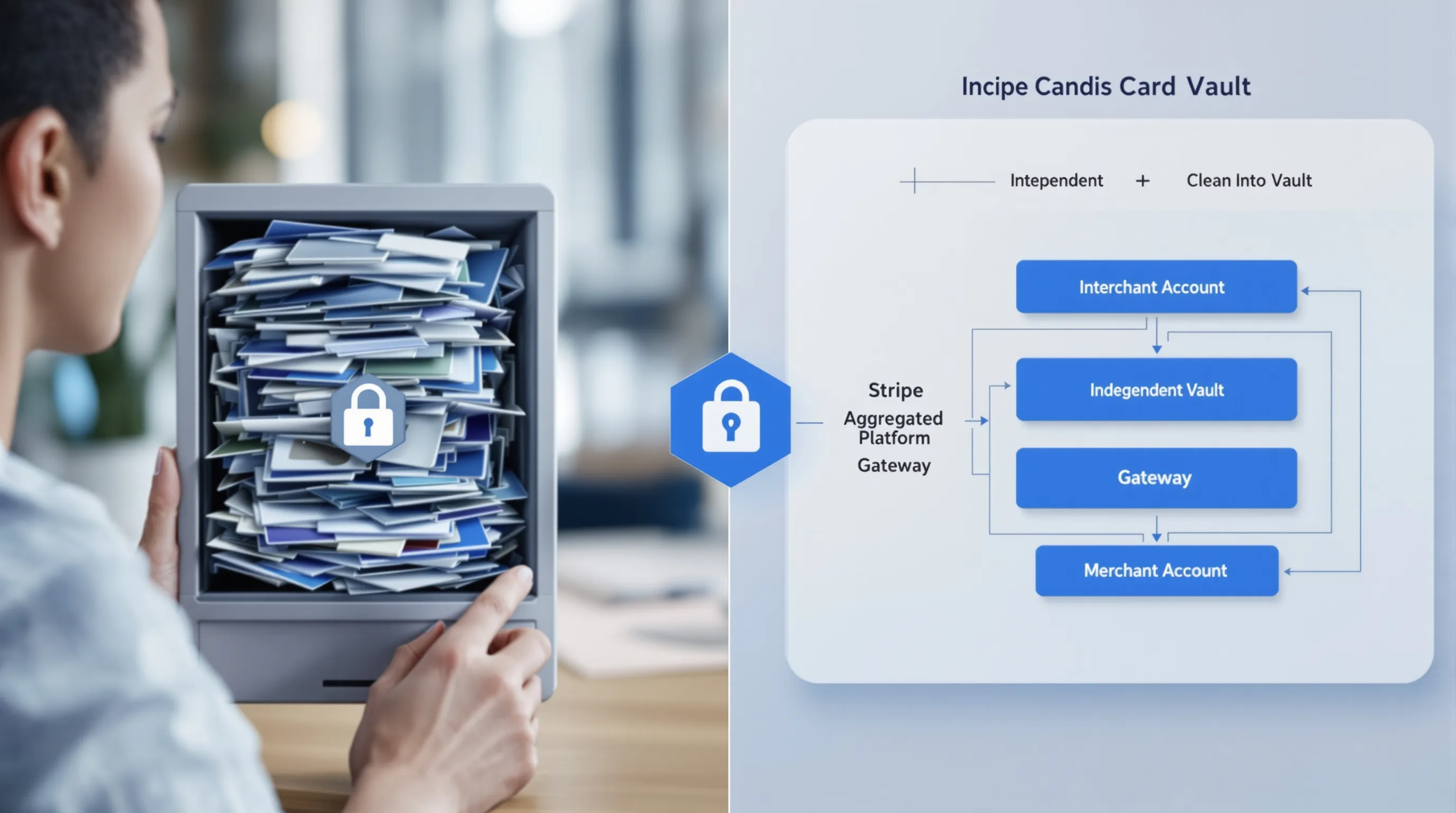
Before: Processing on an Aggregated Platform
Your stored cards, recurring billing schedules, and customer payment data all live inside the platform's proprietary token vault. Setup is simple. Departure is not. When the platform terminates your account for a policy violation, the vault doesn't come with you. Hostile terminations result in 0 to 15 percent of stored cards being recoverable. Most subscription merchants lose the majority of their recurring billing relationships.
After: Processing on a Dedicated High-Risk Merchant Account
Your card data lives in an independent, gateway-agnostic vault that you control. Your merchant ID is your own. Your billing descriptor is stable. When you need to change processors, your stored card vault migrates with you rather than disappearing. You negotiate from a position of data ownership, not data dependency, and your subscriber relationships survive the transition.
What Will Matter Most in the Next 12 to 24 Months
The platform termination risk facing subscription businesses isn't going away: it's accelerating. Stripe and PayPal have both tightened their category risk policies in recent years, and the categories being flagged as elevated risk are widening, not narrowing. Merchants in recurring supplement subscriptions, digital health, telemedicine, online gaming, and adjacent verticals are facing more account reviews, more reserve requirements, and more terminations than they faced 24 months ago.
Three shifts will define the next two years for subscription merchants navigating payment platform risk:
Token Portability Will Become a Standard Negotiating Point
As merchants become more aware of the stored-card vault trap, token portability (the ability to take card-on-file data when you leave) will move from a technical footnote to a contractual requirement. Forward-thinking subscription businesses will demand explicit data portability provisions before onboarding with any processor. Those who don't will continue to discover that "you own your data" in principle means nothing when the processor controls the only key to decrypt it. Merchants who negotiate portability upfront will have significantly lower switching costs when they eventually need to move.
High-Risk Specialized Processors Will Gain Market Share
The ongoing tightening by Stripe and PayPal is creating sustained demand for processors who specialize in exactly the merchant profiles being rejected. Merchants who've experienced terminations are unlikely to rebuild on aggregated platforms. Their next processor will be a dedicated high-risk merchant account provider, and they'll choose based on vertical expertise, data portability, and migration support, not processing rate alone. This is the fastest-growing segment in payment processing right now, and it's being driven almost entirely by merchants pushed off platforms who didn't have a plan.
Re-Authorization Campaign Infrastructure Will Become a Core Competency
The merchants who build the most durable subscription businesses will treat re-authorization capability as permanent infrastructure, not emergency response. That means maintaining current customer contact data, building payment update flows as a standing feature, and working with processors who understand the dunning dynamics of high-risk recurring billing. The ability to re-authorize 60 to 70 percent of subscribers in 30 days will separate resilient subscription businesses from fragile ones. It starts with choosing the right payment partner before a crisis forces the decision.
Our Outlook for 12-24 months
Where Online Payment Lock-In Is Headed Next
Three forecasts on what will keep businesses tied to their payment processor over the next two years.
The Next Wave Of Payment Lock-In
Use these forecasts to gauge how much switching friction to expect before committing to a payment processor.
As commercial Variable Recurring Payments, marketed by GoCardless as 'Recurring Pay by Bank,' scale past the roughly 80% of UK consumer bank accounts they already reach, businesses adopting them for higher-retention recurring billing will find themselves newly tied to bank mandate rails rather than card tokens over the next 12-24 months.
Complaints about processors will increasingly center on cancellation penalties and bundled equipment leases rather than headline processing rates, pushing more small and mid-size businesses toward providers offering no-lease, no-penalty contracts within the next 12-24 months.
Over the next 12-24 months, businesses switching online payment processors will keep facing multi-week rebuilds of subscription logic, webhooks, dunning flows, and saved card tokens, making token portability and gateway-agnostic tooling a bigger competitive differentiator than headline transaction rates.
Signals We're Still Testing A merchant who migrated off Stripe reported nearly three weeks of work rebuilding subscription logic, proration, webhooks, dunning flows, and a billing portal, plus re-migrating customers' saved payment methods. Direct Debit recurring payments already average a 38-month customer lifetime versus 14 months on card, and 38% of consumers, rising to 60% among Gen Z, say they're open to using bank-based recurring payments instead of cards. One retailer was charged a $695 cancellation fee and faced a non-cancellable 48-month, $16,000 equipment lease for terminals that could be bought outright for about $300 each, while another business owner cut $70K in annual card and ACH fees, 31% of profit, by switching processors.
Signals For And Against Each Forecast
Each forecast lists real-world evidence that supports it alongside sources that complicate it.
- Against it: Changing payment processors. [Community / Forum]Original poster (u/disestblshmntariansm) asked whether card data tokenized with Processor A can be transferred to another processor, or if merchants are "effectively locked in.". “Beware - everyone who says you own the data or whatever, isn't telling you it will probably take an act of god to actually get it if you want to change…”
- Looking for a payment processor for small Brick and Mortar retail shop is the strongest public backing for this call. [Community / Forum]Original poster (u/livelaughloving14) currently uses Riverside for payment processing and Clover for equipment/hardware. “Riverside charged a $695 cancellation fee for the processing account, and the equipment had a non-cancellable lease: 48 months, total cost: $16,000 for 2 FD150…”
- How are payment processors getting away with this?? supports this forecast. [Community / Forum]“That's 31% of our profit taken. Nearly a third. On a good year.”
- Best Payment Processors that Integrate with Shopify is the strongest public backing for this call. [Video]Shopify Payments Basic plan: 2.9% + 30 cents per transaction. “Shopify is going to get their pound of flesh no matter what.”
- The €1.4T payment platform with a take rate catch is the strongest argument against it. [Substack / Newsletter]Adyen kept approximately €2.36B of net revenue from that volume. “Adyen earns when big merchants want fewer failed payments, less fraud, and one system across websites, apps, and stores.”
- The case rests on Migrated from Stripe to a different payment processor. Surprisingly. [Community / Forum]Original poster (OP) migrated from Stripe to a different payment processor; expected the work to take a weekend but it took almost three weeks of focused work. “Expected it to be a weekend project. Took almost three weeks of focused work.”
- Changing payment processors points the same way. [Community / Forum]u/Dependent_Yard5818 states Cybersource or Authorize.net are better options than PayPal "if you seek token transferability.".
- Backing it: Switching Payment Processor: Questions for business owners. [Community / Forum]Original poster (u/jdrumpfl) uses Lightspeed as POS for one store and Square for another; in-store payments only. “Lightspeed will charge you a penalty for using outside processing and Square won't work with anything else.”
What Could Change These Forecasts
These forecasts could shift if processors adopt new data standards or open banking rules evolve.
Where We're Hedging
Of everything here, 70 rests on the firmest ground, and 70 carries the most open questions.
- The moment regulators or buyers head the other way, Bank-rail recurring payments create a new kind of lock-in is the exposed call.
- Should the evidence swing against the mainstream view, Bank-rail recurring payments create a new kind of lock-in outlasts the rest.
Key Takeaways
- The real lock-in is the vault, not the contract: processor tokens are proprietary and cannot transfer to a new processor without the old processor's explicit cooperation
- Token migrations recover 40 to 65 percent of stored cards in cooperative cases: hostile terminations typically recover 0 to 15 percent
- Re-authorization campaigns recover 60 to 72 percent of subscribers when started before the billing failure, not after. Timing is everything
- Dedicated merchant accounts with independent vaults offer data portability that aggregated platforms structurally cannot provide
- SeamlessChex approves established merchants within 24 to 48 hours (fast enough to get ahead of the next billing cycle after a forced termination)
The payment platform decision looks like a feature comparison until the day it isn't. I've watched merchants lose significant portions of their subscriber base not because they couldn't find a new processor, but because they didn't understand what they were leaving behind, with no plan for the 40 percent of stored cards that wouldn't transfer in a hostile termination.
The merchants who fare best build their payment stack in layers from the start: an independent vault, a flexible gateway, and a dedicated high-risk merchant account with a processor that specializes in their vertical. That architecture costs more to set up than signing up for Stripe, but it costs far less than losing 30 percent of your subscribers in a forced migration you didn't anticipate.
If you're evaluating your options now (or you've already received a termination notice), SeamlessChex can help you get back to processing with a dedicated merchant account built for businesses like yours.
If your subscription business has been terminated by Stripe, Shopify, or PayPal, every day without active processing is a day closer to subscriber churn you can't recover. Contact SeamlessChex for an approval decision within 24 to 48 hours. We work with established merchants processing $25,000 or more per month.
Written by
Jonathan Albert
Co-Founder, SeamlessChex
Jonathan Albert is Co-Founder of SeamlessChex, a credit card processing and fintech payments platform recognized on the Inc. 5000.
Connect on LinkedInFrequently Asked Questions
Can I transfer my Stripe customer tokens to a new payment processor?
No. Stripe tokens are processor-specific and cannot be read by any other processor. To transfer card data, Stripe must export the underlying card numbers (PANs), which requires their cooperation, a PCI-compliant receiving vault, and typically 30 to 90 days even in cooperative terminations. Hostile terminations typically result in zero data export.
What happens to my recurring billing when a processor terminates my account?
Your recurring billing stops immediately at the old processor. All stored card tokens become invalid anywhere else. You'll need to run a re-authorization campaign asking customers to re-enter their payment information on a new platform. Well-executed campaigns recover 60 to 72 percent of subscribers within 60 days.
How long does a token migration take?
For cooperative terminations, a full token migration typically takes 30 to 90 days. Policy violation terminations often result in the old processor refusing to cooperate entirely, making the timeline indefinite or impossible. Even cooperative migrations can carry export fees: industry reports cite costs upwards of 5,000 euros for 80,000 tokens from some vault providers.
What is a gateway-agnostic vault?
A gateway-agnostic vault stores card data independently of any single payment processor. When you switch processors, your stored card tokens stay with the vault and remain valid, preventing total data loss when vault and processor are bundled under the same company.
Does SeamlessChex work with merchants who've been shut down by Stripe?
Yes. SeamlessChex specializes in credit card processing for established businesses terminated by Stripe, Shopify Payments, and PayPal. We provide expedited approval within 24 to 48 hours for merchants processing at least $25,000 per month, and offer guidance through the re-authorization campaign process to minimize subscriber loss.
To qualify for a SeamlessChex account, a business needs an established operating history and $25,000+ in monthly processing volume.