



Quick Answer
When Stripe closes your US LLC account, you typically have a 30 to 90-day window to export your customer data via the Stripe dashboard (CSV exports) or API before access is fully revoked. Start with the dashboard CSV exports for customers, subscriptions, charges, invoices, and payouts: each takes under 60 seconds. If dashboard access is already gone, test your API key immediately; API access often persists past the dashboard cutoff. After the 90-day window closes, data recovery requires a formal CCPA or GDPR data access request, which takes 45 to 90 days. Payment tokens cannot be exported or ported to another processor, so plan for customer re-collection at 60 to 80 percent recovery with proactive communication.
A Stripe account closure for a US LLC is not just a payment disruption: it is a data emergency with a closing window. This guide covers the complete recovery sequence: how to export your customer database before access is cut, which alternative systems hold backup copies of your records when the Stripe window closes, how to port customer billing relationships to a new processor, and what legal remedies are available if Stripe restricts or delays your data access. If your account has already been closed or is under review, the clock started the moment you received that email.
Questions this article answers
- How long do I have to export my Stripe customer data after my LLC account is closed?
- What customer data can I actually recover from Stripe, and what is permanently gone?
- How do I migrate customer subscriptions to a new payment processor after a Stripe termination?
Quick Answer
When Stripe closes a US LLC merchant account, most operators immediately fixate on the held funds, but the customer database is often more valuable and just as at risk. Stripe's data-access window after account termination is finite: in most cases, dashboard access survives 30 days from the closure notice, and API read access typically persists for up to 90 days before the account is fully decommissioned. Miss that window, and recovering your customer records requires a formal legal data request that can take 60 to 90 days to fulfill.
I have seen this scenario play out with businesses that came to us after a Stripe termination. The pattern is consistent: operators spend the first week fighting the closure, the next week chasing the held funds, and by the time they think about their customer data, the export window has already closed. The result is a billing relationship with hundreds or thousands of customers that has to be rebuilt from scratch, or pieced together from incomplete records across email platforms, CRMs, and accounting software.
The discussion threads that document Stripe account closures make clear what is at stake. One r/stripe thread captures the core problem: "If Stripe were to shut down my account, I'd lose all subscriptions, and then have to reach out to every customer to ask them to please sign back up again through a different payment processor." That is exactly what happens, and the operators who navigate it with the least damage are the ones who treat data recovery as the first priority, not the third.
This guide walks through the exact sequence for recovering your Stripe customer database after a US LLC account closure: what data you can export and how long you have to do it, which alternative sources to check when Stripe access is cut, how to migrate those billing relationships to a new processor, and what legal options exist if Stripe restricts your data access.
What Happens to Your Stripe Data When Your LLC Account Is Closed?
Stripe treats account termination as a three-phase process, each with different implications for your data access. Understanding these phases, and how quickly they advance, determines how urgently you need to act.
Phase 1: Notice Period (Days 1-30)
In most standard terminations, Stripe issues a closure notice by email. During this period, the dashboard remains fully operational: you can log in, run exports, and make API calls. This is your highest-priority window. Every day spent disputing the closure rather than exporting data is a day you cannot recover, as of .
During Phase 1, you can export the following from the Stripe dashboard:
- Customer records: Full name, email, phone number, metadata fields, and account creation date
- Subscription data: Plan details, billing cycle, current status, and trial end dates
- Transaction history: All charges, refunds, disputes, and payment intents
- Invoice history: Every issued invoice and its line items
- Payout records: All bank transfers and their associated charges
- Dispute history: Chargeback records, outcomes, and documentation (relevant for your next underwriting application)
One category is effectively non-portable: saved payment methods. Stripe's tokenized card numbers and ACH bank account tokens are Stripe-proprietary. They cannot be transferred to another processor in usable form. As one r/stripe commenter who faced this situation put it bluntly: "If Stripe were to shut down my account, I'd lose all subscriptions, and then have to reach out to every customer to ask them to please sign back up again through a different payment processor." That is exactly what happens, and it is the part of the data problem most operators underestimate when they first receive a closure notice.
Phase 2: Restricted Access (Days 31-90)
After the initial notice period, many terminated accounts enter a restricted state. Dashboard access may be limited or revoked entirely, but API read access often persists for up to 90 days from the termination date. If you missed the Phase 1 export window, this is your second opportunity, but it requires using the Stripe API directly rather than the dashboard UI.
A pattern documented across multiple Stripe closure cases (including accounts closed without stated reason or after a single transaction) shows that even after dashboard access was cut, API keys remained active for several weeks. Many affected operators did not realize the API was still accessible. If you are in this phase, test your API key against a simple GET /v1/customers call immediately. If it returns data, start your programmatic export now.
Phase 3: Data Decommission (Day 90+)
After approximately 90 days, Stripe begins decommissioning the account fully. At this stage, recovering data requires submitting a formal data subject access request (DSAR) under CCPA or GDPR, depending on your jurisdiction and where your customers are located. Stripe's published response commitment for these requests is 45 calendar days under CCPA, with one 45-day extension permitted. Complex account data requests tend to run closer to 60 to 90 days total in practice.
| Phase | Timeline | Access Level | Recommended Action |
|---|---|---|---|
| Notice Period | Days 1-30 | Full dashboard + API | Export all records via dashboard CSV and API immediately |
| Restricted Access | Days 31-90 | API read-only (typically) | Programmatic export via API; escalate support ticket |
| Decommissioned | Day 90+ | None (DSAR only) | Submit formal CCPA or GDPR data access request; allow 45-90 days |
The single most important thing to understand about this timeline: it runs concurrently with your account dispute, not after it. Do not wait for the dispute to resolve before exporting your data. Run the export regardless of the outcome: you can always discard the backup if the account is reinstated. You cannot recover data from a decommissioned account without a formal legal process.
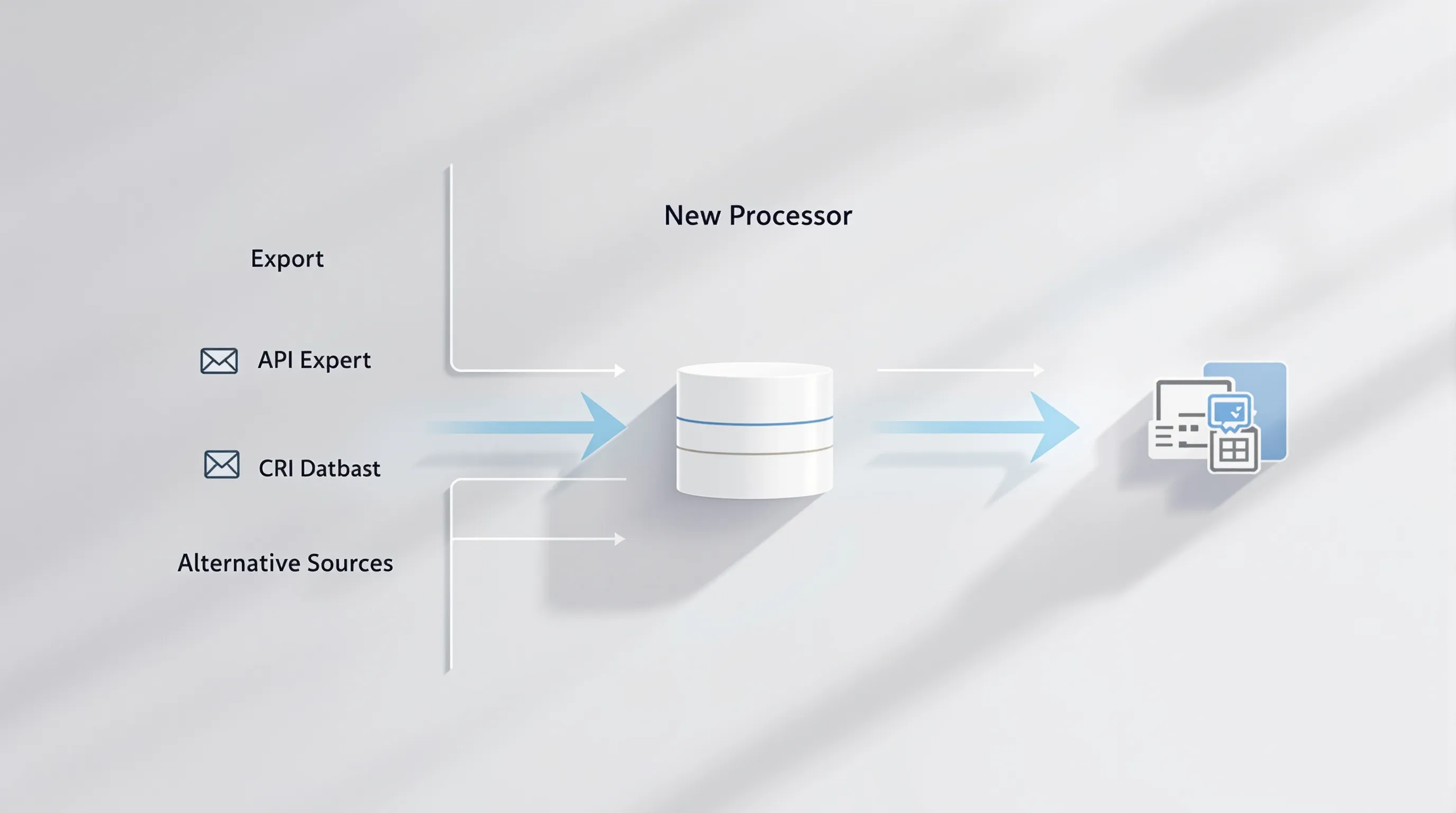
Step-by-Step: Exporting Your Customer Database from Stripe
The export process has two tracks: the dashboard path (faster, no code required) and the API path (more complete, more resilient if dashboard access becomes restricted). Run both if you still have full access.
Track 1: Dashboard CSV Export
Log into your Stripe dashboard and navigate to each of the following sections. Download the CSV export for each before doing anything else: each takes less than 60 seconds, and the window can close without warning.
- Customers (Customers → Export): Downloads customer ID, email, name, phone, created date, and all metadata. This is the core of your billing database, so do this first.
- Subscriptions (Billing → Subscriptions → Export): Includes subscription ID, customer ID, plan and price IDs, current status, billing cycle dates, and trial information.
- Charges (Payments → All Transactions → Export): Full transaction history with amounts, status, card type (last four digits), and failure reasons.
- Invoices (Billing → Invoices → Export): Line-item detail for every invoice issued (amounts, descriptions, and tax applied).
- Payouts (Balance → Payouts → Export): All bank transfer records and their associated charges.
- Disputes (Payments → Disputes → Export): Chargeback history with outcomes. Your next processor's underwriting team will ask about this, and having the documentation ready speeds approval.
Track 2: API Export for Complete Records
The dashboard CSVs are useful but incomplete. Stripe's API gives you richer structured data, including metadata fields, linked objects, and the full event log. If you have any engineering resources available, run this export in parallel with the dashboard downloads.
The key API endpoints to query are:
GET /v1/customers: Paginated list of all customers with full object data including metadataGET /v1/subscriptions: All subscriptions with items, metadata, discount objects, and trial configurationsGET /v1/payment_intents: Complete payment intent history with status and failure codesGET /v1/invoices: Full invoice objects with all line items and applied discountsGET /v1/events: The event log, which captures state changes that may not be visible in object-level queries
Use Stripe's auto_paging_iter() in their Python or Ruby libraries to paginate through large datasets without manual cursor management. For accounts with more than 10,000 customers, expect the full export to take two to four hours on standard API rate limits. Start it running in the background while you handle other parts of the recovery.
The PAN Migration Option
Stripe offers an official PAN (Primary Account Number) migration tool that transfers tokenized cardholder data directly to another payment processor, without ever exposing the raw card numbers to you, which eliminates PCI liability. This tool does not let you see the actual card data yourself; Stripe transfers it directly to the receiving processor.
This option is available in good standing, and the pathway is documented at Stripe's data migrations documentation. However, accounts terminated for policy violations are generally excluded from the migration program, and smaller accounts below enterprise processing thresholds may not qualify. Ask your new processor's underwriting team whether they can accept a Stripe PAN transfer as part of your onboarding discussion.
Alternative Recovery Sources When Stripe Access Is Already Cut
If your export window has already closed, or if your records need to be cross-referenced and filled in, your customer database is likely partially recoverable from other systems your business used. Work through this checklist systematically:
- Email marketing platform (Mailchimp, Klaviyo, ActiveCampaign): If you synced Stripe customers to an email list, the email address, name, and subscription status may be intact. In most cases, this is the most complete backup available outside of Stripe itself.
- CRM (Salesforce, HubSpot, Pipedrive): Check whether customer records were synced from Stripe or entered manually. CRM data often includes contact details and account notes that Stripe does not capture.
- Subscription management software (Chargebee, Recurly, Zuora): If you used a subscription management layer on top of Stripe, that platform holds its own copy of subscription data. The export may be available independent of your Stripe account status.
- Your own application database: For SaaS businesses, this is often the most reliable source. If your application has a user table with Stripe customer ID as a foreign key, that table holds your complete customer record independent of Stripe entirely.
- Accounting software (QuickBooks, Xero, FreshBooks): If Stripe synced to your accounting platform, transaction-level records with customer details should be present there.
- Stripe-generated invoice emails: Every invoice email Stripe sent contains customer name, email, amount, and product description. These form a recoverable record for each paying customer.
Cross-reference these sources against your Stripe CSV export to identify gaps. Customers in your own application database but absent from Stripe export are likely free users: you still have their contact information and can reach them about the migration.
Migrating Customer Billing Relationships to a New Processor
Recovering your customer database is step one. Migrating those billing relationships to a new processor, without losing your active subscriber base, is the harder problem, and it is where most operators underestimate the work required.
The Payment Method Problem
Stripe's tokenized payment methods (card tokens and bank account ACH tokens) are Stripe-proprietary. They cannot be transferred to another processor. This is the central challenge of subscription migration after a Stripe termination: you have the customer records, but not their payment credentials in a form any other acquirer can use.
There are three practical paths to address this:
- Direct re-collection from customers: Contact your subscriber base, explain that you have moved to a new payment platform, and ask them to re-enter their payment information. This is the most common path. With proactive, well-timed communication, subscription businesses typically recover 60 to 80 percent of their active subscriber base through re-collection. The remaining 20 to 40 percent represents involuntary churn: customers who do not respond, have outdated contact information, or take the transition as an opportunity to cancel.
- Network tokenization transfer (if applicable): For businesses that stored card credentials through Visa Token Service or Mastercard Digital Enablement Service (separately from Stripe's own tokenization layer), those network-level tokens may be portable to another processor that supports network token import. This requires verification with your new processor's underwriting team before assuming portability.
- Facilitated migration program: Some high-volume payment facilitators offer assisted migration programs. They manage the customer outreach, payment re-collection, and data transfer into the new processing environment on your behalf. At SeamlessChex, we support this process for qualifying merchants as part of our onboarding for Stripe-terminated businesses.
How to Communicate the Migration to Your Subscribers
Customer communication during a processor migration directly affects your re-collection rate. From what I have seen working with businesses through this transition, operators who communicate proactively, before subscriptions fail, retain substantially more customers than those who wait for failed payment notifications to drive action.
Effective migration communication follows this sequence:
- Send a plain-language announcement email at least 30 days before the migration deadline: "We have updated our payment processor. To keep your subscription active, please update your payment method by [date]."
- Follow up at day 20 (10-day reminder) and again at deadline day (final notice): three touchpoints minimum.
- Create a dedicated landing page with a direct link to the payment update form on your new processor.
- Offer an incentive for early updaters: one month free or a percentage discount consistently lifts re-collection rates by 10 to 15 percentage points, based on migration patterns I have observed with businesses making this transition.
- For subscribers who miss the deadline, attempt one automatic retry through your new processor before sending a cancellation notice.
Legal Options When Stripe Restricts Your Data Access
If Stripe denies or delays your data access request beyond the 90-day window, you have formal remedies available.
- CCPA data access request: Any California business, or any business serving California residents, can submit a formal CCPA Section 1798.100 data access request to Stripe. Stripe is required to respond within 45 calendar days, with one permitted 45-day extension. Submit in writing and document the submission date.
- GDPR Article 15 request: For businesses with customers in the EU, a GDPR Article 15 request requires Stripe to provide a full copy of all personal data they process on your behalf within 30 calendar days.
- Legal hold letter: If you believe Stripe may delete your data before you can formally request it, a legal hold letter from an attorney creates a documented preservation obligation. Send it early. It is most effective before the 90-day mark.
- Arbitration for withheld funds: If the data denial is combined with held funds, Stripe's terms of service include a mandatory arbitration clause for disputes over $10,000. For smaller amounts, small claims court (typically available up to $10,000 to $15,000 depending on the state) is an accessible option.
How SeamlessChex Can Help After a Stripe Closure
SeamlessChex specializes in onboarding subscription businesses and high-risk merchants that have been terminated by Stripe, Shopify, or PayPal. We work with established businesses processing at least $25,000 per month, and we understand the underwriting context that termination-affected businesses bring with them.
Our onboarding process for Stripe-terminated merchants includes:
- Same-day merchant account decisions for qualifying businesses
- Support for recurring billing and subscription management through Seamless Merchant
- ACH and bank transfer billing through Seamless ACH, operational independently from card processing
- No long-term contracts: month-to-month terms with no early termination fees
- Hands-on support during payment method re-collection and subscriber migration
If your Stripe account has been closed and you need to restore billing operations quickly, contact our team to start the approval process. Qualifying businesses can often have a new processing environment active within 24 to 48 hours.
What Will Matter Most for Data Portability in the Next 12 to 24 Months?
The wave of Stripe account closures affecting subscription businesses in 2025 and 2026 has exposed a structural vulnerability in how businesses manage their payment infrastructure. The payment industry is beginning to respond, and the businesses that position themselves now will navigate the next processor transition with substantially less disruption.
Network Tokenization Is Becoming the Standard
The fundamental problem with Stripe-locked payment tokens is that they are Stripe's proprietary format. Network tokenization, where the card networks (Visa, Mastercard, American Express) issue and hold the token rather than the processor, solves this portability problem at the infrastructure level. A Visa network token can be used at any Visa-certified acquirer, making payment methods portable across processors.
In the next 12 to 24 months, expect network tokenization to become the default for subscription businesses. Processors that support network token migration will have a significant competitive advantage for acquiring Stripe-terminated merchants. When evaluating a new processor after a Stripe closure, ask specifically whether they support network token import and whether they can request token transfers from your card network on your behalf.
Data Portability Regulations Are Tightening
CCPA, GDPR, and the emerging patchwork of US state privacy laws are creating new obligations for payment processors as data holders. Stripe and similar platforms are increasingly required to provide structured, machine-readable exports of customer data on request. The regulatory trend is toward shorter response times (currently 45 days under CCPA; proposed updates target 30 days in several state frameworks) and broader scope of required data.
Businesses that are prepared to invoke these rights quickly, by having their legal templates ready and knowing exactly what data to request, will recover faster from processor terminations. Keep a CCPA and GDPR data access request template on file as part of your payment operations playbook, before you need it.
Multi-Processor Architecture Is No Longer Optional
The businesses that navigated Stripe terminations in 2025 and 2026 with the least disruption had one thing in common: they were not running all their billing through a single processor. Multi-processor architecture, where different payment methods, geographies, or customer segments route through different processors, provides natural continuity when one processor restricts or terminates an account.
For subscription businesses, a practical approach is to run card billing through one processor and ACH or bank transfer billing through another. This provides operational continuity if either processor restricts the account: ACH billing through a separate processor can continue uninterrupted while card billing is migrated. SeamlessChex supports exactly this structure through Seamless ACH for bank transfer billing, operating independently from card processing relationships.
Customer Communication Infrastructure Matters More Than the Data Itself
In the end, recovering your customer database is only valuable if you can reach those customers and ask them to re-authorize their billing relationship. The businesses that successfully migrated their subscriber bases after Stripe terminations were those with strong direct communication channels: active email lists, in-app notification capabilities, and regular engagement with their subscriber base outside of payment-related emails.
If your current business model relies on Stripe's subscription billing without maintaining a direct communication channel to your customers outside of Stripe, that is the highest-priority gap to close, regardless of your relationship with your current processor. Own your customer communication infrastructure. A clean, deliverable email list is more valuable than 100,000 Stripe customer IDs if Stripe is the only way you know how to reach them.
Our Outlook for 12-24 months
Where Stripe Closure Recovery Is Headed
Three forecasts on how merchants recover held funds and customer payment data after a Stripe account closure.
Forecasts for Post-Closure Recovery
Use these forecasts to plan fund recovery and payment continuity before a closure happens, not after.
Merchants in flagged categories such as peptides, SARMs, nutraceuticals, and GLP-1 products will keep facing sudden Stripe account closures over the next 12-24 months, pushing more of them to search for fund-recovery steps and high-risk-friendly processors, even when their own dispute history is clean.
Over the next 12-24 months, merchants closed by Stripe will be routed through Stripe's official PAN (cardholder data) migration tool to move customers to a new processor, rather than relying on self-managed database exports or backups set up in advance.
The assumption that a closed account leaves a recoverable, merchant-viewable customer database will keep proving false; over the next 12-24 months, expect closures to be resolved through customer re-authorization or a new processor relationship, not through data handed back to the business.
Signals We're Still Testing Stripe already runs a PAN migration/export tool that transfers cardholder data directly to another processor, and merchants report the tool 'doesn't let you see any data' because Stripe eliminates PCI liability by keeping the transfer processor-to-processor. In the r/stripe backup-data thread, a merchant confirmed Stripe's export tool 'doesn't let you see any data' - it moves cardholder records directly to the receiving processor and never exposes them to the account holder.
Supporting and contrary evidence
Each forecast is checked against Stripe closure reports and merchant demand signals that support or challenge it.
- Against it: Stiped Closed My Account And Will Refund All My Customers. [Community / Forum]Original poster (OP) runs a florist company; began using Stripe as a backup payment processor around 10-Dec-2021. “I am currently in the process of contacting my lawyers and a legal case will be filed against the company both in the United States as well as in the Middle…”
- Is it possible/smart to continuously backup Stripe customer card data is the strongest public backing for this call. [Community / Forum]Stripe offers an official "PAN migration"/export tool that transfers cardholder data directly to another payment processor; per u/Unlikely_Medium2311, "The export tool from stripe doesn't let you see any data" - Stripe transfers it… “Consumer apps with casual users will lose 90% of their customer base and MRR if that happens.”
- If Stripe changes its PAN migration policy to give merchants direct, self-service access to their own customer card data instead of processor-to-processor-only transfer, or if regulators mandate merchant-facing data portability for closed payment accounts, this outlook would reverse.
- Backing it: Is it possible/smart to continuously backup Stripe customer card data. [Community / Forum]Stripe's data migration policy is documented at https://docs.stripe.com/get-started/data-migrations/pan-export (cited by u/schmerold).
- If Stripe changes its PAN migration policy to give merchants direct, self-service access to their own customer card data instead of processor-to-processor-only transfer, or if regulators mandate merchant-facing data portability for closed payment accounts, this outlook would reverse.
What could change this outlook
These forecasts could shift if Stripe alters its data export policy or regulators intervene on payment account portability.
Confidence, With Limits
Of everything here, 84 rests on the firmest ground, and 51 carries the most open questions.
- High-risk category closures keep driving recovery and alternative-processor demand. That call weakens first if regulators or buyers move in the opposite direction.
- Merchants won't get direct access to their own customer database. That one becomes the more durable forecast if the source mix shifts toward stronger contrary evidence.
A Stripe account closure is a crisis with a narrow recovery window. The customer database you built (the names, emails, billing histories, and subscription relationships) is not gone when Stripe closes your LLC account, but it becomes harder to recover with every day that passes. The businesses that come through a processor termination intact are the ones that treat data recovery as the first priority, not an afterthought once the dispute is settled.
The sequence is straightforward once you know it: export immediately via the dashboard and API while access exists, check alternative sources if that window has already closed, submit a formal data request if you are past the 90-day mark, and start migrating customer billing relationships to a new processor before your subscribers churn from failed payment retries. The payment method re-collection problem is real but manageable: most subscription businesses that communicate proactively retain 60 to 80 percent of their subscriber base through a migration.
What makes the difference is speed. If your Stripe account has been closed or is at risk of closure, the time to act on your data is now, before the access window closes, not after. And if you need a new home for your subscription billing, SeamlessChex is built for exactly this situation: established businesses processing $25,000 or more per month that need reliable payment processing after a major processor relationship ends. Contact our team to begin the approval process: qualifying businesses can often be processing within 24 to 48 hours. If you also need guidance on recovering funds held after termination, our guide on unfreezing reserves on a terminated account covers that process in detail.
Written by
Jonathan Albert
Co-Founder, SeamlessChex
Jonathan Albert is Co-Founder of SeamlessChex, a credit card processing and fintech payments platform recognized on the Inc. 5000.
Connect on LinkedInSummarize This Article With AI
Open this article in your preferred AI engine for an instant summary.
Frequently Asked Questions
How long do I have to export my Stripe customer data after my account is closed?
In most standard terminations, Stripe provides 30 days of full dashboard access from the closure notice date. API read access typically persists for up to 90 days. After 90 days, recovering data requires a formal CCPA or GDPR data subject access request, which takes 45 to 90 days to fulfill. Act on your data export within the first 30 days whenever possible. The window can shorten without warning depending on why the account was closed.
Can I transfer my Stripe customer payment methods to a new processor?
Stripe's proprietary payment tokens cannot be directly transferred to other processors. Stripe offers an official PAN (Primary Account Number) migration tool that transfers tokenized card data directly to a receiving processor without exposing the raw numbers, but this program is generally limited to accounts in good standing and may not be available to terminated accounts. For most Stripe-terminated businesses, the practical path is direct re-collection: contact customers and ask them to re-enter payment information on your new processor. Expect 60 to 80 percent re-collection with proactive communication.
What customer data does Stripe actually export?
Stripe's dashboard CSV exports include customer name, email, phone, metadata, and creation date. Subscription exports include plan, billing cycle, status, and trial dates. The API provides richer structured data than the dashboard, including linked objects and event history. You cannot export full card numbers or bank account numbers: only the last four digits and tokenized identifiers. Dispute history is also exportable and useful for your next underwriting application.
What is a DSAR and how do I submit one to Stripe?
A data subject access request (DSAR) is a formal request under CCPA (California) or GDPR (EU) asking Stripe to provide all personal data they hold associated with your account and your customers. Submit it in writing to Stripe's designated privacy contact via their privacy request form. Reference CCPA Section 1798.100 or GDPR Article 15, specify that you are requesting all customer and transaction data associated with your terminated account, and document the submission date. Stripe must respond within 45 calendar days under CCPA.
Will a Stripe termination affect my ability to get a new merchant account?
It depends on the reason for termination. Risk-flagged terminations may result in your business being listed on the Terminated Merchant File (TMF/MATCH list), which requires disclosure to future processors. SeamlessChex reviews terminated merchants on a case-by-case basis and works with businesses that have the volume and operating history to qualify. Bring your Stripe termination notice, transaction history, and dispute records to your next application. Our TMF/MATCH list merchant account page covers that process in detail.
How do I communicate a payment migration to my subscribers without losing them?
Send a plain-language email announcement at least 30 days before the migration deadline, with two follow-up reminders (day 20 and deadline day). Create a dedicated payment update page with a direct link to your new payment form. Offer an incentive (free month, discount) for early updaters, which lifts re-collection rates by 10 to 15 percentage points. For subscribers who miss the deadline, attempt one automatic retry before sending a cancellation notice. Businesses that communicate proactively before subscriptions fail retain substantially more customers than those who wait for failed payment emails to prompt action.
SeamlessChex onboards established merchants; the practical minimum is $25,000 in monthly payment volume.