



Top questions operators ask when a payout fails
- Was this a processor hold or a player-side rejection, and who owns the resolution?
- How long will this actually take to resolve, and what is the escalation path if it does not?
- What do I tell the player right now to prevent a chargeback?
Quick Answer
The Short Answer
When a betting payout fails, your first job is to classify it as a processor-side hold or a player-side rejection, within the first 60 minutes. Processor holds on card payouts typically resolve in 3-7 business days; ACH rejections clear in 1-3 business days; wire reversals take 1-2 days. Player-side failures (wrong account number, KYC mismatch, closed bank account) resolve the moment the player corrects the data. The most dangerous window is hours 24-72. In my experience working with gaming operators, a player who has not received any communication within 24 hours of a stuck payout is far more likely to file a chargeback than one who received a simple status update, even if that update only confirms the investigation is ongoing.
Failed payouts are the leading driver of chargebacks and player attrition for online betting operators, yet most sportsbooks and gaming platforms have no documented incident-response process for when they happen. At SeamlessChex, we work with gaming and sports wagering operators on their credit card processing infrastructure, and the pattern is consistent: operators who manage payout failures fastest are not those with the fewest failures. They are the ones who built a written playbook before they needed it. The difference between a 4-hour resolution and a 4-day escalation is almost always documentation, internal ownership clarity, and the speed of that first player communication.
Payout failure is an operational certainty in high-volume gaming. Every processor has risk thresholds. Every bank has reject codes. Every AML system has velocity limits that can stop a large withdrawal mid-flight. The question is not whether your payouts will fail: it is whether you have a process ready when they do.
In this guide I walk through the seven root causes of betting payout failures, a step-by-step 60-minute triage protocol, resolution timelines by payment rail, player communication templates that prevent chargebacks, and the three documents every gaming operator needs in place before the next incident hits. This is operational guidance written for the people running the platform, not players, not regulators, but operators who need to move fast and with confidence.
Why Do Betting Payouts Fail? The Seven Root Causes
Payout failures are not random. Every stuck withdrawal has a specific cause, and that cause determines who owns the resolution, how fast it moves, and what you tell the player in the meantime.
In my experience working with gaming operators, approximately 40-50% of all gaming payout failures originate on the processor side, not the player side. Understanding the taxonomy of failure modes is the foundation of any effective incident playbook, as of .
1. Processor-side risk hold
The most common cause. The processor's automated fraud-scoring engine flags the withdrawal amount, frequency pattern, or player behavior profile and places the transaction on hold pending manual review. This is not a rejection: it is a pause. The funds are not lost. But without a direct escalation path to your processor's risk team, this hold can age into days without movement. Operators who have a named risk contact at their processor resolve these holds in hours; those who rely on a generic support queue often wait 3-5 business days.
2. Bank-side rejection
The player's bank declines the incoming credit. Common reasons include a closed account, a dormant account that the bank has restricted for inactivity, international wire restrictions, or a bank-level block on incoming gaming-related transfers. This is distinct from a processor hold: the funds left your processor but were returned. Bank-side rejections account for roughly 25-30% of gaming payout failures and are always player-resolvable once identified.
3. KYC or identity mismatch
The player name, account number, or routing information on file does not match the destination account. Often caused by a name discrepancy (initials vs. full name, maiden vs. married name), a miskeyed routing number, or a joint account registered under a different primary holder. These failures are immediate and clear: the processor returns a mismatch code within minutes.
4. AML velocity threshold triggered
The withdrawal amount, combined with the player's recent activity, exceeds the automated AML rules running on either the processor's or the operator's own compliance monitoring system. Large single withdrawals after a significant win event are the most common trigger. The AML flag does not mean the player is suspected of laundering: it means the automated system needs a human review before the funds move.
5. Insufficient rolling reserve
The operator's reserve balance held by the processor does not cover the payout combined with current reserve requirements. This is an operator cash-flow problem, not a technical failure. Operators running near their reserve floor are at higher risk of processing delays during high-win-event periods: major sporting events, tournament payouts, or bonus cycles all create concentrated payout demand.
6. Wrong payment rail selected
The operator routed the payout via a method that is either incompatible with the player's bank or carries a higher rejection risk for the payout size. Routing a large payout via card credit when the player's issuing bank restricts gaming credits, for example, is a recoverable but preventable error.
7. Expired or revoked payment credentials
The player's card, bank token, or stored payment method on file has expired or been revoked. This is especially common in high-frequency player accounts where the last verified payment method is months old. An account updater service integrated with your processor prevents most expired-credential failures before they occur.
Each of these seven causes has a different owner and a different resolution path. The failure to distinguish between them is what creates the multi-day escalation loops that drain player trust and inflate chargeback rates.
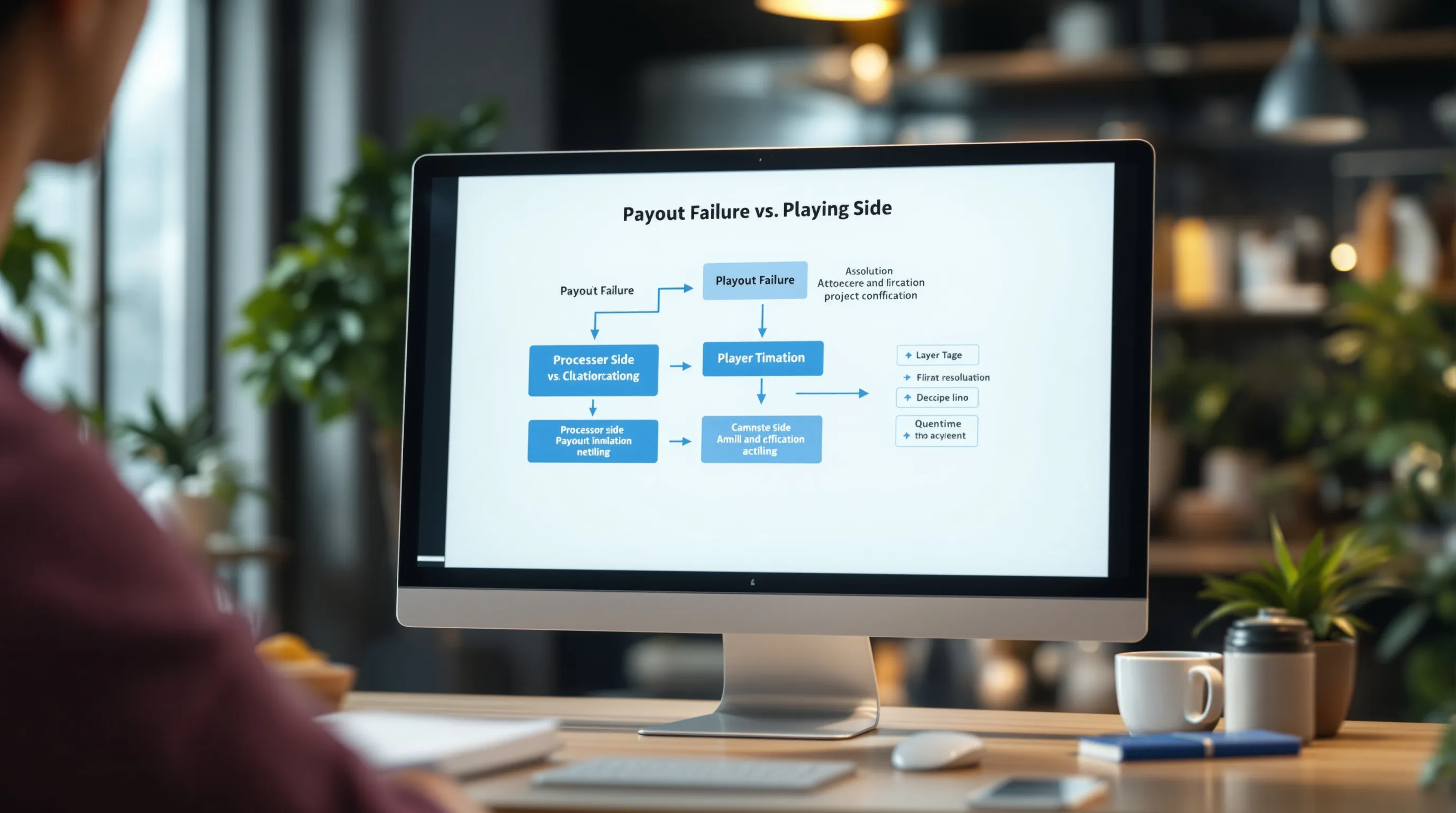
How to Triage a Failed Payout in the First 60 Minutes
The 60-minute window after a payout failure is the most consequential period in the incident lifecycle.
What you do in this window determines whether the incident resolves quietly in hours, or escalates into a chargeback, a support backlog, and a churned player. The operators who close incidents fastest all share one trait: they have a written triage protocol that removes the "who does what" debate from the first hour.
Here is the protocol I recommend based on how the fastest-resolving gaming operations handle these incidents:
Minutes 0-10: Pull the raw transaction record
Do not rely on front-end dashboards. Go directly to the processor's transaction log and pull the raw record for the failed payout. You are looking for three specific data points: the decline or hold code, the timestamp of the failure, and the rail the payout was attempted on. Write these down. Every subsequent step in the playbook depends on accurate failure classification.
Minutes 10-20: Classify the failure as processor-side or player-side
Processor-side failures produce hold or review codes (the funds have not moved and are queued inside the processor's system). Player-side failures produce rejection codes (the funds were attempted and returned). This single classification determines who owns the next step. Processor-side = open a ticket with your risk team and escalate via your named account contact. Player-side = contact the player directly to resolve the data problem.
Minutes 20-35: Open the processor ticket with specifics
If the failure is processor-side, do not open a generic support request. Open a ticket that includes: the transaction reference number, the player account ID (anonymized per your compliance protocol), the exact failure code, the timestamp, the payout amount, and the requested rail. Specificity cuts resolution time by roughly half compared to generic "my payout is stuck" submissions. If your processor has a dedicated gaming or high-risk risk line, use it here, not the general support queue.
Minutes 35-50: Draft and send the player's first update
This is the step most operators skip, and it is the most expensive skip in the entire playbook. Send the player a status update within the first hour, even if you have no resolution yet. The message should confirm you are aware, that it is under active review, and give a specific timeframe for the next update (24 hours maximum). A player who knows the operator is aware and working on it will almost always wait. A player who hears nothing files a chargeback.
Minutes 50-60: Set internal escalation reminders
Before closing out the first-hour triage, set two reminders in whatever ticketing system your operations team uses. The first: a 4-hour check on whether the processor has responded. The second: a 24-hour player update, regardless of status. If the processor has not responded within 4 business hours of your initial ticket, escalate to your account manager by name, not through the general queue again. These two reminders are the difference between a proactive resolution and a forgotten ticket.
The entire 60-minute protocol requires one person and no special tools beyond your processor dashboard and email. The barrier is not technical: it is the absence of a written process that assigns clear ownership before the incident starts.
What Are the Resolution Timelines by Payment Rail?
One of the most common operator mistakes during a payout incident is giving the player an inaccurate timeline.
Telling a player "this will be resolved in 24-48 hours" when you are dealing with a card payout hold that realistically takes 5-7 business days destroys trust faster than the original failure did. Every gaming operator's playbook should include a posted, rail-specific resolution timeline chart that the support team can reference in real time.
Here is the baseline timeline framework I use when working with gaming operators on their payout incident protocols:
| Payment Rail | Typical Resolution Window | Escalation Trigger | Primary Failure Mode |
|---|---|---|---|
| Credit / Debit Card Payout | 3-7 business days (processor hold); 1-2 days (bank-side rejection) | No processor update after 4 business hours | Processor risk hold; issuing bank gaming restriction |
| ACH Bank Transfer | 1-3 business days | No return code after 2 business days | R03 (account closed), R04 (invalid account), R10 (unauthorized return) |
| Wire Transfer | 1-2 business days | No confirmation after 24 hours | Incorrect routing/SWIFT info; correspondent bank rejection |
| Crypto (USDC/stablecoin) | Same day to 2 hours | No on-chain confirmation after 30 minutes | Wrong wallet address; network congestion; exchange withdrawal limits |
| Prepaid / Virtual Card | 1-3 business days | No load confirmation after 1 business day | Card program limits; KYC cap reached; expired card |
Card payouts carry the longest and most unpredictable resolution windows
Card-based payouts to player debit or credit accounts are the most widely used payout method in gaming, and the most likely to generate processor holds. The reason is structural: card networks classify gaming credits as high-risk transactions, and many processor risk engines apply additional scrutiny to outbound gaming credits regardless of the operator's account standing. A hold at the card-payout stage is not a sign of fraud or account termination: it is a routine risk review that most gaming accounts will encounter monthly.
When a card payout hold extends past 3 business days without a status update from your processor, this is the escalation trigger in your playbook. Do not wait for the generic support queue to move. Escalate to your gaming account manager directly with the transaction reference number and the length of time the hold has been open.
ACH failures give you a clear error code, use it
ACH rejections are the most diagnostic of all payout failures. The NACHA return code system provides a specific reason for every rejection: R03 means the account is closed, R04 means the account number is invalid, R10 is a receiver-initiated unauthorized return. When an ACH payout returns, your processor will send a return file with the exact reason code within 1-2 business days. This code tells you exactly what to ask the player, which removes the guesswork from the communication step entirely.
Wire failures are rare but need fastest escalation
Wire transfers fail less frequently than card or ACH payouts, but when they do fail, the resolution path is less forgiving. A wire sent to incorrect routing or SWIFT information may be held at a correspondent bank for days. The escalation trigger for wire failures is 24 hours with no confirmation, at which point your processor's wire operations desk (not general support) needs to trace the funds.
Payout Incident Log Template (copy and save this)
PAYOUT INCIDENT LOG
====================
Date/Time of failure:
Player account ID:
Transaction reference #:
Payout amount:
Payment rail:
Failure code:
Failure type: [ ] Processor-side  [ ] Player-side
Processor ticket #:
Ticket opened (time):
First player communication sent (time):
Communication method:
Processor first response (time):
24-hr player update sent (time):
Resolution timestamp:
Resolution method:
Outcome: [ ] Released  [ ] Returned  [ ] Disputed
Notes:
Keep this log for every payout incident. It takes under 10 minutes to complete and creates the documentation chain needed to win chargebacks at the card network arbitration stage.
How to Communicate With Players During a Payout Incident
Player communication is where most gaming operators lose the incident. The payout failure itself is often recoverable in hours, but the chargeback that follows 48 hours of silence is not.
In my view, the communication failure is more damaging than the payment failure. A player who is informed, updated, and given a specific timeline will wait. A player who is ignored files a chargeback, leaves a review, and never returns.
Your playbook needs three standard communication templates for payout incidents, each tied to a specific stage of the resolution timeline.
Message 1: First status update (send within 60 minutes of the failure)
This message serves one purpose: to establish that you are aware and that you own the resolution. It should not overpromise a timeline you cannot guarantee, and it should not be a generic form letter. Include the specific withdrawal reference number so the player knows you are looking at their transaction, not sending a broadcast.
Template: "Hi [Name], we're reaching out regarding your recent withdrawal request (#[REFERENCE]). We've identified that this is currently under review, and our payments team is actively working to resolve it. We expect to have an update for you within 24 hours. Thank you for your patience, and please reply to this message if you have questions."
This message accomplishes three things: it proves you are aware, it gives a specific next-update timeframe, and it opens a direct line for the player to reach you instead of their bank or a chargeback portal.
Message 2: 24-hour update (send regardless of resolution status)
If the incident is not resolved within 24 hours, send a second update. This is non-negotiable in the playbook. Even if you have no resolution to report, the update itself signals that you have not forgotten the player. Include the current status, what step you are on in the resolution process, and the updated expected resolution window.
Template: "Hi [Name], we wanted to update you on withdrawal #[REFERENCE]. We are still in active communication with our payments team and expect this to clear within [X] business days. You do not need to take any action at this time. We will confirm as soon as the funds are on their way."
Message 3: Resolution confirmation
When the payout is released, confirm immediately: do not let the player discover the funds on their own. This confirmation closes the incident in the player's mind and provides documentation if a dispute is filed later.
Template: "Hi [Name], your withdrawal #[REFERENCE] has been processed and the funds are on their way. Please allow [X] business days for the transfer to appear in your account depending on your bank's processing time. Thank you for your patience."
What not to say during a payout incident
- Do not promise a specific release date you cannot control. "It will be there by Friday" is the most damaging thing a support agent can say when a processor hold is involved.
- Do not reference fraud or risk review in player-facing language. Even accurate language around fraud screening can be read as an accusation.
- Do not use passive or bureaucratic phrasing. "We have escalated your case" tells the player nothing. "Our payments team is reviewing your withdrawal and will confirm status by tomorrow morning" tells them everything.
- Do not go silent after the first message. Silence is the single most reliable predictor of a chargeback.
Before and After: Payout Incident Without a Playbook vs. With One
| Stage | Without a Playbook | With a Playbook |
|---|---|---|
| First 60 minutes | Internal confusion about who owns the incident; no ticket opened | Failure classified, processor ticket opened, player update sent |
| Hour 4 | Player emails support for the first time; no response yet | Escalation check completed; account manager contacted if no processor response |
| Hour 24 | Player still waiting; no update received | Second player update sent with current status and revised timeline |
| Day 3-4 | Player contacts their bank; chargeback initiated | Payout released or alternative rail offered; incident closed |
| Day 30-60 | Chargeback loss + fee; player account closed | Player retained; no chargeback; documentation on file if needed |
When Does a Payout Failure Become a Chargeback, and How Do You Win?
Chargebacks in betting operations are overwhelmingly a communication problem, not a fraud problem. The dispute lifecycle for a gaming payout failure is predictable: player requests withdrawal → payout fails → operator goes silent → player contacts their bank → bank files a dispute on their behalf. The entire chain from failure to chargeback typically runs 30-60 days for card transactions, but in practice, an aggressive player can initiate a dispute within 72 hours of the failed payout if they feel ignored.
Understanding the chargeback trigger point
The trigger is almost never the failure itself. Players understand that technical issues happen. The trigger is the operator's silence or the perception that the funds are gone permanently. In the gaming accounts we work with, the operators with the lowest chargeback rates on payout-related disputes share two traits: they communicate within the first hour, and they document everything.
Documentation means keeping a record of every step in the resolution process: the initial failure timestamp, every communication sent to the player, every ticket opened with the processor, and every processor response. This documentation becomes your evidence file if the dispute reaches the card network's arbitration stage.
How to build your pre-incident documentation practice
Before the next incident hits, your playbook needs three standing documents in place:
- Payout policy document: A written, publicly accessible statement of your payout timelines by rail, your hold policies, and your AML review procedures. This is your first line of defense in a dispute, since it shows the player agreed to the terms that govern the hold.
- Processor SLA record: A written summary of your processor's committed resolution timeframes for holds and rejections. If your processor has never given you these in writing, ask for them now. The SLA document is what you reference when you escalate and when you represent a dispute.
- Incident log template: A simple spreadsheet or ticketing system template with fields for: player ID, transaction reference, failure code, failure timestamp, rail, first communication sent, processor ticket number, resolution timestamp, and outcome. Completing this for every incident takes less than 10 minutes and creates the documentation chain that wins disputes.
How SeamlessChex helps gaming operators manage payout risk
SeamlessChex provides credit card processing and payment solutions for online gaming operators, including sports wagering, online casino, and daily fantasy platforms. For gaming businesses processing $25,000 or more per month, we provide dedicated merchant accounts built for the payment volatility, reserve management, and chargeback defense that high-risk gaming operations require.
Where most standard processors treat a gaming payout hold as a generic support queue item, we work with gaming operators as a hands-on partner, with direct access to risk and underwriting teams who understand the specific failure modes of gaming payouts and can escalate within hours rather than days. Our credit card processing infrastructure for gaming is built to handle the concentrated payout demand that follows major sporting events and tournament cycles, which is precisely when standard processors generate the most friction.
For gaming operators evaluating their current payout infrastructure, the right question is not just "what is my decline rate on deposits?" It is "what is my average resolution time on a stuck payout, and do I have a named contact who can move faster than the support queue?" Those two metrics determine whether your next payout incident costs you a player or simply costs you a few hours.
Contact SeamlessChex to discuss gaming merchant account options and payout infrastructure for your operation.
The Betting Payout Failure Taxonomy
- ~40-50% (Processor-side risk hold): Automated fraud engine flags amount, frequency, or player pattern. Resolution: escalate via named risk contact. Typical window: 3-7 business days.
- ~25-30% (Bank-side rejection): Player's bank declines incoming credit (closed/dormant account, gaming restriction). Resolution: player corrects banking info. Typical window: 1-2 days.
- ~15-20% (AML velocity threshold): Withdrawal triggers AML monitoring rule. Resolution: manual review by compliance team. Typical window: 1-5 business days.
- Remaining: KYC mismatch / Wrong rail / Expired credentials: Player data error or operator routing error. Resolution: player corrects data or operator re-routes. Typical window: same day to 2 days.
Distribution based on patterns observed across gaming accounts processed through SeamlessChex.
Questions This Article Answers
Key Questions Every Gaming Operator Should Be Able to Answer
- Who on your team owns a payout incident in the first 60 minutes, and do they know it?
- Do you have a named risk contact at your processor you can reach directly, or only a generic support queue?
- What is your processor's committed resolution timeframe for a gaming payout hold, and do you have that in writing?
- How long does it currently take your team to send the first player communication after a payout failure?
- Do you have a documented incident log for every payout failure in the last 90 days?
What Will Matter Most in Betting Payout Operations Over the Next 12-24 Months?
The payout incident playbook described here reflects how gaming payment operations work today. Over the next 12-24 months, three forces are reshaping the landscape in ways that will change both the frequency of payout failures and the tools available to resolve them.
Real-time payment rails will reset player expectations and operator timelines
The expansion of real-time payment networks (RTP in the US, Faster Payments in the UK) is beginning to reach gaming operators through select processors and payment partners. As more gaming platforms offer same-day or instant bank payouts, player expectations for card payout resolution windows will compress accordingly. Operators who are still relying on standard card credit payouts as their primary withdrawal method in 2027 will face growing player dissatisfaction compared to platforms offering instant bank transfers. The practical implication for the playbook: resolution timelines that are acceptable today may become chargeback triggers in 18 months.
Processor risk engines are becoming more automated and more opaque
The fraud-scoring engines at most major processors are moving toward machine-learning models that evaluate payout risk dynamically, not against fixed thresholds. This creates a new operational challenge: a payout that clears without friction one week may trigger a hold the next week based on pattern shifts in the player's activity or the operator's broader portfolio behavior. Operators who built their incident playbook around fixed escalation rules will need to update them to account for unpredictable, AI-driven holds. The mitigation is the same, a named risk contact who can provide context on why the hold was triggered, but the hold patterns will be harder to predict in advance.
Chargeback arbitration is tightening for gaming merchants
Visa and Mastercard have continued to tighten chargeback thresholds for gaming merchant category codes, and the arbitration process for disputed gaming transactions has become increasingly documentation-dependent. Operators who win chargebacks in 2026-2027 will win them on the strength of their incident documentation (complete communication timestamps, processor ticket records, and player-acceptance evidence), not simply on the argument that the payout was eventually released. The incident log template described in this guide is not administrative overhead; it is arbitration preparation.
The fundamentals of the playbook (classify fast, escalate by name, communicate within the hour, document everything) will not change. What will change is the standard the industry holds operators to, and the speed at which players expect those fundamentals to execute.
Looking Ahead to 6-12 months
Where Betting Payout Reliability Heads Next
Three scored forecasts on how betting operators will settle wagers, absorb errors, and fund faster payouts over the coming year.
Forecasts for payout settlement and disputes
Read each forecast as a near-term bet on operator behavior, then weigh the confidence before committing to a payment or settlement approach.
Betting operators will increasingly automate wager settlement and payout release to cut the disputes that arise from delayed funds and mispriced markets, replacing multi-day transfer lags with near-real-time payment flows over the next 6-12 months.
Rather than eliminating payout disputes, faster crypto and automated settlement will raise operator exposure to fraud and irreversible errors, increasing demand for high-risk processing that can handle reversals for betting and crypto-linked businesses over the next 6-12 months.
Demand will grow for high-risk merchant processing that offers rapid approval and flexible terms, as betting and adjacent operators seek payment partners who can onboard quickly and support them through payout incidents over the next 6-12 months.
Early, Unconfirmed Signals Payment-rail mechanics already show legacy bank transfers creating 3-5 day gaps between requesting and receiving funds, while smart-contract settlement is being promoted to automate payouts the instant conditions are met. A real payout failure already shows a settled bet voided after an IT pricing error priced at 28/1 instead of 1/16, leaving the customer chased for a clawback, while buyers actively search for processing built for crypto businesses facing frequent fraud. Buyers in this market are already asking which processing solutions work best for high-risk merchants and searching for same-day approval with no contract, pointing to unmet demand for fast, flexible high-risk onboarding.
Evidence behind the payout forecasts
Both supporting sources and contrary signals are listed so you can judge how firmly each payout forecast holds.
- Betting site paid out bet and now the bet is void and they is the clearest counter-signal. [Community / Forum]
- Betting site paid out bet and now the bet is void and they supports this forecast. [Community / Forum]
- Pushing back: The Digital Transformation of Sports Betting: Trends, Technology. [Blog]
What could shift payout risk
These scenarios describe the settlement, fraud, and regulatory shifts that would push these forecasts in a different direction.
Where We're Hedging
63 reflects our strongest conviction, while 58 is where we are most prepared to be wrong.
- Buyers changing priorities, or regulators changing rules, hit Instant settlement pressure first.
- A source base that turns contrary would leave Automation shifts risk, not disputes as the forecast still standing.
Frequently Asked Questions: Betting Payout Failures
How long does a failed betting payout take to resolve?
Resolution time depends on the payment rail and the failure type. Card payout holds resolve in 3-7 business days; bank-side rejections clear in 1-2 days once the player corrects their information. ACH rejections resolve in 1-3 business days once the return code is received. Wire failures need escalation within 24 hours. Operators who escalate through a named processor contact rather than the generic support queue typically resolve holds 2-3x faster.
What is the most common reason a gaming payout fails?
The most common cause is a processor-side risk hold: the processor's automated fraud-scoring engine flags the withdrawal amount, frequency, or player behavior pattern. This is not a fraud accusation and does not mean the player is at risk; it is a routine review that most gaming accounts encounter regularly, especially after high-win events. The second most common cause is a bank-side rejection, where the player's bank declines the incoming credit.
How do I prevent a payout failure from becoming a chargeback?
The single most effective prevention is proactive player communication within the first 60 minutes of the failure. A player who knows the operator is aware and working on the issue will almost always wait. Beyond communication, maintain three pre-incident documents: a public payout policy by rail, a written processor SLA, and a completed incident log for every payout failure that becomes your evidence file if a dispute reaches arbitration.
What NACHA return codes should gaming operators know?
The three ACH return codes most relevant to gaming payouts are: R03 (No Account / Unable to Locate Account), R04 (Invalid Account Number), and R10 (Customer Advises Not Authorized, used when the receiver's bank initiates a return). Each code tells you exactly what to ask the player and removes guesswork from the communication step.
Can I offer alternative payment rails if a payout fails?
Yes, and in some cases it is the fastest resolution path. If a card payout hold is unresolved after 3 business days, offering the player an ACH payout to a verified bank account (or a wire for large amounts) can release the funds faster than waiting for the card hold to clear. This requires the player to verify alternate banking information, so the communication template for this option should be clear and non-alarming in how it frames the request.
What should I document for every payout incident?
At minimum: the failure timestamp, the failure code, the payment rail, the player account reference (anonymized), every communication sent to the player with timestamps, the processor ticket number and all processor responses, and the resolution timestamp and method. This documentation chain is what operators present when representing a chargeback dispute at the card network level.
Does SeamlessChex support gaming operator payout processing?
Yes. SeamlessChex provides credit card processing and merchant account services for online gaming operators, including sportsbooks, online casinos, and daily fantasy platforms. Gaming businesses processing $25,000 or more per month can apply for a dedicated gaming merchant account with direct access to risk and underwriting teams. Contact SeamlessChex to discuss your operation.
Key Takeaways
Key Takeaways
- 40-50% of gaming payout failures are processor-side holds, not fraud, and they resolve faster with a named escalation contact than through a generic support queue.
- The chargeback trigger is almost never the payout failure itself: it is the operator's silence in the hours that follow.
- Every operator needs a written 60-minute triage protocol that assigns clear internal ownership before incidents happen.
- Card payouts hold 3-7 business days; ACH rejections clear in 1-3 days with a NACHA return code that tells you exactly what to ask the player.
- Three pre-incident documents prevent chargebacks: a public payout policy, a processor SLA in writing, and a completed incident log for every failure.
- Proactive player communication (within 60 minutes, at 24 hours, and at resolution) is the highest-leverage chargeback prevention tool available to any gaming operator.
The playbook described in this guide is not complex. It is a failure classification system, a triage protocol, a communication cadence, and three standing documents. None of it requires new technology or significant investment. What it requires is the discipline to build it before the next payout failure happens: building it during the incident is exactly what costs operators players, chargebacks, and reputation.
From what I have seen working with gaming operators on their payment infrastructure, the ones who manage this best treat payout incidents the same way a payments operations team at any financial institution would: with documentation, ownership, and proactive communication as the non-negotiable defaults. The playbook is the difference between handling an incident in 4 hours or letting it age into a 4-day crisis.
If your current payment processor cannot give you a named risk contact, a committed hold-resolution SLA, or a direct escalation path for gaming payout failures, that is worth addressing before the next high-volume event puts your payout queue under pressure. SeamlessChex works with established gaming operators to provide the credit card processing infrastructure and the partner-level support that makes those incidents manageable and recoverable.
Sources & Further Reading
Additional Resources
- NACHA ACH Return Reason Codes: Complete reference for ACH rejection codes including R03, R04, and R10 used in gaming payout failures.
- Visa Dispute Resolution Guidelines: Visa's framework for chargeback arbitration, including documentation requirements for disputed transactions.
- Mastercard Chargeback Resolution Process: Mastercard's dispute lifecycle and evidence standards for merchant representation.
- SeamlessChex Online Gaming Payment Processing: Credit card processing and merchant account solutions for sportsbooks, online casinos, and daily fantasy platforms.
Related Articles
- How Rolling Reserves Cap Casino Payout Limits - How reserve requirements affect payout availability and what operators can do to manage reserve floors.
- The 3-MID Rule for Gambling Payment Stability - Why distributing processing volume across multiple merchant IDs protects gaming operators from account-level disruptions.
- High-Risk Card Funding: 72 Hours vs a 180-Day Reserve - Understanding funding timelines and reserve structures for gaming merchant accounts.
- Same-Day Settlement and What T+0 Means for Cash Flow - How settlement timing affects payout capacity and cash flow for gaming operators.
Written by
Jonathan Albert
Co-Founder, SeamlessChex
Jonathan Albert is Co-Founder of SeamlessChex, a credit card processing and fintech payments platform recognized on the Inc. 5000.
Connect on LinkedInTo qualify for a SeamlessChex account, a business needs an established operating history and $25,000+ in monthly processing volume.