



Quick Answer
Across gaming MIDs, card declines cluster primarily at AVS and CVV mismatches (the largest category) and issuer velocity limits (the second-largest), not at outright fraud blocks. Both are recoverable with the right retry logic, calibrated AVS settings, and MID cascade routing. True unrecoverable declines, stolen or invalid cards, are a minority. Most gaming operators running 15-20% decline rates are losing recoverable deposit revenue, not dealing with an inherently unfixable problem.
Most gaming operators I talk to have learned to think of card declines as a fixed cost of the vertical, an unavoidable tax on doing business in a high-risk payment category. I understand why that assumption develops. Gaming MIDs do carry higher baseline decline rates than standard e-commerce by design, and the generic error messages that reach the player give no indication of why a transaction was refused.
But from the MID side, the picture is different. When I look at the actual decline distributions on gaming accounts, the data consistently points to a smaller and more recoverable problem than operators expect. The largest portion of gaming declines comes from address verification failures and CVV mismatches, not from fraud-triggered risk blocks. The second-largest cluster is issuer velocity limits: a player's bank has imposed a daily or session cap on gaming authorizations, and the fourth deposit in one evening hits that ceiling. Both categories respond to operational fixes.
True unrecoverable declines, stolen cards, permanently blocked BINs, confirmed fraud signals, do exist in gaming. But in a well-managed MID, they are a minority. The error is treating all declines with the same severity as a fraud block, because that assumption pushes recoverable revenue permanently into the loss column.
This guide breaks down each decline category from the MID perspective, explains how to distinguish recoverable from unrecoverable, and details the retry logic and routing architecture that turns those recoverable declines into completed deposits. The goal is a gaming payment stack that is honest about where friction lives and built to remove it.
Across the gaming merchant accounts we manage at SeamlessChex, the most common conversation I have with new clients goes the same way: they have a decline rate somewhere between 12% and 20%, they assume most of those declines are permanent risk blocks, and they are wrong. In my experience, the majority of gaming card declines cluster at AVS and CVV mismatches or issuer velocity limits, both of which are recoverable categories, not at outright fraud rejections. The difference between a 15% decline rate and a 7% decline rate on the same player base is almost never the players themselves. It is the payment infrastructure around them.
This piece walks through where gaming declines actually come from when you look at the MID-level data, how to distinguish recoverable categories from genuinely unrecoverable ones, and what operational changes bring those recoverable declines back as completed deposits. If your gaming platform is losing deposit revenue to declines that appear inevitable, most of that revenue is probably not gone. It is waiting for the right retry logic or routing configuration to recover it.
Questions this article answers
- Where do card declines actually cluster on a gaming deposit page?
- Which gaming decline reason codes are recoverable and which are not?
- How does MID cascade routing reduce visible deposit declines for gaming operators?
Why Gaming MIDs Carry Higher Baseline Decline Rates Than Standard E-Commerce
Gaming merchant accounts are classified under merchant category codes that immediately signal elevated risk to card-issuing banks, and that classification shapes every authorization decision before the player finishes entering their card number.
When a player submits a deposit, the transaction reaches their issuing bank tagged with a gaming MCC: most commonly MCC 7995 for gambling and wagering, or adjacent codes used by daily fantasy and skill-gaming operators. The bank's fraud-scoring engine evaluates that transaction through a lens calibrated specifically for gaming, applying tighter velocity thresholds, stricter address verification requirements, and in some cases a flat policy that blocks gaming transactions at the cardholder's opt-in or by default, as of .
Standard e-commerce merchants at a mature, well-configured MID typically see card decline rates in the 2-5% range. From the gaming merchant accounts I work with at SeamlessChex, baseline decline rates before any systematic optimization usually run between 10% and 20%, depending on the player base, geographic mix, and the specific card types in the deposit flow. That gap is not noise. It is structural, and operators who treat it as unavoidable are leaving real deposit revenue unrecovered.
Three factors drive that structural gap:
- Card-not-present environment: Gaming deposits are CNP transactions, which carry higher issuer-side fraud scores than card-present purchases. Issuers apply tighter velocity limits and stricter AVS requirements across all CNP channels, and gaming sits at the riskier end of that spectrum by MCC designation alone.
- MCC-specific issuer policies: Many US consumer credit card portfolios maintain separate authorization rules for gaming MCCs. Some issuers block MCC 7995 transactions outright by default, or allow cardholders to self-enroll in a gambling block that no merchant-side configuration can work around.
- Player deposit behavior: Unlike a software subscription or a single e-commerce checkout, gaming depositors reload multiple times per session as they rebuy. That frequency pattern trips velocity monitoring at the issuer even on legitimate, high-value player accounts.
| Factor | Standard E-Commerce MID | Gaming MID |
|---|---|---|
| Typical baseline decline rate | 2-5% | 10-20% |
| MCC risk classification | Low to moderate | High (MCC 7995 / wagering) |
| Velocity monitoring sensitivity | Standard | Heightened |
| Consumer opt-out / block risk | Rare | Possible (gambling-block feature) |
| AVS and CVV enforcement strictness | Standard | Stricter |
Understanding these structural factors matters because it reframes the problem. Most of what drives gaming declines above the e-commerce baseline is not fraud risk that warrants a permanent block. It is friction, and friction is recoverable with a better-configured MID and a smarter payment stack.
AVS and CVV Failures: Where the Largest Share of Gaming Declines Actually Cluster
Address Verification System (AVS) checks two components of a cardholder's billing address against what their issuing bank has on file: the numeric portion of the street address and the ZIP code.
When a gaming operator's payment gateway is configured to require a full match on both fields, any player whose entered address differs from the issuer's record will decline, regardless of whether the card is valid or the account holds sufficient funds.
In my experience reviewing decline distributions across the gaming merchant accounts we manage, AVS and CVV-related failures are consistently the largest cluster, typically accounting for well over half of total declines at a new gaming client before any remediation work is done. That number surprises operators. They tend to assume their declines are coming from risk-based rejections, when the actual problem is a billing address that has not been updated since the cardholder moved two years ago.
Gaming amplifies AVS failures for specific, predictable reasons:
- Browser autofill pulling stale addresses: Players deposit quickly, often on mobile. Autofill populates a saved address from years ago, and the player does not notice the mismatch until the decline message appears.
- Cards registered to employer or business addresses: Cardholders whose credit cards carry a corporate billing address will fail street-level AVS consistently, even with a perfectly valid card.
- International players on licensed platforms: Address formatting differences, postal code field lengths, and address structures that lack a numeric street element produce AVS failures with no connection to fraud.
- Recently reissued cards with new CVVs: A card reissued after a data breach or expiration carries a fresh CVV. Players who have that card saved in their gaming wallet will fail CVV verification until they update the stored details.
CVV failures follow a similar logic. Browser autofill populating the wrong CVV field, a prepaid card that does not support CVV matching, or a physical card that has been reissued mid-session are all sources of CVV declines that carry zero fraud signal.
The recovery path for AVS and CVV failures is the most direct of any decline category. These declines are almost entirely recoverable once the player corrects their billing details and retries. A partial AVS configuration, matching on ZIP code only rather than full street-and-ZIP, can reduce this failure rate without materially increasing fraud exposure, particularly when layered with 3D Secure 2 authentication on higher-value deposit amounts.
Addressing this single cluster can move a gaming operator from a 15% decline rate to a 7-9% rate. The cards are valid, the players are real, and the funds exist. The barrier is an address mismatch between what the player typed and what the bank recorded.
Issuer Velocity Rules: The Decline That Looks Like a Risk Block But Isn't
Issuer velocity limits are the most misdiagnosed decline category in gaming payment processing. They produce the same generic "Do Not Honor" response code (code 05) that a true fraud block produces, so operators often treat them as unrecoverable, when most velocity-limited declines are fully recoverable with the right approach.
Here is what actually happens. Many US credit card issuers set per-day or per-merchant authorization limits specifically for gaming MCCs. A cardholder might have a $500 daily gaming authorization limit, or a limit of three gaming transactions per 24-hour window. A player who makes four deposit attempts in a single evening will exhaust that limit and receive a decline on the fourth, even if their credit line is completely available and they have never filed a chargeback in their life.
From the decline reporting on gaming accounts I manage, velocity-limited transactions are the second-largest cluster after AVS/CVV failures. They tend to concentrate during peak play hours and high-activity events: tournament nights, major sports broadcasts, promotional deposit-match windows. The irony is that the most engaged, highest-value players are often the ones hitting velocity limits, because they are the ones making multiple deposits in a session.
The characteristics of a velocity-limited decline are distinct from a true fraud block, though the response code may look the same:
- The cardholder has a good history: Velocity-limited players are often known, verified accounts with multiple previous successful deposits on your platform.
- The decline is time-bounded: A player who fails at 9pm because they have hit their daily limit will often succeed the next morning with the same card, same amount, with no intervention.
- The pattern is session-specific: Velocity failures cluster on a player's fourth, fifth, or sixth deposit attempt in a short window, not on their first or second.
Recovery paths for velocity-limited declines:
- Timed retry: Prompt the player to try again in 24 hours rather than attempting an immediate retry, which only extends the wait or triggers additional fraud scoring.
- Alternate MID routing: A secondary gaming MID at a different acquiring bank may have a separate velocity counter for the same card. Routing the declined transaction to a second MID can recover the deposit in real time.
- ACH as an immediate alternative: Offering ACH deposit via Seamless ACH as a payment option at the point of decline gives velocity-limited players a working path to fund their account without waiting for the next day's reset.
Velocity-limited transactions represent recoverable revenue. The player wants to deposit, the funds exist, and the card is legitimate. The barrier is a timing rule at the issuer, not a judgment about the player's creditworthiness or fraud risk.
Outright Risk Blocks: Genuinely Unrecoverable, and Rarer Than Most Operators Expect
True risk blocks are the smallest cluster of gaming declines in a well-managed payment operation.
They feel like the dominant problem because they produce the most alarming signals, but in my experience they account for a minority of total decline volume on an established gaming MID. The error is in treating all declines with the same severity as a genuine risk block.
A true risk block is a card-level or account-level rejection that originates from a confirmed fraud signal, not from a configuration mismatch or a velocity limit. The decline reason codes that indicate a genuine risk block include:
- Code 41 (Lost Card): The cardholder has reported the card stolen. Any transaction on this card is flagged at the network level. Do not retry.
- Code 43 (Stolen Card): Similar to code 41, a confirmed stolen card report. Retrying a stolen-card decline increases your chargeback ratio and can trigger MID review by your acquirer.
- Code 14 (Invalid Account Number): The card number does not correspond to an active account. This can indicate a synthetically generated card number used by bad actors for card testing attacks.
- Code 54 (Expired Card): The card's expiration date has passed. Not a fraud signal in isolation, but unrecoverable without the player updating to a new card.
- Code 62 (Restricted Card): The issuer has placed a specific restriction on the card that blocks gaming or high-risk MCCs permanently, independent of velocity limits.
What makes true risk blocks dangerous from an operational standpoint is not their volume, it is their chargeback risk multiplier. Retrying a code-41 or code-43 decline pushes a transaction through a card whose owner will dispute any charge the moment it posts. That retry turns one declined authorization into a confirmed chargeback, which counts against your MID's chargeback ratio and, at scale, can threaten the MID itself.
Card-testing attacks deserve special mention. Bad actors run synthetic card numbers through gaming deposit pages at low amounts to identify active cards before selling them. These attempts produce code-14 responses in clusters. If a gaming operator sees a sudden spike in code-14 declines, particularly on small round-number amounts from new accounts, that pattern warrants a fraud review, not a retry campaign.
The correct operational response to true risk blocks is separation, not recovery. Build your decline reason code taxonomy to route codes 41, 43, 14, and 62 to a do-not-retry list and flag them for fraud review. Reserve your retry and routing logic for the AVS/CVV and velocity categories where recovery is achievable and legitimate.
Retry Logic and MID Routing: How to Convert Declined Deposits Into Revenue
Once you understand that most gaming declines cluster into recoverable categories, the next step is building a system that acts on that knowledge in real time.
Retry logic and MID cascade routing are the two operational tools that convert declined deposit attempts into completed transactions.
Retry logic starts with decline reason code segmentation. The gateway response code tells you what happened and, critically, whether an immediate retry or a delayed retry makes sense. Here is a working framework:
| Decline Code | Reason | Retry Strategy | Expected Recovery |
|---|---|---|---|
| Code 05 (Do Not Honor) | Velocity limit or generic block | Retry after 24 hours or route to alternate MID | Moderate to high |
| Code N7 / AVS mismatch | Billing address does not match | Prompt player to update address, retry immediately | High |
| Code 82 (CVV failure) | CVV does not match | Prompt player to re-enter card details, retry | High |
| Code 51 (Insufficient Funds) | Balance below transaction amount | Do not retry; offer lower deposit amount or ACH | Low |
| Code 41 / 43 (Lost/Stolen) | Card reported lost or stolen | Do not retry; flag for fraud review | None |
| Code 14 (Invalid Account) | Card number invalid | Do not retry; review for card testing | None |
MID cascade routing adds a second layer to this framework. When a transaction declines on your primary gaming MID, routing logic can forward that declined authorization to a secondary MID at a different acquiring bank in real time, before the player sees a decline message. The secondary MID may have a different velocity counter for the same card, different BIN-level acceptance policies, or different AVS strictness settings.
The result from gaming operators who implement cascade routing consistently is a meaningful reduction in visible declines: the player sees the deposit process, receives a confirmation, and never knows that two MIDs were involved in delivering that outcome.
ACH deposit serves as a third rail in this framework. When a card decline is confirmed as unrecoverable in the current session, whether from velocity exhaustion or a card the player cannot immediately update, offering ACH deposit as an immediate alternative keeps the player's deposit intent active rather than sending them to a competitor. Seamless ACH integrates directly into this flow, allowing gaming operators to offer bank account deposits at the same checkout point where the card declined.
The combination of decline-code-aware retry logic, real-time MID cascade, and ACH fallback is the operational architecture that closes the gap between a 15-20% gaming decline rate and an optimized rate below 8%.
How SeamlessChex Structures Gaming Merchant Accounts to Minimize Declines
SeamlessChex is a credit card processing and payment technology company that places merchant accounts for high-risk verticals, including online gaming and sports betting operators.
When I work with a gaming client on their payment stack, the decline reduction conversation is always central, because a well-structured gaming MID and a poorly structured one can produce dramatically different outcomes on the same player base.
Here is how we approach gaming merchant account placement and configuration:
- Multiple MIDs with differentiated acquiring relationships: We place gaming operators across more than one acquiring bank where volume and business type warrant it. Different acquiring relationships mean different BIN-level acceptance profiles and separate velocity counters, which is the foundation of effective cascade routing.
- AVS configuration calibrated to the player base: Rather than applying maximum AVS strictness by default, we analyze the incoming decline distribution and configure AVS match requirements to balance fraud protection against unnecessary friction. For most gaming operators, ZIP-code-only matching plus 3DS2 on high-value transactions is the right starting point.
- Real-time decline reason code tracking: We set up reporting that categorizes declines by code on a daily basis, so the operator has visibility into which cluster is driving volume at any given time. When AVS failures spike, the fix is different from when velocity limits spike, and knowing the difference quickly matters.
- ACH integration as a secondary deposit rail: Through Seamless ACH, gaming operators can offer bank account-funded deposits at the same checkout. This serves both as a fallback for card declines and as a primary option for players who prefer ACH or whose card issuer maintains restrictive gaming MCC policies.
- Chargeback monitoring and ratio management: A gaming MID's long-term health depends on keeping chargeback ratios within Visa and Mastercard thresholds. We monitor this continuously and advise operators on the operational changes, player verification steps, and dispute response processes that keep ratios in range.
SeamlessChex works with established gaming businesses that process a minimum of $25,000 per month in deposits. That minimum reflects the underwriting reality of gaming merchant accounts: acquirers want to see operational history, consistent volume, and a compliance framework before approving a gaming MID. Operators at or above that volume who are experiencing high decline rates, who have lost a gaming MID, or who are being processed through a flat-rate aggregator that cannot sustain gaming volume, are exactly the businesses our gaming payment processing solutions are designed for.
The goal in every gaming account we place is the same: fewer declines that should not be declines, and a payment infrastructure that grows with the operator's volume without becoming a fragility point.
Decline Code Routing Logic: A Working Framework
// Gaming MID decline routing framework
function handleDecline(responseCode, attemptNumber) {
  const DO_NOT_RETRY = [41, 43, 14, 62]; // Lost/stolen/invalid - flag for fraud review
  const RETRY_24H   = [05, 61];          // Velocity-limited - wait for counter reset
  const RETRY_NOW   = ["N7", 82];        // AVS/CVV - prompt player to correct and resubmit
  const OFFER_ACH   = [51];              // Insufficient funds - offer bank-funded deposit
if (DO_NOT_RETRY.includes(responseCode)) return “flag_fraud_review”;
if (RETRY_24H.includes(responseCode))    return attemptNumber === 1
? “cascade_to_secondary_mid”
: “retry_after_24h”;
if (RETRY_NOW.includes(responseCode))    return “prompt_player_correct_and_retry”;
if (OFFER_ACH.includes(responseCode))    return “present_ach_deposit_option”;
return “generic_retry_with_delay”;
}
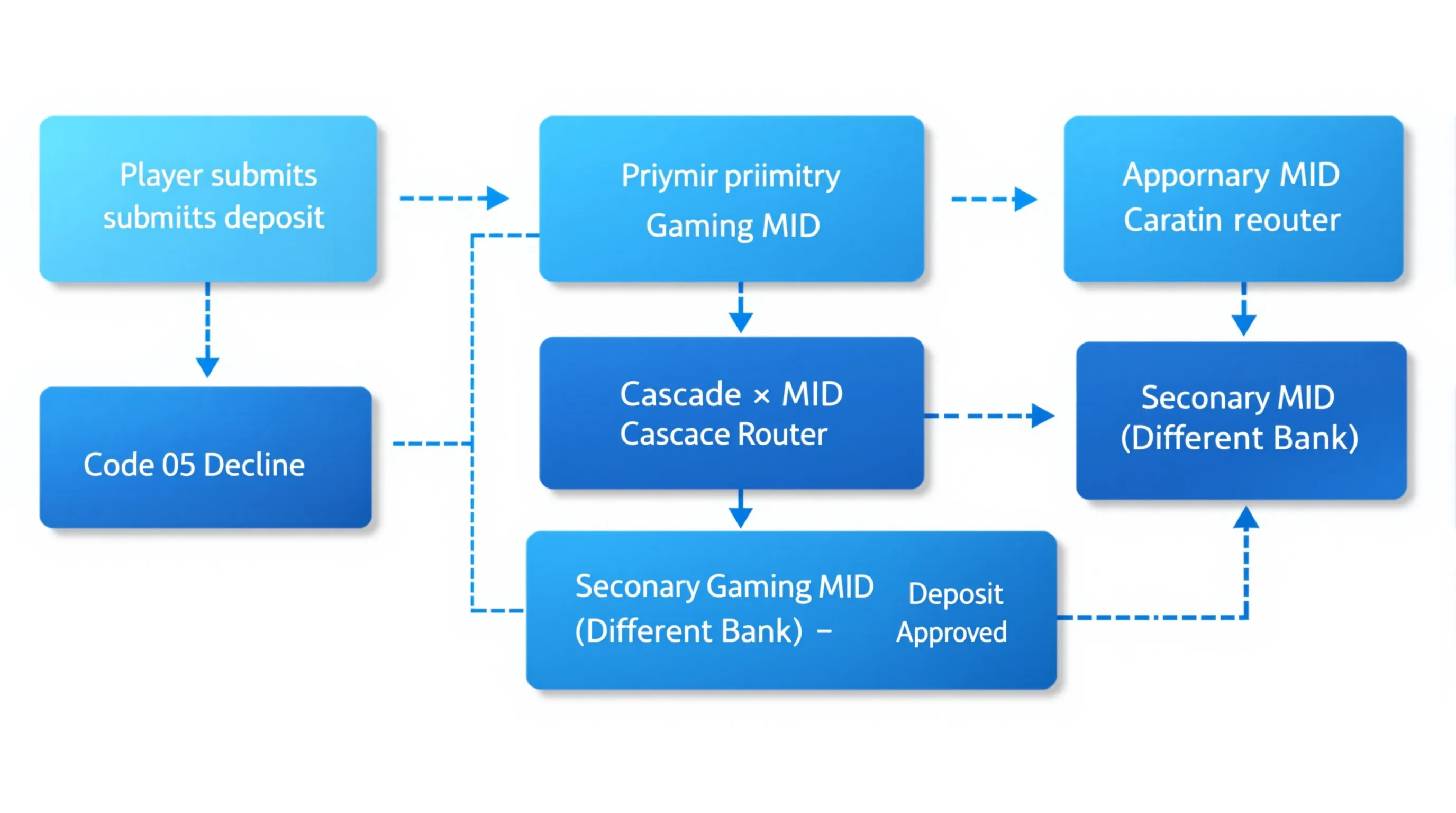
Before: Single Aggregator MID, No Decline Taxonomy
A sports betting operator runs all deposits through a single flat-rate aggregator. Every declined transaction receives the same error message regardless of reason code. The team treats all declines as unrecoverable. No retry logic exists. No secondary MID is available. Decline rate: 18%. Revenue lost to recoverable declines: substantial but unmeasured. Top-tier players hitting velocity limits silently stop depositing.
After: SeamlessChex Multi-MID Structure With Decline Routing
The same operator moves to a SeamlessChex gaming merchant account with a primary and secondary MID, calibrated AVS settings, real-time decline code tracking, cascade routing for velocity-limited transactions, and Seamless ACH as a checkout fallback. Players who hit a velocity wall see an ACH deposit option immediately. Address-mismatch declines trigger a one-step correction prompt. Decline rate: below 8%. Recovered deposit volume funds the margin the previous stack was losing.
What Will Shape Gaming Payment Decline Rates Most in the Next 12 to 24 Months
The dynamics around gaming card declines are not static. Several developments over the next two years will change where declines cluster and how recoverable they are, and gaming operators who understand these shifts in advance will be better positioned to keep their payment infrastructure current.
3D Secure 2 Adoption Will Shift AVS Responsibility
3DS2 authentication moves a portion of fraud liability from the merchant to the issuer when authentication succeeds, and it reduces the need for strict AVS matching as the primary fraud signal on high-value transactions. As more gaming operators implement 3DS2 on larger deposit amounts, issuers will be able to approve transactions they would previously decline based on AVS alone. The operators who have not yet implemented 3DS2 will continue carrying AVS-driven declines that their competitors will not.
AI-Driven Issuer Fraud Models Will Recalibrate Velocity Rules
Major card networks and issuers are actively deploying foundation model-based fraud detection that operates across merchant categories in real time. Stripe's model raised detection of fraud hidden inside merchant volume from 59% to 97%. Adyen has published a 46% reduction in authorization-rate loss from its own model upgrades. The practical effect for gaming is that issuer-side velocity rules will become more dynamic, with some legitimate player patterns receiving more latitude and others facing tighter controls, based on behavioral scoring rather than fixed daily limits. Gaming operators whose players exhibit unusual patterns even within legitimate use will face more variation in decline outcomes.
Account-to-Account Payment Alternatives Will Expand the Deposit Rail
As FedNow adoption grows and real-time bank-to-bank transfers become more accessible, gaming operators will have a genuine secondary deposit rail that does not depend on card network authorization at all. Operators who build ACH and bank-transfer deposit options now, rather than treating them as a last resort, will be ahead of the transition when card-based deposit friction increases under tighter regulatory or network pressure.
Gaming MCC Policy Fragmentation Will Increase
Different US credit card issuers are moving in different directions on gaming MCC policies, with some expanding cardholder controls and others maintaining blanket restrictions. This fragmentation means the player's issuing bank will matter more, not less, in determining whether a deposit succeeds. Multi-MID structures with differentiated BIN acceptance profiles will become a baseline requirement for gaming operators as this fragmentation develops, rather than an advanced optimization.
What 12-24 months May Bring
Where Gaming Card Declines Head Next
Three forecasts show which gaming card declines resolve quickly and which ones signal a permanent processor-level block.
Three Forecasts For Gaming Payment Declines
Use these forecasts to judge whether a decline pattern is a fixable fraud flag or a structural processor exit.
Demand for dedicated high-risk merchant account providers serving gaming and gaming-adjacent verticals will keep rising through 2026 as mainstream processors narrow which gaming categories they'll underwrite.
A growing share of gaming-adjacent declines - especially for mystery box and card-rip style sites - will trace to Visa and Mastercard category-level restrictions rather than to retryable fraud holds, making them permanent rather than recoverable.
Card-network fraud detection systems will keep reducing false declines on legitimate gaming purchases, but transactions tied to categories Visa and Mastercard have already pressured platforms to remove will stay blocked regardless of the fraud score.
Weak Signals Worth Watching Stripe's foundation model raised detection of fraud hidden inside large merchants' volume from 59% to 97%, after earlier specialist systems had already cut successful card-testing attacks by 80% over two years on more than $1 trillion in volume. Buyers are already searching for merchant account providers willing to approve mystery box or card-rip websites, a sign mainstream processors are declining the category outright rather than flagging individual transactions. Buyers are actively asking who the top high-risk merchant account providers are for 2026 and which providers approve high-risk e-commerce and mystery box businesses, rather than relying on general processors.
Evidence Behind The Decline Patterns
Each forecast lists the market evidence supporting it alongside evidence that could weaken it.
- Why do the payment processors care? points the same way. [Community / Forum]Original poster (u/CommitteeScary2956) states game removals/de-indexing followed threats from Visa and Mastercard, attributed by many commenters to pressure from an activist group called Collective Shout. “Payment processors mostly act out of risk management, not morals. One big scandal or regulatory hit costs them more than a few lost game sales.”
- The case rests on Everyone is fully aware of the actions of the payment processors, so. [Community / Forum]Payment processors (named: Visa, Mastercard, PayPal) have reportedly refused to process payments for certain content categories for "decades," per commenter Thisismyworkday. “Do not forget, do not forgive and take any opportunity to screw them over if you can. That is more than enough for me.”
- Transaction Foundation Models supports this forecast. [Substack / Newsletter]Revolut's PRAGMA model, co-published with NVIDIA, trained on over 20 billion events from 25 million customers. “Both numbers come from the same team, in the same paper.”
- Building the Tokenized Payments Stack: Securing Cards, Accounts, and AI‑Driven Commerce is the strongest public backing for this call. [Blog]Network tokens are typically 13-19 digit numbers that mimic a card number but carry dynamic cryptograms, token CVVs, and domain controls (device, merchant, channel, geography). “No direct first-person spoken quotes from named third parties are present; content is authored analysis by Adnan Masood without quoted external sources in the…”
What Could Shift These Predictions
These scenarios describe the real-world shifts in network policy or fraud technology that would change the forecasts above.
Where We're Hedging
71 reflects our strongest conviction, while 65 is where we are most prepared to be wrong.
- If the regulatory or buying picture flips, Specialized High-Risk Processors Gain Ground breaks first.
- Mounting evidence on the other side would move Category Blocks, Not Fraud Flags, Drive the Unrecoverable Share to the front.
Key Takeaways
Key Takeaways
- Gaming MIDs carry 10-20% baseline decline rates versus 2-5% for standard e-commerce, driven by MCC classification and player deposit behavior, not inherent risk that cannot be managed.
- AVS and CVV mismatches are the dominant decline cluster, typically accounting for well over half of declines, and are almost entirely recoverable once the player updates their billing details.
- Issuer velocity limits produce the same code-05 response as fraud blocks but are time-bounded and recoverable via 24-hour retry or cascade to a secondary MID.
- Never retry codes 41, 43, or 14: lost/stolen cards and invalid account numbers produce chargebacks, not approvals, and retrying them actively harms your MID's chargeback ratio.
- The path from 15% to below 8% decline rate runs through decline code taxonomy, calibrated AVS settings, cascade routing across multiple MIDs, and ACH as a secondary deposit rail.
Gaming card declines are not uniformly bad news. The ones rooted in AVS mismatches, expired card details, or issuer velocity limits are recoverable with a payment stack designed to act on that information. The ones rooted in genuine fraud are a small minority, and handling them correctly, which means not retrying them, protects your MID's chargeback ratio rather than threatening it.
What separates gaming operators who run stable, growing deposit volumes from those who constantly fight declining authorization rates is not luck or a more cooperative player base. It is MID structure, decline code taxonomy, and a processor partner with the acquiring relationships to support cascade routing and secondary rail options when the primary card path closes.
SeamlessChex partners with established gaming businesses processing $25,000 or more per month to build that infrastructure. I would rather talk to a gaming operator before their decline rate becomes a chargeback problem than after. Contact our team to review your current payment stack and identify the recoverable volume you are losing today.
Gaming operators experiencing persistent deposit decline rates above 10% can find direct support through SeamlessChex's online gaming payment processing solutions. We work with established platforms processing $25,000 or more per month to place and configure merchant accounts built for the gaming environment.
Written by
Jonathan Albert
Co-Founder, SeamlessChex
Jonathan Albert is Co-Founder of SeamlessChex, a credit card processing and fintech payments platform recognized on the Inc. 5000.
Connect on LinkedInFrequently Asked Questions: Gaming Card Declines and MID Management
What is the most common reason gaming deposit cards are declined?
AVS (Address Verification System) mismatches are the most frequent cause, accounting for a large share of total declines on most gaming MIDs before any remediation. The player's entered billing address does not match what the card issuer has on file, and the gateway declines the transaction. The card itself is valid and the funds exist.
What is an issuer velocity limit in gaming payment processing?
Many credit card issuers set a per-day or per-transaction-count limit on gaming authorizations, separate from the cardholder's general credit limit. A player who deposits three or four times in one session may exhaust this gaming-specific limit, producing a "Do Not Honor" (code 05) decline even though their card has available credit. These declines are temporary and recoverable after the issuer's counter resets, typically in 24 hours.
Should gaming operators retry all declined deposit transactions?
No. Retry strategy must depend on the decline reason code. AVS and CVV failures should be retried after the player corrects their card details. Velocity-limited declines (code 05) should be retried after a 24-hour window or routed to a secondary MID. Lost or stolen card declines (codes 41 and 43) must never be retried, as any resulting charge will produce a confirmed chargeback.
What is MID cascade routing in gaming processing?
Cascade routing is the practice of forwarding a declined transaction to a secondary merchant account (MID) at a different acquiring bank in real time, before the player sees a decline message. The secondary MID may have a different velocity counter or BIN acceptance profile, allowing the transaction to complete on the second attempt without visible friction to the player.
How does SeamlessChex help gaming operators reduce card decline rates?
SeamlessChex places gaming merchant accounts with a structure that includes primary and secondary MIDs, calibrated AVS configuration, real-time decline code monitoring, and ACH deposit as a secondary rail through Seamless ACH. We work with established gaming operators processing $25,000 or more per month. This integrated approach typically brings decline rates from the 15-20% baseline range to below 8%.
What decline rate should a gaming operator expect as a baseline?
Gaming MIDs typically see baseline card decline rates between 10% and 20% before any systematic optimization, compared to 2-5% for standard e-commerce. The gap reflects the MCC classification, card-not-present risk scoring, and player deposit behavior patterns that trigger issuer velocity monitoring. With proper MID structure and retry logic, rates below 8% are achievable on an established player base.
Summarize This Article With AI
Open this article in your preferred AI engine for an instant summary.
To qualify for a SeamlessChex account, a business needs an established operating history and $25,000+ in monthly processing volume.