


Quick Answer
A mystery pack or break platform needs six documents: financial baseline, odds disclosure, customer balance ledger, fulfillment SLA, vault reconciliation and buyback policy. Each answers one risk an underwriter prices.
Miss one, and that risk stays an open question.
Key Points
- In September 2026, our underwriting team said break platforms are priced on five elements: prepaid credit, randomized outcome, delayed physical fulfillment, stored balances and buybacks.
- The packet holds six documents: a financial baseline, a break format and odds disclosure, a customer balance ledger, a fulfillment SLA, a vault reconciliation and a buyback policy.
- MVSI, an underwriting automation vendor, wrote in August 2026 that follow-up is usually triggered by incomplete applications or discrepancies in financial data.
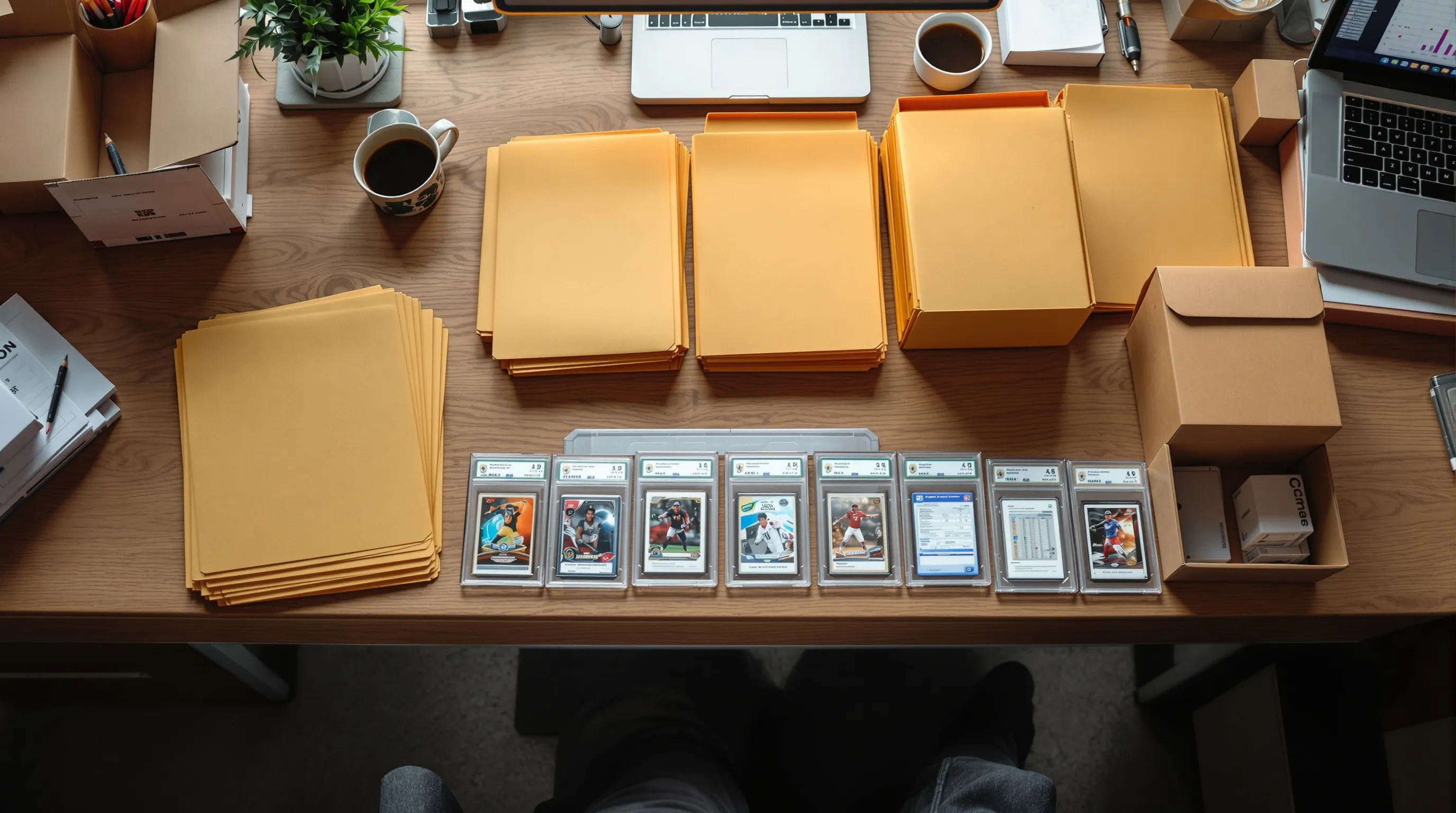
One document for each risk an underwriter prices, plus the financial baseline.
An underwriter reading a break platform's file is not pricing cards. Our underwriting team sees five things instead: prepaid credit, a randomized outcome, delayed physical fulfillment, stored balances and buybacks. Each raises its own question. I think each deserves its own document.
Employers already work this way. A good new hire packet is meant to be one compact package holding every form the first day needs, handed over before anyone has to ask for it. A merchant file can do the same, and below I map one document to each element, then add the financial baseline every application starts with, so the reviewer's first pass reads as answered rather than open.
A request for more documents is one of the least useful things a break operator can hear from underwriting. It rarely says which document, or why. I want to fix that. Start by asking each processor you are weighing which parts of your break model its underwriters want in writing. Build those, add your financial baseline, and the request stops being vague. Start with what an underwriter is actually looking at.
What risk shape does an underwriter actually see in a break platform?
Our underwriting team prices five elements, not trading cards: prepaid credit, a randomized outcome, delayed physical fulfillment, stored balances, and buybacks. Your application should name all five.
Before drafting a single document, run your business against these questions:
- Prepaid credit: do customers fund a balance before they buy?
- Randomized outcome: does a pack or spot deliver an unknown card?
- Delayed physical fulfillment: does the card ship later, or stay vaulted?
- Stored balances: does customer money sit on your platform?
- Buybacks: do you repurchase pulled cards?
The common assumption is that a rip site is a collectibles retailer. A note from our team in September 2026 put it plainly: the processor "isn't really pricing 'trading cards'." Applying as a card shop misdescribes the business. The comparables we point to are Courtyard and Rips by Triumph, which is why the real qualification question is whether a processor already boards platforms of that shape.
Generic underwriting guides list five review areas: financial health, business model, transaction history, compliance, and security. Each break element lands in one of them. Prepaid credit and stored balances raise future-delivery and refund exposure. The randomized outcome draws classification and chargeback questions. Delayed fulfillment invites non-receipt disputes, and buybacks open a cash-out path that gets money-movement review.
Card funding through a dedicated merchant payment processing account stays the primary rail. If some customers load balances by ACH as a second rail, Nacha's rules add a wrinkle: debiting a customer before the authorization date is a rules violation, so the funding authorization belongs in the file too.
Combining 3 sources points to one conclusion. The research section below walks through it. Ask yourself which of the five you could not explain in writing today. I would rather see a merchant over-explain its buyback flow than leave it to guesswork, because a long file costs reading time while a misread one can cost the approval. So the documents themselves come next, one per element.
Why does a complete break-platform application still stall in review?
A break platform can send every document an underwriter asks for and still get a follow-up email. We compared the standard checklist with how breaks actually run and found a gap.
Start with the checklist. MVSI, a company that sells underwriting automation to payment providers, set out the usual process in August 2026: gather documentation, review the application, follow up, approve, onboard. Its document list is the familiar one. Business registration, financial statements, tax identification numbers, proof of address, bank statements and merchant processing statements. Its account of what slows a file down is just as plain: "Follow-up is usually triggered by incomplete applications or discrepancies in financial data," and "manual review remains available for higher-risk cases."
Now set that list beside the five elements our underwriting team prices. Every standard document proves something real: the company exists, pays taxes and moves money through a bank. None of them describes any of the five.
| Element we price | Described by the standard packet? | Question left for the reviewer |
|---|---|---|
| Prepaid credit | No | What have customers paid for that has not been delivered yet? |
| Randomized outcome | No | How are spots sold and assigned, and what can a buyer end up with? |
| Delayed physical fulfillment | No | When does the card ship, or where is it held? |
| Stored balances | No | How much customer money sits on the platform? |
| Buybacks | No | When and how does money flow back out to customers? |
A file can be complete by the checklist and still incomplete on the points the reviewer is pricing. That is our reading, and it matches MVSI's own description of what triggers follow-up.
Marketplaces worked out their own answers some time ago. In a 2023 eBay community thread, a seller quoted the marketplace's policy: breaks "may be sold by pre-approved sellers only, and the buyer must receive the entire pack, box, or slot they purchased." According to the same quoted policy, mystery boxes are allowed only when the listing gives general information about contents and "does not single out items with monetary or collector's value unless they are included with every purchase." An underwriter would read those as controls on two of the five elements: what the buyer is promised before the outcome is known, and what the buyer must physically receive afterward. A platform that already follows rules like these can put them in writing.
The randomized element sounds like the hardest part to document. In practice, breakers already run it by stated rules. A 2025 Baseball America primer, written by a collector who buys break spots, walks through the common formats.
How a break turns a payment into a random outcome
- Fixed spots: breakers usually sell 15, 30 or 32 spots, depending on format.
- Random teams: 30 spots sell at the same price, and teams are randomized once every spot is purchased.
- Auctions: bidding typically starts at $1. After the winning bid, a wheel spin assigns a random team or player.
- Serials: one high-priced spot is split into 10 spots numbered 0 to 9, and each card goes to the spot matching the last digit of its serial number.
Drawn from Baseball America's Breaking 101 guide, December 2025.
The same writer is frank about the downside. Even on case breaks, a buyer can still "skunk," which the guide defines as "the breaking term for walking away with nothing." Buyers in the eBay thread argued over whether that makes breaks gambling. One called them "a crapshoot." Another pointed out that a sealed box from a local card shop carries the same uncertainty. A reviewer may raise the same question. A written account of how spots are sold, assigned and filled lets the reviewer judge the mechanics instead of a label.
Even a well-documented file may get a qualified approval. MVSI notes that approved merchants "may face certain restrictions, such as rolling reserves or transaction limits, depending on their risk level." Merchants know to ask about these terms. In a 2018 Reddit thread for small businesses, one owner listing what mattered in a processor put "Reserve holds and charge back/fraudulent transaction policy" next to the rate. We also set a volume floor: we board established businesses processing at least $25,000 a month.
Read side by side, these sources describe two separate questions. The standard packet answers whether a business is real and solvent. A break platform raises a second: what exactly is sold, held, shipped and paid back, and under which rules. Marketplaces and breakers have already written many of those rules down. The evidence suggests files stall when nobody hands those rules to the underwriter.
- Read your own application against the five elements. If you cannot point to a page that explains each one, expect the reviewer to ask about it.
- Write down every break format you run: how many spots, when teams or players are randomized, how serial spots are assigned, and what a buyer receives if a spot pulls nothing.
- Put your delivery and disclosure rules in writing. If a marketplace has pre-approved you to sell breaks, ask the processor whether that approval belongs in your file.
- Before applying, ask each processor whether approval could come with a rolling reserve or a transaction limit, and how chargebacks are handled.
- Confirm your monthly volume, since we board established businesses processing $25,000 a month and up.
How we checked this
We compared a 2026 vendor explainer on merchant underwriting with a 2025 collector's guide to card breaks, a 2023 eBay community thread and a 2018 Reddit thread for small businesses. Two things come from us: the five elements, which reflect our underwriting team's view as of September 2026, and the $25,000 monthly minimum. MVSI sells underwriting automation. The eBay policy wording comes from a user quoting it in a forum, and we did not read it on an eBay policy page. The Baseball America guide reflects one writer's own experience. The Reddit and eBay comments are individual opinions and do not show a pattern. We board merchants in this segment, so we have a stake in the answer. Still unknown: how often break-platform files are held up in review, and for how long. None of our sources measured that.
- MVSI, guide to merchant underwriting for payment providers, August 25, 2026.
- Baseball America, Baseball card breaking 101 guide, December 2, 2025.
- eBay Community, selling forum thread on trading card breaks, June 16, 2023.
- Reddit r/smallbusiness, thread on choosing a card processor, October 19, 2018.
- Our underwriting team's view on break and mystery-pack platforms, September 2026, and our merchant qualification minimum, July 2026.
Which six documents should a break platform put in its merchant application?
Six documents cover it: a financial baseline, a break format and odds disclosure, a customer balance ledger, a fulfillment SLA, a vault reconciliation, and a written buyback policy.
| Risk element | Document | What it proves |
|---|---|---|
| Business baseline | Financial baseline: registration, tax ID, bank and processing statements | The business exists and has a track record |
| Randomized outcome | Break format and odds disclosure | Buyers know exactly what a spot or pack can deliver |
| Prepaid credit and stored balances | Customer balance ledger | Every funded dollar ties to a named customer |
| Delayed physical fulfillment | Fulfillment SLA | Cards ship on a stated clock |
| Vaulted cards awaiting shipment | Vault reconciliation | Held inventory matches what customers own |
| Buybacks | Buyback policy | The cash-out path has written limits and pricing rules |
The financial baseline is the familiar part: registration documents, financial statements, a tax ID, proof of address, plus bank and processing statements. Underwriting follow-ups usually start with an incomplete application. Send it complete. The same baseline matters if you are pursuing TMF/MATCH list merchant account approval after a prior closure.
The odds disclosure should describe every format you run. Baseball America's December 2025 breaking primer notes that breakers usually sell 15, 30, or 32 spots, that random-team breaks assign teams once all spots sell, and that auctions end with a wheel spin assigning a team or player. Write each mechanic down. In 2023, eBay's quoted break policy allowed bonuses only when identical for all buyers, and I think that is a sensible bar for your own bonus language.
The balance ledger shows each customer's funded, spent, refunded, and outstanding amounts. Card loads should dominate it. Where ACH funds a balance, Nacha's developer guide notes ACH is not processed on weekends or certain federal holidays, so mark pending loads separately from settled ones.
The fulfillment SLA, vault reconciliation, and buyback policy close the remaining gaps. The SLA states how fast pulled cards ship. The reconciliation ties every vaulted card to an owner. The buyback policy sets who can sell back, at what price basis, and how payouts move. Underwriters read these three together, because each one answers a version of the same worry: does the customer end up with what they paid for?
That is a lot of paperwork, and it invites a fair objection from operators who have seen processors promise onboarding in minutes.
Is the packet worth building when some processors board merchants in minutes?
Yes, for an established platform. Fast onboarding skips the review, not the risk, and a processor that never priced your five elements has little basis for keeping you boarded.
The shortcut deserves a fair hearing. No-KYC gateways pitch setup in under 60 seconds, no ID or business documents, and settlement in stablecoins instead of dollars. Even in that market, crypto processors that add Visa and Mastercard acceptance through a partner trigger KYC and business documentation, and that step takes days or weeks. One writer covering the space concedes that a business needing a licensed, audit-ready processor may need a formally licensed platform.
Flat-rate processors offer a gentler version of the same trade. In a 2018 r/smallbusiness thread, one owner said Square signup "practically takes 5 minutes." Another commenter in that thread warned that Stripe's gateway is proprietary, so switching processors later means redoing development work.
Speed up front can become lock-in later. Fast boarding does not price your risk. It postpones the question until a dispute spike or a buyback surge forces it, usually at the worst moment for cash flow.
Our underwriting team frames the choice another way. As one team member put it, "any processor already comfortable with Courtyard or Triumph has underwritten this shape before." My advice follows from that: pick the processor that recognizes your model, then hand it the packet.
The payoff grows with volume. Once spot sales scale, high-volume credit card processing on a dedicated account depends on a file an underwriter can reopen and still understand, which is exactly what six mapped documents give them.
What should a break operator do before applying?
Build the six documents first, then apply to a processor that already boards rip and break platforms. Ask each processor which break and rip formats it already supports.
Most onboarding packets are lists of standard forms. Indeed's guide to new hire paperwork, updated June 16, 2026, names 9 types, nearly all the same for every employer. A merchant packet for a break platform cannot work that way. Date every document, so a reviewer can see it describes how your platform runs today.
My view is that this file does more than clear review. It becomes leverage. In a 2023 r/sales thread, a bank merchant processing rep said merchants often used a competing bid to get their current processor to lower its rate. A complete, current packet makes you easy to bid on. Keep it updated as your formats, balances, and buyback rules change, and your credit card processing terms stay open to renegotiation instead of locked to the first offer.
Frequently Asked Questions
What else do break operators ask about getting boarded?
Most follow-up questions land on speed, true cost, what to do with an unanswered underwriting question, and how ACH timing fits beside credit card processing.
How soon can a break platform start taking card payments?
SeamlessChex offers same-day onboarding with no contracts, and we approve subscription and high-risk businesses other processors turn away. A complete packet is what lets that speed hold up. Send your file through our contact page and we will tell you where it stands.
Does a low quoted rate show what I will actually pay?
Not always. Interchange-plus pricing passes through the card networks' base cost plus a separate markup. In a 2018 small business thread, one commenter saw a contract that charged 6.37% on purchasing cards, and warned that switching could cost $250 or more in cancellation fees. Read the card-type schedule, not just the headline.
What if underwriting asks something I cannot answer yet?
Say so, then come back with the answer. A 2025 medical sales podcast made the same point about clients: admitting you don't know is fine as long as you follow up, because many people promise and never return. I would apply that exactly to an underwriter's questions.
If I also accept ACH, which timing rules matter?
Nacha caps Same Day ACH at $1,000,000 per entry. It also recommends sending a pre-notification at least three business days before the first live debit, and again whenever a customer's account number or bank changes. Build those dates into your balance ledger before the first payout cycle runs.
Written by
Lily Flanigan
Operations Manager, SeamlessChex
Lily Flanigan is Operations Manager at SeamlessChex, a credit card processing and fintech payments platform recognized on the Inc. 5000, where she focuses on operations and process optimization.
Connect on LinkedInSeamlessChex works with established businesses processing a minimum of $25,000 per month.