



Whether your payment processor is HIPAA compliant depends entirely on what your own system sends it.
HIPAA-compliant payment processing refers to any checkout architecture that keeps protected health information out of the payment transaction itself. HIPAA attaches to the data, not the business category. According to Finix's HIPAA compliance guide, banks and payment processors are generally exempt under the financial-institution exemption when they are only moving money - but that exemption stops the moment PHI enters the transaction record.
The PHI-Touch Test, introduced in this article, is a decision framework for determining whether your payment architecture triggers HIPAA scope. PCI DSS is always required for card processing. HIPAA scope is an architecture question. Those are different standards with different triggers, and conflating them is where most compliance errors begin.
Whether a BAA is required from your processor depends on what your own system sends it. A walled-off, tokenized checkout that never receives clinical data may qualify for the financial-institution exemption. An integrated billing-payment portal that passes diagnosis codes or patient identifiers into the transaction record does not. The law follows the data.
HIPAA-compliant payment processing refers to any checkout architecture that prevents protected health information from reaching the payment transaction itself. The law attaches to the data, not the business category. According to Finix's HIPAA compliance guide, banks and payment processors are generally exempt when they're only moving money - but that exemption stops applying the moment PHI enters the transaction flow. Whether your processor is compliant depends entirely on what your own system sends it.
Does Your Payment Page Actually Touch PHI?
HIPAA attaches to your payment architecture, not your business category. A card checkout that never handles protected health information likely sits outside HIPAA's direct reach.
A comparison of compliance guides and practitioner discussions across multiple forums shows the same split: half the sources say any healthcare-adjacent business needs a HIPAA-compliant processor; the other half say the financial-institution exemption probably covers standard card processing. Neither camp gives you a way to decide which answer applies to your checkout. That gap is exactly what the PHI-Touch Test is designed to close, as of .
According to HIPAA guidance summarized by Finix, "the same processor can be compliant for a practice that segregates PHI correctly and a liability for one that pastes diagnosis codes into receipt fields." The vendor does not determine your compliance posture. Your architecture does.
A common misconception is that operating in healthcare means you automatically need a full HIPAA-compliant payment setup. The reality is that HIPAA scope is triggered by PHI presence in the transaction, not by your industry alone. According to practitioner discussions on r/webdev, if a payment flow carries no health information, HIPAA compliance concerns for the payment processor simply do not arise.
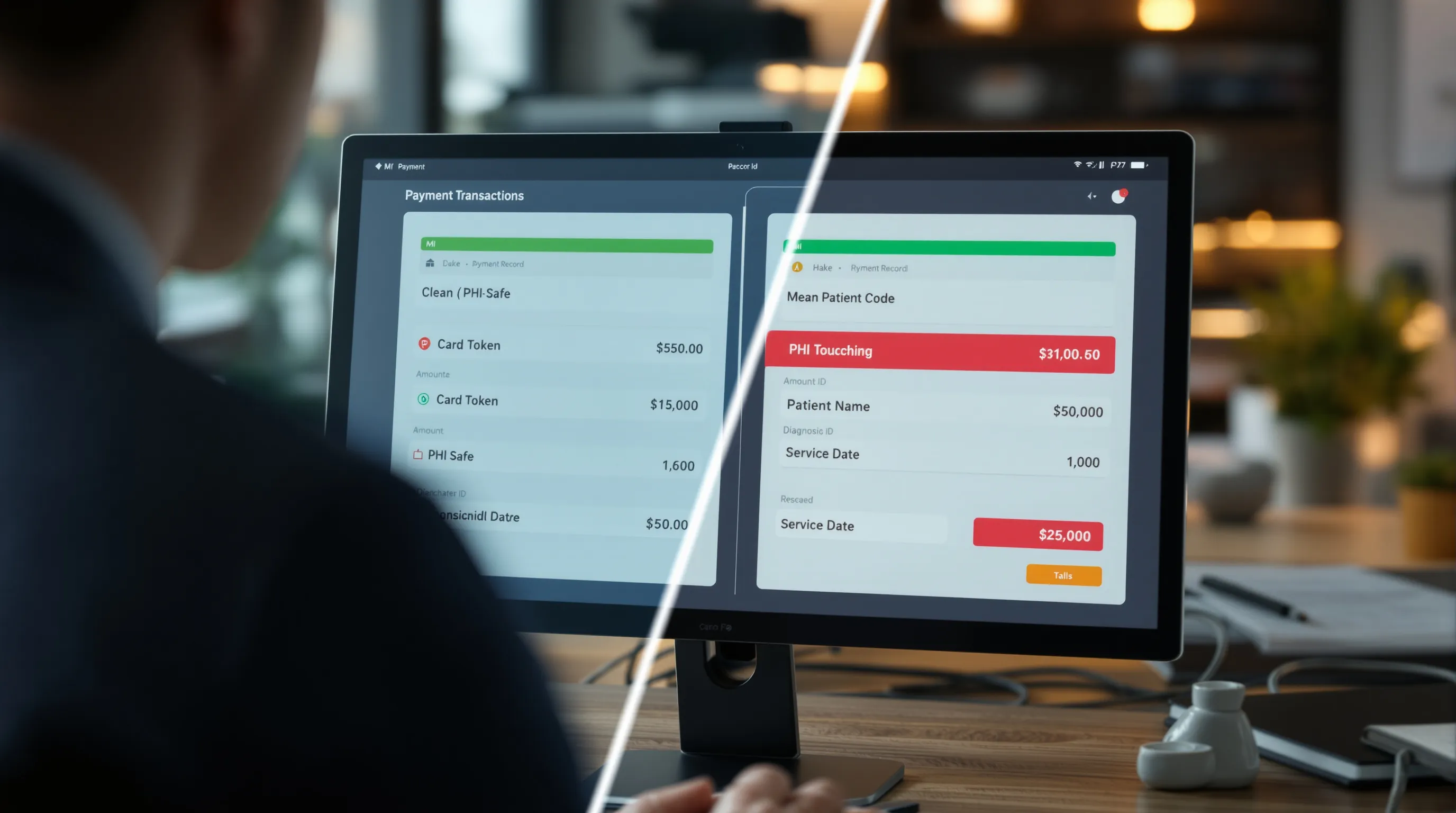
What Is the Financial-Institution Exemption, and When Does It Stop Applying?
HIPAA includes a specific carve-out for financial institutions that process payment transactions without ever handling protected health information.
According to Finix's HIPAA compliance guide, "banks and payment processors are generally exempt when they're only moving money." That exemption is real. But it is narrow. The moment a transaction record contains clinical information, the exemption stops applying. In my experience working with businesses in regulated categories, this is where most merchants get into trouble: they assume the exemption covers their entire payment setup rather than just the card-movement layer of it.
HIPAA also draws a firm line around auxiliary services. Payment analytics, reporting dashboards, and receipt generation that pull patient-identifiable information alongside transaction data are not covered by the financial-institution exemption, even if the underlying card swipe is. The takeaway: the exemption travels with the action of moving money, not with the processor as a whole.
In practice, this means your processor choice matters less than your data architecture. PCI DSS compliance is always required for card processing. HIPAA scope is a separate question, determined entirely by whether PHI enters the transaction flow.
How Does HIPAA Apply to Healthcare Payment Processing?
The video below walks through how HIPAA intersects with payment systems in healthcare settings, including when a processor must sign a BAA and when the financial-institution exemption applies.
The central point is one I return to often with healthcare-adjacent clients: the compliance question is not which processor has a HIPAA badge, but what data your own checkout sends to any processor. A payment system that receives only a card token, an amount, and a merchant ID operates in a fundamentally different compliance environment than one that also receives a patient identifier, a diagnosis code, or a date of service. The architecture of the transaction decides the scope. Processor selection comes after.
Why Do Square, Stripe, and Other Processors Get Contradictory HIPAA Reviews?
Practitioners arguing over whether a specific processor is HIPAA compliant are often answering different questions about different implementations of the same platform.
Square is a good example. Private practice communities online show practitioners claiming Square won't sign a BAA, and in the same thread, others documenting that Square's BAA has been available online for years. Both groups are correct. Square's standard card-collection flow does not transmit or store PHI in typical use. Collecting payment alone, without clinical data attached, falls within the financial-institution exemption. A BAA becomes relevant only if the merchant's setup starts attaching PHI to transactions.
According to a practitioner discussion in r/healthIT, "HIPAA exceptions apply only to the direct processing of credit card payment. Auxiliary services, like receipt generation, analytics, or reporting, are not exempt." That clarification resolves most of the confusion. The disagreements are not about the platform. They are about which features of the platform the merchant is actually using.
According to Finix, "if a processor won't sign a BAA, it can't be used in any payment flow that could touch PHI. No exceptions." That rule is sound. What it does not tell you is whether your specific flow touches PHI at all. That is the question the PHI-Touch Test is built to answer.
The difference between a PHI-safe and a PHI-touching transaction record is visible at the field level. A tokenized card checkout that records only the payment details passes the test. The same checkout fails the moment it links to clinical identifiers.
// PHI-SAFE transaction record (passes PHI-Touch Test)
{
  "transaction_id": "txn_8a7f3c",
  "card_token":     "tok_9x2kLmP4",
  "amount":         200.00,
  "currency":       "USD",
  "merchant":       "Practice Name",
  "date":           "2026-09-01"
  // No patient name, no diagnosis, no service code, no patient ID
}

// PHI-TOUCHING transaction record (fails PHI-Touch Test)
{
  "transaction_id": "txn_8a7f3c",
  "card_token":     "tok_9x2kLmP4",
  "amount":         200.00,
  "patient_id":     "P00123",
  "patient_name":   "Jane Doe",
  "diagnosis_code": "E11.9",
  "service_date":   "2026-09-01",
  "service_type":   "Office Visit"
  // PHI present: processor needs BAA; financial-institution exemption does NOT apply
}
According to Finix's HIPAA compliance guide, a payment solution that handles only the transaction - not the clinical record - can remain outside HIPAA scope. The moment patient-identifiable fields enter the record, that scope boundary disappears.
How Does Your Payment Architecture Determine Whether PHI Is Present?
Tokenization and data segregation are the two architectural decisions that most directly control whether a card checkout ever touches PHI.
Tokenization replaces a card number with a random token, so the payment system never stores the actual card digits. That removes card data from the merchant's environment. But it does not, by itself, keep PHI out of the transaction. If the merchant's system also links transaction records to patient names, diagnosis codes, or clinical records, PHI is present regardless of whether the card number is tokenized.
According to Finix's 2026 healthcare payments guide, the billing system and the payment solution are distinct layers: "a billing system handles coding, claims submission, and patient statement generation. A payment solution handles the actual transaction." When those two layers remain separate, the payment solution may never see PHI. When they merge, or when payment records are generated from billing data, the distinction disappears.
A parallel from healthcare data law makes this concrete. A limited data set under HIPAA, which may retain dates of service and ZIP codes, is still classified as PHI even after identifying fields are removed. The same logic applies to payment records. A transaction record that retains a service date, a practice name, and an account number linked to a patient file is PHI, even if no diagnosis code appears in the record itself. What this means: the PHI-Touch question is not just about what is in the transaction. It is also about what the transaction is linked to.
What Changes When a Telehealth Practice Separates Its Billing System From Its Payment Processor?
Separating billing from payment processing removes PHI from the transaction record, shifts the checkout outside HIPAA scope, and changes what your processor is required to provide.
| Scenario | Before: Integrated billing-payment portal | After: Separated tokenized checkout |
|---|---|---|
| Transaction record contents | Patient name, diagnosis code, service date, card token - PHI present | Card token, amount, date, merchant ID - no PHI |
| HIPAA scope | In scope. PHI present in transaction flow. BAA required from processor. | Potentially out of scope. Financial-institution exemption may apply. |
| Processor requirement | Processor must sign BAA. Generic processors (Stripe, Square standard) may be ineligible. | Processor must meet PCI DSS. BAA is optional, not required by default. |
| Breach exposure | A payment-system breach is also a HIPAA breach. 60-day OCR reporting obligation triggered. | A payment breach is a PCI incident. HIPAA reporting obligation depends on whether PHI was separately exposed. |
| Compliance cost | Both PCI DSS and HIPAA programs required. BAA negotiation adds vendor selection friction. | PCI DSS required. HIPAA compliance work concentrated in the EHR/billing layer, not the payment processor. |
According to Finix's HIPAA compliance guide, a processor that handles only the transaction, with no PHI reaching it, falls under the financial-institution exemption. The architecture change does not eliminate compliance work. It concentrates that work in the right layer.
What Should a Merchant Check Before Trusting Their Payment Stack Is HIPAA-Safe?
Run four questions against your current checkout flow, and your HIPAA scope question answers itself before a breach forces the answer.
I recommend working through these in order:
- Does the payment form collect any patient-identifiable information? Name, date of birth, and insurance ID are PHI. A card number alone is not.
- Does your receipt generation pull from clinical records? Service codes, diagnosis references, or treatment descriptions in a receipt email bring PHI into the transaction record.
- Is the payment system linked to your EHR or billing system? Linked systems share data. A payment confirmation that pulls appointment context from an integrated health record is touching PHI even if the checkout page looks clean.
- Who can see the transaction record, and what does it contain? A linked transaction log visible to clinical staff, containing patient names and service dates, is a PHI-bearing record under HIPAA.
The cost of skipping this check is rising. According to Daniel Cham's 2025 healthcare security analysis, ransomware attacks on healthcare organizations rose more than 25% in 2025, with billing systems among the most targeted entry points. OCR fines and breach-notification obligations - the 60-day reporting rule applies from the date a breach is discovered - follow from where PHI lives, not just where the card number goes.
In practice, most billing-system breaches are not payment-processor breaches. The takeaway: your processor's compliance posture only matters if your architecture has already let PHI into the transaction flow.
| Checkout Scenario | PHI in Transaction? | Financial-Institution Exemption | BAA with Processor Required? | PHI-Touch Result |
|---|---|---|---|---|
| Card-only form: token, amount, date, merchant name - no clinical fields | No | Potentially applies | Not required by default | Passes |
| Payment form that also collects patient name and date of service | Yes | Exemption fails | Required | Fails |
| Receipt email that includes diagnosis codes or CPT service codes | Yes | Exemption fails | Required | Fails |
| EHR-integrated billing portal that passes patient ID to the processor | Yes | Exemption fails | Required | Fails |
| Separate payment layer, walled off from billing system, collecting only card data | No | Potentially applies | Not required by default | Passes |
What Will Drive HIPAA Payment Compliance Decisions in the Next 12 to 24 Months?
The short answer: processor BAA availability will expand, but high-risk merchant underwriting will matter more than HIPAA vendor selection for most healthcare-adjacent businesses.
- Voluntary BAAs will spread to more mainstream processors. Prediction: More processors will follow Square's model of offering an optional BAA to healthcare merchants, even where the financial-institution exemption technically applies. Weak signal: According to Square's own help documentation, collecting a payment alone typically does not transmit or store PHI, yet Square offers a BAA on request anyway. Why it matters: Practices need to know whether a BAA is offered by default or only on request. That distinction determines which checkout flows are safe for higher-risk transactions. Confidence: medium.
- High-risk underwriting will eclipse HIPAA-specific processor questions. Prediction: For GLP-1 dispensaries, nutraceutical sellers, and telehealth platforms, buyer attention will shift from "Is this processor HIPAA compliant?" to "Can this processor actually approve my account?" Weak signal: Unresolved buyer queries increasingly center on merchant approval for regulated categories. Standard tokenized card processing already keeps PHI out of the transaction for most direct-pay practices. Why it matters: A merchant can have a signed BAA and still be declined. High-risk underwriting is the gate; HIPAA compliance is the floor. Confidence: low (contrarian).
- Rising ransomware will push billing platforms toward stricter contracts. Prediction: As ransomware incidents targeting healthcare billing systems keep rising, more platforms will move toward mandatory BAAs and stricter security controls, independent of the financial-institution exemption. Weak signal: Billing systems and smaller clinics were among the most targeted entry points in 2025 healthcare breaches, raising the cost of skipping a BAA even when a processor is technically exempt. Why it matters: Practices relying on the exemption to avoid formal compliance work face growing breach and liability exposure. Confidence: medium.
What most buyers miss: the financial-institution exemption is a legal carve-out, not a security posture. A processor exempt from HIPAA can still be the entry point for a breach. From what I have seen in credit card processing for healthcare-adjacent businesses, the merchants who spend energy on architecture and data-flow mapping fare better than those hunting for a compliance label on a vendor's website.
Our Outlook for 12-24 months
Where HIPAA Payment Compliance Is Headed Next
Three forecasts assess how payment processors, providers, and regulators may resolve the financial-institution-exemption question over the next two years.
Forecasts For Healthcare Payment Compliance
Use these forecasts to gauge how soon payment vendors and practices will need to settle exemption and BAA questions.
Buyer demand will concentrate more on high-risk merchant approval for card processing, including for GLP-1 and nutraceutical sellers, than on HIPAA-specific compliance questions, since standard tokenized processing already keeps PHI out of most transactions.
More mainstream processors will follow Square's pattern of offering an optional BAA to healthcare merchants over the next 12-24 months, even though standard card collection through PCI-compliant flows doesn't itself transmit PHI.
As ransomware attacks on healthcare billing systems keep climbing, more medical billing and payment platforms will move toward mandatory BAAs and stricter security controls over the next 12-24 months, independent of whether the financial-institution exemption would otherwise apply.
Signals We're Still Testing Square already offers a BAA on request even though commenters note that collecting payment alone typically doesn't transmit or store PHI, per Square's own help documentation. Unresolved buyer questions increasingly center on how to get approved as a high-risk merchant and where to find processing for regulated categories like GLP-1 stores and nutraceuticals, rather than on HIPAA compliance itself. Ransomware incidents targeting healthcare organizations rose more than 25% in 2025, with billing systems and smaller clinics especially vulnerable, echoing an earlier case where a 2019 ransomware attack on an accounting firm exposed a healthcare client's PHI and led to a patient lawsuit.
Supporting And Contrary Evidence
Each forecast lists the market evidence that supports it alongside sources that complicate or contradict it.
- Is square HIPAA compliant? supports this forecast. [Community / Forum]Original poster ("bivalvian") is opening a direct-pay (cash) model practice, working with depleted funds and a compressed timeline, needing to collect credit card info up front on their website to secure payment for scheduling. “Credit card processors like Square fall under PCI compliance, not HIPAA.”
- Is square HIPAA compliant? is the strongest public backing for this call. [Community / Forum]Credit card processors like Square fall under PCI compliance, not HIPAA - per commenter FeistyGas4222; collecting payment alone does not transmit or store PHI in standard workflows.
- Strengthening Trust: Cybersecurity and Data Privacy in Medical Billing supports this forecast. [Blog]Under HIPAA, breaches affecting over 500 individuals must be reported within 60 days of discovery. “Encryption is critical but insufficient if not paired with proper configuration, regular audits, and continuous staff training. Human error remains the biggest…”
- HIPAA-Enabled Payment Processing is what puts this forecast on the board. [Video]One of the affected firm's clients was Community Care Physicians, which is how PHI became implicated in the breach. “There are 18 different identifiers that Hippa classifies as personal health information this includes financial information such as account numbers Social…”
What Could Change These Forecasts
These scenarios describe regulatory or market shifts that would alter the predicted direction.
Confidence, With Limits
84 reflects our strongest conviction, while 84 is where we are most prepared to be wrong.
- The moment regulators or buyers head the other way, High-risk merchant underwriting eclipses HIPAA-specific questions is the exposed call.
- Should the evidence swing against the mainstream view, High-risk merchant underwriting eclipses HIPAA-specific questions outlasts the rest.
Frequently Asked Questions: HIPAA Compliant Payment Processing
Does HIPAA apply to all healthcare payment processors?
No. HIPAA applies to payment processors only when protected health information is present in the transaction flow. Banks and processors that handle purely financial data - card numbers, amounts, dates - are generally covered by the financial-institution exemption. The exemption disappears only when PHI enters the transaction record alongside payment data.
What is a Business Associate Agreement, and when do I need one with my processor?
A Business Associate Agreement (BAA) is a contract that governs how a vendor handles protected health information on behalf of a covered entity. You need a BAA with your payment processor only when your payment flow transmits or stores PHI. If your checkout is architected to keep PHI out of the transaction record, a BAA with the processor may not be required. Requiring one when the exemption applies does no harm, but failing to have one when PHI is actually present creates liability.
Does using a HIPAA-certified payment processor automatically make my checkout compliant?
No. A processor's HIPAA certification covers how it handles data once received. It does not determine what your system sends. A certified processor receiving PHI-laden transaction records is still a HIPAA compliance risk. The compliance question starts with your architecture, not the vendor's certification.
Is Stripe HIPAA compliant for healthcare payments?
Stripe offers a BAA for covered entities. Whether Stripe's standard card-collection flow is in HIPAA scope for your business depends on whether your transaction records include PHI. According to Finix's 2026 healthcare payment solutions guide, a payment solution that handles only the financial transaction - without clinical data - can operate outside HIPAA scope even when the merchant is a covered entity. The same processor can be compliant for one practice and a liability for another, depending on each practice's data architecture.
What is PCI DSS, and how is it different from HIPAA?
PCI DSS (Payment Card Industry Data Security Standard) is a security framework that applies to any merchant processing card payments, regardless of industry. It governs card data handling, storage, and transmission. HIPAA is a separate federal law governing protected health information. Both can apply simultaneously to a healthcare merchant that accepts card payments. PCI DSS is always in scope when cards are processed. HIPAA scope depends on whether PHI is also present.
What counts as protected health information in a payment record?
Protected health information (PHI) is any individually identifiable information relating to a person's health condition, treatment, or payment for treatment. In a payment record, PHI includes patient names, dates of service, diagnosis codes, treatment descriptions, or account numbers linked to a patient's medical record. A card token and a transaction amount, without any of these fields, are generally not PHI. The moment clinical identifiers enter the record, PHI is present regardless of whether the card number is tokenized.
Can a healthcare SaaS platform use standard payment processing without HIPAA concerns?
It depends on whether the SaaS platform handles PHI alongside payment data. A healthcare SaaS that runs separate, isolated payment forms - collecting only card data with no clinical fields - may operate under the financial-institution exemption for those transactions. If the platform integrates payment with clinical records, or if receipts include health service details, HIPAA compliance becomes relevant and a BAA with the processor should be evaluated.
Key Takeaways
What Are the Key Takeaways on HIPAA Payment Compliance?
HIPAA attaches to the payment flow only when PHI is present. Architecture determines scope. Vendor selection comes second.
- HIPAA scope follows the data, not the industry. A healthcare merchant whose checkout never receives PHI may qualify for the financial-institution exemption, regardless of what type of business they run.
- Tokenization satisfies PCI DSS, not HIPAA. Swapping a card number for a token removes card data from your environment. It does not prevent PHI from entering the transaction if clinical fields are also collected.
- The billing layer and the payment layer are different compliance surfaces. Separating them is the single most effective architectural step for keeping PHI out of the payment transaction record.
- A BAA is required only when PHI reaches the processor. Requiring one when the exemption applies adds administrative friction but not compliance. Failing to have one when PHI is actually present creates real liability.
- Breach enforcement is rising. OCR fines and 60-day reporting obligations follow PHI wherever it lives - including in payment systems that were never designed to hold it. The time to audit your checkout architecture is before a breach, not after.
From what I have seen working with healthcare-adjacent businesses, the PHI-Touch Test cuts through the processor-selection noise. Your payment vendor's HIPAA posture matters only after your own architecture has already decided whether PHI reaches it. PCI DSS is always required. HIPAA scope is an architecture question, not a vendor comparison. As breach enforcement tightens, the merchants who have already mapped their data flows will be far better positioned than those relying on a processor's compliance badge.
Sources & Further Reading
Where Can I Learn More About HIPAA Payment Compliance?
These are the primary sources I drew on for this article. Each addresses a distinct layer of the HIPAA-payment question.
- HHS Office for Civil Rights (OCR) - HIPAA for Professionals: The authoritative source on covered entities, business associates, and the financial-institution exemption. HHS publishes enforcement actions and guidance on PHI scope.
- Finix HIPAA Compliance Guide (2026): Covers how the billing layer and payment layer interact, when a processor qualifies for the exemption, and what a BAA must contain for healthcare merchants.
- Holland and Knight HIPAA Legal Analysis (2025): Legal analysis of PHI scope, including the limited data set rules and how dates of service and ZIP codes can retain PHI classification even after de-identification steps.
- PCI Security Standards Council - PCI DSS v4.0: The card-processing compliance framework that applies to every merchant regardless of HIPAA scope. Tokenization requirements, network segmentation, and cardholder data environment rules.
- HHS Guidance on Remote Communication Technologies (2023): Covers how telehealth platforms and patient portal integrations trigger HIPAA scope when video or messaging systems handle PHI alongside payment flows.
Related Articles
- What Is High-Risk Merchant Credit Card Processing? - How acquirers classify merchant risk and what that means for healthcare-adjacent businesses seeking approval.
- The 2026 Approval Outlook for GLP-1 and Peptide Sellers - The underwriting factors that slow approval for GLP-1 and peptide sellers, including compliance documentation requirements.
- The Month-6 Re-Review That Kills Peptide Accounts - How processors re-evaluate high-risk healthcare accounts after the initial approval window and what merchants can do to stay active.
- How to Take Credit Card Payments Without Getting Shut Down - Why Stripe, Square, and PayPal close accounts in regulated verticals and how a dedicated merchant account provides stability.
- Chargeback vs ACH Return: How Reversals Hit Merchants - The mechanics of payment reversals for healthcare billing and how they affect merchant account standing.
Written by
Lily Flanigan
Operations Manager, SeamlessChex
Lily Flanigan is Operations Manager at SeamlessChex, a credit card processing and fintech payments platform recognized on the Inc. 5000, where she focuses on operations and process optimization.
Connect on LinkedInSeamlessChex partners with established businesses that process $25,000 or more in monthly volume.