


Key Points
- Card payments take two to three business days because authorization clears in milliseconds but funds move through overnight batch settlement between acquiring and issuing banks.
- Keeping your chargeback rate below 0.9% is the primary qualification gate for next-day funding; above it, processors impose rolling reserves of 5 to 10% for 90 to 180 days.
- At $200,000 per month, instant payouts at 1.5% cost $36,000 per year, while qualifying for next-day standard funding eliminates that fee entirely.

Quick Answer
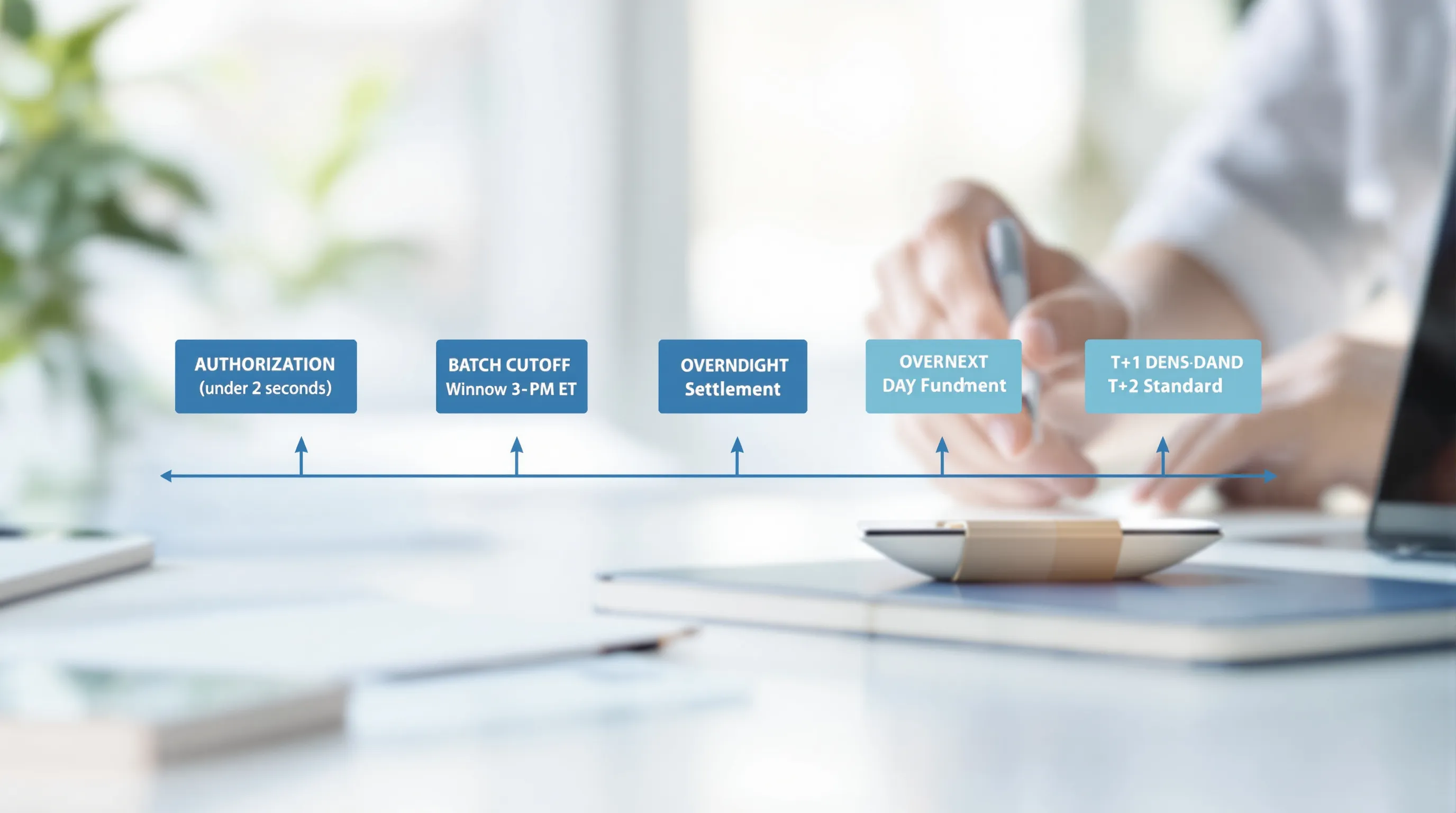
Card payments feel slow because authorization and funding are two separate processes. Your card is approved in under two seconds, but the money moves in overnight batch settlement - typically T+2 (two business days after the sale). To get funded faster, close your batch before your processor's daily cutoff, keep your chargeback rate below 0.9%, and build at least six months of consistent processing history. Businesses that meet these criteria qualify for next-day standard funding. Instant payouts (T+0) are available for a fee - roughly 1.5% to 1.95% per payout - but qualifying for next-day standard funding is the more economical long-term path for most established merchants processing $25,000 or more per month.
If you have watched a card payment clear at the register and then waited two, three, sometimes four days for the money to land in your bank account, you have asked the question: why is this so slow?
The frustrating answer is that the card networks aren't the problem. Visa and Mastercard route authorizations in milliseconds. The actual delay lives in what happens after authorization - the overnight batch settlement process, the inter-bank fund transfer, and the risk protocols that processors apply before releasing funds.
The more useful answer is that some of those delays are outside your control, and some are not. The overnight batch architecture isn't changing. But the batch cutoff timing, the chargeback rate that triggers holds, and the account history that determines your funding tier are levers you own.
In this piece, I'll cover:
- How the authorization-to-settlement gap actually works and why T+2 is the default
- The processor's daily batch cutoff - and how missing it costs a full business day
- The chargeback threshold (0.9%) that separates normal funding from risk-triggered holds
- What reserve holds are, what triggers them, and how long they last
- The eligibility criteria for next-day funding at most major processors
- The real cost of instant payouts (T+0) and when that fee is actually worth paying
- How SeamlessChex approaches funding speed for established credit card merchants
A Federal Reserve Financial Services survey found that 80% of businesses cite instant fund access as a top priority, and 86% have already adopted some form of faster payments. The infrastructure for faster funding exists. The question is whether your account profile is positioned to access it.
Most merchants processing credit cards in 2026 operate on a T+2 settlement cycle - a sale completed today doesn't fund until two business days later - but the bottleneck isn't the card networks, which authorize transactions in under two seconds. The delay lives in the overnight batch settlement process, the processor's daily cutoff window, and a chargeback threshold most merchants don't know about until it's already triggered a hold on their account.
From what I have seen working with established businesses across high-risk and high-volume verticals, the gap between slow funding and next-day funding usually comes down to two numbers: the processor's daily batch cutoff time, and a chargeback rate that stays below 0.9%. Miss the cutoff or cross that threshold, and funding slides by a full day or gets held indefinitely. Hit both marks consistently, and next-day settlement becomes standard - not a feature you pay extra for.
This piece flips the usual explainer on its head. I'm not going to walk through the mechanics of why card payments are slow, because that question has been answered. What I rarely see covered is the merchant's side: the specific levers that determine whether your Tuesday sale hits your bank on Wednesday or Friday. That's the problem worth solving - and it is more solvable than most processors let on.
SeamlessChex works with established businesses processing $25,000 or more per month in credit card volume. The patterns I describe here come from that experience and from working through the underwriting criteria that separate standard from accelerated funding timelines.
Forecast: 12-24 months
Where Merchant Card Funding Speed Heads Next
Three forecasts on how fast merchants will actually get paid after a card swipe, based on current settlement and payout trends.
Funding Speed Forecasts
Use these to gauge how much real control you have over when card funds land in your account.
Demand from subscription, recurring-billing, and high-risk merchants for approved card processing will keep growing, pushing more processors to build sales-data-based underwriting tracks over the next 12-24 months.
More card processors will expand instant or same-day payout tiers priced around 1.5%-2% per payout over the next 12-24 months, turning same-day funding into a purchasable option rather than a rare feature.
Despite growth in instant-payment products, the majority of card transactions will keep settling on T+1 to T+3 cycles through 2027-2028, because authorization and fund movement remain separate, batch-based processes.
Early Indicators Stripe already charges about 1.5% and Square about 1.95% for instant payouts that can land within seconds (T+0), distinct from the standard T+2/T+3 cycle. Settlement between financial institutions typically takes 1-2 business days after authorization, and actual fund movement happens overnight in a batch process, even though authorization itself completes in under two seconds. Buyers are actively looking for how subscription businesses get approved for recurring billing merchant accounts and which processors serve high-risk categories, while fintech underwriting already leans on processing volume and sales history instead of traditional financial statements.
Supporting and Contrary Evidence
Each forecast lists the data points that back it up and the ones that complicate it.
- Lending, fast and slow - Increase Bank is the strongest public backing for this call. [Industry Publication]Fintech working capital offers from platforms like Stripe, Shopify, and Square feature average terms of 9 months and amounts "mostly well under $100k.". “How did fintechs win so much of the market for small business working capital - and why did it stop there?”
- The case rests on How long do payment processors take to pay out? [Community / Forum]Standard payout formula is expressed as T+X days, where T = transaction date and X = number of days until payout completion. “You can't fully control settlement timing, but you do have control over whom you choose to work with.”
- Businesses and Consumers Adopting Faster/Instant Payments to is what puts this forecast on the board. [Industry Publication]86% of businesses and 74% of consumers used faster or instant payments in the past 12 months. “A robust 86% of businesses and 74% of consumers said they used faster or instant payments in the past 12 months, and most (74% of businesses and 79% of…”
- Card Payment Processing: From Tap to Settlement is what puts this forecast on the board. [Blog]The entire authorization process typically completes in under two seconds. “the Scheme is the essential 'translator' and 'policeman,' ensuring that billions of transactions find their way home with millisecond precision.”
- Backing it: Agentic Payments 101 (1/2): How the Card Payment System Works. [Blog]A card payment takes less than two seconds, during which a message crosses four or five companies, possibly three continents. “the next buyer at the checkout may be an agent”
What Could Change These Forecasts
Shifts in settlement infrastructure or payout pricing could speed up or slow down these timelines.
Where We're Hedging
77 reflects our strongest conviction, while 50 is where we are most prepared to be wrong.
- High-risk and recurring-billing merchants push underwriting to adapt. That call weakens first if regulators or buyers move in the opposite direction.
- Most card funding stays on multi-day batch settlement. That one becomes the more durable forecast if the source mix shifts toward stronger contrary evidence.
What Actually Happens Between the Tap and Your Deposit
Most merchants assume the money starts moving the moment a customer's card is approved. It does not. Understanding this gap is the first step toward closing it.
When a card taps or swipes, the authorization process completes in under two seconds. Your processor contacts the card network, the card network routes the request to the cardholder's bank, the bank verifies available funds and approves the transaction, and a hold is placed on those funds. That part is genuinely fast. But as Adnan Masood, a former systems architect at Green Dot Corporation, described it: "no money moved. The money moves tonight, in a batch, while you sleep."
That "tonight" matters more than most merchants realize. Card payments settle in a batch process, typically run once per business day by the acquiring bank. Every transaction captured before the daily cutoff gets bundled into that night's settlement file and sent to the card networks for clearing. The networks then instruct each issuing bank to release the held funds. That inter-bank transfer takes one to two business days. Add one more step for funds to reach your merchant account, and you arrive at the standard T+2 timeline most processors quote by default.
T+2 means your Tuesday sale funds on Thursday, assuming nothing unusual. Miss the cutoff on Tuesday, and the sale doesn't enter settlement until Wednesday night. That makes the funding date Friday. One cutoff miss costs an entire business day.
Why Batch Cutoffs Matter More Than the Card Networks Do
The card networks themselves, Visa and Mastercard, are not the bottleneck. Authorization travels through them in milliseconds. Settlement - the actual movement of money between financial institutions - is a separate layer that still operates on scheduled batch windows rather than real-time rails. SWIFT data shows that in 2024, nearly 50% of global payments take two to five days to execute, precisely because settlement infrastructure still runs on overnight batch cycles.
Processors set their own cutoff times, typically between 3:00 PM and 7:00 PM Eastern. Some run multiple settlement windows per day. The practical takeaway: if you know your processor's cutoff, you can time your batch close to stay inside it consistently and pull funding one full day earlier than merchants who let batches close whenever the day ends.
The Settlement Timeline at a Glance
| Event | Time to Complete | What Happens |
|---|---|---|
| Card authorization | Under 2 seconds | Processor confirms funds; hold placed on cardholder account |
| Daily batch close | Processor cutoff (typically 3-7 PM ET) | Transactions captured in the settlement file |
| Inter-bank settlement | 1-2 business days | Networks instruct issuing banks to release funds |
| Standard merchant funding | T+2 to T+3 | Funds deposited into your business bank account |
| Next-day funding | T+1 | Available to qualifying accounts that close batch before cutoff |
| Instant payout (T+0) | Seconds to minutes | Fee-based; typically 1.5%-1.95% of payout amount |
The table above makes one thing clear: the slowness merchants experience lives almost entirely in the settlement and funding steps, not authorization. Those are the steps where the merchant-controlled levers exist.
The Three Levers That Actually Control Your Funding Speed
Most content about slow card payments explains the mechanics. Very little tells merchants what they can actually change.
From what I have seen working with established businesses across multiple verticals, three variables move the funding timeline more than anything else: chargeback rate, processing volume consistency, and account age.
Lever One: Chargeback Rate
Processors monitor chargeback rates closely, and the threshold that triggers intervention sits lower than most merchants expect. Accounts that stay below 0.9% monthly chargebacks as a percentage of processed volume maintain normal funding cycles. Once a merchant approaches or crosses that threshold, processors respond in one of several ways:
- Funding holds: Settlement may be delayed an additional two to five business days while the account is reviewed.
- Rolling reserves: The processor withholds a percentage of each transaction, typically 5% to 10%, and holds it for 90 to 180 days as a loss buffer.
- Payout suspension: In severe cases, the processor freezes all pending settlements until disputes are resolved.
Visa's standard chargeback monitoring program flags accounts above 0.9%. Its elevated program starts at 1.8%. Mastercard's Excessive Chargeback Program begins at 1.0%. Merchants who consistently operate below 0.6% are rarely flagged at all - and those are the accounts that qualify for the fastest funding tiers.
Reducing chargebacks requires attention to three areas: clear billing descriptors so customers recognize the charge, responsive customer service to resolve disputes before they escalate, and fraud prevention tools including velocity checks, AVS, and CVV verification. A 0.3-percentage-point reduction in chargeback rate is often the difference between standard T+2 funding and qualifying for next-day settlement.
If a reserve hold is already in place at your current processor, the guide to unfreezing reserves on a terminated account walks through the release process step by step.
Lever Two: Volume Consistency
Processors use automated risk models to evaluate accounts continuously. Consistent volume patterns signal a stable, legitimate business. Spikes - a sudden doubling or tripling of monthly volume without advance notice - register as fraud signals, even when the increase is entirely legitimate.
Merchants comparing processors have noted this directly: "Volume spikes can also slow things down; processors view these as major red flags for fraud, so they'll take extra time with them." The holds triggered by volume spikes can last from a few days to several weeks, depending on the processor's policy and the size of the deviation.
The practical fix: notify your processor in writing before any planned volume increase, whether from a seasonal sale, product launch, or new distribution channel. Processors with hands-on account management can whitelist these windows so they don't trip automated risk filters.
Lever Three: Account Age and Processing History
New merchant accounts at most processors carry extended holds during the first 60 to 90 days of operation. This is the seasoning period. During this window, processors are covering payment obligations before they receive the cardholder's funds. Stripe explained this to one merchant directly: "Stripe is literally covering my payout until they get the customer's money."
The seasoning timeline shortens when accounts demonstrate low chargebacks, consistent volume, and no fraud flags. Established businesses with 12 or more months of consistent processing history typically receive the fastest funding timelines and the most favorable risk treatment. This is one of the most underappreciated advantages of a processor relationship built on a documented account history rather than automated onboarding.
What Next-Day Funding Requires, and What Instant Payouts Actually Cost
Next-day funding is not a premium feature reserved for enterprise merchants. It is a standard tier that most processors offer to qualifying accounts.
Understanding the eligibility criteria - and the real fee structure of instant alternatives - gives you a clear decision matrix, as of .
Eligibility Criteria for Next-Day Card Funding
Based on what I see across the accounts we work with at SeamlessChex, next-day funding consistently becomes available when a merchant meets the following conditions:
- Monthly processing volume of $25,000 or more: Lower volumes receive standard T+2 treatment at most processors. Higher volumes signal an established business with predictable cash flow.
- Chargeback rate below 0.9%: This threshold separates standard from accelerated funding across most acquiring bank risk frameworks.
- Processing history of 6 months or longer: Seasoned accounts receive faster funding as the trust record builds. Accounts under 90 days almost always face extended holds regardless of volume.
- No pending reserves or active disputes: Active rolling reserves indicate a risk-elevated account. Processors rarely offer next-day funding to accounts under active reserve requirements.
- Consistent fraud pattern: No recent volume spikes, no suspicious geographic concentrations, no mismatched billing and shipping addresses in card-not-present transactions.
Batch cutoff compliance is the operational requirement on top of these: even a fully qualifying account misses next-day funding if the batch closes after the processor's daily cutoff.
Instant Payouts: The Fee-for-Speed Calculation
For merchants who cannot wait for next-business-day funding, instant payouts offer T+0 access to funds, typically within minutes. The tradeoff is a per-payout fee:
| Processor | Standard Funding | Next-Day | Instant Payout Fee | Notes |
|---|---|---|---|---|
| Stripe | T+3 (standard) | Available for qualifying accounts | ~1.5% per payout | 60-day hold for new accounts before instant payouts activate |
| Square | T+1 to T+2 | Business debit card for direct access | ~1.95% per payout | Debit card allows direct spend from Square balance |
| SeamlessChex | Next-day for qualifying merchants | Standard for established accounts | Contact for terms | Designed for businesses processing $25,000+/month |
A 1.5% instant payout fee sounds modest, but for a business processing $200,000 per month, that is $3,000 per month in payout fees - $36,000 annually - on top of standard processing costs. For most established merchants, the better path is qualifying for next-day standard funding by maintaining a clean account profile, rather than paying the instant payout premium indefinitely.
High-Risk Merchants: A Separate Funding Track
High-risk merchants - including subscription businesses, gaming and online betting operators, nutraceutical and peptide sellers, and TMF/MATCH-list recovery accounts - face a distinct set of funding dynamics. Standard processors frequently apply 90-to-180-day rolling reserves at 5% to 10% of volume, extended holds of up to 14 business days on flagged transactions, and funding suspensions during dispute investigations.
The practical solution for high-risk businesses is a dedicated high-risk merchant account through a processor that prices and structures accounts for the category rather than treating them as exceptions. Processors built for high-risk verticals structure reserves more transparently, communicate hold timelines upfront, and offer faster release schedules as the account seasons. That is a materially better outcome than a standard processor who holds funds indefinitely the moment a chargeback ratio moves up. For a full breakdown of the fee structures involved, see our analysis of high-risk merchant fees that cost more than the rate.
A Federal Reserve Financial Services survey found that 80% of businesses cite instant fund access as a top priority - and 86% have already adopted some form of faster payments. The businesses achieving faster funding are not waiting for better infrastructure. They are maintaining the account profile that qualifies them for it. Our high-volume credit card processing services are structured with that goal in mind.
What Will Matter Most for Card Funding Speed in the Next 12 to 24 Months
The architecture of card settlement isn't going to be redesigned over the next two years. Overnight batch processing between acquiring and issuing banks is deeply embedded infrastructure with regulatory and liquidity implications that newer real-time rail products weren't primarily designed to replace. What will change is the merchant experience - and it will diverge sharply between businesses that actively manage account health and businesses that don't.
Account Health Becomes a Competitive Differentiator
A Federal Reserve Financial Services survey found that 86% of businesses used faster or instant payments in the past 12 months, and 80% cited instant fund access as a top priority. The businesses achieving faster funding aren't waiting for better infrastructure. They're maintaining the chargeback rates, volume consistency, and processing history that qualify them for the fastest funding tiers their processors offer.
As processor underwriting continues to shift from static approval thresholds to real-time data modeling, this dynamic will accelerate. Accounts that look clean - below 0.9% chargebacks, consistent monthly volume, no fraud flags - will get funded faster automatically. Accounts that don't will face increasingly extended holds, and the gap between the two groups will widen over time.
Subscription and Recurring-Billing Businesses Face a Pivotal Processor Decision
Stripe, Shopify, and PayPal are actively closing subscription and recurring-billing accounts across categories they classify as elevated risk. Merchants displaced by those closures face a sharp divide: general-purpose processors who apply high-risk holds by default, or dedicated processors who structure the account for recurring billing from day one.
The funding implications are significant. A subscription business that moves to a general-purpose processor without disclosing its recurring billing model often faces holds triggered when the processor's risk model identifies the pattern as anomalous. A business that moves to a processor who specializes in subscription accounts gets a structure that accommodates the model - with funding timelines that reflect actual risk rather than perceived category risk. More on this is covered in our piece on choosing the right payment rail for subscription businesses.
The Real Cost of Instant Payouts Will Come Into Focus
As more processors offer T+0 instant payout options, merchants who haven't done the math will start to. A 1.5% instant payout fee on $50,000 per month in processing is $750 per month - $9,000 per year. On $200,000 per month, that's $36,000 annually. That is a line item buried in processor statements that, once surfaced, drives a straightforward cost-benefit analysis: qualify for next-day standard funding or keep paying the premium.
The businesses best positioned to make that shift are those with established processing history, low chargebacks, and a processor who actively manages the account rather than passively processing it. That combination is more accessible than most merchants realize - and it starts with a conversation, not a product upgrade.
Top Questions Merchants Ask About Card Funding Speed
- Why does my card payment take 2 to 3 days to deposit when the card was approved instantly?
- What is my processor actually looking at when it holds my funds, and how do I get them released faster?
- Do I need to pay extra for instant or next-day card settlement, or can I qualify without the fee?
The Bottom Line on Faster Card Funding
Card funding speed is not a fixed feature of the payment system - it is a function of batch cutoff compliance, account health, and the right processor relationship. Most merchants operating on T+2 or T+3 timelines have more control over that number than their current processor has communicated to them.
The two variables that matter most: close your batch before the daily cutoff every day, and keep chargebacks below 0.9%. Do both consistently for six months or more, and next-day funding becomes a realistic standard outcome, not a premium add-on. Use the 1.5% instant payout option only when the cash flow urgency genuinely justifies the cost - at meaningful volume, that fee adds up faster than most merchants realize.
SeamlessChex helps established businesses structure credit card merchant accounts that prioritize funding speed, transparent reserve terms, and hands-on account management. If you're processing on a timeline that doesn't match your business needs, the right conversation starts with understanding exactly why - and what it takes to change it.
Talk to SeamlessChex about your current funding timeline and what a dedicated credit card merchant account could look like for your business.
Written by
Jonathan Albert
Co-Founder, SeamlessChex
Jonathan Albert is Co-Founder of SeamlessChex, a credit card processing and fintech payments platform recognized on the Inc. 5000.
Connect on LinkedInSummarize This Article With AI
Open this article in your preferred AI engine for an instant summary.
Frequently Asked Questions
Why do card payments take 2 to 3 days to fund my account?
Card authorization completes in under two seconds, but the actual money movement happens in a separate overnight batch settlement process. Your processor bundles all transactions before a daily cutoff into a settlement file and sends it to the card networks. The networks instruct issuing banks to release funds, a step that takes one to two business days. Add one more day for the funds to reach your merchant account, and you arrive at the standard T+2 or T+3 timeline.
What chargeback rate triggers a funding hold?
Most processors apply heightened scrutiny to accounts with monthly chargeback rates above 0.9% of processed transactions. Visa's standard chargeback monitoring program flags accounts at this threshold. Mastercard's Excessive Chargeback Program begins at 1.0%. Above these levels, processors may impose rolling reserves of 5% to 10% held for 90 to 180 days, funding delays, or full payout suspension until disputes are resolved.
How do I qualify for next-day card funding?
Next-day funding requires consistent monthly volume of $25,000 or more, a chargeback rate below 0.9%, at least six months of processing history, no active rolling reserves, and batch closure before your processor's daily cutoff. The main obstacles for most merchants are elevated chargebacks and new account seasoning delays. Meeting all five criteria consistently moves most accounts from T+2 to T+1.
What is an instant payout and what does it cost?
Instant payouts (T+0) move funds to your account within minutes. Stripe charges approximately 1.5% per instant payout; Square charges approximately 1.95%. For a business processing $200,000 per month, a 1.5% fee costs $3,000 per month - $36,000 annually. Qualifying for next-day standard funding eliminates this cost entirely and is the more economical path for most established merchants.
How long does a new merchant account hold last?
Most processors apply extended holds during the first 60 to 90 days of account operation. Stripe requires 60 days before instant payout features activate. During the seasoning period, processors are effectively covering payment obligations before the cardholder's funds settle. The hold shortens when the account demonstrates clean chargebacks, consistent volume, and no fraud flags.
Can high-risk merchants get next-day funding?
Yes, with a processor structured for the category. High-risk merchants - subscription businesses, gaming operators, peptide and nutraceutical sellers, and TMF/MATCH-list recovery accounts - often face extended holds and rolling reserves at general-purpose processors. Dedicated high-risk processors structure accounts for the category from day one, with reserve terms and funding timelines that reflect actual business risk rather than category assumptions. The same eligibility criteria apply: chargebacks below 0.9%, consistent volume, and established processing history.
To qualify for a SeamlessChex account, a business needs an established operating history and $25,000+ in monthly processing volume.