



Quick Answer
The Short Answer
HIPAA-compliant payment processing requires more than a signed Business Associate Agreement. PHI leaks through four post-transaction workflows that most processors never address: refund memo fields that embed clinical context, chargeback rebuttal packets that disclose clinical notes to card networks without HIPAA coverage, support call recordings stored on un-BAA'd infrastructure, and card descriptors that reveal treatment specialty to third-party statement viewers. Closing these gaps requires written policies for refund annotation, minimum-PHI chargeback evidence protocols, explicit BAA coverage for support call infrastructure, and descriptor scrubbing at account setup.
Questions this article answers
- Does a BAA cover my chargeback rebuttal workflow? Probably not by default. Most processor BAAs cover transaction processing, not dispute evidence packets sent to card networks.
- Are card descriptors a HIPAA concern? Yes. Descriptors that reveal a healthcare specialty disclose PHI to third-party statement viewers who have no HIPAA authorization.
- What information can I include in a chargeback rebuttal without violating HIPAA? Payment receipts, transaction dates, and financial consent forms. Clinical notes, diagnosis codes, and EOBs should be excluded.
Questions This Article Answers
- What PHI leak points exist in healthcare payment processing beyond the transaction itself?
- Does my BAA cover chargeback rebuttals, support calls, and card descriptors?
- What should a HIPAA-compliant chargeback rebuttal packet include, and what should it exclude?
- How do card descriptors create PHI disclosure risk for patients?
- What is the HIPAA minimum-necessary standard and how does it apply to payment workflows?
Quick Answer
Healthcare practices that have signed a BAA with their payment processor and assume they're done have closed one door and left four others open. In 2024, more than 276 million healthcare records were exposed without authorization (the worst year on record for healthcare data breaches), and payment workflows accounted for a significant share of the unaudited exposure surface. HIPAA imposes penalties of $100 to $50,000 per instance of exposed PHI, with annual maximums reaching $1.5 million, and the instances that cost practices the most are rarely the ones they expected.
I'm Jonathan Albert, Co-Founder of SeamlessChex. We've spent more than a decade building payment infrastructure for businesses that move money in regulated industries: healthcare, telemedicine, specialty clinics, and high-risk verticals that most processors decline to serve. In that time, I've seen the same compliance gap surface over and over: practices that did everything right at the transaction layer, then exposed PHI in every refund they processed, every dispute they contested, every support call they fielded, and every card statement their patients received.
This guide addresses the four edge-case PHI leak points that standard HIPAA payment compliance programs miss. It's not a primer on what HIPAA is. It's a practical guide to closing the gaps that a signed BAA alone doesn't cover: the workflows your processor almost certainly never mentioned and your compliance program almost certainly never audited.
Why HIPAA Payment Compliance Fails at the Edges
Most healthcare practices treat HIPAA payment compliance as a one-time checklist item: sign a Business Associate Agreement with your processor, enable encryption, and move on.
I've seen this pattern repeatedly when we onboard healthcare merchants, and it's the single most dangerous assumption in healthcare billing today. A signed BAA does not protect PHI that flows through workflows your processor was never designed to handle.
The core issue is architectural. HIPAA compliance in payment processing is typically engineered around the transaction itself, the moment a card is swiped, tapped, or keyed. Payment processors invest heavily in encrypting that transaction path. What they rarely engineer for are the ancillary workflows that happen after the transaction closes: the refund, the dispute, the support call, the card statement. These are the edges where PHI actually leaks.
The data confirms this. According to a 2024 healthcare breach analysis, more than 276 million healthcare records were exposed without authorization in the United States in 2024 alone (the worst year on record). As one industry source put it, "payment systems are often overlooked, even though they handle some of the most sensitive information a patient can share." That observation is particularly true of the post-transaction workflows that never get audited.
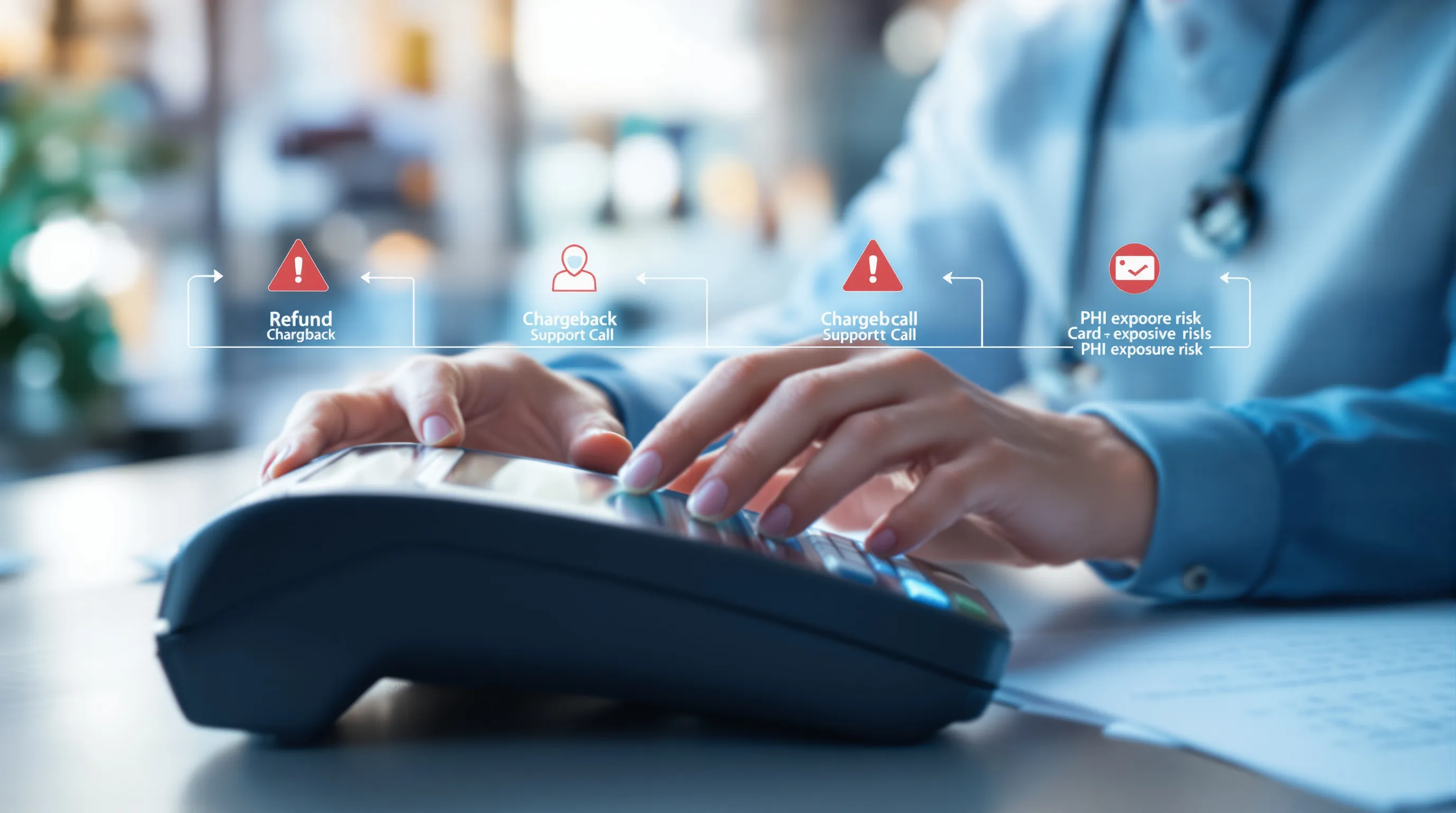
From what I've seen working with telemedicine and healthcare practices, there are four primary PHI leak vectors in payment processing that most compliance programs completely ignore:
- Refund memos and transaction notes that embed patient names, diagnosis codes, or treatment descriptions directly into processor dashboards
- Chargeback rebuttal packets that bundle clinical documentation (appointment records, treatment notes, even EOBs) into dispute evidence files sent to card networks that have no HIPAA obligation
- Support call recordings and transcripts where agents collect PHI during identity verification and store it on infrastructure not covered by the BAA
- Card descriptors that encode the practice name or specialty in ways that reveal a patient's treatment category to anyone reviewing their bank statement
Each of these vectors operates outside the primary transaction path. Each involves PHI. And each is, in my experience, routinely overlooked during HIPAA payment audits because the audits focus on the transaction layer rather than the workflow layer.
There is also a widely held misconception that HIPAA and PCI DSS are interchangeable compliance frameworks. They are not. PCI DSS governs how cardholder data is secured: card numbers, CVV codes, magnetic stripe data. HIPAA governs how protected health information is handled. A processor can be fully PCI-compliant and still expose PHI through every workflow in this guide. The two frameworks solve different problems. A healthcare practice needs both, and needs to understand where each one stops.
Under HIPAA, you, the covered entity, retain responsibility for ensuring that any PHI disclosed to a business associate is disclosed under a valid agreement and handled within HIPAA's minimum-necessary standard. When a workflow routes PHI beyond the reach of that agreement, the exposure risk sits with you, not with the processor. The good news is that each of these leak points has a practical fix. The challenge is knowing they exist in the first place.
How Refund Workflows Expose PHI Without Anyone Noticing
Refunds seem administratively simple. A patient overpays, a service gets cancelled, a billing error gets corrected, and someone processes a refund.
What makes refunds a HIPAA liability is the data that accompanies them, not the money movement itself.
The problem starts with refund memo fields. Most payment processor dashboards include a notes or memo field alongside the refund action. These fields exist for internal record-keeping: the kind of annotations that help billing staff remember why a particular transaction was reversed. In healthcare settings, staff routinely enter clinical context into these fields: "refund: patient cancelled chemo appointment," "overpayment for therapy session 3/4," "insurance covered: reversed behavioral health copay." Every one of those entries is PHI under HIPAA's definition of individually identifiable health information.
Under HIPAA's minimum-necessary standard (45 CFR §164.502(b)), PHI disclosures must be limited to the information reasonably necessary to accomplish the purpose. A refund requires a transaction amount, an account reference, and perhaps a generic reason code. It does not require a patient's diagnosis, appointment type, or treatment history. When staff annotate refund records with clinical detail, they're creating PHI inside a system that may not be fully within the scope of your BAA.
The second refund risk comes from processor dashboard access controls. Most payment processor dashboards are designed for retail environments, not healthcare. Role-based access controls are often minimal: a billing coordinator, a front-desk supervisor, and a practice manager may all see the same refund records with the same clinical annotations. If the processor dashboard is hosted on infrastructure that hasn't been hardened for HIPAA and isn't covered by an explicit BAA, every user with dashboard access potentially represents an unauthorized PHI disclosure.
| Refund Workflow Element | Non-Compliant Practice | HIPAA-Compliant Practice |
|---|---|---|
| Memo/notes field | "Refund: patient cancelled diabetes management visit" | "Refund: service cancellation" (generic reason code only) |
| Transaction reference | Patient name + date of service + procedure | Internal account ID only; no clinical identifiers |
| Dashboard access | All billing staff see full refund notes including clinical annotations | Role-based access; clinical notes separated from payment records |
| Processor data retention | Refund records with PHI stored indefinitely in processor system | Processor system stores payment data only; PHI retained in EHR under HIPAA controls |
HIPAA requires that records containing PHI (or documentation governing how PHI is exposed) be retained for a minimum of six years. That retention requirement applies to your processor's records too, if they contain PHI. A refund memo entered today is a potential audit exhibit six years from now. The safest refund record is one that contains no PHI at all.
The fix is straightforward once you've identified the problem. Establish a written policy that prohibits clinical identifiers in any payment processor memo, note, or annotation field. Use generic reason codes (service cancellation, billing adjustment, duplicate charge) that reference a transaction ID without embedding clinical context. Link the transaction ID to the clinical record inside your EHR system, not inside the processor dashboard. The payment processor's systems contain no PHI, and the BAA requirement is satisfied because there's nothing to protect.
From what I've seen during healthcare merchant onboarding, this policy change takes about a week to implement and train, and it closes a PHI leak point that most practices don't even know they have.
Chargeback Rebuttals Are a PHI Packet Waiting to Happen
Of all the edge-workflow PHI risks in healthcare payment processing, chargeback rebuttals are the most severe, and the most systematically ignored.
I've had more than a few healthcare practice owners genuinely surprised when I explain what happens to the evidence they submit during a dispute. The surprise is warranted. The exposure is real.
Here's how a chargeback rebuttal works in a healthcare context. A patient disputes a charge: they claim the service wasn't rendered, or the billing looked unfamiliar. According to Chargebacks911's 2026 Field Report, nearly 44% of all chargebacks are classified as friendly fraud, meaning the cardholder disputes a legitimate charge. In healthcare, that often means a billing description the patient doesn't recognize, or a charge a spouse or family member sees on a shared account. The card network opens a dispute and gives your acquiring bank a window, typically 30 to 45 days, to submit rebuttal evidence. To fight the chargeback, you need to prove the service was rendered.
And that documentation almost always contains PHI. A complete chargeback rebuttal packet in a healthcare setting typically includes:
- Patient name and date of birth (to establish identity)
- Date of service and service location
- Procedure or treatment type (often identifiable from CPT code or plain-language description)
- Signed patient consent or intake forms
- Clinical notes or appointment records confirming the service occurred
- Explanation of Benefits (EOB) copies linking the claim to a diagnosis
That packet travels from you to your processor, from your processor to the acquiring bank, and from the acquiring bank to the card network's dispute resolution team. Visa's dispute team, Mastercard's dispute team, and any third-party dispute management platform in that chain are not covered by your BAA. The PHI you submit to fight a chargeback has been disclosed to at least three entities outside your HIPAA compliance framework, every time a dispute is opened.
| Chargeback Rebuttal Component | PHI Risk Level | HIPAA-Compliant Alternative |
|---|---|---|
| Patient name + DOB | High (direct PHI identifiers) | Use internal account ID; confirm identity without clinical linkage |
| Clinical notes / appointment records | Critical (full PHI disclosure) | Submit service confirmation with date only; retain clinical detail in EHR |
| EOB or insurance claim copy | Critical (diagnosis codes exposed) | Do not include; use payment receipt showing service category only |
| Signed consent forms | Medium (depends on content) | Submit financial consent only; withhold clinical intake forms |
| Procedure description | High (reveals treatment type) | Use billing category or generic service description |
The minimum-necessary standard under 45 CFR §164.502(b) requires that PHI disclosures be limited to what's reasonably necessary for the purpose. The purpose of a chargeback rebuttal is to confirm that a billed service occurred and was authorized by the patient. That purpose does not require diagnosis codes, clinical notes, or treatment history. A payment receipt, a service date, and a signed financial authorization form is usually sufficient to win a dispute, and none of those need to contain PHI. As one healthcare compliance practitioner put it plainly: "PHI belongs only in BAA-covered platforms; payment processors should handle cards and nothing clinical."
Practices that train their billing staff on dispute-evidence hygiene (what to include and what to deliberately exclude) reduce their PHI exposure dramatically without losing chargeback wins. In my experience, the oversharing happens not from bad intent but from a reasonable impulse to give the card network everything so you definitely win. The answer is not more documentation; it's the right documentation, with PHI stripped out.
Support Calls Create Oral PHI Disclosures Under HIPAA
Support calls are the most overlooked PHI leak point in healthcare payment processing, partly because the disclosure happens verbally rather than in writing.
But oral PHI disclosures are fully regulated under HIPAA's Privacy Rule (45 CFR §164.502), and a support call that links a patient's identity to their treatment or billing history is a PHI disclosure regardless of whether anything was typed or printed.
The typical support call scenario goes like this: a patient calls your billing line (or your processor's general support line) to ask about a charge on their bank statement. The agent, trying to locate the account and verify identity, runs through a standard verification script: full name, date of birth, last four of their Social Security number, billing address. Once identity is confirmed, the agent looks up the account and reads back transaction details: "I see a charge from March 15th for your appointment at [practice name]." That sentence, spoken aloud, recorded, and stored on the processor's infrastructure, is PHI. It links a patient's identity to a date of service at a named healthcare provider.
The HIPAA problem compounds when you consider where those recordings go. Payment processor support call recordings are typically stored in cloud infrastructure maintained by the processor's telephony or CRM vendor. Unless your BAA explicitly covers the processor's call-recording infrastructure and any third-party vendors that platform uses, those recordings are PHI stored outside your HIPAA compliance boundary. HIPAA penalties for PHI exposure range from $100 to $50,000 per instance, with maximum annual penalties reaching $1.5 million, and a single support call recording that contains PHI and is stored on un-BAA'd infrastructure is, technically, an instance.
- Most generic BAAs cover payment processing systems but not telephony or CRM platforms
- Recordings are often retained for 30 to 90 days by default, but some processors retain them indefinitely
- Agent verification scripts that collect name, DOB, and service history create a PHI record in the CRM, not just in the call recording
- Third-party quality assurance vendors who review call recordings for training purposes represent an additional, often un-BAA'd disclosure
There is also a verbal-disclosure risk on the practice side. When a billing coordinator calls a processor's support line to resolve a payment issue and recites patient details to a support agent, that disclosure is governed by HIPAA's minimum-necessary standard. The coordinator should provide the minimum patient-identifiable information necessary to resolve the payment question: an account or transaction reference number, not a patient's name and diagnosis.
Audit-proofing support calls requires three concrete steps. First, establish a written protocol for what information billing staff are permitted to disclose verbally when calling payment support lines, and train to it. Second, review your BAA to confirm it explicitly covers the processor's support infrastructure, including call recording platforms and any CRM systems where call notes are stored. Third, request that your processor or support vendor confirm their data-retention policy for call recordings and enforce it through the BAA. HIPAA's Breach Notification Rule gives covered entities 72 hours to notify HHS of a discovered breach. That means the time to close a support-call infrastructure gap is before an audit, not after.
Practices that have never thought about their support-call workflows are often the most exposed. The solution is not complicated. It's policy, training, and contract language, and it starts with knowing the risk exists.
Card Descriptors That Reveal Treatment: The PHI Risk Nobody Audits
Card descriptors are the business name and additional detail that appear on a cardholder's bank statement after a transaction.
They're limited to 22 characters for the primary descriptor field. And in healthcare payment processing, they represent a PHI disclosure risk that I have never once seen addressed in a standard HIPAA payment processing checklist.
HIPAA classifies 18 specific identifiers as protected health information, and those identifiers apply whether the information is in digital, paper, or oral form. A card statement entry that reads "TELEMED MENTHLTH CTR" or "WGHT LOSS CLINIC LLC" or "GLP1 WELLNESS GRP" does more than identify the merchant. Any person who sees that bank statement (a spouse, a partner, an employer reviewing expense receipts, or a financial institution reviewing account history) can now link that cardholder to a specific healthcare service category. That is a PHI disclosure. It was made by the payment system. And it was made to recipients who have no HIPAA obligation and no authorization from the patient.
The risk is not hypothetical. Consider telemedicine practices specializing in behavioral health, addiction medicine, sexual health, or weight management, all high-growth segments of the telehealth market. For patients in these specialties, a card statement that reveals the care category to a third-party viewer could cause real harm: relationship damage, employment consequences, insurance implications. The practice didn't intend the disclosure. The processor didn't flag it. But the PHI left the building on every single transaction.
The practical fix is descriptor scrubbing: replacing specialty-revealing practice names in the card descriptor with a neutral trade name that does not communicate treatment type. Many processors allow merchants to configure a "soft descriptor" (the secondary line that appears alongside the main descriptor) and, in some cases, the primary descriptor itself. A neutral descriptor policy means every transaction clears under a name that does not telegraph specialty to third-party viewers of the bank statement.
How SeamlessChex Closes the Payment PHI Gaps for Healthcare Merchants
SeamlessChex is a full-service payment technology company that helps healthcare and telemedicine businesses accept credit card payments with the compliance infrastructure the industry actually requires, not just the BAA checkbox. For established healthcare businesses processing $25,000 or more per month, we offer a dedicated telemedicine merchant account designed for the compliance realities of HIPAA-regulated billing. That means:
- A signed BAA that explicitly covers payment processing, chargeback management workflows, and support call infrastructure
- Descriptor scrubbing as part of standard merchant setup, not an afterthought
- Chargeback workflow guidance so your team submits minimum-PHI dispute evidence that wins disputes without over-disclosing
- Dedicated merchant accounts with the stability and compliance controls that generic aggregator accounts cannot provide
- Hands-on onboarding support that walks through each of the edge-case leak points described in this guide
When we onboard telemedicine and specialty healthcare merchants, descriptor scrubbing and refund memo policy are both part of our standard merchant setup workflow. We work with practices to configure descriptors that satisfy card network requirements (the merchant must be identifiable for dispute resolution) while avoiding specialty disclosure to third-party viewers of the bank statement. This is a configuration conversation that most processors never have with healthcare merchants, because most processors weren't built for healthcare. We were.
If your current processor has never talked to you about refund memo policies, descriptor configuration, or chargeback evidence hygiene, that conversation is overdue. Contact SeamlessChex today to learn how we set up healthcare merchants for compliant, stable credit card processing from day one.
HIPAA Payment Processing BAA Checklist: What to Verify Before You Sign
Use this checklist when evaluating a payment processor's BAA and compliance posture. A processor that can't confirm each item in writing should be treated as a compliance gap.
HIPAA PAYMENT PROCESSING COMPLIANCE CHECKLIST
==============================================

BAA SCOPE: Confirm in writing that the BAA covers:
  [ ] Core payment processing systems and infrastructure
  [ ] Chargeback / dispute management workflows
  [ ] Customer support call recording infrastructure
  [ ] CRM and ticketing systems used by support teams
  [ ] Any subcontractors or third-party platforms used
      for dispute management, telephony, or data storage

DESCRIPTOR CONFIGURATION: Confirm:
  [ ] Processor allows neutral primary descriptor
      (no specialty-revealing practice name required)
  [ ] Soft descriptor can be configured independently
  [ ] Descriptor reviewed and approved before go-live

REFUND WORKFLOW CONTROLS: Confirm:
  [ ] Memo/notes fields cannot accept free-text PHI
      (or policy prohibits clinical identifiers in these fields)
  [ ] Role-based access controls restrict dashboard views
  [ ] Refund reason codes are generic (no clinical context)

CHARGEBACK REBUTTAL PROTOCOL: Confirm:
  [ ] Processor provides dispute-evidence guidance
  [ ] Your team trained on minimum-PHI submission standard
  [ ] Financial consent (not clinical intake) used as evidence
  [ ] EOBs and clinical notes excluded from rebuttal packets

SUPPORT CALL HANDLING: Confirm:
  [ ] Call recording infrastructure covered by BAA
  [ ] Recording retention policy defined and enforced
  [ ] Support agents trained NOT to recite clinical context
  [ ] Internal protocol for minimum-necessary disclosures

DATA RETENTION: Confirm:
  [ ] PHI-free policy for all processor-side records
  [ ] 6-year BAA retention compliance documented
  [ ] 72-hour breach notification commitment in writing
Before and After: PHI-Exposed vs. PHI-Safe Payment Descriptor
Before: PHI-Exposing Descriptor
Card Statement Entry:
TELEMED MENTALHLTH CTR 800-555-0100
What it reveals: The cardholder received telehealth services at a mental health center. Anyone who sees this bank statement (a spouse, an employer, a bank officer reviewing the account) now knows this person sought mental health treatment. That is PHI. It was disclosed to every viewer of the statement without patient authorization.
Risk: HIPAA violation on every transaction. Patient relationship and reputation exposure. Potential for relationship or employment harm to the patient.
After: PHI-Safe Descriptor (Scrubbed)
Card Statement Entry:
SC HEALTH BILLING 800-555-0100
What it reveals: A health billing charge. No specialty, no treatment type, no clinical context visible to third-party statement viewers. The merchant is identifiable for dispute resolution purposes (the processor maintains the full merchant record), but the treatment category is not disclosed to anyone who doesn't need to know.
Result: PHI-free transaction record. Patient privacy protected on every card statement. No third-party disclosure risk from descriptor alone.
The descriptor scrubbing process takes one conversation with your processor during account setup. For practices that have been operating with a specialty-revealing descriptor, the fix is a descriptor change request, typically completed within 3 to 5 business days. It is one of the fastest PHI leak points to close, and one of the most commonly overlooked.
What Will Shape HIPAA Payment Compliance in the Next 12-24 Months
HIPAA enforcement has historically focused on large healthcare organizations: hospital systems, major insurers, national providers. That dynamic is shifting. HHS Office for Civil Rights has indicated increased attention to smaller covered entities and their business associates, particularly as telehealth growth has put HIPAA obligations in the hands of thousands of smaller practices that lack the compliance infrastructure of enterprise health systems.
Several trends are converging that make the edge-case PHI leak points described in this guide more urgent, not less, over the near term:
Telehealth expansion creates more payment compliance surface
Telehealth volume grew dramatically through the pandemic period and has remained elevated. Digital-first billing workflows in telehealth create more points of PHI contact in payment processing (more online refunds, more digital dispute packets, more automated support call systems) than traditional in-person practice billing. Each of those contact points is an audit surface.
Friendly fraud is rising in healthcare billing
According to Chargebacks911's 2026 Field Report, friendly fraud accounts for nearly 44% of all chargebacks. In healthcare, patients who don't recognize a billing descriptor or dispute a charge that a family member saw are a growing segment of that fraud category. Rising chargeback rates mean more rebuttal packets, more PHI in dispute workflows, and more compliance exposure per dollar of revenue. Practices that establish PHI-free dispute protocols now are better positioned as dispute volumes grow.
Card network tokenization is expanding but doesn't solve descriptor PHI
Major card networks are expanding tokenization infrastructure, which protects card numbers in transit and reduces fraud at the transaction layer. This is a PCI compliance improvement, not a HIPAA improvement. Tokenization does not address what appears in the descriptor field of a bank statement. The descriptor risk grows alongside transaction volume, regardless of how well the underlying card number is protected.
AI-driven support tools create new call-recording risks
Payment processors and healthcare billing platforms are increasingly deploying AI-assisted support tools (chatbots, automated IVR systems, AI call transcription) to handle patient billing inquiries. These tools create new PHI storage points. AI-generated call transcripts that link patient identity to service history are PHI. If those transcripts are stored on infrastructure not covered by your BAA (which most AI support tools are not yet positioned to provide), the automation that was supposed to reduce risk has created new exposure. Healthcare practices evaluating AI billing support tools should include BAA coverage as a threshold requirement.
The common thread across all of these trends is the same one that runs through this entire guide: payment compliance that addresses the transaction and ignores the workflow layer will be increasingly inadequate as transaction volumes rise, dispute rates climb, and automation creates new PHI contact points in places the original BAA never anticipated.
Looking Ahead to 12-24 months
Where HIPAA Payment Compliance Is Headed Next
Three evidence-scored forecasts on how healthcare providers will close payment-related PHI exposure over the next two years.
What Happens Next In Compliant Payment Processing
Use these forecasts to gauge which payment compliance risks are likely to grow or ease over the next 12 to 24 months.
Merchants selling GLP-1 products, peptides, and nutraceuticals will increasingly seek dedicated high-risk merchant accounts built for recurring billing rather than default processors, expanding demand for vetted, compliant payment channels in these categories.
Practices will keep moving off general-purpose processors like Stripe and Square toward vendors that sign Business Associate Agreements and add point-to-point encryption, as a signed BAA becomes a baseline requirement rather than an afterthought.
Healthcare breach volume and cost will likely keep rising through the forecast window despite wider availability of tokenization, encryption, and BAA-backed payment platforms, because vendor risk outside the processor itself remains the larger exposure.
Early, Unconfirmed Signals Practice-side accounts report Stripe and Square are PCI-compliant but not HIPAA-compliant on their own and do not provide a BAA, pushing practices toward add-on or purpose-built alternatives. 2024 was already the worst year on record for healthcare data breaches, with more than 276 million records exposed and an average per-breach cost near $6.5 million, and breaches tied to third-party vendors already account for over 30% of all healthcare incidents. Recurring unanswered buyer questions about payment processing for GLP-1 stores, peptide merchants, and nutraceuticals point to unmet demand for compliant recurring-billing accounts in these health-adjacent categories.
Supporting And Contrary Signals
Each forecast lists the real-world sources that support it alongside sources that complicate it.
- Hi all! I'm wondering what payment processing system y'all are using is the clearest counter-signal. [Community / Forum]Original poster (rebgray) is evaluating Stripe for private practice payment processing and asks whether the payment system must be HIPAA compliant. “I can save you 99% of your processing fees every month! Chat with me if you're looking to save and partner with a great company.”
- The case rests on Hi all! I'm wondering what payment processing system y'all are using. [Community / Forum]Stripe pricing cited by commenter Kiramadera: 2.9% plus $0.30 per transaction.
- Is square HIPAA compliant? points the same way. [Community / Forum]Original poster (u/bivalvian) is opening a direct-pay private practice and needs to collect credit card info on their website for scheduling; was evaluating Square and Athena, and considering Practice Fusion as an EMR. “Credit card processors like Square fall under PCI compliance, not HIPAA. You're not transmitting or storing protected health info just by collecting payments,…”
- The case rests on HIPAA-Enabled Payment Processing. [Video]A ransomware attack hit an accounting firm in December 2019; hackers had breach access for 3 days. “if the investigation reveals that the accounting firm did have inadequate security then it will have broken both state law and the regulations of the health…”
- Pushing back: Credit Card Payment For Private Practice - HIPAA Compliance. [Community / Forum]Original poster (u/TheSource777) is a private practice therapist seeking a HIPAA-compliant credit card processor for private-pay clients, posted to r/therapists (thread archived, ~3 years before current date per Reddit timestamp). “HIPAA rules do not apply to financial transactions with respect to payment processing.”
- How Compliant Payment Systems Reduce Legal and Financial Risk points the same way. [Video]2024 was the worst year on record for healthcare data breaches, per the source. “HIPPA compliant credit card processing is no longer optional.”
- 9 Ways HITRUST Helps Healthcare Providers Protect - Medium supports this forecast. [Blog]HIPAA non-compliance penalties range from $100 to $50,000 per violation/record, with potential maximum annual penalties reaching $1.5 million. “No direct first-person quotes attributed to named individuals within the body text; content is presented as third-person reporting/company messaging, with Hugh…”
- Anyone work in healthcare? Why is PHI security so is the strongest public backing for this call. [Community / Forum]
- Top Tools and Software That Help You Stay HIPAA Compliant complicates the call. [Industry Publication]Article published 09 October 2025 on Finextra by an anonymous contributor ("Retired member"). “Failing to follow HIPAA regulations can result in significant penalties, lawsuits, and loss of patient trust.”
- Against it: HIPAA-Enabled Payment Processing. [Video]The accounting firm's client, Community Care Physicians, had protected health information (PHI) stolen along with financial data.
What Could Change These Forecasts
Regulatory updates, new breach data, or shifts in vendor liability rules could alter these predictions.
Our Margin for Error
84 reflects our strongest conviction, while 63 is where we are most prepared to be wrong.
- A reversal by regulators or buyers undercuts Specialty health-product merchants push into compliant recurring billing before anything else.
- If the balance of sources tips against the consensus, Breach costs keep climbing even as compliant payment tools multiply becomes the safer call.
Key Takeaways
Key Takeaways
- A signed BAA is necessary but not sufficient: PHI leaks through post-transaction workflows that most processor BAAs never cover
- Refund memos are a PHI risk: prohibit clinical identifiers in any processor memo or notes field; use generic reason codes only
- Chargeback rebuttal packets are the highest-severity leak point: clinical notes, EOBs, and diagnosis codes sent to card networks are PHI disclosures outside your HIPAA framework
- Support call recordings require explicit BAA coverage: telephony and CRM infrastructure must be covered by the BAA, not assumed
- Card descriptors can be PHI: specialty-revealing practice names disclose treatment category to third-party statement viewers; descriptor scrubbing closes this gap at setup
- HIPAA and PCI DSS are not the same framework: PCI compliance does not satisfy HIPAA obligations for PHI in payment workflows
- Internal violations are more common than external breaches: carelessness and partial adherence in billing workflows create more exposure than most ransomware scenarios
- The minimum-necessary standard applies to every PHI disclosure, including refund memos, dispute evidence, and verbal support disclosures
HIPAA-compliant payment processing is an ongoing operational discipline, not a one-time compliance event. The BAA is the beginning of that discipline, not the end. Every workflow that touches a patient's identity in a payment context (refunds, disputes, support calls, card statements) is a potential PHI disclosure, and most of those workflows operate well beyond the scope of what a standard processor BAA covers.
The four leak points in this guide (refund memos, chargeback rebuttals, support call recordings, and card descriptors) are fixable. None of them require significant technology investment or workflow redesign. They require written policies, staff training, BAA scope verification, and one setup conversation with your processor about descriptor configuration. Most of these fixes cost nothing. The cost of not making them is measured in per-instance HIPAA penalties, breach notification obligations, and patient trust.
From what I've seen building payment infrastructure for healthcare and telemedicine businesses, the practices that close these gaps do it proactively, before an audit surfaces the exposure, not after. If your current processor has never raised any of these issues with you, that's useful information about whether they were built to serve healthcare businesses. We were. Talk to SeamlessChex about what a healthcare-designed merchant account looks like in practice.
Written by
Jonathan Albert
Co-Founder, SeamlessChex
Jonathan Albert is Co-Founder of SeamlessChex, a credit card processing and fintech payments platform recognized on the Inc. 5000.
Connect on LinkedInFrequently Asked Questions: HIPAA Payment Processing
Does HIPAA apply to payment processing if the processor only handles financial transactions?
It depends on what information the processor touches. A financial institution that only processes a credit card payment (receiving the card number, amount, and merchant ID) is not automatically a business associate under HIPAA. But if the processor also handles practice management, billing, reporting, or any workflow that touches patient identifiers linked to treatment data, it becomes a business associate and a BAA is required. Most healthcare payment setups today involve processors that do far more than run a card, which means most healthcare processors should have a BAA in place.
What is the minimum-necessary standard and how does it apply to payment disputes?
The HIPAA minimum-necessary standard (45 CFR §164.502(b)) requires that any disclosure of PHI be limited to the information reasonably necessary to accomplish the purpose of the disclosure. Applied to payment disputes, this means a chargeback rebuttal should include only what is necessary to prove the transaction occurred (a payment receipt, service date, and financial authorization) and should not include clinical notes, diagnosis codes, treatment descriptions, or EOBs, which go beyond what the dispute purpose requires.
Are verbal disclosures on support calls covered by HIPAA?
Yes. HIPAA's Privacy Rule governs PHI in all forms: electronic, written, and oral. A support agent reading back a patient's name, date of service, and practice name in response to a billing inquiry is making an oral PHI disclosure. If that call is recorded and stored on infrastructure not covered by your BAA, the recording constitutes PHI stored outside your HIPAA compliance boundary.
Can a card descriptor reveal PHI?
Yes. HIPAA defines PHI as information that identifies or could reasonably identify an individual and relates to their health condition, treatment, or payment for treatment. A card descriptor that includes a healthcare specialty name (behavioral health, addiction treatment, GLP-1 or weight management) links the cardholder's identity to a treatment category. That linkage constitutes PHI, and its disclosure to third-party statement viewers is a HIPAA concern that most practices have never addressed.
What should a HIPAA-compliant chargeback rebuttal include?
A HIPAA-compliant rebuttal packet should include: a copy of the payment receipt showing the transaction amount and date, a signed financial authorization form confirming the patient agreed to the charge, and a service confirmation showing the date of service. It should NOT include clinical notes, appointment records with treatment descriptions, diagnosis or CPT codes, EOBs, or any document that links the patient's identity to a health condition. Most disputes can be won with financial documentation alone.
What HIPAA penalties apply to payment processing violations?
HIPAA civil penalties range from $100 to $50,000 per violation, depending on the level of culpability: from lack of knowledge at the low end to willful neglect without correction at the high end. Annual penalty caps reach $1.5 million per violation category. Criminal penalties for intentional misuse of PHI can reach 10 years. Healthcare data breaches cost organizations an average of $10.9 million in total impact per incident, making preventive compliance investment a clear financial priority.
Does SeamlessChex sign a BAA for healthcare merchants?
Yes. SeamlessChex provides a Business Associate Agreement that covers our payment processing infrastructure. For healthcare merchants, we also discuss BAA scope as part of onboarding, including what's covered, what support and dispute workflows look like, and how descriptor configuration works. Healthcare businesses processing $25,000 or more per month can contact us to discuss account setup and compliance requirements.
Sources & Further Reading
References
- HHS.gov - HIPAA Privacy Rule Overview
- HHS.gov - HIPAA and Health Information Technology
- HHS.gov - Breach Notification Rule
- CMS - HIPAA Administrative Simplification
- PCI Security Standards Council - PCI DSS
- IBM Cost of a Data Breach Report 2024
- HHS - Resolution Agreements and Civil Money Penalties
- AHIMA - Health Information Management Standards
- FTC - Health Privacy Guidance for Businesses
- Chargebacks911 - 2026 Chargeback Field Report
Our merchant accounts are designed for operating businesses with at least $25,000 in monthly processing volume.