


This guide explains how online casinos actually process player deposits and payouts, from the authorization chain that routes every deposit attempt, to the KYC verification holds that delay first withdrawals, to the payout rails that determine how fast funds reach players. Written for gaming operators and iGaming platform managers who need to understand the mechanics behind their payment infrastructure, not just the methods on their checkout page.
Questions this article answers
- Why do casino deposits get declined even when the player has funds available?
- What causes online casino payout delays, and which delays are legally required vs. avoidable?
- Which payout rail (ACH, card push, or wire) is fastest for gaming operators?
Quick Answer
The Short Answer
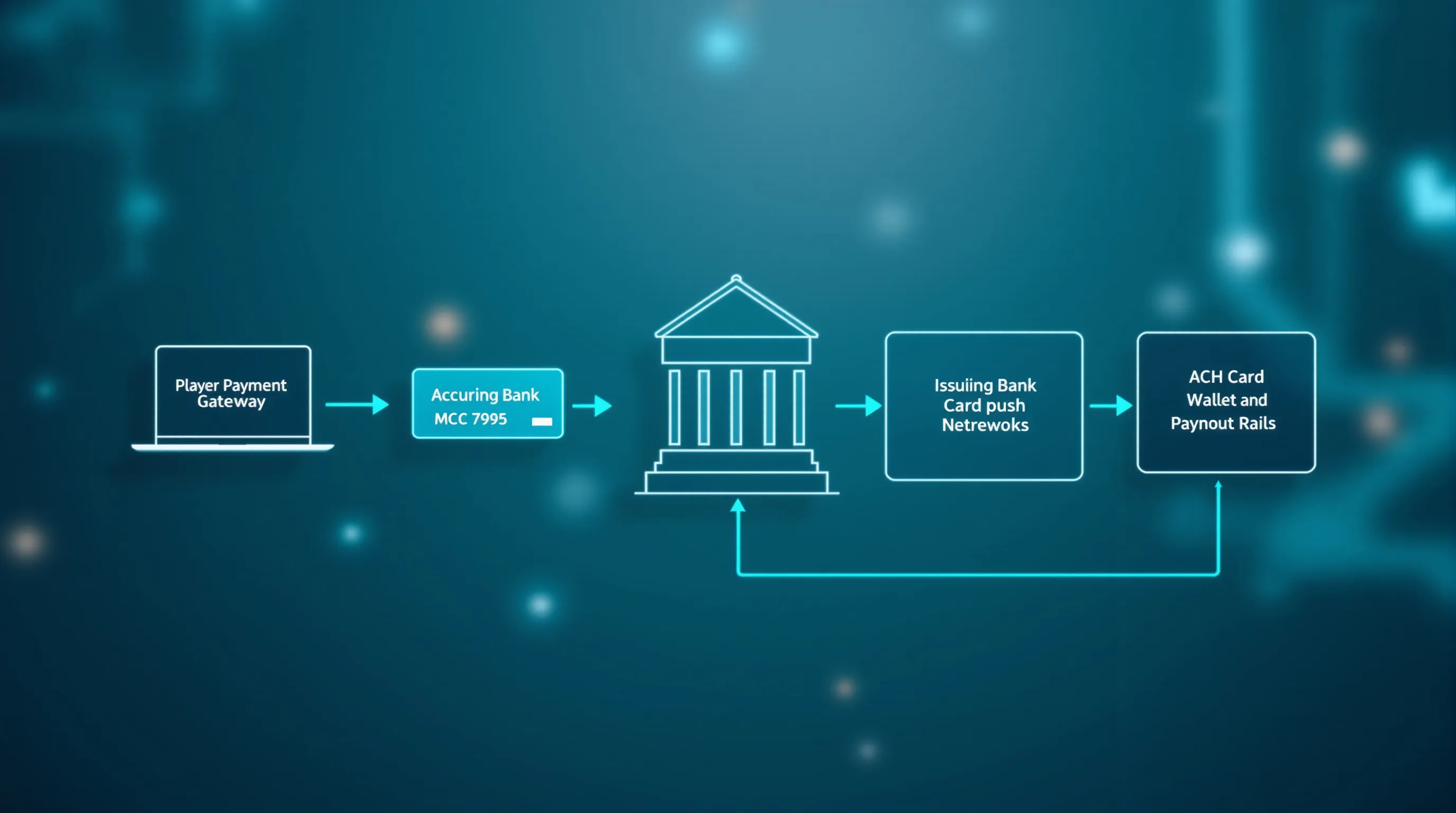
Online casinos process player deposits through a five-step authorization chain: the payment gateway tokenizes the transaction, the acquiring bank routes it, the issuing bank approves or declines (where most gaming declines actually occur), the platform credits the player wallet in real time, and settlement follows within 24-48 hours. Payouts follow a parallel process: a withdrawal request triggers KYC and bonus validation, risk scoring, payout rail selection (ACH, card push, or wire), and fund transfer to the player.
Most deposit failures occur at the issuing bank level due to MCC 7995 gambling restrictions, not at the gateway or platform. Most payout delays occur during internal validation, not on the banking rail itself. A dedicated gaming processor with alternative routing and streamlined internal approval workflows addresses both problems at their actual source.
Quick Answer
Online casinos route player funds through a multi-step authorization chain where MCC code 7995 alone causes 15-40% of card transactions to decline at the issuing bank before a player ever sees a decline message. KYC holds delay approximately 1 in 4 first withdrawals by 2-3 business days on average, and rolling reserves tie up 5-10% of monthly processing volume for 90-180 days in gaming merchant accounts. Understanding these mechanics (not just the payment methods players see at checkout) is what separates operators who run profitable, low-friction payment operations from those who lose players to abandonment and chargebacks at every step.
This guide covers the full operational lifecycle of iGaming money flow: how deposits are authorized, why they get declined, what KYC holds actually involve, how payout requests are processed, which rails to use for which transaction types, and how rolling reserves affect operator cash flow. If you run a gaming operation or are evaluating payment infrastructure for one, this is the process you need to understand.
How Player Deposits Enter the System
The moment a player clicks "Deposit," a multi-step authorization process begins that most operators never see directly, but that determines whether funds land in a merchant account in minutes or get declined outright.
Here is how the authorization chain works, step by step:
- Player submits payment details. The player enters card or bank account information on the casino's deposit page. A payment gateway tokenizes the data immediately, replacing raw card numbers with an encrypted token so sensitive information never touches the operator's servers.
- Gateway routes the transaction. The gateway forwards the tokenized transaction to the acquiring bank (the financial institution that holds the operator's merchant account). The acquiring bank is the operator's sponsor in the card network, and its willingness to process gaming transactions (MCC code 7995) determines how far a transaction gets.
- The issuing bank makes the authorization decision. The acquiring bank transmits a request to the player's issuing bank (their credit union, bank, or card issuer). This is where most gaming declines actually happen. Many US-based issuing banks have opted out of processing gambling-coded transactions, so the decline hits regardless of whether the player has funds available.
- Authorization response returns in seconds. If approved, the issuing bank places a hold on the player's funds. The acquiring bank confirms approval to the gateway, which relays the result to the casino platform. The platform then credits the player's wallet, typically in real time.
- Settlement happens later. Authorization and settlement are separate events. The actual transfer of funds from the player's bank to the operator's merchant account occurs through the card network's batch settlement process, usually within 24-48 hours of the original authorization.
Understanding this flow matters for every operational decision you make about payment infrastructure. The wallet system (described aptly as the component that "controls deposits, withdrawals, bonuses, and player balances with real-time accuracy") sits at the center of the player experience, but it depends on every upstream step functioning correctly. When a deposit fails at step 3, it is not a gateway problem or a platform problem: it is an issuer problem that requires either a different payment method or a processor with routing strategies that bypass issuer-level gaming restrictions.
What Payment Methods Online Casinos Accept, and Why Some Get Blocked
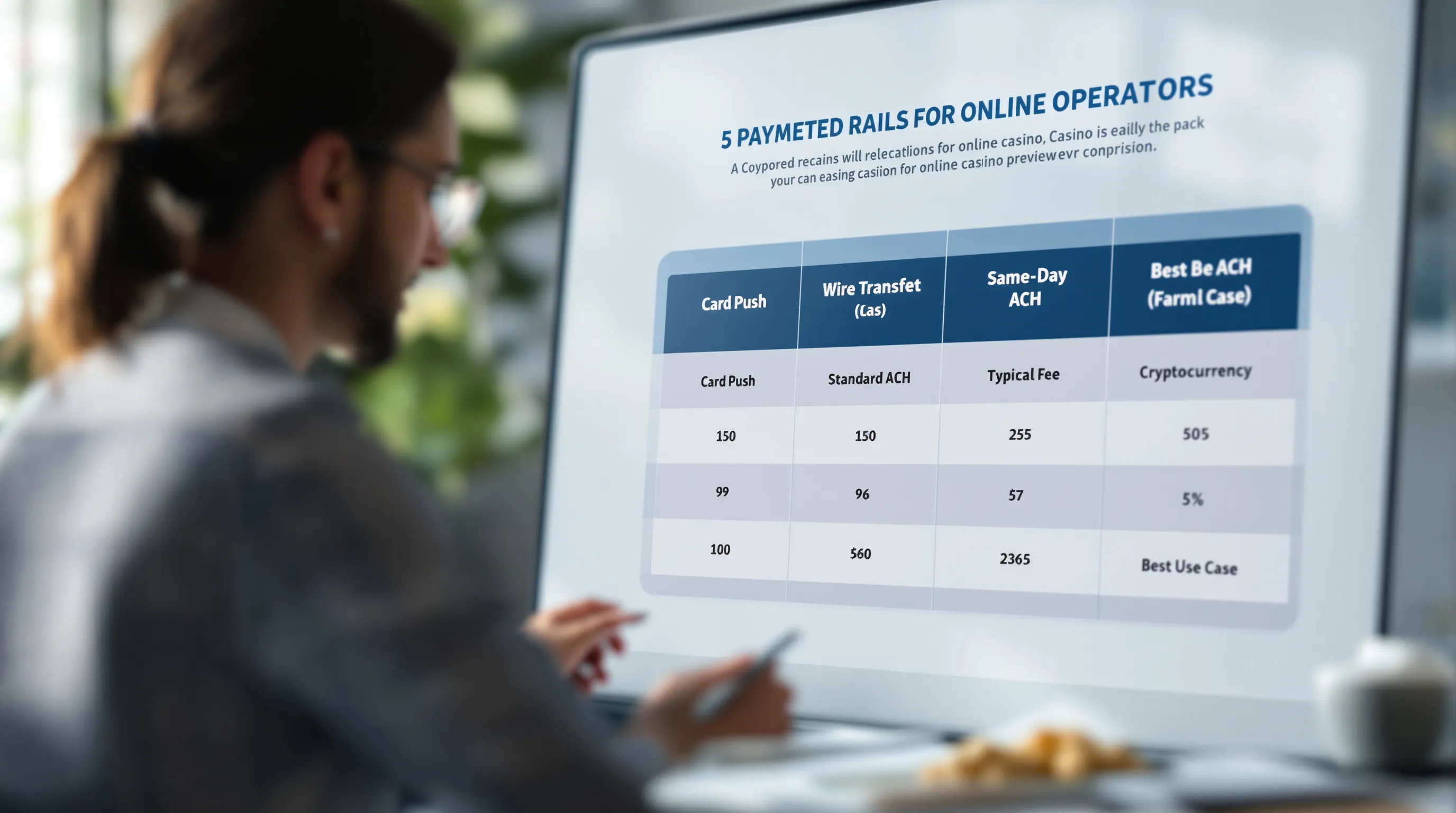
Online casinos process player deposits through a handful of primary payment methods. Each one carries different approval dynamics for gaming operators, and the right mix can meaningfully change the percentage of deposits that complete successfully.
Credit and debit cards remain the most common deposit method for US players. Visa and Mastercard both permit gaming transactions where legally allowed, but approval at the card level is determined by the issuing bank, not the card network itself. A meaningful share of card-funded gaming deposits face issuer-level declines because individual banks restrict gambling transactions as a blanket cardholder protection policy, even when the player has more than enough available balance. Community discussions among players reflect this reality: players routinely seek workarounds because their cards are blocked at casino sites, not because the sites refuse to accept cards.
ACH bank transfers bypass the card network entirely by pulling funds directly from a player's bank account. For gaming operators, ACH is an increasingly important deposit rail because it is less susceptible to the issuer-level gambling blocks that affect card transactions. The tradeoff is timing: ACH deposits typically take 1-3 business days to clear, which makes them less appealing to players who want to play immediately after funding their account.
Digital wallets (PayPal, Skrill, Neteller, and others) act as intermediaries, accepting funds from a player's bank or card and then passing them to the casino. This abstraction layer sometimes improves approval rates: the casino sees the wallet transaction, not the underlying card or bank account. That said, PayPal has its own gambling usage restrictions, and players in r/gambling report having accounts limited or funds frozen when withdrawals are coded as gambling-related rather than standard transfers.
Cryptocurrency sidesteps the traditional banking system entirely. Approval rates for players who hold crypto are effectively 100%. The tradeoffs are price volatility for non-stablecoin assets and the compliance overhead of crypto AML monitoring.
The most effective gaming payment stacks combine multiple methods (card plus ACH at minimum) to maximize the share of deposit attempts that complete on the first try.
Why Casino Deposits Get Declined at Standard Banks
The single most operationally damaging problem I see gaming operators face is deposit declines they cannot explain to players, and, in many cases, cannot fully explain to themselves.
The cause is almost always structural, not transactional.
MCC 7995 triggers automatic review at every step. Every gaming merchant account is coded under Merchant Category Code 7995 (betting, casino gambling, lottery tickets). This code is visible to every bank and card network in the authorization chain. Some US-based issuing banks automatically decline any transaction coded 7995, regardless of the player's available balance or the transaction amount. The operator did nothing wrong. The player's card is not frozen. The issuing bank simply does not permit gambling charges, as a blanket policy, applied at the BIN (Bank Identification Number) level before any fraud logic even runs.
Acquiring bank restrictions compound the problem. Not every acquiring bank accepts gaming merchants. Those that do face heightened compliance requirements from Visa and Mastercard, which they pass down to operators in the form of higher fees, tighter underwriting, and lower chargeback tolerance. Some acquiring banks exit gaming relationships entirely during compliance reviews, creating sudden account terminations for operators who were not at fault and did nothing to trigger the exit.
Real-time fraud scoring adds a third filter. Even when issuer-level and acquirer-level restrictions are not in play, fraud prevention systems on both sides of the transaction evaluate each deposit in real time. New players, high-value initial deposits, and international cards more often trigger velocity checks or pattern-matching rules that produce additional declines.
The operational solution is a processor with gaming-specific acquiring relationships and intelligent routing capability. A dedicated gaming processor routes transactions across multiple acquiring relationships to recover declines that would be permanent at a standard bank. If a gaming operation's card decline rate exceeds 15%, that is the first sign the acquiring setup needs attention, not the gateway configuration or the platform itself.
// Simplified deposit authorization flow
// Step 1: Player initiates deposit
POST /api/deposit {
  player_id: "PL-12345",
  amount: 100.00,
  currency: "USD",
  payment_method: "card",
  card_token: "tok_abc123"   // tokenized by gateway, raw PAN never stored
}

// Step 2: Platform sends to payment processor
processor.authorize({
  merchant_id: "MID-7995-XYZ",   // MCC 7995 gaming account
  amount: 10000,                  // in cents
  token: "tok_abc123",
  descriptor: "Casino Deposit"
})

// Step 3: Processor routes to acquiring bank → issuing bank
// Issuing bank evaluates:
//   - Cardholder balance: OK
//   - BIN-level gambling block: NONE (or BLOCKED at ~40% of US issuers)
//   - Fraud score: PASS
// Response: { approved: true, auth_code: "AUTH8821", avs: "Y" }

// Step 4: Platform credits player wallet (real-time)
player.wallet.credit(amount: 100.00, status: "available")

// Step 5: Settlement batch (T+1 to T+2 business days)
settlement.process({
  batch_id: "BATCH-20260730",
  net_amount: 99.25,   // after interchange and processor fees
  deposit_to: operator_bank_account
})
Note: MCC 7995 triggers enhanced review at the acquiring and issuing bank level. Operators with a dedicated gaming processor benefit from pre-established acquiring relationships that accept this MCC without requiring individual transaction exceptions.
How KYC Verification Affects Deposits and Account Holds
KYC (Know Your Customer) compliance is not just a regulatory checkbox: it directly shapes the deposit and withdrawal experience for players and creates operational costs that every gaming operator needs to plan around systematically.
Under US anti-money laundering rules and state gaming regulations, operators must verify player identity before permitting withdrawals above certain thresholds. Most platforms implement a tiered KYC approach:
- Tier 1 (entry level): Name, email, date of birth. Basic account registration. Deposits allowed immediately with no document review required.
- Tier 2 (higher deposit or first withdrawal threshold): Government-issued photo ID and proof of address (utility bill or bank statement). Manual or automated document review required before the withdrawal is released.
- Tier 3 (high-value players, $10,000+ in activity): Enhanced due diligence. May include source of funds documentation, phone verification, and enhanced AML screening against OFAC and sanctions lists.
From what I have observed across gaming operators, approximately 1 in 4 new player accounts triggers some form of enhanced KYC review before the first withdrawal is approved. For accounts where documents are clean and legible, the median review time runs 2-3 business days. Incomplete or mismatched documents extend holds significantly, a pattern well documented in player communities, where accounts wait over 30 days in extreme cases, with each document submission met by requests for additional files rather than clear approval or rejection. The most common friction point: document photos that are blurry, expired, or show a name that doesn't match the account.
Deposits during KYC holds create chargeback risk. Most platforms allow deposits while KYC review is pending but block withdrawals until verification is complete. A player who deposits, wagers, wins, and then cannot withdraw because KYC was not completed has every incentive to file a chargeback. This pattern is one of the more predictable sources of gaming chargebacks, and it is almost entirely preventable.
The most effective mitigation is collecting KYC documents during account registration rather than at the first withdrawal request. Operators who front-load identity verification see lower chargeback rates, shorter payout processing times, and fewer player disputes.
How Online Casino Payout Requests Are Processed
Payout processing is where player trust is won or lost. A smooth, predictable withdrawal experience is one of the strongest retention levers an operator controls, and the mechanics behind it are more layered than most platforms communicate to players upfront.
When a player initiates a withdrawal request, the following sequence unfolds:
- Platform validates the request. The casino's back-end checks that the player account is in good standing: KYC verification is complete, no active bonus wagering requirements remain, and no pending fraud review flags exist on the account. Accounts that fail any of these checks enter a review queue, which is where most payout delays originate.
- Risk engine scoring. Every withdrawal passes through a fraud scoring system that evaluates patterns (withdrawal amount relative to deposit history, velocity (how many withdrawals in a defined period), destination account details, and behavioral signals). High-scoring requests may trigger manual review or a secondary identity check.
- Payout queued and rail selected. Once cleared, the system queues the payout and selects the appropriate rail based on the player's registered payment method, jurisdiction, transaction amount, and the operator's configured routing rules. Large payouts are sometimes split across multiple rails.
- Funds leave the merchant account. The acquiring bank or processor initiates the transfer. At this point, the operator's direct involvement ends: the funds are in motion toward the player's bank, card, or wallet.
- Settlement on the player's end. Depending on the rail selected, funds appear in the player's account anywhere from 30 minutes to 5 business days after initiation. The rail determines how quickly this final step completes.
The critical insight for operators: most payout delays happen at steps 1 and 2 (internal validation and risk scoring), not at the banking rail itself. Player communities consistently report frustration with repeated document requests and "account under review" responses that stretch for weeks, not hours. Streamlining internal approval workflows typically has more impact on real-world payout speed than switching payment rails. A payout that sits in an internal review queue for 48 hours before reaching the ACH network is not an ACH problem: it is an internal operations problem.
Payout Rails Compared: ACH, Wire, Card Push, and Digital Wallets
Not all payout methods are created equal. Each rail carries a different combination of speed, cost, reversibility risk, and availability, and the right mix depends on your player base, average payout size, and operational priorities.
Here is how the main payout rails compare from an operator's perspective:
ACH (Automated Clearing House) is the workhorse of US-based payouts. Funds transfer directly from the operator's bank account to the player's bank account via the Nacha network. ACH is low-cost (typically $0.25-$1.00 per transaction), highly scalable, and well-understood by players. Standard ACH takes 1-3 business days to settle. Same-Day ACH (available since 2016 and expanded in recent years) cuts this to same-business-day for transactions submitted before the daily cutoff, at a modest per-transaction premium. The limitation: ACH is reversible. Returns (the ACH equivalent of a chargeback) can occur up to 60 days after settlement for unauthorized transactions, which creates a specific risk exposure for gaming operators.
Wire transfer offers the fastest bank-to-bank settlement: same business day for domestic wires submitted before the bank's cutoff (typically 3-4 PM Eastern). Wire fees run $15-$35 per outbound transaction, which makes this rail practical for high-value player payouts ($5,000+) but uneconomical for smaller or routine withdrawals. Wire transfers are also effectively non-reversible once settled, which reduces one category of operator risk.
Card push (Visa Direct / Mastercard Send) is the most underutilized mainstream payout rail in the gaming space. Funds are pushed directly to the player's debit card. Settlement is typically 30 minutes to 24 hours. The player receives funds in their bank account without opening a separate wallet or account, which dramatically reduces friction for the player. Costs run $0.50-$1.50 per transaction.
Digital wallets function as intermediaries: operators fund the wallet, the player withdraws from the wallet to their bank on their own schedule. Speed and cost vary by provider.
The most effective gaming payout stack combines ACH for standard withdrawals, card push for fast-track or VIP requests, and wire for high-value transactions, each matched to the player need and transaction size it serves best.
How Long Casino Payouts Actually Take (by Method)
Payout speed is one of the top reasons players choose one online casino over another.
From an operator's perspective, end-to-end payout timing is determined by three sequential delays: the operator's internal approval time, the rail processing time, and the receiving bank's posting time. The rail gets most of the attention, but internal approval is usually the largest variable.
Here are realistic end-to-end timelines by method, from withdrawal request to funds in the player's account:
- Standard ACH: Internal approval same-day if requested before noon. Rail processing 1-3 business days via standard ACH batch. Player receives funds 1-4 business days total from withdrawal request.
- Same-Day ACH: Must be submitted by Nacha cutoff (10:00 AM or 2:45 PM ET for the respective same-day windows). Arrives same business day. Player receives funds same day or following business day.
- Wire transfer: Same-day initiation possible for most operators. Rail settles same business day if initiated before the bank's wire cutoff (typically 3-4 PM ET). Player receives same business day for domestic wires.
- Card push (Visa Direct / Mastercard Send): Operator approval same-day. Rail settles in 30 minutes to 24 hours. Players typically see funds within a few hours, often faster with Visa Direct.
- Digital wallets: Operator-to-wallet credit is typically near real-time. Wallet-to-player-bank transfer then takes 1-5 business days depending on the wallet provider's own transfer policies.
- Cryptocurrency: Blockchain confirmation in 10-60 minutes for Bitcoin; seconds to minutes for stablecoins on faster chains. No bank posting delay.
The industry benchmark for "fast payout" is any method that puts funds in the player's account within 24 hours. Card push and Same-Day ACH both clear this bar. Standard ACH does not. Traditional banking channels, as players themselves observe, can take "several days for winnings to arrive," a friction point that operators controlling their payout infrastructure can meaningfully eliminate.
From an operator cash flow standpoint, faster payouts carry higher per-transaction fees. The practical approach is to tier payout options: route standard withdrawals through ACH and offer card push as a premium or VIP-tier service, so speed improvements pay for themselves through player retention.
Before: Standard Payment Processor
- Card decline rate 25-40% on gaming MCC 7995 transactions
- Single acquiring bank relationship; no alternative routing
- KYC process manual and disconnected from payment operations
- Payout limited to standard ACH (3+ day settlement)
- Rolling reserve 10%+ with no negotiated release timeline
- Account terminated when chargeback ratio rises
- Support via ticket queue; gaming expertise minimal
After: SeamlessChex Gaming Processor
- Reduced card decline rate through multi-acquirer routing for MCC 7995
- Multiple acquiring relationships enable routing around issuer-level blocks
- KYC documentation aligned with gaming compliance requirements
- Access to ACH, Same-Day ACH, and card push for tiered payout speed
- Rolling reserve negotiated based on operating history and chargeback record
- Processor stays in the relationship when volume or chargeback ratios move
- Direct access to gaming payment specialists who understand MCC 7995
Why Payouts Get Delayed, Flagged, or Denied
Even when the mechanics work correctly, payouts get held. Understanding the most common causes allows operators to build systems that minimize unnecessary friction, and helps distinguish between holds that are legally required versus holds that reflect poorly on the platform.
Unverified or incomplete KYC is the most common reason new player payouts stall. If a player reaches the withdrawal threshold without completing identity verification, the platform must pause the payout until documents are submitted and reviewed. The player experience here is often damaging: repeated requests for additional documents without clear explanations, generic "account under review" responses, and hold periods that extend far beyond what KYC review actually requires. Building KYC collection into onboarding eliminates this delay almost entirely.
Active bonus wagering requirements generate significant customer service volume. Most casino bonuses attach a playthrough requirement: the player must wager the bonus amount a set number of times before funds become withdrawable. If a player attempts to withdraw before meeting the requirement, the system holds the payout or removes the bonus balance. When players do not understand these terms, chargeback rates rise and platform reputation suffers.
AML triggers on transaction patterns create compliance-driven holds. Withdrawals that exceed Currency Transaction Report thresholds (single transactions at or above $10,000) require mandatory CTR filing before funds can move. Patterns of structuring (smaller transactions designed to avoid reporting thresholds) trigger Suspicious Activity Report review, which can extend holds indefinitely while compliance teams investigate. These holds are legally mandated and cannot be shortcut.
Destination account mismatches hold payouts when the withdrawal destination does not match the deposit source. Many operators require that payouts go to the same payment method used for the most recent deposit (a same-name, same-method requirement designed to prevent money laundering). Players who attempt to withdraw to a different account trigger manual verification.
Reserve holds at the processor level affect operator liquidity but not individual player payouts directly. If the operator's merchant account is under a rolling reserve, the processor retains a percentage of gross volume before releasing net funds, reducing the operator's available balance for payout funding.
"Most payout delays happen inside the platform, not at the bank. A withdrawal that sits in an internal review queue for 48 hours before reaching the ACH network is not an ACH problem. Streamlining internal approval workflows has more impact on real-world player cashout speed than switching payment rails."
Jonathan Albert, Co-Founder, SeamlessChex
How Operators Manage Reserve Accounts and Rolling Reserves
Rolling reserves are one of the most cash-flow-sensitive aspects of running a gaming operation, and one of the areas where I find new gaming operators are most often caught off guard.
Understanding the mechanics before you sign a processing agreement is essential to managing working capital correctly.
A rolling reserve is a risk-management tool used by acquiring banks and processors to protect against potential chargebacks, fraud losses, or sudden operator closure. Instead of receiving 100% of processed volume in each settlement, the operator receives net settlements minus a held percentage. That held percentage accumulates in a reserve account and is released on a rolling schedule, typically 90-180 days after the month the funds were collected.
Typical reserve structures in gaming look like this:
- Reserve rate: 5-10% of gross monthly processing volume, depending on chargeback history, time in business, and the acquiring bank's own risk appetite for gaming.
- Reserve period: 90 days is common for established operators with clean chargeback records. Higher-risk accounts or newer operators may face 120-180 day hold periods.
- Reserve cap: Some processors cap the reserve at a fixed percentage of a rolling three-month volume, so the reserve balance does not grow indefinitely as the business scales.
The cash flow math matters significantly. An operator processing $500,000 per month at a 7% rolling reserve with a 90-day hold period will have approximately $105,000 tied up in reserve at any given time (funds that are not available for operations, payout funding, or growth investment). Operators need to plan working capital around this structural gap before it becomes a cash flow crisis.
How reserves release: after the hold period ends, reserved funds typically release automatically to the operator's settlement account on the same rolling schedule used to collect them. Operators should review monthly statements carefully to confirm releases are occurring on schedule and that no additional amounts are being withheld without explanation.
A good processor provides full transparency on reserve calculations, release timelines, and current reserve balances. Lack of visibility into reserve accounts is a red flag. It typically signals either poor systems or deliberate opacity, both of which create risk for the operator.
How SeamlessChex Supports Online Casino Payment Operations
SeamlessChex is a payment technology company that helps businesses in complex, high-friction industries move money reliably, including online gaming and betting operators who need infrastructure that actually works with their MCC code, not against it.
What sets our approach apart from a standard payment processor is the combination of high-risk merchant account access, routing capability, and the kind of hands-on support that most gaming operators cannot get from larger, generalist processors that treat MCC 7995 accounts as a compliance liability.
Specifically, SeamlessChex helps online casino operators:
- Get approved for a gaming merchant account when other processors have declined, terminated, or placed accounts on remediation programs. We work with established gaming businesses processing a minimum of $25,000 per month, operators with volume and operating history, not pre-launch startups.
- Improve deposit approval rates through acquiring relationships and routing strategies that reduce the impact of issuer-level gambling blocks. Every recovered decline is a player who completes a deposit instead of abandoning the session.
- Access multiple payout rails (including ACH, Same-Day ACH, and card push options) through a single processing relationship, with routing logic to match each withdrawal to the appropriate rail based on amount, timing, and player preference.
- Manage compliance obligations with a processor that understands gaming-specific AML requirements, KYC documentation expectations, and chargeback monitoring thresholds, and does not exit the relationship the moment a chargeback ratio moves.
- Get real support from real people. Payment problems in iGaming rarely happen on a convenient schedule. When a deposit batch fails or a payout rail goes down, you need a processor you can actually reach, not a ticket queue with a 72-hour response window.
If your gaming operation is facing high deposit decline rates, persistent payout delays, or a processor relationship that is creating more friction than it resolves, I would recommend starting with a direct conversation about your current setup. SeamlessChex onboards established gaming merchants; the practical minimum is $25,000 in monthly processing volume. Contact SeamlessChex to discuss a gaming merchant account, or explore our online gaming payment processing solutions to see how we approach this vertical.
DEPOSIT FLOW (left to right)
Player → Payment Gateway (tokenizes card data) → Acquiring Bank (MCC 7995 acceptance) → Issuing Bank (approve/decline at BIN level) → Authorization Response → Player Wallet Credit (real-time) → Batch Settlement (T+24-48 hours)
KEY DECLINE POINT: Issuing bank BIN-level gambling block (affects 15-40% of US card transactions)
PAYOUT FLOW (left to right)
Player Withdrawal Request → Platform Validation (KYC complete? Bonus met? No fraud flags?) → Risk Score → Rail Selection → Funds Depart Merchant Account → Player Receipt
KEY DELAY POINT: Internal validation queue (KYC holds, bonus requirement checks)
PAYOUT RAIL TIMELINES: Card Push (30 min to 24 hrs) | Wire Same Day | Same-Day ACH Same Day | ACH 1-3 days
Questions This Article Answers
- What happens at each step of a casino deposit authorization?
- Why do gaming transactions get declined at the issuing bank level?
- How does KYC verification create payout holds, and how can operators reduce them?
- Which payout rail is fastest, cheapest, and most appropriate for each transaction size?
- How do rolling reserves affect gaming operator cash flow?
What Will Matter Most in the Next 12-24 Months for iGaming Payments
The iGaming payment landscape is shifting in ways that will directly affect how operators process deposits and pay out winnings. Several forces are converging at once, and operators who anticipate them will be better positioned to maintain approval rates and player trust through the transition.
Instant payouts are becoming the expected baseline. Players who experience same-day card push or crypto settlement at one platform will not tolerate 3-day ACH timelines at competitors. The operators who will retain players in 2026 and beyond are those who have built tiered payout rails that make instant payouts the default for standard withdrawals, not a premium feature. Card push adoption among gaming acquirers is accelerating, and the cost differential between ACH and card push is narrowing enough that the speed advantage justifies it for most transaction sizes.
State-by-state regulatory expansion is adding compliance complexity faster than most operators are prepared for. As online gaming legalizes in additional US states, each jurisdiction brings its own KYC requirements, reporting thresholds, and permitted payment methods. Operators who built compliance workflows for one or two states are discovering that horizontal expansion requires either dedicated compliance infrastructure or a processor partner who has pre-built those relationships and workflows per jurisdiction.
AI-powered fraud scoring is reducing false declines. The binary BIN-level gambling blocks that cause 15-40% declines are being supplemented (and in some cases replaced) by adaptive issuer scoring that evaluates individual cardholder behavior rather than blanket MCC blocking. Operators who can demonstrate low fraud rates and structured AML compliance are increasingly being approved for better issuer relationships, not just acquiring relationships. This is creating a measurable separation between platforms with sophisticated compliance operations and those treating compliance as a cost center.
Forecast: 12-24 months
Where Casino Payment Rails Are Headed Next
Three forecasts on how deposit and payout methods, withdrawal delays, and high-risk processing demand are likely to shift over the next two years.
Payment Rail And Payout Forecasts
Use these to gauge which deposit and payout methods and delay risks are likely to matter most for players and operators.
Over the next 12-24 months, more casino operators and players will route deposits and payouts through e-wallets and cryptocurrency rather than debit or credit cards, as card-based gambling transactions keep triggering account freezes, holds, and higher fees.
Over the next 12-24 months, demand for specialized high-risk merchant processing will keep expanding beyond gambling into other restricted categories such as peptides, SARMs, GLP-1 products, and nutraceuticals, pushing providers to serve multiple high-risk verticals rather than gambling alone.
Even as crypto and instant-rail options spread, a meaningful share of players will still face multi-day or multi-week payout delays over the next 12-24 months, because fraud and identity checks - not settlement technology - are the bottleneck.
Early Indicators PayPal froze a player's account and withheld withdrawals after a casino operator coded them as "payments for goods and services," while Philippine-facing operators already treat cards as their weakest, least stable rail behind local e-wallets. Operators reported running fraud checks on every cashout, while players on 888 Casino and other sites described withdrawals stuck in verification for 20 to 30-plus days despite repeatedly submitting KYC documents. Buyers are actively asking where to find high-risk merchant accounts and payment processing for peptides, SARMs, GLP-1 stores, and nutraceuticals, echoing the same underwriting questions long asked by gambling operators.
Supporting And Contrary Evidence
Each forecast lists the real-world reports that support it alongside those that push back on it.
- What's your go to way to deposit/withdraw at online casinos? is the strongest public backing for this call. [Community / Forum]Original poster (NebulaEmotional5502) notes some casino sites only accept cards, others only crypto, and some now support Apple Pay. “It's lock you out first, ask questions later, and the appeals process is non-existent 🫤”
- Looking for Payment Gateway Solutions for Casino (Philippine Market) supports this forecast. [Community / Forum]Original poster (u/dansaidit) is seeking a payment gateway for an online casino/gaming operation targeting the Philippines, requiring support for local e-wallets (GCash, Maya) and PH banks, API integration, and high-risk merchant tolerance. “The key is whether the gateway has direct local acquiring relationships in PH vs routing through aggregators (that's where freezes happen).”
- Are there any sites I can get on a deposit money straight from a card? points the same way. [Community / Forum]Original poster (u/ModsAreMusty) wants to deposit money via card to play on Roobet.com but lacks a crypto wallet and states he "can't make one.". “Are there any sites that I can use that let's me deposit money straight from a card?”
- If card networks and payment processors formally classify and price gambling transactions instead of freezing or miscoding them, and if operators loosen post-win account reviews, both the rail-shift and the persistent-delay patterns could reverse.
- Pushing back: Online Casino Payment Gateway: How iGaming Operators Are. [Blog]Typical 2026 high-risk iGaming payment processing terms cited: 5-9% per-transaction fee, 10-15% rolling reserve held 6-12 months, $200-$500 monthly gateway fees, $50-$100 chargeback fees, $500-$2,000 setup fees. “None of that matters to most payment processors." - on regulatory legitimacy being irrelevant to payment processor risk assessment.”
- Has anyone here had a bad experience withdrawing from an online points the same way. [Community / Forum]Original poster (u/Bmouse298) asked r/onlinegambling how common it is to have withdrawal problems, citing verification delays, withdrawal limits, and account reviews triggered right after a win. “Don't play on Rolla or Wow Vegas had to damn near threaten to sue to get my payment”
- 888 Casino delaying my withdrawal for over a month repeated supports this forecast. [Community / Forum]Original poster's (OP, "Beginning-Insect-822") withdrawal request from 888 Casino has been pending for "over 30 days" / "over a month" at time of posting. “Nope still waiting now ive waited over two weeks since that last socument that ghey could possibly ask and im still waiting like these guys are straight…”
- Why are online casino cashouts so slow? points the same way. [Community / Forum]No verifiable, sourced statistics exist in this thread - all content is anecdotal, unattributed Reddit commentary from anonymous users (usernames only, no credentials).
- How Fast Crypto Transactions Improve the Gaming Experience is the strongest argument against it. [Blog]Spartans Casino is cited as an example platform offering cryptocurrency payment options within a "modern casino environment.". “Fast cryptocurrency transactions are helping redefine what players expect from online gambling.”
- Pushing back: Cashing out online casino winnings into bank account. [Community / Forum]Original poster won under $500 AUD at an unnamed online casino. “If you wanna fuck around with crypto any of them cept ltc are fine. If you don't want your winnings to lose any value before you can off ramp them to fiat, go…”
What Could Change These Forecasts
Regulatory, banking, or fraud-policy shifts could accelerate or reverse these payment trends.
Confidence, With Limits
We hold 90 with the most confidence, while 65 is the one we would flag as most likely to shift.
- If regulators or buyers move in the opposite direction, Card rails keep losing ground to e-wallets and crypto would weaken first.
- If the source mix shifts toward stronger contrary evidence, Withdrawal delays keep happening even on faster rails could become the more durable forecast.
Key Takeaways
- Deposits fail at the issuing bank, not the gateway: MCC 7995 causes 15-40% of card transactions to be declined by issuer-level gambling blocks, a processor routing problem, not a platform problem.
- Most payout delays are internal: KYC holds, bonus wagering requirements, and risk queue processing cause more cashout delays than banking rail speed.
- Front-load KYC to prevent chargebacks: Collecting identity documents at registration rather than at first withdrawal eliminates the most common source of gaming chargebacks.
- Tier your payout rails: ACH for standard payouts, card push for VIP/fast-track, wire for high-value transactions ($5,000+).
- Plan for rolling reserves: At 7% reserve on $500K monthly volume with 90-day hold, approximately $105K is tied up at any given time. Plan working capital accordingly.
- Choose a gaming-specific processor: MCC 7995 requires a processor with dedicated acquiring relationships and compliance expertise, not a generalist provider.
The deposit-and-payout cycle is the operational foundation of every online casino, and the operators who understand it at the mechanics level have a real advantage over those who treat it as a black box. Most deposit failures are not platform failures. Most payout delays are not rail failures. They are acquiring relationship problems, KYC workflow problems, and reserve structure problems that have known solutions.
Getting the payment infrastructure right means combining the right acquiring relationships for MCC 7995, a tiered payout rail strategy that matches speed to player segment, a front-loaded KYC process that eliminates withdrawal friction, and a processor that understands gaming compliance rather than treating it as a compliance liability. These are not aspirational goals: they are operational decisions that directly determine deposit approval rates, player retention, and chargeback exposure. Explore SeamlessChex gaming payment solutions to see how a dedicated gaming processor approaches each of these areas, or contact us directly to discuss your operation's specific requirements.
If your gaming operation is experiencing high deposit decline rates or payout delays that are affecting player retention, contact SeamlessChex to discuss a gaming merchant account. We work with established operators processing $25,000 or more per month.
Frequently Asked Questions
How long does it take for an online casino deposit to go through?
Card deposits typically credit to a player's casino wallet in real time once authorized. The authorization itself completes in seconds. Settlement (the actual movement of funds from the player's bank to the operator's merchant account) takes 24-48 hours. ACH deposits take 1-3 business days to credit. Players see real-time credit on most cards because the platform credits the wallet on authorization, not on final settlement.
Why do casino deposits get declined when I have enough funds?
The most common cause is an issuer-level gambling block. Many US banks restrict gambling transactions at the BIN level, meaning they automatically decline any transaction coded under MCC 7995 (betting, casino gambling) regardless of the cardholder's available balance. This is a bank policy decision, not a casino platform issue. Using a different payment method (ACH, digital wallet, or a card from a different bank) typically resolves it.
How long do online casino withdrawals take?
Payout time depends on the rail used and the operator's internal approval time. Card push (Visa Direct / Mastercard Send) is the fastest fiat option at 30 minutes to 24 hours. Wire transfer settles same business day. Standard ACH takes 1-3 business days. Same-Day ACH is same business day if submitted before the Nacha cutoff. Most payout delays happen during the operator's internal KYC and risk validation process, not on the banking rail itself.
What causes casino payout delays?
The most common causes are: incomplete KYC verification (player hasn't submitted required identity documents), active bonus wagering requirements that haven't been met, AML monitoring triggers on large or structured withdrawal patterns, and destination account mismatches (where the withdrawal destination doesn't match the deposit source). Legally required AML holds cannot be bypassed. KYC and bonus-related delays are preventable with better onboarding and communication practices.
What is a rolling reserve in online casino payment processing?
A rolling reserve is a percentage of gross processing volume held back by the acquiring bank or processor as a risk buffer. Gaming operators typically face reserve rates of 5-10% of monthly volume held for 90-180 days before release. At a 7% reserve rate on $500,000 monthly volume with a 90-day hold, an operator will have approximately $105,000 in reserve at steady state. Reserves protect processors against potential chargebacks, fraud losses, or sudden business closure.
How does KYC affect casino payouts?
KYC (Know Your Customer) verification is required before most platforms allow withdrawals above certain thresholds. If a player hasn't completed identity verification, their withdrawal request is held until documents are reviewed, typically 2-3 business days for clean documents, longer if documents are incomplete or mismatched. Operators who collect KYC during account registration rather than at the first withdrawal request eliminate most KYC-related payout delays.
What is the fastest payout method at an online casino?
Card push (Visa Direct or Mastercard Send) is the fastest mainstream fiat payout rail, settling in 30 minutes to 24 hours directly to a player's debit card. Wire transfer is same business day but better suited to large payouts ($5,000+) due to fees. Cryptocurrency offers near-instant settlement on faster blockchain networks but requires players to hold crypto. Same-Day ACH is same business day for transactions submitted before the daily Nacha cutoff, at lower cost than card push or wire.
Sources & Further Reading
References and Resources
- Nacha Operating Rules: ACH Payment Network Standards. The governing rules for ACH transactions including Same-Day ACH settlement timelines and cutoff windows.
- Visa Direct: Card Push Technology. Visa's real-time push payment platform enabling near-instant payouts to Visa debit cards.
- Mastercard Send: Mastercard Developer. Mastercard's push payment solution for real-time disbursements to eligible debit and prepaid cards.
- FinCEN: AML Program Requirements. Federal requirements for anti-money laundering programs, Currency Transaction Reports (CTR), and Suspicious Activity Reports (SAR).
- FFIEC BSA/AML Examination Manual: Casinos and Card Clubs. Federal Financial Institutions Examination Council guidance on AML compliance for gaming institutions.
- American Gaming Association: iGaming Research. Industry statistics on online gambling revenue, player behavior, and regulatory landscape across US states.
- Federal Reserve: Same-Day ACH. Federal Reserve guidance on Same-Day ACH implementation, settlement windows, and dollar limits.
- PCI Security Standards Council: PCI DSS Documentation. Payment Card Industry Data Security Standard requirements for merchants and payment processors handling cardholder data.
- National Council on Problem Gambling. Responsible gambling resources and compliance guidance for operators.
- Consumer Financial Protection Bureau: Prepaid Accounts Rule. CFPB regulation governing prepaid card accounts and digital wallets used in payment processing.
Written by
Jonathan Albert
Co-Founder, SeamlessChex
Jonathan Albert is Co-Founder of SeamlessChex, a credit card processing and fintech payments platform recognized on the Inc. 5000.
Connect on LinkedInRelated Articles
- Gaming Payment Solutions for Operators and Platforms - How SeamlessChex structures credit card merchant accounts and payment infrastructure for licensed gaming operators.
- Payment Gateway for Online Gaming Operators - A detailed look at gaming-approved gateway features: MCC 7995 routing, fraud controls, and payout integration.
- Secure Gaming Payments: Fraud and Chargeback Defenses - Strategies for reducing chargeback rates below 1% and protecting gaming merchant accounts from termination.
- Cutting Fraud and Declines on Gambling Payment Processing - Tactical approaches to improving deposit approval rates and reducing fraud loss in high-risk gaming environments.
- Accepting Digital Wallet Payments as an Online Betting Operator - Digital wallet integration strategies for betting operators, including PayPal restrictions, PayNearMe, and alternative wallet options.
Summarize This Article With AI
Open this article in your preferred AI engine for an instant summary.
Our merchant accounts are designed for operating businesses with at least $25,000 in monthly processing volume.